
Facts & prices checked: 2026-06-25
Tanzania is the benchmark for lion viewing. When people ask me whether Tanzania or Kenya is better for lions, the question almost answers itself: Tanzania has approximately 17,000 wild lions — the largest single-country population in Africa. I run a hotel on Zanzibar’s east coast and take guests into the bush each season. What strikes visitors most is not just that lions are there, but how predictably and in what numbers. This guide covers where to find them by park, how to time your visit, what to look for behaviourally, and how to photograph them well.
Why Tanzania is Africa’s lion capital
Tanzania’s 2024 TAWIRI wildlife census counted approximately 17,000 lions — by far the largest wild lion population of any country in Africa. Kenya, by comparison, holds approximately 2,000 lions. Tanzania’s advantage comes from the scale and quality of its protected area network: the Serengeti ecosystem alone covers tens of thousands of square kilometres of intact savannah, the Selous-Niassa corridor to the south is one of the largest contiguous protected areas in the world, and Ruaha-Rungwa forms another vast block where lions can maintain large territories.
Adult male lions weigh between 150 and 250 kg. They are apex predators, which means their presence is a sign of ecosystem health — enough prey biomass, enough space, enough protection from humans. Tanzania has all three in sufficient quantity to support lion populations that simply do not exist at comparable scale anywhere else on the continent.
What Tanzania offers that other countries cannot match is variety of lion experience. The Serengeti’s open plains put lions in front of you in broad daylight. The Ngorongoro Crater concentrates one of the world’s most studied isolated populations in a 260 km² bowl. Ruaha puts you in front of Tanzania’s largest male coalitions in a park that sees a fraction of Serengeti visitor numbers. Each delivers something different.
Serengeti lions: the heart of it
The Serengeti ecosystem is estimated to hold approximately 3,000–3,500 lions organised into roughly 300 prides. This is the largest lion population in a single ecosystem in Africa, and for most visitors the Serengeti is where they will spend the most time with lions.
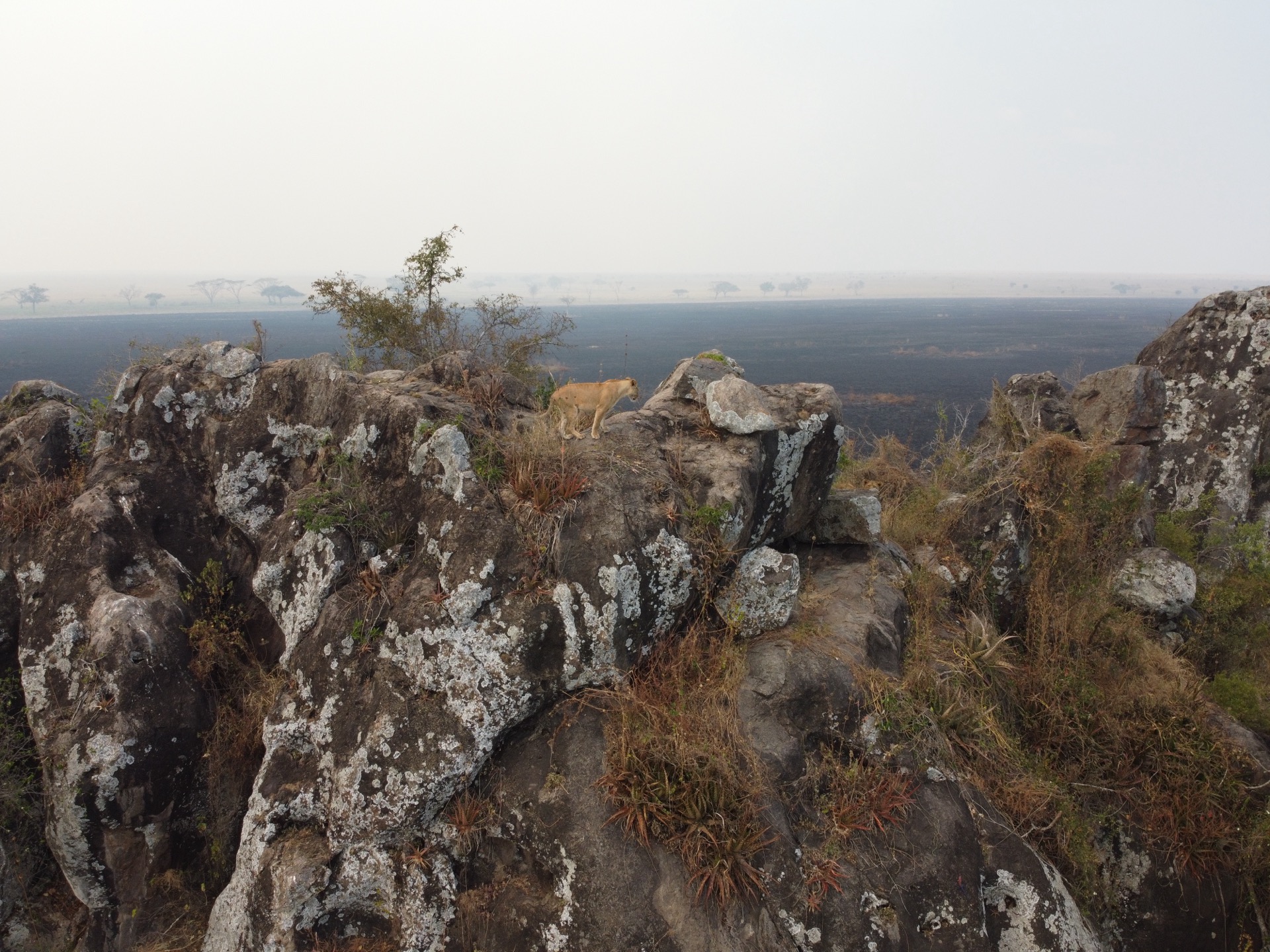
Seronera (central Serengeti) is the year-round anchor. The Seronera River valley has permanent water, which holds resident prey and therefore resident prides in stable territories year-round. Guides who work Seronera know individual lions by their ear notches and facial spot patterns — the same prides have used the same territories for decades. Lions rest in the shade of riverine trees, on kopjes (rocky outcrops), and in the grassland, and experienced guides find them quickly. On a four-night central Serengeti stay, not seeing a lion would be genuinely unusual.
The riverine forest around Seronera also has sausage trees (Kigelia africana) and large figs where lions rest in the branches — not the same as Lake Manyara’s documented tree-climbing behaviour, but a reliable and photogenic position that Seronera guides check regularly.
Ndutu and the southern short-grass plains (January–March) are where the Serengeti’s lion viewing reaches a different level entirely. During the wildebeest calving season — roughly January to March, peaking in February — approximately half a million calves are born in a compressed window on the mineral-rich plains around Ndutu. The prides that follow this calving concentration have so much prey available that they hunt in daylight, sometimes multiple times per morning. Calves that are days or hours old are separated from their mothers constantly as the herds move; lion prides barely need to strategise. This is the most intense predator-prey dynamic I have encountered anywhere in Africa, and I have been running guests into it for years.
Northern Serengeti (Kogatende and Lamai, July–October) is the river-crossing zone. When the wildebeest herds push north and pile at the Mara River, the lion prides of the northern Serengeti are positioned and waiting. The combination of river crossings and big-cat sightings in this zone — with far fewer vehicles than the central Serengeti in high season — makes it one of Tanzania’s most rewarding wildlife experiences for visitors who commit to getting there.
Ngorongoro Crater: the dark-maned kings
The Ngorongoro Crater holds more than 60 lions on its 260 km² floor. These are among the most photographed and studied lions in the world, and for good reason: the crater’s geography makes them uniquely visible and uniquely interesting.
The caldera walls — the rim sits roughly 600 metres above the crater floor — create a natural enclosure. Lions can and do leave the crater, but male lions from outside rarely penetrate the resident prides. Over generations this has produced a population with measurable genetic differences from surrounding savannah lions. Most visibly: the crater’s males tend to develop very dark, full manes. The darkening is associated with genetic drift in a reproductively isolated population where certain male traits become dominant through the founder effect. A Ngorongoro male with a near-black mane standing on the short-grass crater floor is one of Tanzania’s most distinctive wildlife sights, and it is available on almost any descent into the crater.
Viewing conditions in Ngorongoro Crater are excellent. The floor is open, the population is resident and accustomed to vehicles, and the concentration of prey species — wildebeest, zebra, buffalo, gazelle — means lions are relatively easy to locate. The number of vehicles allowed on the crater floor at any one time is managed, which keeps sightings from becoming the congested affairs you can encounter at peak season in Seronera.
Tarangire and Ruaha
Tarangire is Tanzania’s best-known dry-season elephant park, but its lions are worth planning around. During July–October, when the rains have ended and water concentrates at the Tarangire River, prey species aggregate in numbers that allow large, stable prides to function. The lions follow the elephant herds and buffalo concentrations — large prey means large prides are viable. Tarangire is significantly less crowded than the Serengeti, and lion sightings here often involve fewer vehicles at the scene.
Families visiting Tanzania for lion sightings will find Ngorongoro Crater and Tarangire the most reliable family-friendly parks: short distances between sightings, compact viewing areas, and full-day vehicle-based game drives without walking requirements. The Tanzania family safari guide covers the full age breakdown (under 5 vs 5–8 vs 9–13 vs 14+), best parks for children, what to pack including malaria prophylaxis for children, and why Zanzibar’s Jozani Forest red colobus monkeys and Mnarani turtle centre complete a family trip.
Ruaha is where Tanzania’s lion story takes its most striking turn. Ruaha National Park holds approximately 10% of the world’s lion population — a figure that puts Tanzania’s overall scale into perspective. The park’s lion-to-land ratio, combined with the dense prey populations of the Ruaha-Rungwa ecosystem, allows male lions to grow very large and form some of Tanzania’s biggest coalitions. Males with territories in Ruaha are frequently broader and heavier than their Serengeti counterparts.
Ruaha is also where the Ruaha Carnivore Project has achieved some of the most significant human-wildlife conflict reduction in African conservation — reducing killings of lions, leopards, cheetahs, and African wild dogs by 80% in its core study area. This matters for understanding why Ruaha’s lion population has remained robust: active conflict-mitigation work protects the population in the buffer zones where retaliatory killing would otherwise occur.
Buffalo are the most significant and dangerous prey item for Tanzania’s large lion prides — a hunt on a full-grown Cape buffalo is a violent multi-lion effort that carries genuine injury risk for the lions; buffalo fight back, trample, and hook with their horns. Buffalo herds also successfully mob-defend against lion attacks on calves, sometimes driving a full pride off a kill. The Ruaha lion population’s interaction with the Ruaha River buffalo concentrations (herds of 500-1,000+ in June-October dry season) is one of Tanzania’s premier predator-prey spectacles. The Tanzania buffalo guide covers the full buffalo profile, the dagga boy bachelor bulls, Ngorongoro’s enclosed herd of more than 25,000 animals, and viewing advice.
What Ruaha cannot offer is the sheer visitor infrastructure of the northern circuit. Camps are fewer, distances between sightings are longer, and you will need a dedicated southern circuit trip — typically 5–7 days in Ruaha alone to do it properly. In return: some of the most exclusive and unhurried lion sightings in East Africa. For a month-by-month breakdown of when Ruaha’s lion viewing is at its best — including the July–September peak for river-corridor encounters, October’s transition into birdwatching season, and why December to February is underrated for wild dog and predator activity — see the Ruaha best time to visit guide.
Nyerere also supports a large and relatively undisturbed lion population across its 30,893 km² — one of Africa’s largest national parks. Unlike the northern circuit, Nyerere’s lions are encountered in a wilderness setting with few other vehicles, often alongside the park’s defining experiences: boat safaris on the Rufiji River and walking safaris in the miombo woodland. The experience of tracking a lion pride on foot — following a fresh track through dry miombo with a professional guide reading dew pattern and gait direction, finding the pride sleeping in shade before they know you are there — is fundamentally different from observing them from a Land Cruiser. Walking safaris in Nyerere and Ruaha operate under strict protocols with an armed ranger escort; encounters at close range happen and are managed precisely because those protocols work. The Tanzania walking safari guide covers which parks allow it, encounter protocols, minimum age (typically 12), and how to choose a camp that specialises in walking rather than treating it as a checkbox activity. The park closes from end of March to May 31; the lion viewing season aligns with the boat safari peak — June to October, with the dry season concentrating prey at the Rufiji and its tributaries. For the full park profile — wild dogs, Rufiji boat safaris, walking safari options, park fees, and the Stiegler’s Gorge dam controversy — see the full Nyerere write-up. For how the seasons affect lion sightings, wild dog denning, and Rufiji boat safari conditions month by month, see the Nyerere best time to visit guide.
Best timing for lion encounters
Lions are present in Tanzania’s parks all year. They do not follow the Great Migration and they do not move between parks seasonally. The question is not whether you will see lions but what kind of lion encounter you want.
January–March (Ndutu, southern Serengeti): The calving season is when lion viewing peaks in frequency and intensity. Prides have extraordinary prey availability and hunt in full daylight. This is the window for multiple kills per morning, cubs visible at the kill, and the full drama of predator-prey interaction on open ground. It is also the easiest time to find lions because the prides are where the calving is happening — concentrated on a relatively contained stretch of short-grass plain.
July–October (northern Serengeti and the wider ecosystem): The Great Migration concentrates in the north and at the Mara River. Resident lion prides in the Kogatende-Lamai area are well positioned, and predator-prey interactions around the river crossings are exceptional. July–October is also dry-season peak for Tarangire and Ruaha — across the board the best time for lion viewing across multiple parks.
Year-round: Seronera in the central Serengeti delivers reliable lion sightings twelve months of the year. Ngorongoro Crater’s resident population is always present. If you are visiting outside peak windows, do not adjust your lion expectations down — you will see lions.
Avoid for access, not for wildlife: March–May (long rains) can make some Ndutu roads difficult to navigate, and a few seasonal camps close. The lions are still there; access to them may require a different vehicle or a different camp.
Lion behaviour: what to look for on game drives
Lions in Tanzania’s national parks are highly habituated to safari vehicles — the vast majority of close encounters are curiosity rather than aggression. The Tanzania safari safety guide covers exactly how to behave during a close lion encounter (stay seated, don’t break the vehicle silhouette, the pop-up roof hatch rules), distinguishes camp lion activity from vehicle encounter protocols, and explains how lion danger compares to the other Big Five — hippos kill approximately 500 people per year in Africa; buffalo are the most dangerous of the Big Five for hunters on foot; the danger hierarchy is not what most visitors expect.
Lions are primarily nocturnal hunters — they sleep 18–20 hours a day and do most of their killing in darkness. This shapes everything about how you encounter them on a safari drive.
Best windows: Early morning (first light, around 05:30–06:00, to approximately 09:00–09:30) and late afternoon (16:00 to sunset). During these windows lions are moving, greeting each other, patrolling territorial boundaries, and occasionally hunting. Midday, roughly 10:00–15:00, lions are almost always resting in deep shade. A midday lion sighting is real but passive — wait and watch rather than expecting action.
Gear for early morning drives: The 05:30 departure means cold. At Ngorongoro Crater, where the floor sits at roughly 1,700 m and the rim rises to about 2,300 m, early morning temperatures can drop to 10–15°C before the sun is high. Bring a fleece on every drive regardless of what the midday forecast suggests. Binoculars are essential for reading lion behaviour at distance — spotting a male’s body posture at 400 m tells you whether to drive closer or wait. For what to pack, how to stay under the 15 kg soft-bag limit on bush flights between parks, and which malaria prophylaxis to take for a Tanzania itinerary that combines parks with Zanzibar, see our safari packing guide.
Tree lions in Seronera: The sausage trees and large figs in the Seronera River corridor are where lions rest elevated off the ground, particularly in the heat of the day. The guide checks particular branches — this is not guesswork, it is knowledge built from years of working the same territory. A lion draped over a forked branch 3 metres off the ground, morning light coming in sideways, is one of the defining Serengeti images.
At a kill: If your guide finds a fresh kill, stay. Lions may remain at a carcass for hours, eating in shifts, keeping hyena and vultures at distance with minimal effort. The succession of feeding — cubs eating alongside adults, spotted hyenas circling at distance, marabou storks waiting — is its own complete drama that unfolds over time. Drive-by lion watching misses all of this.
Lions dominate Tanzania’s predator hierarchy through coalition size and intimidation — but their hunt success rate is far below the African wild dog’s approximately 80% and the spotted hyena’s 70%+. The dynamic most visitors miss: hyenas frequently outnumber lions at a kill and reclaim the carcass; lions steal from hyenas at least as often as the reverse. The Tanzania predators guide maps the full food web — how each predator’s hunting method, body plan, and social structure fits a different ecological role, where to find wild dogs in Nyerere (800–1,000 animals, Africa’s largest population), and why the vulture aggregation overhead is usually the first visible clue that a kill has happened.
Cubs: Cub sightings are most likely during and after the calving season in the southern Serengeti (February–April), when the abundance of prey makes it easier for mothers to raise cubs successfully. The synchronised cub-raising behaviour of large prides — where related females often give birth in the same period — means cub sightings can involve many cubs at once.
Night drives: Not available inside Tanzania’s national parks, but permitted in private conservancies and concession areas adjacent to parks. If your itinerary includes a conservancy stay (some Serengeti and Ruaha operators have this), ask about night drives. Lions on the hunt in spotlight are a categorically different experience from lions resting by day.
The lion-viewing equation changes with vehicle type: in a shared vehicle (4–6 guests), the least patient person sets the departure time from a sighting. In a private vehicle, you stay for 90 minutes through a full lion hunt if that’s what you want. At a lion kill, private vehicles can hold position through all the complex social dynamics — the cubs’ access, the sub-adults’ posturing, the jackals and vultures waiting on the periphery — while shared vehicles move on after 20 minutes. The Tanzania luxury safari guide explains the full spectrum of what changes at different price points, including which private concessions adjacent to the Serengeti permit night drives that reveal leopard and serval behaviour unavailable inside the national park.
Conservation and threats
Tanzania’s lion population is healthy relative to the rest of Africa, but it faces real threats that community programmes and park management are actively working against.
Human-wildlife conflict is the primary pressure. Lions that move beyond park boundaries into communal land take livestock, and retaliatory killing by herders is the leading cause of lion deaths outside protected areas. In Ruaha, the Ruaha Carnivore Project’s intervention — providing livestock protection training, early-warning systems, and community income alternatives — reduced carnivore killings by 80% in its study area. Similar programmes operate in the Serengeti-Mara ecosystem. The effectiveness of these programmes is directly linked to whether Tanzania’s lion population outside park boundaries recovers or continues to decline.
Wire snares set for bushmeat (primarily targeting impala, zebra, and buffalo) kill lions and other large carnivores as bycatch. TANAPA anti-snare patrols operate in the Serengeti and other parks, and snare removal is a significant ongoing activity. The problem is worst in buffer zones and areas with high bushmeat pressure near park boundaries.
Disease: In 1994 a canine distemper virus (CDV) epidemic spread through the Serengeti lion population from domestic dogs in surrounding villages. The event caused significant lion deaths and has been studied extensively. It is a documented model for how disease can move from human settlements into wildlife populations when buffer zones are inadequate. The Serengeti lion population recovered in the years following, and the park’s population has remained robust — but the event is a standing reminder that domestic dog vaccination in communities near parks is a direct conservation tool.
Photography guide
Photographing lions in Tanzania is accessible even for beginners — the animals are visible and relatively tolerant of vehicles — but a few specific techniques make the difference between ordinary and exceptional images.
Front light first: Position the vehicle so the sun is behind you and lighting the lion’s face. Your guide controls the vehicle’s orientation; tell them what you want before you arrive at the sighting. Most guides who work with photographers already know this instinctively, but stating it clearly at the start of the drive removes any ambiguity.
Work at vehicle level: For a lion resting on the ground, the most powerful angle is level with the animal’s eyes — which requires shooting low in the vehicle, often through a window rather than through the roof hatch. A beanbag draped over the window frame gives stable support. The eye-level angle compresses the background, isolates the lion against plain grass or sky, and creates the sense of the animal’s scale that a top-down shot loses. Lions are Tanzania’s most-photographed Big Five member — but lion photography rewards patience and positioning more than any other species. The Tanzania wildlife photography guide covers golden hour timing, the 400mm focal length minimum, why bean bags outperform tripods on safari vehicles, the ethics of not crowding cheetah hunts, and park-by-park strategies for Serengeti, Ngorongoro, and Tarangire.
Sausage tree lions: Shoot upward. A lion in a tree photographed from below, with early morning light catching the underside of the canopy, is dramatically different from the same lion photographed from above at vehicle height. Shift your position in the vehicle to find the angle where light and background work together rather than against each other.
Patience over coverage: The natural safari instinct — particularly on a shorter trip — is to collect sightings. Experienced wildlife photographers do the opposite: find a good sighting and stay. A pride at a kill, watched for 45 minutes, will give you grooming, movement, dominance interactions, and behaviour you simply cannot get by arriving, taking five frames through the roof hatch, and moving on. The best lion images I have seen from the Serengeti were all made by people who stayed too long, not people who arrived at the right moment.
The Ndutu plain in February is where I have watched the most concentrated lion activity of anywhere in Tanzania. The wildebeest calving is happening at scale — tens of thousands of calves born in a matter of weeks — and the prides have so much prey that they hunt in daylight, sometimes multiple times before 9am. I once watched the same pride make three kills in a single morning. This is not typical for the rest of the year; it is a seasonal phenomenon. But it is the reason the calving season is, in my experience, the most intense wildlife spectacle on earth.
After a lion safari in the Serengeti or Ngorongoro, most Tanzania trips end on Zanzibar. The island’s east coast — Matemwe for Mnemba Atoll snorkelling (USD 30–40 day trip), Paje for kitesurfing, Jambiani for traditional village atmosphere with visible seaweed farming cooperatives — is distinctly different from the busier north coast at Nungwi. The Zanzibar east coast guide explains which beach suits which type of post-safari traveller: quiet couples, kitesurfers, snorkellers, and budget travellers each have a different answer.
For safari visitors who also kitesurf, the timing lines up well: July–August is peak Serengeti lion and wildebeest concentration AND peak Kusi wind season at Paje. A 7-day northern circuit followed by 5–7 days of kite sessions in Paje is one of the most popular East Africa active travel combinations. The Paje wind calendar and kite school guide covers both trade-wind seasons in detail, school costs (full IKO beginner courses USD 350-500), kite sizes by month, and accommodation options near the lagoon.
For a complete month-by-month breakdown of when the Serengeti’s various zones are most active — including where the migration sits and how that affects lion density by area — see the Serengeti: when to go guide. For detail on lion positioning during the calving season specifically — which Ndutu camps are closest to the action and how to book — see the Serengeti calving season guide. Tanzania’s overall wildlife credentials — Big Five by park, wild dog populations, chimpanzees, endemic species — are covered in the full wildlife picture. For the Ngorongoro Crater in full — logistics, crater floor access, rhino sightings alongside lions, and the descent experience — see the full crater write-up. For Ruaha’s lion coalitions in context with the park’s full offer — walking safaris, wild dogs, and remote access — see the Ruaha national park guide. For photographers planning a safari specifically around image-making — kopje light, migration crossing technique, and equipment recommendations — see the Tanzania safari photography guide.
Tanzania’s lions share territory with leopards and cheetahs — and dominate the competitive hierarchy, stealing kills and threatening cubs of both. The Tanzania big cats comparison guide covers how all three species survive in the same landscape: where lions, leopards, and cheetahs each fit, how to tell them apart in the field, and where to see each one. For Tanzania’s leopards specifically — why Seronera’s fig trees are the single most reliable leopard-watching spot in Africa, how kill-caching behavior differs from lions, and which parks give the best leopard sighting odds per hour — see the Tanzania leopard guide. For Seronera specifically — the sausage tree radio network, how guides know individual leopards by facial spot pattern, and why the kopje zones near Moru and Simba produce different encounters from the riverine sightings — see the Seronera leopards guide.
For the most cognitively compelling wildlife encounter in Tanzania, the western parks offer something entirely different from the savanna lions of Serengeti and Ngorongoro: habituated chimpanzee trekking at Mahale Mountains and Gombe Stream on Lake Tanganyika’s shore. Spending an hour with the M-group — 60+ habituated individuals sharing 98.7% of our DNA, using tools, hunting cooperatively, and raising young in multi-generational groups — is qualitatively unlike any savanna wildlife encounter. The Mahale Mountains guide covers the park in full: M-group habituation history (Kyoto University research since 1965), chimp tracking rules (maximum 6 visitors, 1 hour per group), Lake Tanganyika snorkelling, Greystoke Mahale rates, and charter flight logistics from Dar es Salaam. The chimp-trekking guide covers the Mahale vs Gombe choice, permit costs, health rules (no trekking with a cold — chimps are susceptible to human respiratory viruses), and logistics for combining western Tanzania with the northern circuit.
Frequently asked questions
Where in Tanzania has the most lions?
The Serengeti ecosystem holds the highest concentration of lions in Tanzania. The Serengeti park alone is estimated to hold approximately 3,000–3,500 lions organised into roughly 300 prides. Within the Serengeti, the Seronera area (central) has year-round reliable sightings with resident prides that have held stable territories for decades. The Ndutu area (southern Serengeti) is especially productive from January through March during the wildebeest calving season, when prides concentrate around wildebeest herds and hunt in daylight frequently. Ruaha National Park also holds a significant share — approximately 10% of the world's lion population lives there.
What time of day are lions most active in Tanzania?
Early morning (first light to approximately 9am) and late afternoon (around 4pm to sunset) are when lions are most active. At midday — roughly 10am to 3pm — lions are typically resting in shade and are much less active. The standard safari strategy is to leave camp at first light and return for a midday rest, then head out again from mid-afternoon. Night drives in private conservancies (not available in national parks) offer the chance to see lions hunting, but most visitors see their best lion encounters on morning drives.
What is special about the lions in Ngorongoro Crater?
The Ngorongoro Crater holds more than 60 lions on its 260 km² floor. The crater population is effectively isolated from outside gene flow — the steep caldera walls act as a geographic barrier that limits movement of males from the surrounding landscape. This isolation has produced a population famous for very dark manes in males. Sightings in the crater tend to be close and memorable because the population is resident, the habitat is open, and visibility is excellent across the crater floor.
When is the best time to see lions in Tanzania?
Lions are visible year-round in Tanzania — they don't migrate. The best time depends on the experience you want. For frequent daytime hunting: January–March at Ndutu during the wildebeest calving season, when prides have concentrated prey and often hunt multiple times a morning. For the highest overall big-cat density: July–September in the northern Serengeti during the Great Migration, when predators follow prey concentrations at the Mara River. For photography light: October–February gives lower sun angles and warmer tones.
Are there lions in all of Tanzania's national parks?
Lions are present in most of Tanzania's major national parks. The Serengeti, Ngorongoro Conservation Area, Tarangire, Ruaha, and Nyerere (Selous) all have well-established lion populations. Lake Manyara is famous for its tree-climbing lions — a documented but uncommon behaviour linked to insect avoidance, heat escape, and gaining a vantage point for prey. Smaller parks including Mikumi and Katavi also have lions. The parks without reliable lion populations are typically coastal forests and highland chimpanzee habitats such as Gombe and Mahale.
How did the 1994 canine distemper virus affect Serengeti lions?
In 1994 a canine distemper virus (CDV) epidemic spread through the Serengeti lion population, causing significant deaths over a short period. The virus spread from domestic dogs in settlements surrounding the park. The event was closely studied by the Serengeti Lion Project and became one of the most-documented examples of a disease-driven wildlife population event. It underscores why buffer zones between parks and human settlements matter for disease management, and why community conservation programmes that manage domestic dog health are directly relevant to lion conservation.