
Facts & prices checked: 2026-06-25
Tanzania’s national parks receive hundreds of thousands of visitors per year. Serious incidents are rare — but they do happen, and when they happen, they are almost always preventable. The pattern is consistent across reported safari incidents: a visitor exited the vehicle without authorisation, approached a wild animal on foot, ignored a guide’s instruction, or created a food-smell situation in camp that attracted wildlife.
This is not a guide designed to frighten you out of a Tanzania safari. It is a guide for understanding what the rules are, why they exist, and what to do when an animal behaves unexpectedly. The experience is overwhelmingly safe. These rules are why.
The honest framing
Tanzania’s parks are not a wildlife zoo with a glass panel between you and the animals. They are functioning wild ecosystems where predators hunt, hippos defend territories, and buffalo graze in the same locations your vehicle drives through. What makes the experience safe — overwhelmingly, reliably safe — is a combination of professional guides, established protocols, and vehicles that wildlife has learned to ignore.
The parks see genuine numbers. The Serengeti alone hosts well over 350,000 visitors per year. Ngorongoro Crater descends are regulated to preserve animal behaviour and viewing quality. Tarangire, Ruaha, Nyerere — each receives thousands of vehicle-based visitors across the year. In that volume of visitor contact, serious incidents are genuinely uncommon. The risk profile of a properly guided Tanzania safari is lower than most visitors expect.
The incidents that do occur almost always share a common variable: human behaviour that broke the established safety framework. A visitor who exited the vehicle. A tent zip left open at night. Food stored in the camp kitchen rather than locked in the vehicle. The rules covered in this guide exist because the incidents that led to them were real, and preventable.
The vehicle rule — why it is absolute
The most important safety principle on a Tanzania safari is this: do not exit the vehicle without your guide’s explicit permission at a specific, designated safe point. This rule has no exceptions for “just a quick photo,” “the animal seemed calm,” “the guide stepped away for a moment,” or “I’ve done this before.”
The reason is specific to how wildlife perceives vehicles versus humans on foot.
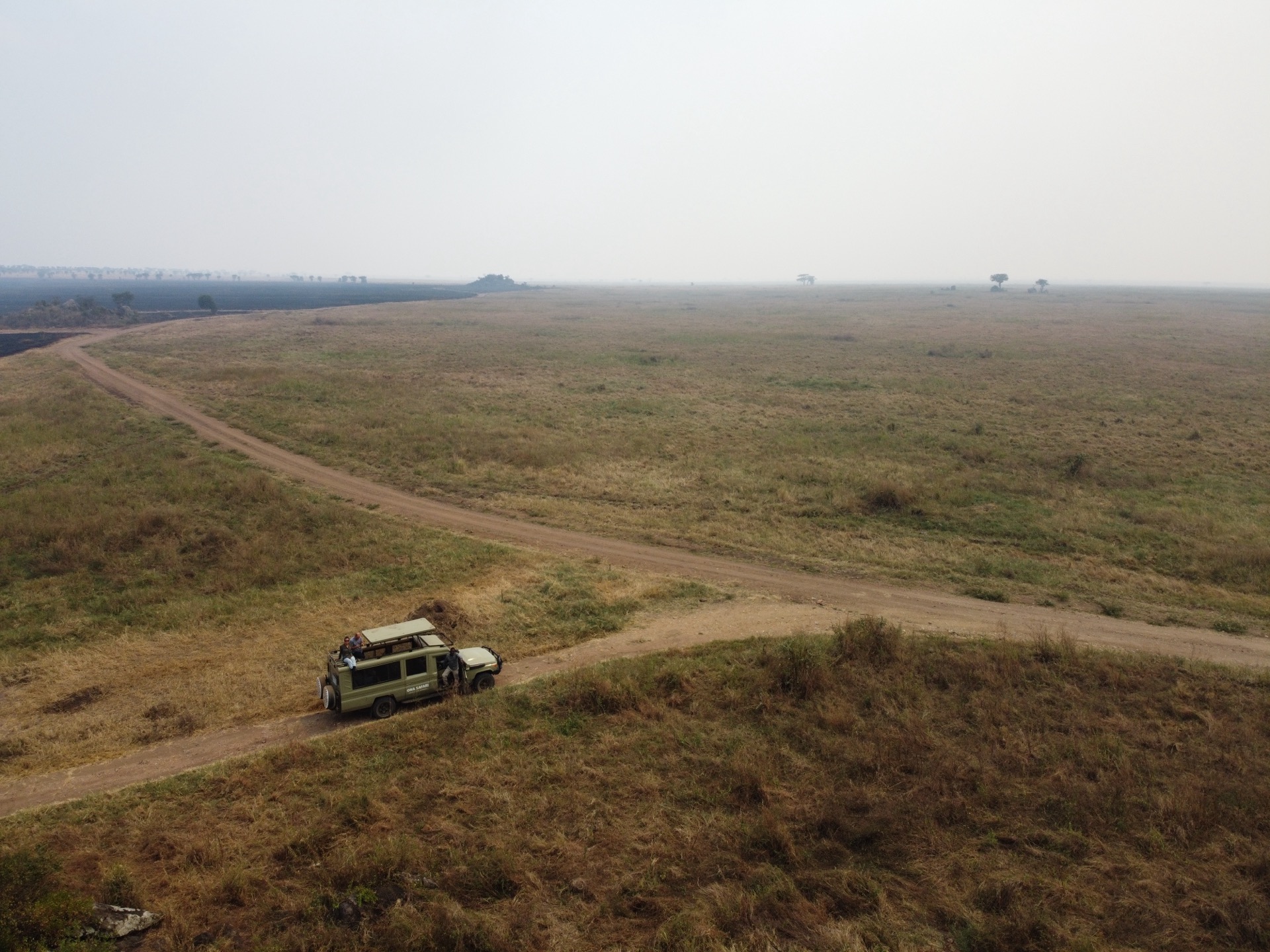
Safari vehicles — Land Cruisers, Land Rovers, customised 4x4s with pop-up roofs — are objects that Tanzania’s wildlife has been exposed to for generations across park boundaries. Lions rest beside vehicles without raising their heads. Elephants feed at distances that would cause any predator-prey response on foot. Buffalo herds part to let vehicles through. This habituation is not tameness — it is familiarity with a specific object that does not look, smell, or behave like a prey animal or a threat.
A human on foot is a completely different category of signal. Prey-sized, moving unpredictably, smelling biological. To a lion, a person outside a vehicle reads as a prey animal — and potentially a threat worth investigating. To a buffalo bull, an unfamiliar shape at close range on foot triggers a very different response than a vehicle at the same distance.
Most safari vehicles in Tanzania have a pop-up roof for standing and photography. The roof hatch is legitimate. The risk emerges when visitors stand fully upright through the hatch, exposing their upper body at a height that breaks the vehicle’s visual profile — particularly near lions or large mammals at close range. The guideline is to crouch or sit in the hatch opening with upper body low, not to stand fully exposed at height when animals are within close range.
Your guide controls the vehicle and sets the rules for roof hatch use. Follow those rules.
The Big Five — danger profiles
Understanding how each species behaves differently helps you follow your guide’s instructions intelligently rather than passively.
Lion. Lions in Tanzania’s national parks are among the most vehicle-habituated wildlife in Africa — decades of safari traffic have produced populations that genuinely ignore vehicles at close range. This habituation is what makes lion viewing so extraordinary: prides hunt, interact, and rest within metres of vehicles without changing their behaviour. Outside the vehicle, this habituation disappears immediately. The same lion that was ignoring your Land Cruiser responds to a person on foot as an unfamiliar biological entity. Stay in the vehicle and the encounter is safe. The immediate risks inside a vehicle are breaking the silhouette (standing through the roof hatch with upper body at lion eye-level), making sudden movements at very close range, or extending arms and camera equipment outside the vehicle body. At close range, keep all limbs inside the vehicle.
Elephant. Elephants are among the most frequent causes of human fatalities in Africa from wildlife — more than any big cat. They are the largest land animals and can move at speed over very short distances. In a vehicle, elephant encounters are managed by experienced guides who read the body language and maintain appropriate distance. Two scenarios require particular attention: bulls in musth (a hormonal state indicated by secretion from the temporal gland visible as a dark stain on the side of the face, and urine dribbling) are unpredictable and can be aggressive — your guide will increase vehicle distance; mother elephants with very young calves are defensive and can escalate rapidly if the vehicle is perceived as too close. The critical distinction is between a mock charge (ears spread wide, head-shaking, noise, raised dust — usually stops) and a genuine charge (ears pinned back, head low, direct and purposeful). Experienced guides read both correctly and respond accordingly: slow and calm vehicle movement away from the animal, not panic acceleration.
Buffalo. The African cape buffalo (Syncerus caffer) has a documented reputation as the most dangerous of the Big Five for hunters on foot — historically responsible for more hunting fatalities than any other Big Five species. Buffalo can charge with little warning and have a tendency to circle back on a threat. In a safari vehicle, buffalo are generally safe to approach at close range — herds are accustomed to vehicles and rarely react aggressively. The specific risk is lone bulls: older males that have separated from the herd tend to be unpredictable and defensive. If your guide keeps greater distance from a lone buffalo than from a herd, this is the reason. The minimum safe distance from any large game on self-driven circuits is 20 metres; for cape buffalo specifically, licensed operators treat that as a floor, not a target.
Hippo. Hippopotamus (Hippopotamus amphibius) are the most dangerous large mammal in Africa by annual human fatality count — the widely cited figure is approximately 500 hippo attacks causing human deaths per year in Africa, more than lions. Tanzania holds an estimated 20,000–30,000 hippopotamus across its rivers, lakes, and wetlands. The danger profile is specific: hippos are highly territorial, very fast on land over short distances despite their bulk, and intensely aggressive when surprised between them and water. Never position yourself between a hippo and its water source. Never swim or wade in rivers or lakes where hippos are present. On boat safaris — Rufiji River in Nyerere, Katavi’s Katuma River — your guide manages distance and angle of approach to avoid triggering territorial responses. The Katavi dry season concentrations are particularly intense; hippos in dwindling pools are compressed and stressed. In a vehicle on land, hippos away from water are less aggressive, but the rules on not exiting the vehicle still apply.
Leopard. Leopards (Panthera pardus) are the least likely of the Big Five to threaten a safari vehicle — they are secretive, cryptic, and almost always retreat from disturbance rather than confront it. A leopard encountered in a tree or resting in open ground will typically slip away if a vehicle approaches too close or too quickly. The specific risk scenario is a cornered or injured leopard at close quarters: many experienced Tanzania guides consider a cornered leopard to be the most dangerous animal in close-quarter confrontation in the bush — smaller than a lion but faster, very strong for its size, with acute reflexes. The most relevant application is on walking safaris in leopard habitat: your guide is particularly cautious about moving through dense vegetation where a leopard might be cornered inadvertently.
Rhino, crocodile, and other risks
Black rhino. Tanzania holds a small population of critically endangered black rhino (Diceros bicornis), concentrated in Ngorongoro Crater and the Mkomazi National Park. Black rhinos have a documented tendency toward unprovoked charges of vehicles and unfamiliar objects — they have poor eyesight and tend to charge what they cannot clearly identify. White rhinos are significantly calmer around vehicles. In Ngorongoro, black rhino sightings from the crater floor do involve charges toward vehicles in historical accounts; your guide manages distance and angle. In a vehicle, the rule is to avoid sudden movement that might startle and maintain more distance than you would with other species.
Nile crocodile. Any river or lake crossing, boat safari, or shoreline approach involves crocodile awareness. Nile crocodiles (Crocodylus niloticus) are present in virtually all of Tanzania’s river systems and lakes — the Rufiji, the Grumeti, Lake Manyara, Lake Tanganyika margins. The rule is simple: do not enter the water in any area where crocodiles are known to be present, and maintain significant distance from any riverbank when exiting a vehicle at a designated point near water. Boat safari guides on the Rufiji are experienced at managing crocodile proximity.
Snakes. Venomous snakes — including puff adder (Bitis arietans), black mamba (Dendroaspis polylepis), and green mamba — are present in Tanzania’s bush. Dangerous snake sightings during standard game drives are rare, and encounters are almost always avoidable because snakes move away from vibration and noise. The practical rules: watch where you step at any designated walking area; never reach under rocks, logs, or dense vegetation without checking; if a snake enters camp, do not attempt to handle or remove it yourself — alert your guide. Snake bites on properly managed safaris are extremely uncommon.
Camp safety
Camping inside Tanzania’s national parks — public campsites, special campsites, and fly camps — means wildlife moves freely through or near your tent at night. There are no fences between your tent and the surrounding ecosystem. This is part of the experience; it is also a responsibility. Our camping format breakdown covers the three campsite tiers in detail; this section covers the specific safety protocols.
Food storage is the single most important camp rule. Every item of food — cooked, raw, or packaged — must be sealed inside the locked vehicle before you sleep. Not under the camp table. Not in a bag between tents. Not in the cooking area. In the vehicle, locked. Hyenas are the most persistent camp visitors in Serengeti and Ruaha campsites, and they are motivated by food smell alone. A hyena that detects food accessible outside a vehicle will return repeatedly and become progressively bolder. Camp staff at reputable operators enforce this rule without exception because the precedent it sets — a campsite associated with accessible food — affects all future guests.
Lions do pass through public campsites, particularly Seronera in the Serengeti. They are typically moving through on patrol routes they have used for years, not targeting the camp. The food storage rule reduces the probability of any wildlife being attracted to and lingering near your campsite.
Night movement requires a headlamp and, ideally, an escort. If your camp has a separate toilet facility, never walk to it at night without a working headlamp and, where your operator provides them, a night escort. Wildlife can be anywhere between your tent and the facility. If your guide offers to escort night movement, take the offer.
Keep tent zips completely closed at night. A partially open tent zip is an entry point for hyenas, smaller carnivores, and other nocturnal wildlife. Zip every entry and mesh panel fully. If you need ventilation, use a tent with separate inner and outer layers rather than leaving a zip open.
If you hear unfamiliar sounds at night — do not exit the tent to investigate. Alert your guide or camp staff. The guide is trained to assess and respond; you are not. The situation that most often goes wrong is the curious guest who exits the tent to look at an animal that turns out to be a threat rather than a curiosity.
Health safety
Malaria prophylaxis. Tanzania is in the highest malaria risk category for travellers. Malaria transmission occurs in all areas below 1,800 metres elevation — which includes all major safari parks and Zanzibar. Prophylaxis is strongly recommended (not merely considered) for any Tanzania itinerary that includes safari or coastal time. Consult a travel health clinic before departure, because the right option depends on your medical history, other medications, and itinerary length.
The three main options:
- Atovaquone-proguanil (Malarone) — start 1–2 days before arrival, continue 7 days after departure; generally the option with the most tolerable side-effect profile; often the first recommendation for Tanzania. Adult dose: one tablet daily.
- Doxycycline — start 1–3 days before, continue 4 weeks after; requires sun-sensitivity caution; antibiotic, so interacts with some medications.
- Mefloquine — start 1–3 weeks before, continue 4 weeks after; the longest lead time; not suitable for everyone (neurological/psychiatric history requires careful assessment).
Children’s dosing for Malarone is weight-based (pediatric tablets available from 5 kg per UK/CDC guidance, with adult tablets appropriate from 40 kg). A travel clinic will calculate the correct dose by weight.
Yellow fever. Tanzania requires proof of yellow fever vaccination for travellers arriving from yellow fever endemic countries. The certificate is valid for life and the requirement applies to travellers over one year of age. If you are travelling directly from a non-endemic country (US, UK, most of Europe), no certificate is required. If your route includes a stopover of more than 12 hours in an endemic country, or if you are departing from one, the certificate is required for entry. Verify the current list of endemic countries with your travel clinic or the destination’s entry requirements before travel, as the list changes.
Hydration. Tanzania’s savanna climate — hot and dry, particularly during the peak safari season from June to October — is dehydrating. The Serengeti plains have near-zero humidity during the dry season and UV intensity is high at equatorial latitudes. Aim for a minimum of 2 litres of water per day during game drives; more if you are out in full sun. At altitude — Ngorongoro Crater rim is approximately 2,300 metres, and signs of dehydration can be more acute here — increase intake further. Signs of dehydration (headache, dark urine, fatigue, dizziness) in hot, dry conditions can escalate quickly; drink before you are thirsty.
Sun protection. UV intensity on the open Serengeti and in the Ngorongoro Crater is significantly higher than at equivalent latitudes in Europe or North America. Apply SPF 50 sunscreen before morning game drives and reapply by midday. UV-blocking sunglasses are essential — a full day on open plains with unprotected eyes causes cumulative damage and significant fatigue.
Insect repellent. DEET-based repellent (30–50% concentration) serves two purposes on a Tanzania safari: mosquito protection (malaria risk) and tsetse fly protection. Tsetse flies are present in woodland and savanna habitats — their bite is painful and immediate; repellent and neutral clothing colours (khaki, olive, tan — not black, which attracts tsetse) significantly reduce biting frequency. Wear long sleeves and long trousers even in heat; the protection from sun, insects, and thorny vegetation justifies the extra warmth.
Walking safari protocols
Walking safaris in Tanzania operate under specific legal and operational requirements. By law, walks must be accompanied by at least one qualified armed ranger in addition to the guiding professional. Groups are typically limited to a maximum of 4–8 guests. Before any walk departs, a mandatory safety briefing covers the communication system — hand signals the guide uses, expected animal response, and what to do if a dangerous animal is encountered.
The briefing rules, which you should take seriously:
- Walk in single file. The guide leads; the armed ranger typically brings up the rear.
- Remain quiet. The guide uses hand signals, not words.
- Follow hand signals immediately. A raised fist means stop — stop immediately without asking why.
- Stay close. The group should remain close enough that the guide can whisper-speak to the last person. Spreading out makes the group harder to manage in a sudden encounter.
If a dangerous animal is encountered — especially a predator:
- Stop immediately on the guide’s signal.
- Do not run. Running triggers the pursuit instinct in lions, leopards, and other predators. This is the single most important rule in a sudden encounter.
- Stand still and face the animal.
- Wait for the guide’s instruction. They will signal retreat — which means slow, controlled backward movement, not turning and walking away.
- Move slowly backward without turning your back on the animal.
Not running is genuinely difficult when a predator is nearby. It is why professional walking safari guides are trained specifically in managing this scenario — their calm response is the model for what the group should do. Following their instructions without hesitation is the correct behaviour.
Tim’s note
I have worked in Tanzania for many years, running a hotel on Zanzibar’s east coast and taking guests into the bush each season. I have not had a serious incident. I have had elephants make mock charges at the vehicle, been in camp overnight when hyenas circled the food storage (they never got anything — every item was sealed in the vehicle), and sat in a Land Cruiser at five metres from a buffalo bull that stared at us for a solid four minutes before moving off. The guide read each situation correctly and made the right call each time. That is the point: the guide knows these animals, and their job is to keep you safe while putting you as close as the safety framework allows.
The most unsettling thing I have seen on a safari was in the Serengeti: a passenger in a nearby vehicle stood fully upright through the roof hatch, upper body completely exposed, leaning out over the side to photograph a lion resting approximately fifteen metres away. The lion did not respond. That was fortune, not safety. The guide’s job is to manage fortune until it becomes unnecessary.
Follow the guide. Stay in the vehicle. Store the food. These three rules cover the vast majority of what makes a Tanzania safari safe.
For how each species behaves in detail — hunting strategies, territorial patterns, and what to watch from a vehicle — see the Tanzania big cats guide covering lion, leopard, and cheetah. For the complete breakdown of camping tiers, campsite fees, and what equipment mobile operators provide, see the full camping tier guide. For health preparation specific to Zanzibar and the coast rather than the bush, including detailed vaccination guidance, see the Tanzania health guide. For planning a northern circuit itinerary that slots Serengeti, Ngorongoro, and Tarangire efficiently, see the northern circuit planning guide. For the full cost breakdown of what a Tanzania safari budget should include — park fees, vehicle costs, guide and ranger fees — see the complete budget guide.
Frequently asked questions
Can you get out of the vehicle on a Tanzania safari?
Only at designated points and with your guide's explicit permission. Inside national park boundaries, you must remain in the vehicle except at specifically designated picnic areas or viewpoints. Getting out of the vehicle near wildlife — even seemingly calm wildlife — is the most common cause of safari incidents. The vehicle is your safety perimeter: animals are habituated to it as a non-threatening object. A human on foot is perceived very differently by every predator and large mammal in the park. Your guide will indicate when and where it is safe to exit, and this instruction should be followed without exception.
What is the most dangerous animal on a Tanzania safari?
By annual human fatalities across Africa, hippopotamus are the most dangerous large mammal — the commonly cited figure is approximately 500 hippo attacks causing human deaths per year in Africa, more than lions. Hippos are extremely territorial, surprisingly fast on land over short distances, and very aggressive when surprised between them and water. Buffalo — the most dangerous of the Big Five for hunters on foot — also cause significant fatalities, particularly from unpredictable lone bulls. Elephants cause more human deaths in Africa overall than any big cat. Lions kill fewer people than hippos or elephants but are the most psychologically feared.
What should you do if a lion approaches your safari vehicle?
Stay calm and seated. Do not make sudden movements. Ensure any windows or roof hatches are in a position that does not expose human body parts at lion level — standing fully upright through the roof hatch breaks the vehicle silhouette that lions have learned to ignore. Alert your guide if they have not already seen the approach. If the lion moves beneath or alongside the vehicle, the guide will drive slowly a short distance away — do not panic or demand a sudden acceleration, as rapid movement can trigger a reaction. Lions in Tanzania's national parks are highly habituated to vehicles and the vast majority of close approaches are curiosity, not aggression.
What vaccinations do you need for a Tanzania safari?
Malaria prophylaxis is strongly recommended for all Tanzania safari destinations — consult a travel health clinic before departure for the option most suitable for your medical history and itinerary. Tanzania is in the highest malaria-risk category; the three recommended prophylaxis options are atovaquone-proguanil (Malarone — often the preferred choice for its tolerability), doxycycline, and mefloquine. Yellow fever vaccination is required by Tanzania for travellers arriving from yellow fever endemic countries; the certificate is valid for life and applies to travellers over one year of age. Routine vaccines including hepatitis A, hepatitis B, and typhoid are also generally recommended for Tanzania travel.
How do you stay safe camping inside a Tanzania national park?
The core camping safety rules: store all food inside the vehicle overnight — never in tents, never near the cooking area, never anywhere outside the sealed vehicle; never walk alone between tents and toilet facilities at night without a guide, escort, or working headlamp; keep all tent zips fully closed at night — animals including hyenas can enter a tent with an open zip; do not cook inside or directly adjacent to your tent; if you hear unusual sounds at night, do not investigate by exiting the tent — alert your guide or camp staff. Hyenas are the most common camp visitors in parks like Serengeti and are attracted to food smells, not people. Lions do pass through public campsites — they are moving through, not targeting the camp.
Are walking safaris safe in Tanzania?
Yes, with a trained guide and proper protocols. Walking safaris in Tanzania must be accompanied by a professional licensed guide and at least one armed ranger — this is a legal requirement, not optional. Before departure, you receive a mandatory safety briefing covering signals, spacing, and what to do if a dangerous animal is encountered. The critical rule is never run — running triggers the pursuit instinct in most predators. The guide makes all decisions on movement and retreat. Walking safaris are conducted only in designated wilderness areas where the guide has current knowledge of animal patterns. Serious incidents on properly guided walking safaris are rare. Minimum age is typically 12 years old, though some fly-camp circuits require 16.