
Facts & prices checked: 2026-06-25
Tanzania’s great migration is usually sold as a wildebeest story. The 1,366,109 wildebeest counted in the 2023 TAWIRI aerial census are the headline number — the dark columns, the river crossings, the calving plains. But approximately 250,000–300,000 Burchell’s zebras make the same 800-kilometre annual circuit. They are not followers. They typically arrive first.
This guide compares the two species across the things that matter for a safari visitor: what they are, how they behave, what they eat, how they reproduce, how they respond to predators, and where in Tanzania each is most reliably seen. The zebra-wildebeest relationship is not a footnote — it is one of the most important ecological processes in the Serengeti system.
What they are: equid versus bovid
The most fundamental difference between zebras and wildebeest is taxonomic. They are not closely related.
Zebras (family Equidae) are equids — members of the horse family. Tanzania’s zebra is the Plains zebra (Equus quagga), specifically the Grant’s zebra subspecies (Equus quagga boehmi), which ranges across central and northern Tanzania. Equids evolved on grasslands as efficient processors of low-quality, high-fibre vegetation. The digestive system of a zebra is built for bulk throughput of coarse material.
Wildebeest (family Bovidae) are bovids — members of the cattle and antelope family. Tanzania’s wildebeest is the Blue wildebeest (Connochaetes taurinus). Bovids have a ruminant digestive system: four stomach chambers that allow repeated fermentation of plant material, extracting maximum nutrition from smaller volumes of higher-quality food.
This taxonomic difference explains almost everything about how the two species interact in the migration. It is not a detail — it is the mechanism.
The ecological partnership: grazing facilitation
The reason approximately 250,000–300,000 zebras and 1,366,109 wildebeest travel the same circuit through the Serengeti-Mara ecosystem is not that they are social companions. It is that their different digestive systems mean they harvest different layers of the same grassland without competing.
The sequence, called grazing facilitation, works as follows:
-
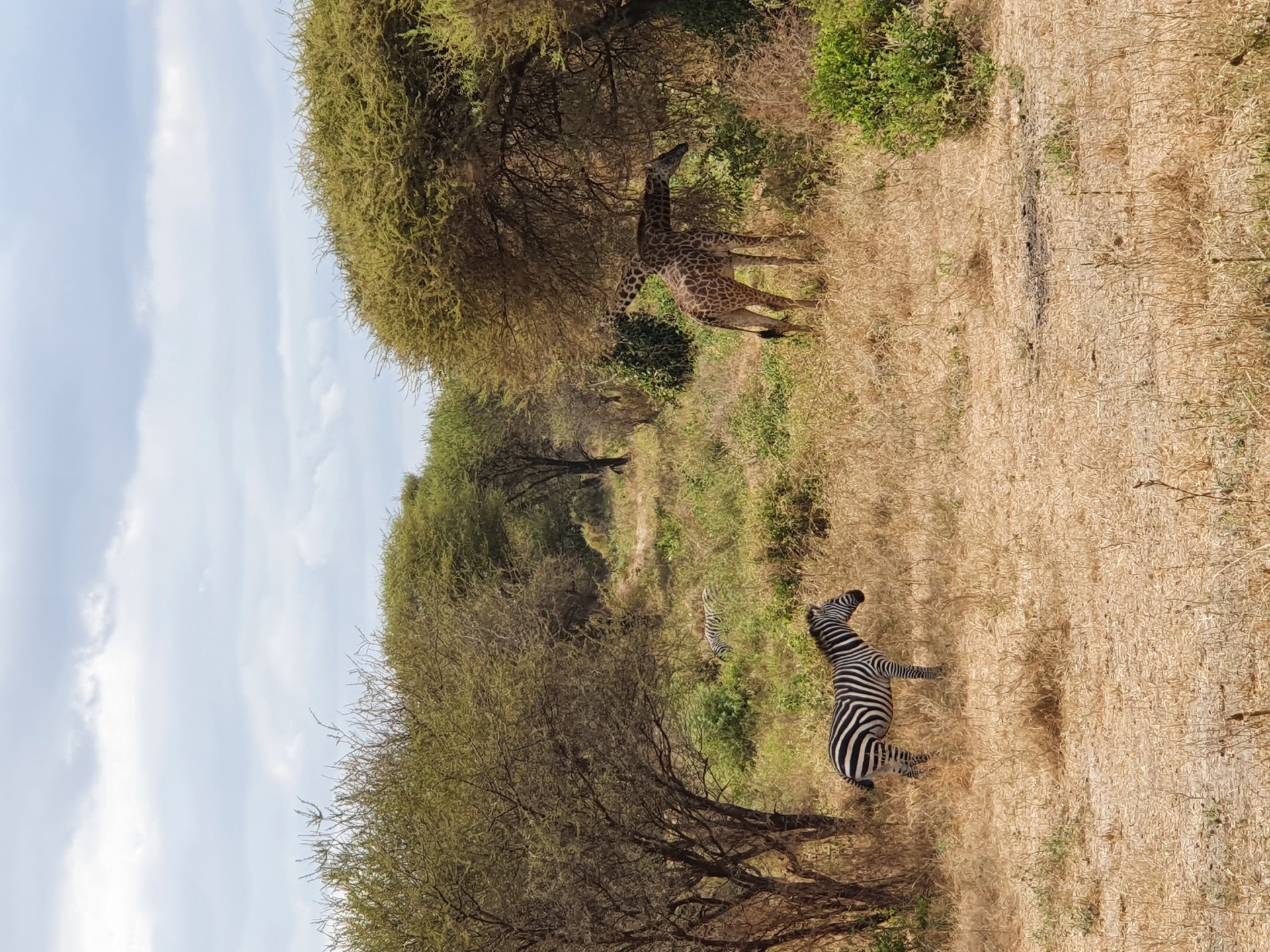
Zebras arrive first. As hindgut fermenters, zebras can extract nutrition from coarse, mature, fibrous grass — the tall standing material in the upper third of the grass sward — that wildebeest cannot efficiently process. Zebras graze this down, effectively opening the grassland.
-
Wildebeest follow. Ruminants like wildebeest are optimised for shorter, higher-quality grass. With the tall material removed by zebras, wildebeest access the protein-rich regrowth and the shorter understorey grasses they prefer. The nutritional demands of pregnancy, lactation, and rapid growth in calves make this quality differential critical for wildebeest survival.
-
Thomson’s gazelles complete the sequence. After wildebeest graze, the very short new shoots emerging from the cropped grassland are exactly the food source these small antelopes prefer. Three species, three grass layers, one landscape — far more total herbivore biomass than if they competed for the same layer.
A 2024 study found that zebra and wildebeest “jockey for the best grasses” in Serengeti National Park but their diet partitioning — zebras on the coarse tall material, wildebeest on the shorter growth — means their interaction is better described as complementarity than competition. A 2024 preprint included in the mixed-species herding literature confirmed that zebra-wildebeest mixed herds are ecologically significant entities in their own right.
Experienced guides use zebra movement as a leading indicator. Where large zebra concentrations are grazing now is often where wildebeest concentrations will appear in the coming days or weeks. The sequence is consistent enough to function as a predictive tool in the field.
Body plan and physical differences
Visitors rarely confuse the two species — the visual contrast is dramatic — but understanding the physical differences helps read behaviour in the field.
Zebras:
- Distinctive black-and-white striped coat; each individual’s stripe pattern is unique, functioning like a fingerprint
- Upright mane (like a horse), robust neck
- Rounded ears, horse-like head shape, prominent nostrils
- Males (stallions) substantially larger than females (mares); aggressive territorial behaviour in family group defence
- Vocalisation: a sharp bark or “kwa-ha” — the sound of a stallion checking the position of his family group, and the ambient soundscape of a large migration herd at dawn
Wildebeest:
- Grey-brown coat with darker face, shaggy mane, and beard; humped shoulders, sloping back
- Long face with broad muzzle, adapted for cropping grass at the base
- Both sexes have curved horns (bovid characteristic)
- Lowing, moaning calls — the low continuous sound of a large wildebeest herd is recognisable from hundreds of metres
For photography, the two species offer very different subjects. Zebra family groups in small numbers at close range — the pattern contrast, the individual variation in stripes, the social interaction between family members — reward portrait-style shooting with a telephoto lens. Wildebeest at river crossings — the scale, the chaos, the crocodile ambushes — reward wider focal lengths and high frame rate.
Calving strategy: opposite approaches to the same problem
Both species must produce offspring that survive predation. They have evolved opposite strategies to achieve this.
Wildebeest: synchronised mass calving. Blue wildebeest in Tanzania calve over a compressed six-to-eight-week season, centred on late January to early February, on the short-grass plains of the southern Serengeti and Ndutu area. Upwards of 500,000 calves are born in this period — roughly 8,000 new calves per day at peak. The evolutionary logic is predator swamping: if every calf arrives simultaneously, the predator population (lions, hyenas, cheetahs, wild dogs, jackals) has a physically limited capacity to process prey. By overwhelming that capacity, most calves survive the critical first days despite extraordinary predator density.
A newborn wildebeest calf attempts to stand within minutes of birth. Within about 30 minutes it is running. It has to be — a calf that cannot run is dead. The Ndutu short-grass plains serve the strategy well: lower grass density means mothers can see their calves, and the volcanic soils that create short grass concentrate the calves in an area where synchronisation itself is possible.
Zebras: year-round calving with mobile foals. Zebra foals are born year-round (with seasonal peaks during and after the rains), not in a compressed synchronised window. A foal is born with legs functional enough to follow the herd within hours. The mother-foal bond is established immediately after birth: the mare prevents other adult zebras from approaching in the first days so the foal can learn the mother’s unique stripe pattern. The bond is strong enough that foals separated from their mothers will continue calling until reunited.
Zebra foals are born with brown stripes rather than black — the high-contrast black-and-white pattern develops over the first months of life. At distance, a brown-striped foal is slightly less visually distinct from the grassland background than an adult — a possible anti-predator advantage in the vulnerable early weeks.
Predator response: kick versus run
Both zebras and wildebeest are primary prey for the same predators — lions, spotted hyenas, and to a lesser degree wild dogs and cheetahs. Their responses differ in ways that reflect body plan and social structure.
Wildebeest response: Flight in large groups, with some degree of alarm signalling within the herd. Wildebeest in large herds have a collective anti-predator advantage from vigilance — many eyes scanning, many animals that can alarm. Individual wildebeest can run at significant speed for sustained distances. The main vulnerability is the calf, and the main defence is the timing and concentration of the calving season.
Zebra response: Flight plus active defence. Adult zebra stallions defend family groups actively — kicking, biting, and interposing themselves between the family and a predator. A well-placed kick from an adult zebra can injure a lion seriously. Hyena hunts on zebra typically require multiple animals in a coordinated approach because of the stallion’s defensive capacity. In Ngorongoro Crater, where spotted hyena density is among the highest in Africa, zebra family group cohesion and stallion defence are visible regularly.
At the Mara River, crocodile predation on both species is opportunistic and driven by the crossing event rather than pursuit. Crocodiles position themselves at known crossing points and wait. Both zebras and wildebeest are taken at river crossings, though the scale of wildebeest crossings — tens of thousands of animals — means wildebeest feature more prominently in the crocodile predation literature simply due to numbers.
Where to see each species in Tanzania
Serengeti — both species, migration-dependent: The Serengeti holds the full migration circuit for both species. Both follow the same clockwise annual route — south to north through the dry season, north to south with the onset of the wet season. The Mara River (July–October) is where crossings of both species are most concentrated. The southern Serengeti in calving season (January–March) is the largest single concentration of both species simultaneously. Year-round resident populations of both species occupy the central Seronera zone.
Ngorongoro Crater — both resident year-round: The crater floor has large resident populations of both species. The enclosed geography prevents outward migration; the crater’s population is stable and present every month. Ngorongoro is the most reliable year-round destination for both species without depending on migration timing. For photography, the combination of both species on the open crater floor with the volcanic rim as backdrop is one of Tanzania’s most reliably achievable compositions.
Tarangire — zebra dominant: The Tarangire ecosystem has strong dry-season concentrations of zebra (June–October) along the Tarangire River. Wildebeest are present but zebra dominate the open areas. The particular combination of Tarangire’s ancient baobab trees with zebra herds in the foreground is specific to this park — not replicated elsewhere on the northern circuit.
Ruaha — zebra dominant, approximately 20,000 resident: Ruaha National Park has approximately 20,000 resident zebra year-round — one of the largest fixed-population concentrations in Tanzania. Wildebeest are less dominant in the Ruaha ecosystem than on the northern circuit. For visitors wanting large zebra numbers in a remote, uncrowded park context, Ruaha is the answer. Best reached by light aircraft.
Lake Manyara — both present: Lake Manyara National Park has both species in its open areas. Numbers are smaller than the Serengeti or Ngorongoro, but the backdrop of the rift valley escarpment and the lake itself makes for distinctive photography. The park’s small size makes encounters with both species reliable on a half-day game drive.
What to watch for in the field
The grazing sequence is most visible when you arrive at a fresh migration front — an area where zebras have recently been grazing and wildebeest are arriving. The grass height gradient across the landscape tells the story: tall, rank grass on the leading edge, cropped shorter grass where zebras have worked, and the wildebeest feeding on what is behind. If your guide is reading the landscape, this gradient is legible from the vehicle.
The social difference is also worth attending to in mixed herds. When a zebra family moves through a wildebeest concentration, the zebra stallion will periodically position himself at the periphery and face outward — scanning, alert, with his family behind him. Wildebeest herd members alarm and run in large groups. The two vigilance strategies exist within a few metres of each other on the same piece of grassland.
I have watched both species at the Mara River in the same hour. The wildebeest build to mass crossings of thousands, the noise and chaos of it overwhelming — you stop trying to track individual animals and just watch the shape of the event. The zebra crossings are readable. You can watch the specific animal that decides to go, follow it into the water, see the crocodile launch and miss or connect. Both are extraordinary. They are just completely different experiences.
For the full natural history of Tanzania’s zebra — the stripe debate, subspecies, grazing facilitation, predation dynamics, and park-by-park viewing guide — see the Tanzania zebra guide. For wildebeest migration biology, the synchronised calving strategy, river crossings, and the ecological impact of 1.37 million grazers on the Serengeti system, see the Tanzania wildebeest guide. For the complete migration circuit — month-by-month, zone-by-zone, crossing-by-crossing — see the month-by-month migration guide. For planning the northern circuit that puts you in position for both species in peak season, see the Northern Circuit trip planner.
Frequently asked questions
Do zebras and wildebeest compete with each other?
No — they are ecological partners, not competitors. A 2024 study confirmed that what looks like competition is actually diet partitioning: zebras consume the tall, coarse, fibrous grass that wildebeest cannot process efficiently, and wildebeest follow to eat the shorter, protein-rich regrowth exposed by zebra grazing. This is called grazing facilitation. Both species benefit — more total herbivore biomass can survive the same landscape because they are harvesting different grass layers rather than competing for the same food.
How many zebras and wildebeest are in the Serengeti migration?
The 2023 TAWIRI aerial census counted 1,366,109 ± 231,741 wildebeest in the Serengeti-Mara ecosystem. The zebra component of the migration is estimated at approximately 250,000–300,000 Burchell's (Plains) zebra. Together, with Thomson's gazelle and other species, the total migration herd exceeds 2 million animals. This is the largest land migration on Earth.
What is the difference between a zebra and a wildebeest?
Zebras are equids — members of the horse family (Equidae), closely related to donkeys and horses. Wildebeest (also called gnu) are bovids — members of the cattle family (Bovidae), more closely related to cattle and antelope. Zebras have black-and-white striped coats and upright manes. Wildebeest are grey-brown with a large bearded head and shaggy mane. Zebras use individual stripe patterns for social recognition; wildebeest rely heavily on visual and auditory signals within large herds. Both are grazers, but they eat different grass layers and have very different calving strategies.
Which is easier to see in Tanzania — zebra or wildebeest?
Both are easy to see on any northern circuit safari, but for different reasons. Zebras have a large resident population in Ngorongoro Crater year-round and are present in all Serengeti zones throughout the year. Wildebeest concentrate dramatically during migration phases — calving season at Ndutu (January–March) and Mara crossings (July–October) produce the most spectacular wildebeest concentrations, but between those phases they are more dispersed. Ruaha in the south has approximately 20,000 resident zebra year-round with no equivalent wildebeest concentration.
Do zebras and wildebeest cross the Mara River together?
Yes — both species cross the Mara River during the northern migration phase (July–October) at the same crossing points. Wildebeest crossings tend to be larger in scale — thousands of animals in a single rush. Zebra crossings at the same points are typically smaller groups, which makes the individual decision-making more visible: a single lead animal at the bank, the group pressing behind it, the moment one animal commits and the rest follow within seconds. Some experienced guides prefer watching zebra crossings specifically for this reason.
Why do zebras lead the migration ahead of wildebeest?
Because of their different digestive systems. Zebras are hindgut fermenters — they can digest coarse, mature, fibrous grass efficiently, extracting nutrition from vegetation that wildebeest largely cannot use. Wildebeest are ruminants (foregut fermenters) that are adapted to shorter, higher-quality grass. When zebras move into a new area and eat the tall grass down, they create the exact grass conditions that wildebeest prefer, which is why wildebeest follow zebras rather than leading. This is grazing facilitation — each species prepares the habitat for the next.