
Facts & prices checked: 2026-06-25
Tanzania is one of the world’s best wildlife photography destinations — and one of the most revealing. The Serengeti’s open savannah, the Ngorongoro Crater’s enclosed bowl, and Tarangire’s baobab groves create conditions where the technical quality of your photographic decisions is immediately apparent. A blurred lion in flat midday light reads worse than a sharp sparrow in golden light. This guide covers the controllable variables.
The most important variable: light
Golden hour is not a metaphor
The hour after sunrise and the hour before sunset in Tanzania produce light that is genuinely different from any other time of day. The sun is low; shadows are long; the colour temperature drops from harsh midday 5,500K to a warm 3,000–4,000K. Animal skin, grass, and fur respond to this quality of light in ways that midday cannot replicate.
The central Serengeti is best photographed at first light from 06:00–08:00 and again from 16:00 until sunset. This is not a general preference — it is the difference between images that work and images that don’t. Both morning and evening game drives start at dawn for this specific reason. The practical implication: be in position at a productive site — a kopje with a resident pride, a water hole, a known kill — as the sun clears the horizon, not driving toward one as the light is rising.
Midday — use it productively
Between 10:00 and 15:00, the light in Tanzania is harsh, flat, and unflattering. Animals are also in their least active phase — lions sleep, zebra stand in shade, birds roost. Three productive uses of midday:
- Rest (genuinely useful: afternoon drives require energy)
- Sit at a fixed site — a water hole or active kill where something is happening regardless of light
- Focus on landscape work — dust trails, dramatic skies, wide-angle savannah
The worst decision on a photography-focused safari is to spend the golden-hour window at lodge breakfast and drive during midday. Front-load the light windows.
Golden hour changes rapidly
Light angle shifts fast near the equator. A shot that works at 06:30 may not work at 07:15. Set specific morning objectives — “I want to be at this kopje at first light” — rather than general ones. The golden-hour window for actionable warm light at vehicle level is approximately 90 minutes in the morning and 60 minutes in the evening.
Equipment: what Tanzania specifically requires
Telephoto focal length
The practical minimum for wildlife in Tanzania’s open parks is 400mm full-frame equivalent (300mm on a crop sensor). The most useful focal length range for vehicle-based game drives is 100–400mm zoom, which covers approaching lions on a kopje, elephant herds at distance, and bird detail.
For cheetah hunts specifically, 500mm is the practical minimum; 600mm is preferred. At 110 km/h a cheetah moves roughly 30 metres per second. Beyond the focal length, aperture and shutter speed matter more than extra reach: 400mm at f/4 in evening light will outperform 600mm at f/6.3 at the same ISO.
For landscapes: A wide zoom (24–35mm) is essential. Serengeti panoramas and Ngorongoro crater-rim shots work best at maximum width, shot low from the vehicle’s roof hatch rather than standing through it.
Shutter speeds for different subjects
The right shutter speed depends on what you’re photographing:
- Stationary large animals (lions resting, elephants feeding): 1/500 sec minimum
- Walking or slow-moving animals (herds crossing, approaching elephant): 1/1000 sec
- Fast movement (wildebeest running, birds in flight): 1/2000 sec or faster
- Cheetah at sprint: 1/2500–1/3200 sec — this is specific to cheetah because of their speed; anything slower produces motion blur on the feet and face
During golden hour, when ISO must rise to maintain these speeds, ISO 3200 is the practical ceiling on modern full-frame sensors before noise becomes obtrusive. Set shutter priority at these values and let ISO float.
Bean bags over tripods
From a vehicle, a standard tripod is almost unusable — vehicle vibration and the angles required make it impractical. A bean bag draped over the vehicle door frame provides a stable platform for everything up to 600mm. Many photographic safari operators build custom window mounts. The single most important rule: shoot with the vehicle engine off whenever the guide can safely switch it off. Engine vibration is the most common cause of telephoto blur on game drives that never gets corrected because photographers assume the subject moved.
Equipment protection: dust over rain
Tanzania’s dry season (June–October) on unsealed roads means fine volcanic dust infiltrates everything — memory card slots, battery compartments, and eventually sensors. Three rules:
- Keep cameras in a dry bag or padded insert between shots; never loose on the vehicle floor
- Use a rocket blower (not cloth) for sensor dust — cloths smear dust into the sensor surface
- Extend zoom lenses before leaving the lodge; zooming pumps air and draws dust toward the rear element and sensor
Heat is the secondary threat, not rain. A camera left on a vehicle dashboard in direct equatorial sun at 30°C+ can overheat. Keep gear in the vehicle shade between drives.
Park-by-park photography strategies
Serengeti: the landscape-wildlife combination
The Serengeti’s open plains allow unlimited compositional freedom — animal in foreground, horizon in background, clouds above. This is the park that most rewards the photographer who thinks about what they want before arriving.
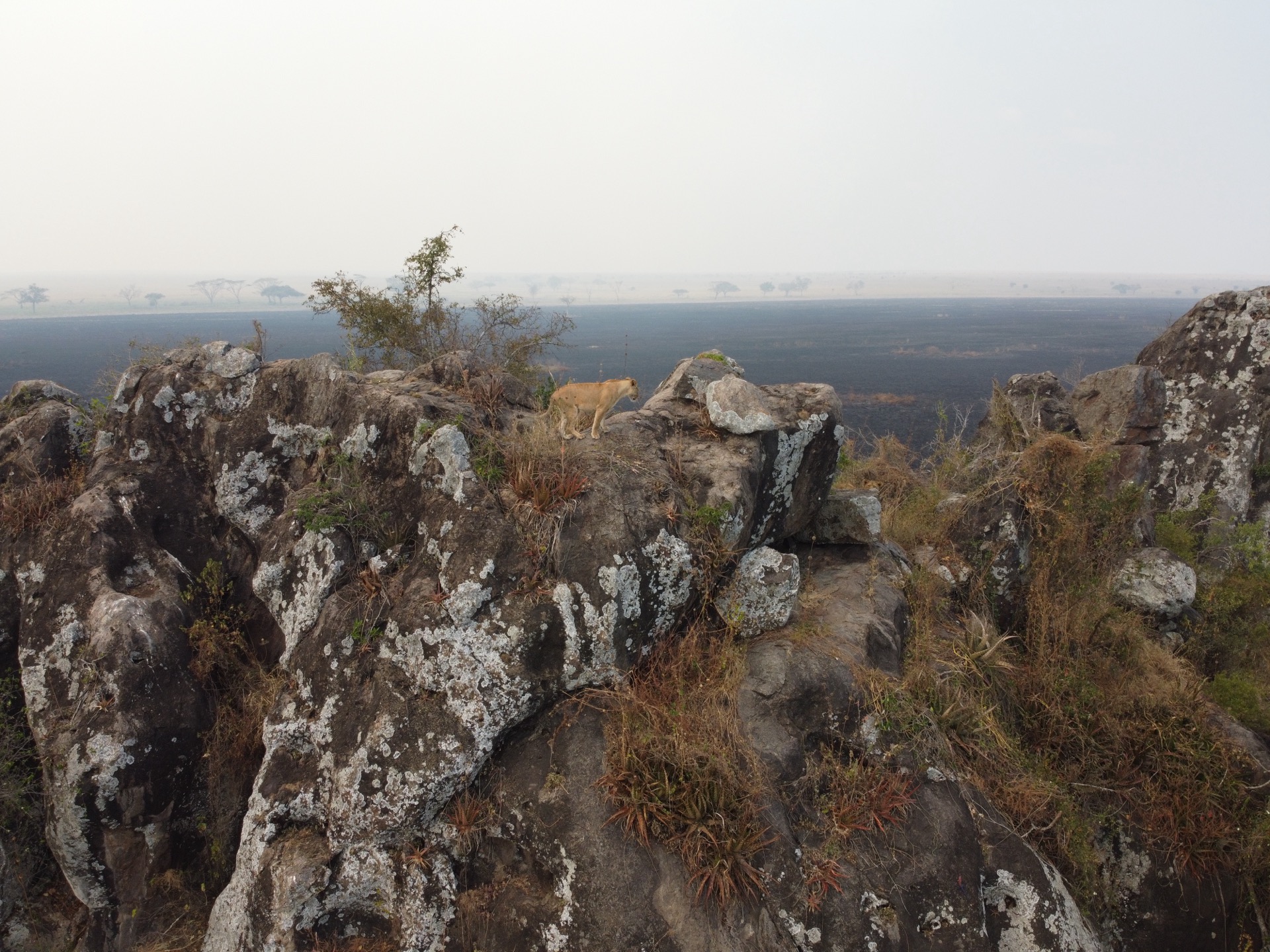
Kopjes (granite outcrops where lions rest and use as territorial lookout points) are the most reliably productive photographic locations in the Serengeti. A kopje with a resident pride gives you elevation, texture, and the lion’s natural resting posture — which is far more interesting than the same lion flat in the grass. Position the vehicle so the sun is behind you lighting the lion’s face. Your guide controls the vehicle orientation; state what you want before you arrive.
For the migration crossings (July–October, northern Serengeti, Mara River): arrive at a crossing point early and stay. Crossings happen when the herds decide, not on a schedule. Early vehicle position at the riverbank determines your shooting angle. The photographers who return with crossing images spent three mornings at the same point; they didn’t arrive at an existing cluster of vehicles.
Calving season (January–March, southern Serengeti around Ndutu): newborns within hours of birth, cheetah hunts in full morning light, predator-prey drama at a scale concentrated by the calving herds. Wide-angle for calving scenes (herds extending to the horizon); 400mm+ for cheetah hunting.
Shoot from vehicle level, not roof level. For Serengeti plain photographs, the camera at roofline height compresses the foreground and loses the sense of open savannah. Shooting low — from a vehicle door window on a beanbag — keeps the horizon line where it creates depth.
Ngorongoro Crater: enclosed and predictable
The crater’s enclosed geography means the same animals are present day after day. The photographic advantage is twofold: predictable subjects (the hippo pool is always in the same corner; the resident prides have known territories) and the crater rim light.
At sunrise, shooting from the eastern crater rim before descent, the sun illuminates the crater floor in warm orange-red light with no overhead shadows. This is the moment that makes Ngorongoro photographs visually distinct from Serengeti — the backlighting, the scale, the enclosed horizon creating a natural frame. The descent takes approximately 30 minutes; arrive at the rim overlook by 06:00.
On the crater floor, vehicles must stay on marked roads — off-road driving is prohibited by TANAPA. Position within the road system to put the sun behind you. The black-maned lions Ngorongoro is famous for (darker manes resulting from genetic drift in a partially isolated population) photograph best in morning light when the mane detail reads against a bright sky or the pale grass.
Black rhino: Ngorongoro hosts one of Tanzania’s few accessible black rhino populations. Sightings are not guaranteed — they are shy and often distant. When they occur, plan on 400mm minimum for a usable frame.
Tarangire: baobabs and elephant herds
Tarangire has the most visually distinctive composition in northern Tanzania. The combination of ancient baobab trees — most estimated at 500 to 900 years old, per the National Audubon Society — and dry-season elephant concentrations creates images specific to this park.
Elephant herds in the dry season (June–October): the Tarangire River area draws elephant concentrations of hundreds of individuals as other water sources dry up. Close-range vehicle photography of large elephant family groups is more accessible here than in the Serengeti.
The baobabs photograph best at golden hour — the low sun creates shadow texture on the bark that midday bleaches out. Position a morning drive specifically for the baobab stands in the central park area, with elephant herds between camera and trees.
Lake Manyara: tree-climbing lions and flamingos
Manyara is a compact park (220 km²) worth a half-day for specific photographic subjects. Tree-climbing lions rest in acacia branches — a documented but uncommon behaviour. When it occurs, the composition (lion draped across a branch against green canopy) is unlike any standard savanna lion photograph. Shoot upward — from below, with early morning light under the canopy, not from roof-hatch height.
Flamingos: when water levels are right, pink bands extending to the horizon along the lake shoreline are photographable with 300mm+. Numbers are seasonal and unpredictable; ask your operator whether concentrations are present before dedicating a morning to it.
Ethical photography rules
The rules that matter most for wildlife photography ethics in Tanzania are not bureaucratic — they are about whether the animal can behave naturally.
Never pressure a guide to move closer than the animal is comfortable with. Especially relevant for cheetahs: the Serengeti Cheetah Project has documented vehicle crowding causing cheetahs to abandon hunts and avoid productive feeding areas. Watching a hunt with one or two vehicles present is categorically different — for the cat and for the photograph — from watching it in a cluster of twelve.
For cheetahs specifically: pre-set continuous autofocus and burst mode before the vehicle reaches a stalking cat. If possible, position beyond the prey, not behind the cheetah — the cat then drives the gazelle toward your frame rather than away from it. When a hunt is beginning, do not approach; let the hunt conclude before repositioning.
No flash on nocturnal wildlife. If your lodge offers night game drives, flash photography of bush babies, genets, or sleeping birds causes genuine distress. Use high ISO and accept the noise.
Do not stand through the vehicle roof hatch near lions or elephants when the vehicle is close. The vehicle’s profile is the safe perimeter — a human figure extending above the roofline breaks the silhouette and can trigger aggressive responses.
Tim’s perspective
The photograph I’m most often asked about from Tanzania was not taken with a long lens. It was the Seronera River hippo pool at 07:20 in September — the first direct light hitting the water at about 10 degrees above the horizon. I had a 70–200mm on. The hippo had her head turned into the light and the water surface was reflecting amber and gold. The photo is sharp because the light was sufficient, the subject was still, and the focal length gave enough compression to separate her from the bank.
The lesson is not about gear. It is that being at the right water at the right time matters more than any combination of lens length and camera body. Seronera at dawn in September is consistently one of the best fixed-position photography spots in East Africa — the water level concentrations, the hippos, the kingfishers, the occasional lion at the bank. I keep going back to that specific pool before 07:00 specifically because the light is predictable and the subject will be there. Planning around known productive sites at specific light times produces better results than maximising distance covered.
The photographers who come back from Tanzania with consistently strong images are not the ones with the best equipment. They are the ones who found a good situation early and stayed until something happened.
For drone operation rules and commercial filming permits in Tanzania’s national parks — the multi-authority TCAA and Film Board requirements — see the Tanzania photography guide. For the full infrastructure of a photography-focused trip (dedicated vehicle, photo-trained guide, golden-hour game drive structure), see the photo-safari infrastructure page. For park-by-park timing — when the Serengeti migration is where, which months Tarangire peaks — see the Serengeti-Ngorongoro-Tarangire circuit guide. For lion viewing specifically by park and season — Ndutu calving, Ngorongoro crater floor, Ruaha coalitions — see the Tanzania lions guide.
Frequently asked questions
What focal length do I need for safari photography in Tanzania?
The practical minimum for vehicle-based game drives in Tanzania's open parks is 400mm full-frame equivalent — or 300mm on a crop-sensor body. A 100–400mm zoom covers the majority of wildlife encounters. For cheetah hunts specifically, 500mm performs significantly better than 400mm, with 600mm being the preferred focal length among dedicated wildlife photographers. A wide zoom (24–35mm) is essential for landscape work — Serengeti panoramas and Ngorongoro crater-rim shots benefit from maximum width, shot low from the vehicle's roof hatch.
When is the best light for photography in Tanzania?
Golden hour: 06:00–08:00 in the morning and 16:30–18:30 in the evening. Tanzania sits within 5 degrees of the equator, so golden hour is short, warm, and consistent year-round. The sun rises fast — the window from first usable warm light to harsh overhead light is approximately 90 minutes. The practical implication: be positioned at a productive site (a kopje, water hole, or kill) before sunrise, not driving toward one as the light rises.
Can I use a tripod on a Tanzania safari?
A standard tripod is impractical on most safari vehicles — the angles and vehicle vibration make it difficult to use effectively. A beanbag placed on the vehicle door frame is the standard solution for telephoto work. Some photographic safari operators provide custom-built window-mount platforms. Shoot with the vehicle engine off whenever possible — engine vibration is the most common cause of telephoto blur on game drives.
Which Tanzania park is best for wildlife photography?
It depends on your photographic goals. Ngorongoro Crater for concentrated wildlife and dramatic crater-rim backlighting at sunrise. Serengeti for landscape-wildlife combinations, kopje lion positioning, and migration crossing action (July–October). Tarangire for elephant herds against ancient baobab trees — a composition specific to this park. Lake Manyara for tree-climbing lions in acacia branches. No park is better for everything; each has a specific visual offering.
What is the best time of year for photography in Tanzania?
Three windows stand out. January–February at Ndutu (southern Serengeti calving season): the most intense predator-prey photography on earth — prides hunting in full daylight, newborn calves, cheetah hunts. July–September in the northern Serengeti: wildebeest river crossings at the Mara River — high action, dramatic scale. June–October (dry season) for Tarangire elephant concentrations at the river, and the best Ngorongoro crater-floor light. The green season (November–May) gives dramatic storm skies and deep-green backgrounds with very few vehicles.
Are there photography permits required in Tanzania national parks?
Standard tourist still photography requires no permit beyond normal park entry fees. The permit system applies to drones (TCAA registration plus TANAPA approval) and commercial filming (Tanzania Film Board permit: USD 1,000 standard, USD 3,000 expedited). Tourist photography — camera, smartphone, no drone — is unrestricted within the parks. See the full [Tanzania photography guide](/en/tanzania/photography/) for drone permit details and commercial filming rules.