
Facts & prices checked: 2026-06-16
Tarangire is the park most people skip and later wish they had not. It sits about 1h30 to 2h00 west of Arusha, which makes it the natural first move onto the northern circuit, and in the dry season it holds elephant numbers you will not see anywhere else in Tanzania. If you only have time for the famous names, fine, but if you can spare a night, this is where I send guests who want something that feels less like a queue of safari vehicles.
Why Tarangire: elephants and baobabs
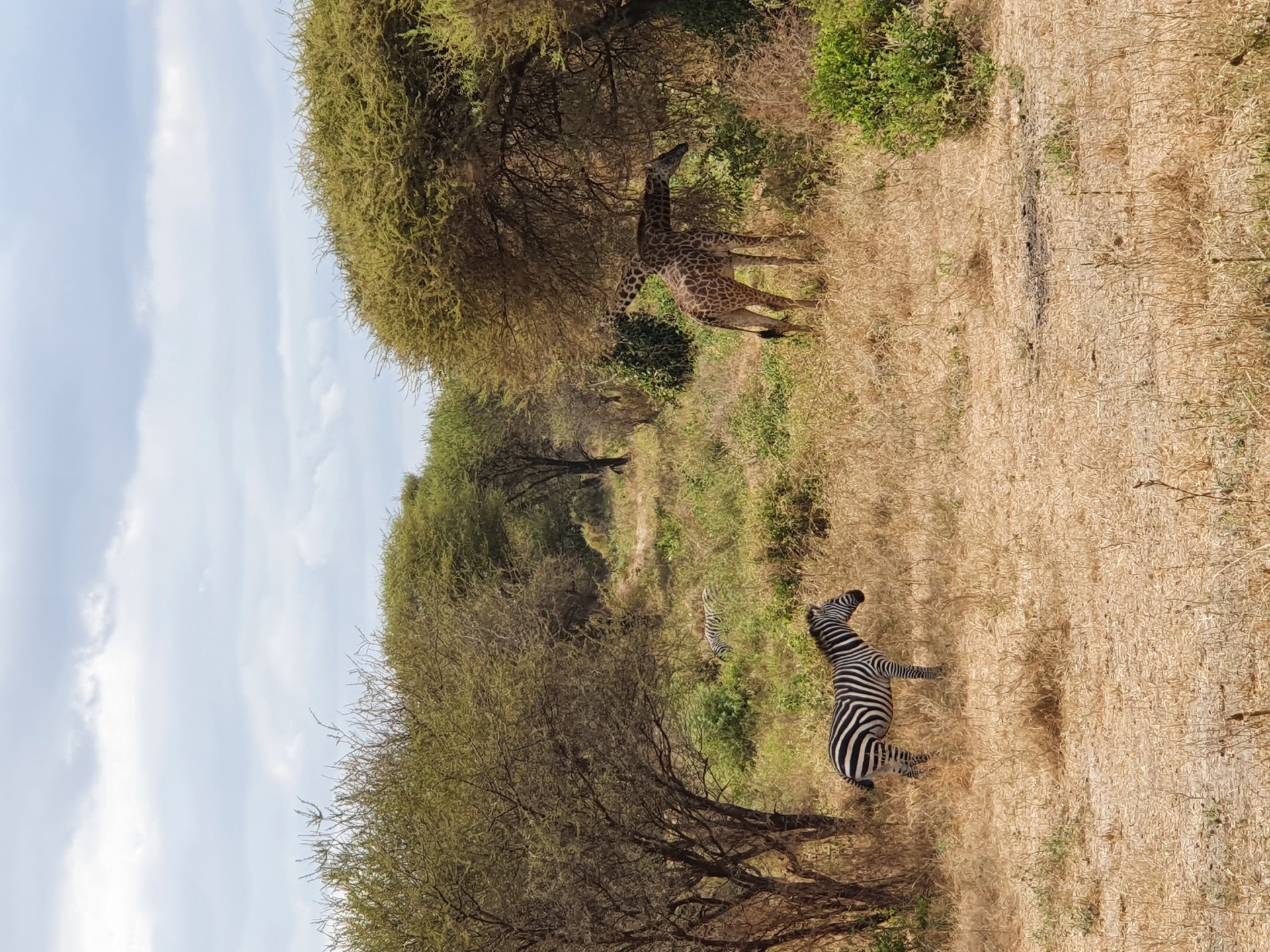
The draw is simple. From June onward, as the surrounding plains dry out, animals funnel toward the Tarangire River, the one reliable water source for miles. Elephants arrive in herds that regularly run 100 to 300 strong at the river’s edge, and on a good July morning you can sit with a single breeding herd for the better part of an hour. Add zebra, wildebeest, buffalo, giraffe and large groups of eland, and the density in the dry months rivals anything on the circuit. Tarangire is Tanzania’s best park for giraffe viewing — the Wild Nature Institute monitors more than 3,500 individual Maasai giraffes in the Tarangire ecosystem, giving year-round herds among ancient baobabs that make it the classic setting for giraffe photography. The Tanzania giraffes guide covers the full natural history, why there are no giraffes inside Ngorongoro Crater, and the Maasai giraffe’s endangered conservation status.
The other signature is the landscape. Tarangire is baobab country, and the big ones here are properly old, fat-trunked trees several hundred years on. They give the park a look that is instantly different from the open Serengeti grasslands. Elephants strip the bark for moisture, so you will see the scars. It is the kind of scenery that makes the drive worth it even on a slow game day.
A note on the cats: lions are around and reasonably reliable along the river, leopards less so. Tarangire is not where you go specifically for predators. Come for the elephants and the scale, treat a lion sighting as a bonus, and you will leave happy.
Best time to go
Dry season, June to October, full stop. July to September is the peak window for the elephant concentrations, and the bush is thin enough that spotting is easy. Daytime temperatures are comfortable, mornings are cool, and the roads are firm.
The green season, November through May, is a different park. The grass grows tall and deep green, the baobabs stand out against storm light, the birding is excellent, and you will share the place with almost no one. The trade-off is honest: water is everywhere, so animals disperse across the wider ecosystem and the headline herds break up. If your trip lands in the green months, Tarangire still earns its place, just adjust your expectations on game density.
Tarangire peaks late in the dry season — August to October — as more water sources across the ecosystem fail and elephant concentrations at the Tarangire River reach their annual maximum. The Tanzania best time to visit guide gives the full month-by-month breakdown for Tarangire specifically, and for the northern circuit, calving season, Kilimanjaro, and Zanzibar beach timing in one place.
Tarangire in November is one of the best safari experiences in Tanzania outside the Ndutu calving season: the park is freshly green from the short rains, elephants gather at the Tarangire River, and the bird diversity peaks as European migrants arrive. Accommodation prices are approximately 30% lower than the July–August peak and the park has almost no tourist vehicles. The green-season value case covers why November is the best budget month for the entire northern circuit.
Underrated versus the Serengeti
People plan a northern-circuit trip around the Serengeti and Ngorongoro and tack Tarangire on as an afterthought, if at all. That is backwards thinking for what the park offers. The Serengeti is unbeatable for big cats and, in the right months, the migration. But it is busy and the fees are higher — USD 82.60 per adult per day (TANAPA 2024/25) against Tarangire’s USD 59.
What you give up by skipping Tarangire is the elephant spectacle and the baobab landscape, neither of which the Serengeti replicates. What to skip instead: if you are short on days, drop a second Serengeti night before you drop Tarangire entirely. One night here at the start of the loop costs you little and pays off immediately.
I have driven this road plenty of times ferrying guests up from the coast connection, and the moment the first baobabs appear about 20 minutes in, the mood in the vehicle always shifts. It does not feel like a warm-up act.
Fitting it into the northern circuit
The logic of the circuit is geographic, and Tarangire sits at the front door. A clean sequence is:
- Day 1: Arusha to Tarangire, afternoon drive, one night.
- Day 2: Morning drive, then on to Lake Manyara or straight toward the Ngorongoro highlands.
- Onward: Ngorongoro Crater, then the Serengeti for two or three nights.
Tarangire and Lake Manyara pair naturally, sitting close together, and Manyara works well as a half-day add-on with its groundwater forest and flamingos. If you want two nights in Tarangire, spend the second drive heading south into the quieter swamp areas, where the crowds thin and the resident elephants linger.
For most people, one night and a solid half to full day of driving is the right amount. Two nights rewards the unhurried and the photographers. Three is generous unless you are a serious birder in green season.
Detailed wildlife: what you actually see in Tarangire
Beyond the headliner elephants, Tarangire has a range of species that makes it competitive with the bigger-name parks on total wildlife diversity.
Elephants: The core attraction. In the dry season the Tarangire River becomes the only water source for a huge area, and herds that have been dispersed across the ecosystem for the wet season converge. A 100-animal herd is ordinary in July. 300 is exceptional but happens. The elephants here include breeding herds with very young calves, bachelor groups, and ancient solitary bulls with tusks that would not look out of place in a museum case. The bush camp locations along the river give you the experience of waking to elephants visible from your tent.
Lions: Present and reasonably reliable but less concentrated than at Ngorongoro or the central Serengeti. They tend to follow the buffalo and elephant herds. River crossings by large buffalo herds sometimes produce lion ambush attempts — patience at the river pays off.
Leopards: Present throughout the park, particularly around the riverine woodland. Sightings are less frequent than at Seronera in the Serengeti but the population is solid.
African wild dogs (painted wolves): Tarangire is one of the better places in northern Tanzania for a wild dog sighting, though they remain rare. Packs range widely and their presence is seasonal. Ask your guide if there are known packs active during your visit.
Greater kudu: Spectacular large antelope with corkscrew horns on the males. They favour the dense bush areas away from the river and are common in Tarangire in a way they are not in the open Serengeti. The spiralling horns photographed against a baobab background is a quintessential Tarangire image.
Fringe-eared oryx: Rare in the Serengeti but regularly seen in the southern Tarangire sections. Their coloration and bone-straight horns make them unmistakeable.
Pythons: Rock pythons inhabit the trees near water, and Tarangire has a slightly famous reputation for tree-climbing pythons coiled in riverine fig and sausage trees. Finding one requires looking up as well as across.
Ostriches and large flocks of plains species: The open grassland areas hold large mixed flocks of zebra, wildebeest, impala, gazelle and eland. The sheer quantity of plains game in the dry season is outstanding.
Giraffes — and the waterhole sequence: Tarangire’s dry-season waterholes are where giraffe behaviour becomes the main event. A single giraffe may spend 25–30 minutes approaching, assessing, retreating, and returning before committing to the splayed-legs drinking posture — the most dangerous 30 seconds of its day, during which it cannot sprint. Watching this play out with a lion known to use the same waterhole adds the context. The Maasai giraffe behaviour guide covers necking combat, the cardiovascular engineering behind the 5.5 m height, calf birth mechanics, and the Wild Nature Institute’s individual-tracking research that makes Tarangire the best-documented giraffe population in Africa.
Birding in Tarangire
Tarangire is consistently ranked among the best birding parks in East Africa, often above the Serengeti for both variety and ease of sighting.
Recorded species count exceeds 500. The mix of riverine woodland, baobab country, open grassland, and swamps in the south creates multiple distinct habitat zones in a relatively compact area.
Key species: Ashy starling (endemic to the Tarangire-Manyara ecosystem and nowhere else on earth), yellow-collared lovebird, Rueppell’s starling, yellow-billed and red-billed hornbills, lilac-breasted rollers, grey-headed kingfisher, superb starling, Southern ground hornbill, martial eagle, secretary bird.
The southern swamp areas (Silale Swamps) are exceptional for waterbirds: yellow-billed stork, saddle-billed stork, african spoonbill, various herons, jacana, and a range of ducks and waders.
The green season (October to April) adds Palearctic migrants from Europe and Asia: European roller, Eurasian bee-eater, spotted flycatcher, nightjar species, and numerous warblers use Tarangire as a wintering ground.
For serious birders, Tarangire in November–December (short rains, migrants arriving, vegetation deep green) is among the finest birding in continental Africa.
The southern sections: Silale Swamp and beyond
Most visitors stay in the northern Tarangire area near the main gate, which is where camps concentrate and where the river elephant viewing is easiest. The southern sections, particularly around the Silale and Gurusi swamps, are a completely different experience.
The road south from Sangaiwe into the deeper park takes about 2 hours of driving to reach the swamps, passing through dense bush that is harder going in the wet season. In the dry season the southern sections hold elephant herds that have moved away from the more crowded northern river, as well as the resident wildlife of the swamp system: hippos, crocodiles, large waterbird populations, and the less-disturbed lions and leopards.
Two nights at minimum is needed to reach the south and return. Most northern itineraries do not allow for this, but the handful of camps in the southern sections (Boundary Hill, Swala Camp, Kuro Tarangire) offer an entirely quieter and more remote version of the park.
Accommodation in Tarangire
Northern camps (near the main gate and river): Most accessible and most commonly used on northern-circuit itineraries. The elephant viewing from the river-facing camps is exceptional. Price range is wide: budget seasonal camps, classic tented camps, and premium river-view lodges all cluster in this zone. Tarangire Safari Lodge and Oliver’s Camp are consistently recommended at different price points.
Tree-house camps: Several properties in and around Tarangire offer elevated accommodation in baobab trees or on platforms, which provides an additional dimension to the stay — listening to elephants drinking below at night is one of those experiences that justifies the premium.
Southern camps: The remote option for longer stays. Fewer vehicles, more personal service, but the access is longer from Arusha and the price typically reflects the exclusivity.
Night drives
Some camps, particularly those on private concession land just outside the park boundary, offer night drives after the national park gates close at sunset. Night drives in the Tarangire ecosystem are excellent: bush babies, genets, civets, nocturnal birds (Verreaux’s eagle-owl is a highlight), and the occasional predator on a late hunt. If your camp offers night drives and you have only one night, take them over a second daytime drive.
Inside the national park itself, night driving is not permitted — only on adjacent private or community land. The Burunge Wildlife Management Area — a Maasai community concession established in 2004, roughly 10 minutes from the main gate — is one of the best of these community parcels: it has reconnected elephant corridors between Tarangire and Lake Manyara and returns 65% of tourism revenue to participating villages. For how WMAs work, the revenue-sharing mechanism, and the Ruaha Carnivore Project’s 80% reduction in carnivore killings, see the Tanzania community conservation guide.
Practical details
Getting there: Approximately 1h30–2h00 from Arusha by road, about 120 km on the Dodoma highway south. The main gate (Tarangire Gate) is the standard entry for northern circuit visitors. The road is tarmac to the turnoff, then dirt track for the final section to the gate. In the wet season this track can be rough; in the dry season it is straightforward in a 4x4.
Solo travellers visiting Tarangire typically join a shared safari vehicle from Arusha — this eliminates the single supplement and fills the vehicle while giving access to the same guide experience as a private safari. Tarangire’s compact geography (easily covered on a 2-day focus) works well for solo schedules. The Tanzania solo travel guide covers joining vs private safari options, single supplement costs, and safety logistics for the full trip.
There is no commercial airstrip at the main gate area. A few camps in the southern sections have private airstrips for light-aircraft arrivals, but the northern approach is road-only from Arusha.
Park fees: USD 59 per adult per day (TANAPA 2024/25). Children’s rates apply for under-16 visitors. Like all TANAPA fees, these are revised periodically; confirm the current rate with your operator before finalising the itinerary. Tarangire in November is one of the best responsible tourism choices on the northern circuit: very low vehicle density at sightings, TANAPA fees funding the same anti-poaching ranger infrastructure as peak season, and accommodation roughly 30% cheaper than July–August. The Tanzania responsible travel guide covers how park fees are spent, vehicle crowding solutions, porter welfare on Kilimanjaro, and how to spot greenwashing in eco-resort claims.
Vehicle type: Standard 4x4 safari vehicle, open or closed-top depending on the camp or operator. Tarangire’s dust is significant in the dry season — sealed camera equipment cases between drives are worth the extra bulk. A beanbag for lens support, binoculars per person, and adequate water for a 3–4 hour morning drive are the basics. For Tarangire specifically, the dry season (June–October) brings extraordinary dust on game-drive tracks — pack all electronics in zip-lock bags inside your duffel; cameras and binoculars in sealed cases. The 15 kg soft-bag limit for bush flights within the northern circuit applies here too. The dust-and-electronics packing notes cover the full gear checklist, the neutral-colours-only rule, malaria prevention, binoculars, and the UK-type power adapter requirement.
Combining with Manyara: Lake Manyara National Park is approximately 40 km north of the Tarangire gate, about a 45-minute drive. A morning in Tarangire and an afternoon in Manyara (or vice versa) on a single day is logistically tight but doable. Most itineraries allocate separate nights, which allows more time in each. Manyara offers different habitat — groundwater forest, the famous tree-climbing lions, and a soda lake with flamingo — complementing Tarangire’s open bush and river.
For the full fee schedule breakdown, including Tarangire’s concession and conservation fees, see the dedicated fees guide.
If you are building the wider trip, start with the Northern Circuit sequencing guide to sequence the parks, and pair this with Lake Manyara as your easy second stop on the way to the crater. The Serengeti is the natural progression from Tarangire on the northern circuit; see the full park overview here. Most northern circuit itineraries add the crater stop after Tarangire. See Tarangire’s TANAPA entry fees before you book. How Tarangire sits in the broader system: Tanzania’s national park comparison. For the month-by-month seasonal breakdown — elephant concentrations by month, green-season birding, and when to book by season — see the Tarangire: when to go guide. For a dedicated elephant guide — where the 100–300+ dry-season herds concentrate, Ngorongoro’s famous tusked bulls, and Tanzania’s poaching recovery story — the Tanzania elephants guide covers every major elephant location in the northern and southern circuits. For visitors seeking a completely different Tanzania safari after the northern circuit, Ruaha, further south offers walking safaris, night drives in concession areas (prohibited in the Serengeti), greater kudu, sable antelope, and elephant herds of 50–200 animals at the Ruaha River — paired with Nyerere as a southern circuit complement to Tarangire and the Serengeti.
Weighing Tarangire directly against the other Northern Circuit parks? The Tarangire vs Serengeti vs Ngorongoro comparison breaks down entry fees, wildlife, and which combination suits your itinerary. For Tarangire’s giraffe population specifically — the drinking-sequence behaviour, best zones, and the Wild Nature Institute’s 3,500-giraffe monitoring project — see the Tarangire giraffes guide.
Frequently asked questions
How many days do you need in Tarangire?
One full day catches the headline game viewing, but two nights lets you do a slow morning and afternoon drive and reach the quieter southern swamps. On a tight northern-circuit loop, most people give it a single night and a half-day drive.
When is the best time to visit Tarangire?
June to October, the dry season, when animals concentrate on the Tarangire River. July to September is peak for elephants. The green season (November to May) turns the park deep green and quiet, but game disperses, so sightings are harder.
Is Tarangire worth it compared to the Serengeti?
Yes, as a complement rather than a replacement. Tarangire delivers elephants and baobabs at a scale the Serengeti does not, with fewer vehicles and lower fees, but the Serengeti still wins for big cats and the migration.
How far is Tarangire from Arusha?
About 1h30 to 2h00 by road, roughly 120 km on tarmac most of the way. It is usually the first stop when heading out from Arusha onto the northern circuit.
Will I see big cats in Tarangire?
Lions are reasonably common and leopards are around, though sightings are less reliable than in the Serengeti or Ngorongoro. Tarangire is also known for tree-climbing pythons and large herds of plains game.
Can you do Tarangire and Lake Manyara in one trip?
Easily. They are close enough to pair, and many itineraries do Tarangire then Manyara on the way to the Ngorongoro Crater and Serengeti. Manyara works well as a half-day add-on.