
Facts & prices checked: 2026-06-25
Tanzania has the largest giraffe population of any country in Africa — approximately 28,580 individuals in the national total (TAWIRI Systematic Reconnaissance Flight data), with more than 35,000 Maasai giraffes estimated across all parks and reserves. Every major Tanzanian park has giraffes. The national animal of Tanzania is the Maasai giraffe, and the species earns that status: nothing else on the savannah produces the same silhouette against an early-morning sky. But Tanzania’s giraffe story is also a conservation story. The Maasai giraffe’s population has declined by approximately 39% — from around 71,000 to 43,200 individuals — and the IUCN now classifies the species as Endangered.
This guide covers where to see giraffes in Tanzania’s major parks, what makes the Maasai giraffe distinct, and what the Wild Nature Institute’s long-term research in Tarangire is finding. It also covers the most common giraffe misconception among first-time Ngorongoro visitors: there are no giraffes on the crater floor, and there never will be.
Africa’s tallest animal — and Tanzania’s endemic subspecies
The giraffe is the tallest animal on earth and the tallest animal in Africa. Tanzania’s giraffes belong to a single species: the Maasai giraffe (Giraffa tippelskirchi), also called the Kilimanjaro giraffe. It is the only giraffe species found in Tanzania, and it is one of the most genetically distinct giraffe populations on the continent.
The Maasai giraffe’s distinguishing mark is its pattern: irregular, jagged-edged patches that are described as vine-leaf-shaped, with darker brown-to-chestnut coloration compared to the more uniform orange of other subspecies. Where the reticulated giraffe of northern Kenya has a clean, clearly defined mesh pattern — crisply separated tan patches on a cream ground — the Maasai giraffe’s patches are irregular, jagged, and darker. If you see a giraffe in Tanzania, it is a Maasai giraffe. If you see one in northern Kenya’s Samburu, it is a reticulated giraffe. They look genuinely different at close range.
Tanzania is the right place to care about this distinction because Tanzania holds more giraffes than any other African country. The national total stands at approximately 28,580 (TAWIRI SRF data), with independent estimates suggesting more than 35,000 Maasai giraffes across parks, reserves, and wildlife management areas combined. Tanzania’s community wildlife management areas specifically show higher giraffe densities than in comparable unmanaged landscapes — a positive data point in a broadly declining picture.
That declining picture matters. The Maasai giraffe is listed as Endangered by the IUCN — a classification applied specifically to this species (not just the broader genus). The global giraffe population fell from approximately 151,702–163,452 individuals in 1985 to 97,562 in 2015, a decline driven by habitat loss and poaching. The Maasai giraffe’s own population trajectory tells the same story: from around 71,000 to roughly 43,200, a 39% decline. Tanzania’s parks and the Wild Nature Institute’s long-term Tarangire monitoring project are among the most important ongoing responses.
I find the conservation context makes giraffe sightings more charged, not less. Seeing a tower of twelve Maasai giraffes moving through Tarangire baobabs is an experience that belongs specifically to Tanzania in a way that it did not when those numbers were higher and the species felt secure.
Natural history: the engineering of the world’s tallest animal
The giraffe’s body is a series of extreme engineering solutions to the problem of being very large and very tall. Each solution creates another problem that requires another solution. The result is an animal that looks ungainly in description and completely right in motion.
Height and weight: Adult male Maasai giraffes reach approximately 5.5 m in height — roughly three times the height of a tall human. That height is not all neck. The front legs alone are approximately 1.8 m. The neck adds approximately another 1.8–2 m. The body and head complete the structure.
The neck’s secret: The giraffe’s neck contains exactly 7 cervical vertebrae — the same number found in almost all other mammals, including humans. Each vertebra is simply greatly elongated, creating the length without adding new bones. The cervical vertebrae of an adult Maasai giraffe are the longest of any animal’s neck vertebrae. The neck is also a social weapon: males compete through “necking” — swinging their necks to deliver blows with their ossicones and skull. Older dominant males typically have bald ossicones from years of fighting.
Ossicones: The projections on a giraffe’s head are not horns — they are ossicones, cartilaginous structures covered in skin and hair rather than keratin. Both males and females have them. Males typically have one pair of main ossicones, often thicker and with bald tips from fighting; some individuals develop a third central ossicone from scar tissue. The ossicone is the primary bludgeon in male-to-male combat.
The tongue and the diet: The giraffe’s tongue is approximately 45–50 cm long and prehensile — capable of grasping and stripping leaves. The color is dark blue-black, thought to protect against UV exposure since the tongue spends hours in direct sunlight stripping acacia branches. Giraffes are primarily acacia browsers. The acacia’s thorns — up to 8 cm on some species — are navigated by the tongue’s precision. A giraffe can consume large quantities of vegetation daily, selectively stripping specific leaf clusters.
Gait and speed: Giraffes walk by moving both legs on the same side simultaneously — an ambling gait distinctive among large mammals. When running, they move into a gallop where the rear legs swing outside the front, reaching approximately 60 km/h over short distances. Very few predators can close a 200-metre gap on a running adult giraffe.
The drinking problem: Drinking is the most vulnerable moment in an adult giraffe’s life. To get its head to water, a giraffe must either splay its front legs out 1.5–2 m to the side, or kneel. Both positions compromise its ability to sprint immediately. At Tanzania’s river crossings — Tarangire River, Rufiji, the Mara — this is where lions study giraffes. A giraffe drinking at a river bend in bad light is the scenario predators wait for.
Lifespan and social structure: Giraffes typically live 25 years in the wild. They are social but do not form stable herds with fixed membership — they move through loose aggregations of 10 to 50 individuals that shift composition continuously. This open-membership system, called a fission-fusion society, means a tower you see at Tarangire today may have a completely different composition of individuals by next month, even if the core location is the same.
Tarangire — Tanzania’s best park for giraffe viewing
The Wild Nature Institute (WNI) has been conducting long-term giraffe monitoring in the Tarangire ecosystem since 2011. The project is now tracking more than 3,500 individual Maasai giraffes across an area of over 25,000 km², using computer-based individual recognition from the patch pattern — each giraffe’s coat is as individually distinct as a human fingerprint. This research makes the Tarangire ecosystem the best-documented giraffe population in Africa and arguably explains why Tarangire consistently performs for wildlife viewing: the habitat genuinely concentrates one of Tanzania’s densest accessible giraffe populations.
In 2015, Tarangire produced a rare record: a white giraffe caused by leucism — a condition that reduces melanin in skin cells — was spotted in the park. Leucism is distinct from albinism (which affects all melanin, including eye color); the Tarangire white giraffe had normal dark eyes. This kind of record is only possible because the population is large enough and the research presence is intensive enough to document anomalies.
For visitors, the practical payoff is simple: Tarangire delivers reliable, year-round giraffe viewing at large-group scale. The baobab landscape is the defining context. Tarangire’s giant baobabs — some several hundred years old, massively fat-trunked, scarred from elephant stripping — provide the visual frame that makes giraffe photography here different from anywhere else in Tanzania. A tower of giraffes moving between baobabs at golden hour is the image Tanzania safari photographers specifically plan around. I have seen this setup many times, and it still does what it did the first time.
The Tarangire River is the dry-season engine. From June to October, as surrounding plains dry out, animals funnel toward it — and giraffe move with them, not because they drink frequently, but because the riverine woodland vegetation along the banks provides the best browsing in the dry season. The result is a genuine concentration. Groups of 20 to 40 Maasai giraffes are a regular sighting in July and August, and the animal density along the river in peak dry season means you are rarely more than a few minutes from a giraffe encounter on any drive.
Giraffes are also viewable in Tarangire’s green season — they do not migrate out of the park the way elephants and wildebeest do. You simply see them more dispersed across the wider woodland rather than concentrated on the river.
Serengeti — widespread herds across 14,763 km²
The Serengeti National Park holds approximately 5,886 ± 1,221 giraffe (TAWIRI-GCF Systematic Reconnaissance Flight data). The wider Serengeti ecosystem — including the Grumeti and Ikorongo Game Reserves, the Ngorongoro Conservation Area borderlands, and the Masai Mara across the Kenyan border — supports an estimated 12,000 giraffe, making it one of the largest single giraffe populations in East Africa.
The Wild Nature Institute also conducts Serengeti giraffe conservation research, using the same individual recognition methodology as the Tarangire project. The computer program identifies each animal’s unique fur pattern from photographs. This research is building the individual movement data needed to understand connectivity between the Tarangire and Serengeti populations.
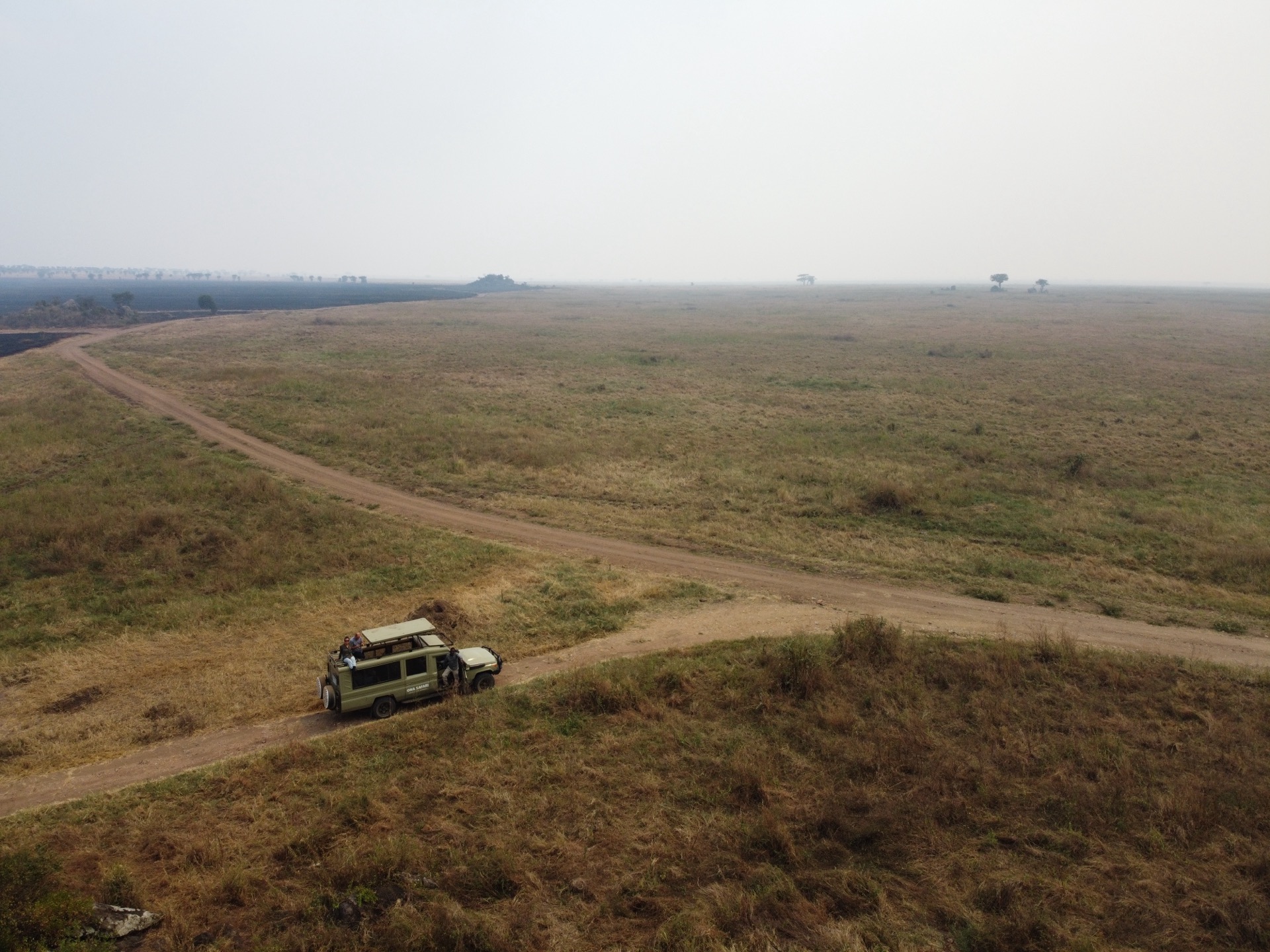
For visitors, giraffe sightings in the Serengeti are common throughout the park and throughout the year. The Seronera area — the central Serengeti, with permanent water and mixed acacia-grassland vegetation — is particularly productive year-round. The Grumeti Game Reserve in the western corridor holds resident giraffe populations with year-round viewing. The Moru Kopjes area in the central Serengeti, where granite inselbergs rise from the grassland, often has giraffes browsing around and between the rocks — a striking visual against the stone.
One point worth understanding: the Serengeti’s giraffe population is different from Tarangire’s in character. In the Serengeti you often encounter giraffes in smaller groups against open grassland — the landscape emphasises the height and the silhouette. In Tarangire you more often encounter them in larger groups against the baobab woodland. Both are worthwhile; they produce different photographic results.
Ngorongoro: no crater-floor giraffes — and why
This is the most important expectation to set before any Ngorongoro itinerary. There are no giraffes on the Ngorongoro Crater floor. None. Not occasionally absent, not rare — permanently, structurally absent.
The reason is the crater walls. The Ngorongoro Crater is a collapsed volcanic caldera, 600 m deep and with steep, heavily forested inner walls. Giraffes cannot navigate the gradient. They are present — in good numbers — on the crater rim and throughout the Ngorongoro Conservation Area outside the crater. If you are driving the rim road or transferring between lodges along the ridge, you will see Maasai giraffes in the acacia woodland. But on the crater floor, where the lions and rhinos and hippos live, there are no giraffes.
This matters because Ngorongoro’s pitch is that it contains almost every major East African species in a compact, easily viewable area. The crater does deliver on that pitch — lions, elephants, black rhino (Tanzania’s only significant remaining rhino population), hippos, wildebeest, zebra, hyena, cheetah, flamingos, and more. But the giraffe is the one conspicuous absence. Guests who have not been briefed sometimes spend time looking for giraffes on the crater floor and are confused when none appear.
The crater rim itself is giraffe habitat. The acacia woodland at altitude is exactly the kind of mixed, semi-open forest giraffes browse in. I have seen herds of eight or ten on the rim road on a morning drive before descending, and it remains an interesting observation — the same species, completely excluded from the spectacle 600 m below them by the shape of the landscape.
Ruaha and the southern circuit
Ruaha National Park in southern Tanzania is described by some sources as having the largest giraffe population of any African reserve — a superlative that also applies (in different formulations) to its elephant population, which speaks to the park’s overall scale and wildlife density. Ruaha giraffes are viewable all year round. The habitat is dry miombo woodland and riverine savanna — excellent giraffe territory where the browse is diverse and the open sightlines along the Ruaha River make viewing straightforward.
Ruaha is Tanzania’s second-largest national park and remains genuinely remote — far fewer visitors than the northern circuit parks. The giraffe population here is largely unstudied compared to Tarangire or the Serengeti, which means visitor sightings are adding to the baseline knowledge. Ruaha is where I would send someone who wants to see giraffes without other vehicles present: a private game drive along the Ruaha River at dawn with a tower of giraffes on the opposite bank and almost certainly no other vehicle in sight.
Mikumi National Park, on the main tarmac road between Dar es Salaam and Iringa, also has reliable giraffe populations — visitor accounts consistently report giraffe sightings on day trips, making Mikumi one of the most accessible giraffe destinations in Tanzania for visitors based on the coast.
Arusha National Park, immediately outside Arusha, has giraffes among its common species and offers the unusual experience of walking safaris alongside them — a rare format where giraffe scale becomes viscerally apparent on foot.
Predators, calves, and the drinking vulnerability
Adult Maasai giraffes are largely immune to predation. The size advantage is real: an adult male giraffe weighs approximately the same as a large car, and a foreleg kick can be lethal. Lion prides in Ruaha and the Serengeti have been documented taking adult giraffes, but it requires coordinated group effort against an animal that is usually at a disadvantage — typically at water, in poor footing, or in a group that has panicked and separated individuals.
The vulnerable points are two:
Drinking: When a giraffe splays its front legs to reach water, it commits to a position that takes several seconds to reverse. If a lion has positioned itself in cover near the drinking site, this is the moment. River banks in Tanzania — the Tarangire River, the Rufiji in Nyerere, the Ruaha River — are where such attempts happen. Crocodiles also take giraffes at rivers; a very large Nile crocodile can hold a giraffe’s head underwater in the splayed-legs posture. The Rufiji River in Nyerere holds large crocodile populations, and giraffe-crocodile interactions are documented there.
Calves: Giraffe calves are born at approximately 1.8–2 m in height — they arrive tall. They can walk within hours. But for the first months of life, they are within range of lions, spotted hyenas, and leopards. Calving concentrations in areas with high predator density carry real calf mortality. The Wild Nature Institute’s individual-level tracking data from Tarangire is building the dataset on calf survival rates — still an open research question for the Maasai giraffe specifically.
Ruaha note: Giraffe Skin Disease
A University of Bristol-linked report documents a striking health issue in the Ruaha population: close to 90% of adult Maasai giraffes in Ruaha National Park show signs of Giraffe Skin Disease (GSD), a condition producing rough, cracked, dark patches on the lower legs. The cause remains under investigation; current hypotheses include an environmental factor in the soil or water rather than a transmissible pathogen. The prevalence in Ruaha is the highest documented in any population. Visiting Ruaha you may notice this — giraffes with dark, roughened patches on their lower legs are not unusual, and it is not a reason for concern about the viewing experience, but it is part of what makes Ruaha’s giraffe population scientifically interesting right now.
Photography and safari strategy
Giraffes are among the most cooperative photographic subjects in Tanzania’s parks. They do not alarm quickly around vehicles, they offer multiple visual angles from a single position, and their height means you are often shooting up at the subject — which produces a different dynamic from most wildlife photography, which tends to flatten things to eye-level.
The Tarangire baobab silhouette: The classic Tanzania giraffe photograph is shot at golden hour in Tarangire — multiple giraffes, or a single prominent individual, set against a large baobab in late afternoon light. The combination of the angular tree silhouette and the giraffe silhouette against an amber sky is the most reproduced image in Tanzania safari photography for good reason: it is genuinely striking and Tarangire delivers it reliably. Arrive at the park at opening time and position along the river; the baobab concentrations on the eastern bank provide multiple opportunities.
Telephoto work (200–400mm): At range, a long telephoto isolates a single giraffe head and neck against sky or vegetation. The patterns become the subject — the jagged vine-leaf patches, the dark ossicones, the extraordinary length of the eyelashes. The blue-black tongue, if extended, photographs vividly at this length. A 400mm at f/5.6 in good morning light gives you a clean portrait against a blurred green background.
Wide angle at close range (16–35mm): When a giraffe approaches the vehicle — which happens in Tarangire and Arusha — the scale shift is extraordinary. Shot from seat level with the giraffe overhead, a wide-angle captures the perspective a telephoto cannot: the animal’s legs at the bottom of the frame, neck curving up and out of shot, vehicle roof visible at the side. This is the shot that actually communicates the scale in a way that a compressed telephoto does not.
Drinking posture: The spread-legged drinking stance is one of the most photographed giraffe behaviors. Position at a likely waterhole before the light gets high; drinking tends to happen in the first two hours after sunrise. The posture is brief — giraffes drink in short sessions before straightening up — so have the camera ready when you see one approaching water.
The clearest strategic advice: if giraffe photography is a priority, build Tarangire into your northern circuit itinerary. A two-night stay with a morning drive on each day gives you the golden hour light on multiple occasions. The park’s giraffe density is higher and more consistent year-round than anywhere else in northern Tanzania, and the baobab landscape provides a visual context no other park matches.
The most memorable giraffe moment I have had in Tanzania was at Tarangire at dusk — a tower of twelve Maasai giraffes moving in single file between two baobabs, silhouetted against an orange sky. They move completely silently. You do not hear them approach and you do not hear them leave. They drift through the frame like something from a slow dream. The proportions only make sense at close range: you are looking at an animal whose neck alone is as tall as a tall man, and the neck is not the largest part. The first time a giraffe walks toward your vehicle and keeps coming, the scale recalibrates. There is no telephoto that gets this right; you have to be there.
Related guides
- Tarangire National Park — full guide to Tanzania’s best park for elephants and giraffe photography
- Tarangire’s giraffe zones and drinking sequence — the park-specific deep dive on necking, the waterhole stand-off, and the Wild Nature Institute’s 3,500-giraffe monitoring project
- Northern Circuit safari guide — Tarangire, Ngorongoro, Serengeti in one itinerary
- Tanzania’s park-by-park species list — complete species guide to Tanzania’s major parks
- the Ngorongoro Crater breakdown — what you will and will not see inside the crater
- Ruaha National Park — Tanzania’s second-largest park and the southern circuit
Frequently asked questions
Where is the best place to see giraffes in Tanzania?
Tarangire National Park is Tanzania's top giraffe destination — the Wild Nature Institute's long-term monitoring project tracks more than 3,500 individual Maasai giraffes across the Tarangire ecosystem (over 25,000 km²), giving you the highest accessible density year-round. The Tarangire River dry-season concentration (June–October) brings excellent viewing when other wildlife is also densest. Serengeti has approximately 5,886 ± 1,221 giraffe in the park and around 12,000 in the wider ecosystem. Ruaha in southern Tanzania is described by some sources as having the largest giraffe population of any African reserve. One important note: giraffes do not descend into the Ngorongoro Crater — they are common on the rim and surrounding NCA but absent from the crater floor.
Are there giraffes in the Ngorongoro Crater?
No — there are no giraffes on the Ngorongoro Crater floor. The crater walls are too steep for giraffes to descend. This is one of the few conspicuous absences in Ngorongoro: you can see lions, elephants, hippos, rhinos, wildebeest, zebra, and most of East Africa's other species, but no giraffes. However, giraffes are abundant on the crater rim, along the rim road, and throughout the Ngorongoro Conservation Area. You will see them driving in and out of the crater area — just not on the crater floor.
What subspecies of giraffe is found in Tanzania?
Tanzania's giraffes are Maasai giraffes (Giraffa tippelskirchi) — the only giraffe species found in Tanzania. The Maasai giraffe is identified by its irregular, jagged, vine-leaf-shaped patches with darker coloration, unlike the more regular network pattern of Kenya's reticulated giraffe. Tanzania and Kenya's southern populations are Maasai giraffes; the reticulated giraffe is found in northern Kenya and Ethiopia. Recent taxonomy now treats the Maasai giraffe as a full separate species (Giraffa tippelskirchi rather than a subspecies of G. camelopardalis). The IUCN classifies the Maasai giraffe as Endangered.
How tall can giraffes grow?
The Maasai giraffe is the world's tallest animal and the tallest subspecies by some estimates. Males can reach approximately 5.5 m (18 feet) in height. Despite the extraordinary neck length, giraffes have the same number of cervical vertebrae as almost all other mammals — 7 — each simply greatly elongated. Calves are born at approximately 1.8–2 m height — taller than most adult humans — and can walk within hours of birth. The Maasai giraffe was previously estimated at around 71,000 individuals; the population has declined to approximately 43,200.
Do lions hunt giraffes in Tanzania?
Rarely — adult giraffes are too large and too dangerous for most predators. A full kick from an adult giraffe's foreleg can be lethal to a lion. Large coordinated lion prides have been documented hunting giraffes in Ruaha and occasionally in the Serengeti, but it is uncommon. The vulnerable moments: giraffes drinking (they must splay their forelegs wide, lowering their head to water and temporarily losing speed and balance); and calves. Giraffe calves are born at approximately 1.8–2 m and are vulnerable to lions, hyenas, and leopards for the first months of life.
Is giraffe photography easy in Tanzania?
Giraffes are among the most photographically rewarding subjects in Tanzania. They are large, move relatively slowly, and are not shy of vehicles. Key shots: the classic silhouette at golden hour against a Tarangire baobab; close-up portrait showing the patch pattern, ossicones, and long eyelashes; the drinking stance with splayed forelegs; a tower moving in single file. Recommended gear: telephoto 200–400mm for face portraits and pattern shots; wide angle (16–35mm) when a giraffe approaches the vehicle closely — the size creates a striking perspective. Tarangire at sunrise among the baobabs is the classic setting.