
Facts & prices checked: 2026-06-24
I know travellers who choose Nyerere over the Serengeti on a second Tanzania trip. They are almost always the ones who want boat safaris, walking in the wilderness, and wild dogs — the three things the northern circuit does not offer — and who have already seen what the Serengeti is best at. Nyerere is not better. It is different, and for the right traveller, it is what they were looking for.
Why Nyerere is different from the northern circuit
The northern circuit — Serengeti, Ngorongoro, Tarangire, Lake Manyara — is the most sold Tanzania safari route because it is genuinely good: the migration, the crater, the elephant numbers in Tarangire. It is also the most visited, particularly at the main sites during the July–August peak. Vehicles queue at kills. The Serengeti’s central Seronera area hosts dozens of safari vehicles simultaneously around a single lion.
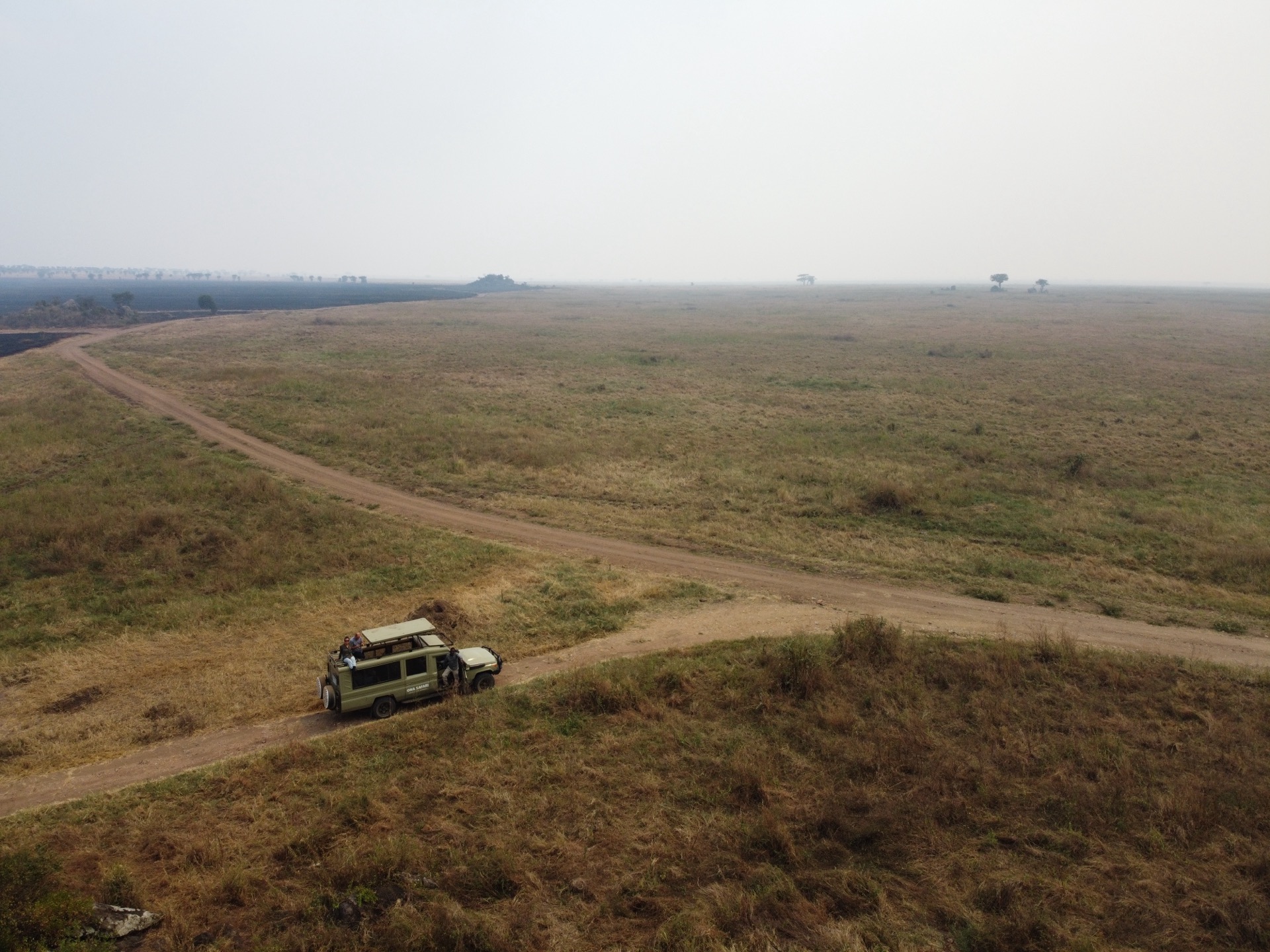
Nyerere does not have that problem because it has far more space and far fewer visitors. It is approximately 30,893 km² — over twice the Serengeti — and serves a fraction of the Serengeti’s annual visitor numbers. This is partly geography (southern Tanzania is farther from international airports and requires a different flight routing), partly marketing (the northern circuit is the packaged product), and partly the logistics of fly-in access. The result for travellers who make the effort to get here: encounters that feel genuinely remote, at a scale that the more managed northern parks cannot replicate.
Nyerere vs Selous: the naming confusion
The name matters because it affects booking, pricing, fees, and the specific management rules at your lodge. The former Selous Game Reserve was established by the British colonial administration in 1905, originally as a game reserve spanning much of southern Tanzania. Over decades it grew to become one of the largest game reserves in the world.
In 2019, the Tanzanian government formally divided the reserve:
- Nyerere National Park (TANAPA): The northern, photographic tourism zone — approximately 30,893 km². Named after Julius Kambarage Nyerere, Tanzania’s first president. TANAPA fees apply (USD 82.60 per adult per day in 2024/25). Walking safaris and boat safaris permitted.
- Selous Game Reserve (TAWA): The southern zone — approximately 20,000 km², retaining licensed hunting blocks. Separate management authority and different permit structure.
When a travel agent or website says “Selous” today, they almost certainly mean the photographic tourism zone that is now officially Nyerere National Park. The old name persists in marketing materials and on some maps. Confirm with your operator whether your itinerary uses TANAPA park fees (Nyerere) or TAWA fees (Selous Game Reserve) — these are different.
The Rufiji River boat safari
The Rufiji River is the hydrological centre of Nyerere National Park and the source of one of its two signature experiences. The river drains roughly a third of Tanzania before entering the Indian Ocean at the Rufiji Delta south of Zanzibar. Within the park, it runs through a landscape of high banks, riverine woodland, open sand bars, and the dense papyrus of its side channels.
The boat safari is typically 2–3 hours: a morning or late-afternoon departure from the lodge’s river jetty in an open or semi-open flat-bottomed boat, running upstream or downstream depending on the conditions. What you see depends on the season, the water level, and the time of day, but a standard session includes:
Hippos in pods of 50–100 animals at their favoured pools — Nyerere holds one of the largest hippo concentrations in East Africa. At the population level, the Rufiji system supports thousands. You will see them closely from the boat; the guide knows which pods are most accessible and keeps appropriate distance.
Nile crocodiles at the water’s edge and on sand bars. Nyerere supports a dense crocodile population on the Rufiji — some of the largest crocodiles in East Africa are here, with older individuals exceeding 4 metres. They are visible, unhurried, and unmistakeable once you have seen a few. The Rufiji River’s Nile crocodile population is one of Nyerere’s defining sights on boat safaris — encounters at 10–15 m from basking crocodiles, some of Tanzania’s largest individuals, are year-round. The Tanzania crocodiles guide covers the Rufiji boat safari, Grumeti’s 3,000-crocodile concentration, and why these animals can wait weeks for a single kill.
Waterbirds in concentrations that do not occur on a game drive: African fish eagle calling from riverside trees, goliath heron stalking the shallows, yellow-billed stork, saddlebill stork, African spoonbill, various kingfisher species on exposed branches, and migrating wader species in the wet-season shallows. Pelicans are common in larger groups. The Rufiji’s permanent water supports resident and migratory waterbird populations that the dry Serengeti grassland cannot.
Elephant and buffalo at the water’s edge, drinking in family groups. Seeing elephants from a boat at water level is a different perspective from the game vehicle — you are at their height rather than above them.
This is an experience available at no other major Tanzanian national park. Walking safaris are permitted at a few northern parks, but river boat safaris are unique to the southern water parks (Nyerere, and the lesser-visited Katavi in the west).
Walking safaris in the wilderness
The second major Nyerere experience is a walking safari — something not permitted in the Serengeti, Ngorongoro, Tarangire, or Lake Manyara. In Nyerere, registered operators can lead guided walking safaris with an armed TANAPA ranger (in addition to the camp guide) over distances of 2–10 km through the bush.
A walking safari delivers a different kind of wildlife engagement from a game drive. You move slowly, at a pace that allows the guide to identify tracks, scat, feeding signs, and environmental indicators. The landscape at walking pace is different from the same landscape at vehicle speed. You hear things you cannot hear from inside a vehicle. The spatial relationship with wildlife — being at ground level, moving quietly — makes even familiar species feel new.
Standard safety protocols apply: stay in a single file behind the ranger, do not run if an animal approaches, and follow instructions exactly. The armed ranger is a genuine safety provision, not a formality — the wilderness areas of Nyerere hold lions, buffalo, and elephants at high density, and the walking experience operates within those conditions. Most incidents on walking safaris are non-events; the guide’s experience and the ranger’s read of the terrain keep most situations from developing.
Morning walks of 2–4 hours are the most common format. Some operators offer multi-day fly-camping safaris that combine walking days with fly-camping in the wilderness — a more committed format for travellers who want maximum immersion.
Wildlife: wild dogs, hippos, and the Big Five
African wild dogs (Lycaon pictus) are the species most people come to Nyerere specifically to see. A peer-reviewed population study (Scientific Reports, 2025) estimates 800–1,000 wild dogs in the broader Selous-Niassa ecosystem — Africa’s largest single documented population of a species that numbers fewer than 7,000 individuals globally. Camera-trap studies within the park have confirmed more than 200 individual animals. Sightings are not guaranteed on any given drive — wild dogs range widely across the ecosystem — but the probability of an encounter on a 3–4 night stay, particularly if you are visiting during the denning season (March–July when packs have pups and are more anchored to a territory), is significantly higher than anywhere else in Tanzania. Nyerere’s African wild dog population is one of the most important in Africa — and a pack rallying before a hunt on the Rufiji floodplain is the most kinetic wildlife sequence in Tanzania. Our wild dog sighting guide covers what to expect, why Nyerere’s habitat is ideal, and how to maximize your sighting chances on a 3+ day stay.
Hippos at scale: the Rufiji system supports a hippo population in the thousands. Concentrations at favoured pools on the boat safari give the impression of density that is genuinely impressive.
Elephants: Nyerere holds a large and relatively undisturbed elephant population. Herds are frequently encountered at the river and in the mixed woodland. The park’s size allows large matriarchal herds to range freely without the vehicle pressure they experience in smaller, more visited parks.
Lions, leopards, and buffalo: All present at high densities. The large buffalo herds of the Rufiji flood plain attract significant lion predation, and game drives in the northern sections frequently produce both species in proximity. Leopards use the riverine woodland and are more often seen from the boat than from vehicles.
Black rhino: Present in Nyerere, though at much lower density than at Ngorongoro. Sightings are possible but not a reason to come specifically.
Crocodiles: As noted, Nyerere holds one of Africa’s densest Nile crocodile populations. This is not an afterthought — large Nile crocodiles in river habitats are among the more dramatic wildlife encounters in Africa, and the boat safari puts you in direct observation range.
Getting there
The standard access from Dar es Salaam (Julius Nyerere International Airport, DAR) is by domestic flight to one of the park’s several airstrips — the most common being Siwandu Airstrip in the north-west of the park. Flight time: approximately 30–45 minutes. Operators: Coastal Aviation, Auric Air, Safari Air Link. One-way fares from approximately USD 60–80 per person, though prices vary with demand and season.
The road alternative exists — approximately 230 km from Dar, 4 hours on tarmac to the Morogoro area and then track into the park — but it is logistically demanding for most international visitors without a self-drive vehicle and local knowledge. It is not the recommended approach.
Luggage restrictions: Domestic bush flights in Tanzania operate soft-luggage-only policies with weight limits of approximately 15 kg per person. Hard-sided suitcases are typically not accepted on aircraft or transferred to your camp. Pack for the reality of the flight: a soft duffel bag, not a rolling hard-shell case.
Costs and accommodation
Park fee: USD 82.60 per adult per day (TANAPA 2024/25). This is the same as the Serengeti and reflects the park’s national park status.
Accommodation tiers:
- Entry-level lodges near the park boundary: approximately USD 100–200 per person per night
- Standard bush camps within the park: USD 200–400 per person per night, typically all-inclusive
- Luxury tented camps (Siwandu, Sand Rivers, Roho ya Selous): USD 600–1,200 per person per night, all-inclusive
Southern circuit all-inclusive (Nyerere 3–4 nights plus Ruaha 3–4 nights, domestic flights between parks, fly-in and fly-out from Dar): approximately USD 400–800 per person per day depending on camp tier. At 7–8 nights total, this is a USD 2,800–6,400 per person trip at the lower end of the standard tier.
Combining with Ruaha: the southern circuit
The standard southern circuit pairs Nyerere with Ruaha — Tanzania’s second-largest national park, roughly 60–90 minutes by domestic flight south-west of Nyerere. The two parks offer minimal overlap in specialist species: Nyerere has the wild dogs, the Rufiji boat safari, and the dense woodland-savannah ecosystem; Ruaha has the elephants in its largest concentrations, the greater kudu, sable antelope, and the different landscape of the Ruaha River corridor. The circuit is designed to give you two ecologically distinct parts of Tanzania’s southern wilderness in one trip.
See our full Ruaha writeup for the elephant herds and antelope detail. Nyerere’s elephant population is one of Africa’s most important recovery stories — from approximately 13,000 in 2013 back toward viable numbers under active national park protection. The Tanzania elephants guide covers the full conservation timeline and where to see the best concentration per season.
Combining with Zanzibar
Nyerere and Zanzibar is logistically one of the easiest combinations in Tanzania. From Nyerere’s airstrips, the flight back to Dar takes 30–45 minutes. From Dar, Zanzibar (ZNZ) is a 20-minute domestic flight or a 2-hour fast ferry from the Dar ferry terminal. Total travel time, airport to airport, is under 3 hours.
This makes the classic combination — a few nights of wilderness safari followed by Indian Ocean beach time — compact and achievable within 10–14 days. Most guests fly into DAR, connect to Nyerere, spend 3–5 nights, then transfer to Zanzibar via Dar. The reverse (Zanzibar first, then safari) works equally well logistically.
For context on the Zanzibar side of the combination, see the Zanzibar overview and the 10-day Tanzania and Zanzibar itinerary.
Best time and practical notes
July–October (dry season): Peak window. Wildlife concentrates at water, boat safaris are at their best, camp access tracks are firm. Camp availability is limited at peak — book 6 months ahead for July and August stays.
March–July (denning season for wild dogs): Wild dog pups are born and packs are anchored near den sites, making sightings significantly more likely. Some rain in March–May, but the dry season builds through June into July.
April–May: Avoid. The long rains close many camps and make tracks impassable.
December–March: Green season. Wildlife disperses somewhat but the park is at its most scenic, birds are at their most diverse, and prices are lower. Good for travellers who prioritise photography and are not solely focused on predator encounters.
For context on how Nyerere fits alongside Ruaha and Mikumi in the southern safari circuit, see the Tanzania southern circuit overview.
For the full park-by-park rate list including TANAPA’s current Nyerere rates, see the fees guide. For how the southern circuit fits within Tanzania’s national park landscape, see Tanzania’s best national parks. For every other park and planning guide, start at the Tanzania safari section.
Frequently asked questions
What is the difference between Nyerere and Selous?
The former Selous Game Reserve — established 1905, one of Africa's oldest — was divided in 2019. The northern photographic tourism zone (approximately 30,893 km²) became Nyerere National Park, managed by TANAPA. The southern zone (approximately 20,000 km²) with hunting concessions remained as Selous Game Reserve under TAWA. Many travel guides and agencies still write 'Selous' — this refers to the old combined area. If you are booking photographic safaris, you are going to Nyerere.
Why is Nyerere less known than the Serengeti?
Three reasons. Location: Nyerere is in southern Tanzania, far from Kilimanjaro International Airport (JRO) where most international flights arrive. Most standard itineraries are built around the northern circuit from Arusha. Marketing: the northern circuit (Serengeti, Ngorongoro, Tarangire) is heavily promoted by large tour operators; Nyerere is not. Logistics: Nyerere requires a domestic flight from Dar es Salaam rather than a road transfer — one more step. The paradox: Nyerere is over three times larger than the Serengeti and has far fewer tourists per square kilometre.
What can you do in Nyerere that you cannot do in the northern parks?
Two experiences unavailable on the northern circuit: boat safaris on the Rufiji River (hippos, crocodiles, waterbirds from a boat — not possible in the Serengeti or Ngorongoro) and walking safaris in wilderness conditions (armed ranger, tracking skills, up to 10 km on foot — prohibited in most northern circuit parks). Wild dog sightings are also significantly more reliable: Africa's largest population is here.
What does Nyerere cost?
Park fee: USD 82.60 per person per day (TANAPA 2024/25) — the same as the Serengeti. Accommodation ranges from entry-level lodges near the park boundary at approximately USD 100–200 per person per night, to standard bush camps within the park at USD 200–400, to luxury tented camps at USD 600–1,200. The domestic flight from Dar es Salaam costs approximately USD 60–80 one-way per person. The southern circuit package (Nyerere 3–4 nights plus Ruaha 3–4 nights, all-inclusive with flights) runs approximately USD 400–800 per person per day depending on camp tier.
When is the best time to visit Nyerere?
July to October is the dry season peak — wildlife concentrates at the Rufiji River and its tributaries, boat safari conditions are best, and game drives produce the densest sightings. Wild dog denning season (pups) runs roughly March to July, which is also a rewarding window despite some rain. Avoid April to May: the long rains close many camps, tracks become impassable, and boat operations may be suspended. December to March offers green conditions, more birds, and lower prices.
How do you combine Nyerere with Zanzibar?
This is one of Tanzania's most efficient combinations. Fly into Dar es Salaam, take the 30–45 minute domestic flight to a Nyerere airstrip, spend 3–5 nights on safari, fly back to Dar, then take either the 20-minute domestic flight to Zanzibar or the 2-hour fast ferry. Total travel time between Nyerere and Zanzibar is under 3 hours. This combination is often shorter and cheaper than the northern circuit plus Zanzibar.
How do you combine Nyerere with Ruaha?
The standard southern circuit: fly into Nyerere, spend 3–4 nights (boat safari, walking safari, wild dogs), then take the 60–90 minute domestic flight to Msembe Airstrip in Ruaha for 3–4 nights (elephants, kudu, sable antelope), then fly out to Dar and onward. This is 7–8 days on safari and covers two entirely different ecosystems with negligible wildlife overlap.