
Facts & prices checked: 2026-06-25
African wild dogs (Lycaon pictus) are Tanzania’s most unpredictable and most rewarding predator encounter. Tanzania holds an estimated 2,300+ individuals — Africa’s largest national population — concentrated in the southern circuit’s two headline parks: Nyerere and Ruaha. Finding a pack is never guaranteed. But when you do, and when you catch them rallying before a hunt, nothing else on a Tanzania safari comes close.
Africa’s most efficient predator
The number that defines wild dogs: approximately 80% of hunts end in a successful kill. For context, lions succeed on roughly 25–30% of attempts. Leopards are similar. Cheetahs, with their sprint-based strategy, land somewhere around 50%. Wild dogs are in a category of their own.
The reason is their hunting method. Wild dogs do not ambush and they do not rely on speed alone. They hunt by endurance — selecting a target animal and running it at a sustained pace of 40–55 km/h across open ground until it exhausts. Different pack members rotate to the front as individuals tire, maintaining collective pressure across distances of 3–5 km. The prey animal cannot recover. The pack can.
The coordination is the thing that stops you. Every individual in the pack knows its role. The chase is not chaotic — it is a directed, rotating mechanism in which the outcome is nearly foregone. Watching a hunt from a vehicle, keeping pace across open grassland, tracking the movement through binoculars as the lead animal changes every 30 seconds: it is the most kinetic wildlife sequence in Tanzania.
Wild dogs also hunt at a different time of day from most large predators. They are crepuscular — most active around dawn and dusk. Early morning game drives, beginning in darkness and reaching open ground by first light, give the best chance of catching a pack already moving.
Before a hunt begins, watch for the pre-hunt rally. The pack gathers, individuals greet each other with a distinctive high-pitched twittering and whimpering, and arousal builds collectively over 5–20 minutes. When the energy peaks, they move — fast, in a tight formation, and with apparent direction. Guides who observe a rally will position the vehicle in the direction the pack is oriented. If you hear wild dogs calling in the dark at 06:00 and you are not already watching them, ask your guide to move immediately.
Nyerere: Tanzania’s wild dog capital
Nyerere itself is Africa’s best single park for African wild dogs. A 2025 peer-reviewed camera-trap survey recorded approximately 222 individuals with a density of 2.14 ± 0.45 per 100 km². Extrapolated across the park, the total population is estimated at 800–1,000 wild dogs — Africa’s largest documented wild dog population within a single protected area. The broader Selous-Niassa transboundary ecosystem (Nyerere plus Mozambique’s Niassa Reserve) is identified by a 2025 Scientific Reports paper as one of the most critical remaining strongholds for the species globally, with fewer than 7,000 wild dogs surviving in the wild.
What makes Nyerere particularly good is not just the numbers. It is the guiding network. Camps in Nyerere maintain radio contact with each other, and guides track specific named packs using GPS collar data — some packs are known individually and their movements logged over years. On a 3–4 night stay in the dry season (June–October), the probability of a sighting with this kind of dedicated effort is significantly higher than anywhere else in Tanzania.
The dry season advantage compounds: as water retreats to the Rufiji River and its tributaries, prey concentrates. Wild dogs follow prey. Game drives and boat safaris converge on the same floodplain corridors, and a pack moving through open ground near the river gives unobstructed views at distances where you can follow the full sequence of a hunt.
One observation that Nyerere uniquely offers: wild dogs from a boat. The Rufiji is wide and flat, and packs sometimes move along the opposite bank to drink or cross. Watching a pack of 15 animals moving through riverine forest at eye level from a boat, 40 metres away, is an entirely different encounter from a vehicle safari — quieter, closer in spatial feel, and without the option for a dust cloud when they run.
The denning season (March–July) adds another dimension. During this window, packs anchor to a den site for 10–12 weeks while pups are young. A pack with an active den moves less, returns to the same location predictably, and gives multi-session observations that a ranging pack cannot. The camp radio network usually knows when a den is active. Ask when you book.
Ruaha: the private encounter
Ruaha, in south-central Tanzania holds Tanzania’s third-largest painted dog population and is the second-best park in Tanzania for wild dog sightings. The Ruaha Carnivore Project — working with the University of Oxford and wildlife research teams — has reduced killings of wild dogs and other carnivores by 80% in its core study area over more than a decade of community engagement work. That protection matters: the Ruaha-Katavi ecosystem is a current WCS research priority for establishing reliable wild dog baseline data.
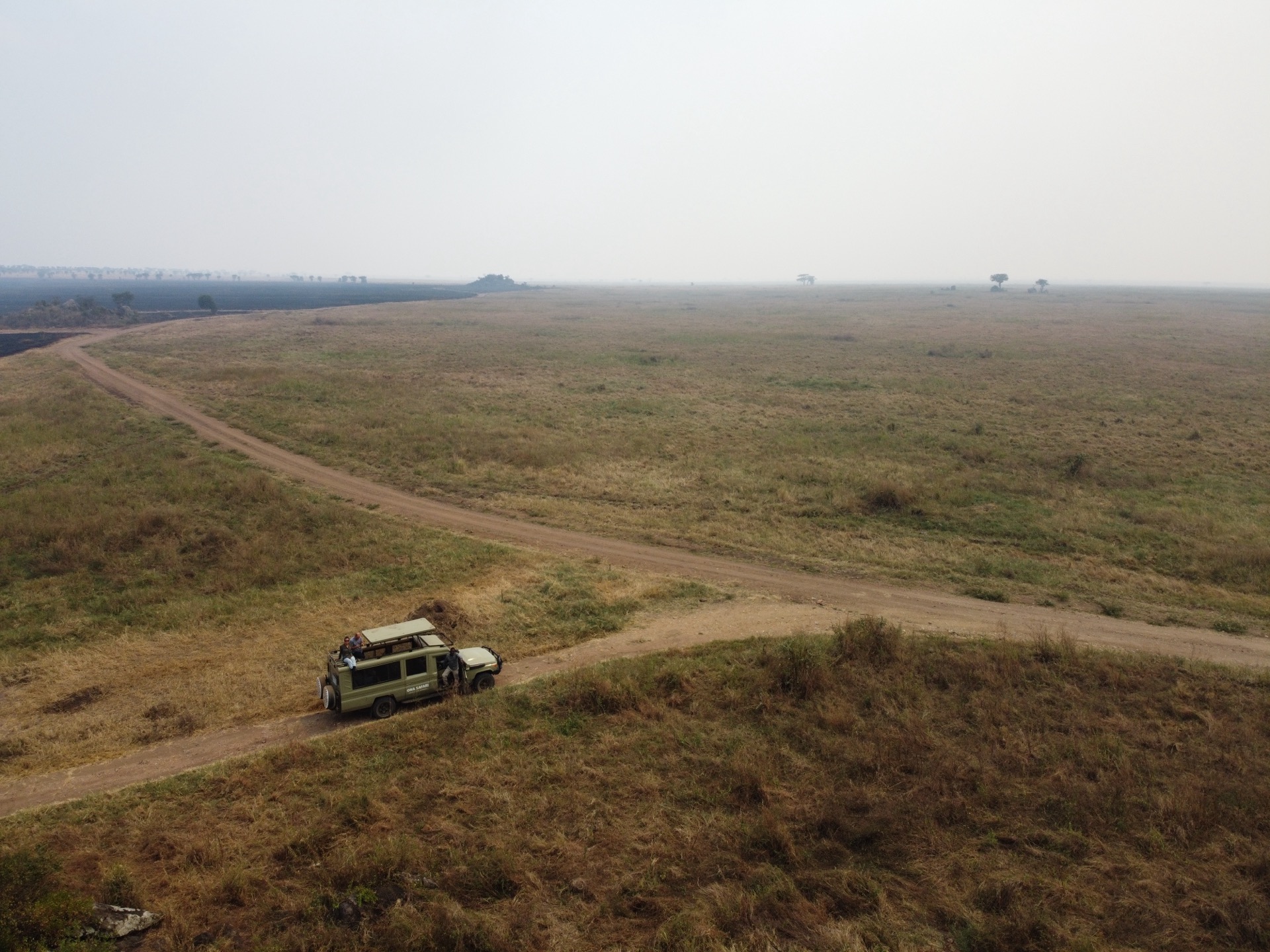
The defining characteristic of a wild dog encounter in Ruaha is solitude. Ruaha receives a fraction of the visitors that Nyerere does, and the vehicle density at any given sighting is almost always zero — guests and guides routinely spend 30–40 minutes with a resting pack without another vehicle in sight. In the northern circuit during peak season, the same sighting would have a convoy of ten cars within minutes of a radio call.
Ruaha’s landscape — the Great Ruaha River valley, the rocky Iringa hills, the miombo woodland interior — is different from Nyerere’s Rufiji ecosystem. Wild dog territory in Ruaha crosses more varied terrain, and packs are tracked across the open Mwagusi area and along the river in the dry season as prey concentrates at permanent water. The dry season window (June–October) applies here too, and the park’s remote character means the experience is unhurried.
Tanzania’s wild dogs are concentrated in the miombo woodland ecosystems of the southern and western circuit — Nyerere, Ruaha, and Katavi. The Tanzania miombo woodland guide explains why miombo is the ecosystem that holds the world’s largest remaining wild dog population and what other miombo-specialist species (sable, roan, greater kudu) you’ll encounter in the same parks.
A combined Nyerere-Ruaha itinerary of 7–8 nights is the standard southern circuit for travellers specifically targeting wild dogs. The domestic flight between the two parks takes 60–90 minutes. The two ecosystems are distinct, wildlife overlaps are minimal, and you get two different perspectives on the same species. For a full breakdown of how the two parks compare — park fees, sighting reliability, denning season timing, vehicle density, and who each park suits — see the Nyerere vs Ruaha wild dog comparison.
Serengeti: why it is not your target park
African wild dogs disappeared from the Serengeti in 1991. The causes were a combination of competition from increasing lion and hyena populations and a catastrophic canine distemper outbreak. The resident population that was present in the 1980s was gone within a decade.
Small numbers of wild dogs have reappeared in recent years — mostly in the eastern Serengeti and the Ndutu area, spilling over from the Ngorongoro Highlands. But these are occasional movements of transient animals, not an established resident population. Sightings are genuinely unusual and are described by Responsible Travel, Expert Africa, and other specialist operators as rare and unexpected.
If you are visiting the Serengeti primarily for the Great Migration, the lions, the cheetahs, and the wildebeest drama — go. If you are specifically targeting wild dogs, the Serengeti is not your park. Build your itinerary around Nyerere and Ruaha.
Katavi and Moyowosi in western Tanzania also hold healthy wild dog populations for travellers who want to extend well off the main circuit, though these parks require significantly more logistical planning. The Katavi write-up covers the park’s dry-season wildlife spectacle alongside the Ruaha-Katavi wild dog population — western Tanzania’s most significant painted dog stronghold, and a current WCS research priority for establishing baseline population data.
What a hunt actually looks like
The sequence is consistent enough that guides can describe it step by step before it happens.
The pack is resting in shade. Something — a change in wind, a sound, a visual cue — causes several animals to stand. Others follow. The greeting begins: individuals approach each other muzzle-to-muzzle, vocalizing with a twittering and whimpering that rises in pitch and frequency as more animals join. This is the rally. It lasts between 5 and 20 minutes. When it stops, the pack moves.
The target animal is selected quickly and without apparent deliberation — usually an impala or warthog that is slower or separated from the herd. The opening sprint is fast, covering 200–300 metres in under 30 seconds. Then the rotation begins. The lead dog drops back, a second takes over. Prey attempts to cut, accelerate, or double back. The pack adjusts. There is no gap opened. No recovery time allowed.
At approximately 3–4 km into the chase, the prey animal’s speed has dropped noticeably. Two or three dogs move to the flanks, cutting angles. The lead dog reaches the target and grips. The rest of the pack arrives within 10 seconds. The kill takes less than a minute.
What happens next is equally striking: the entire pack feeds simultaneously, and within 10–15 minutes there is almost nothing left. Wild dogs have proportionally the largest carnassial teeth of any African carnivore relative to their body size — they are built to slice through meat with maximum efficiency. A full impala, 50–60 kg, is consumed by a pack of 12 in under 20 minutes.
Wild dogs make a lion kill look like a slow movie. The pace, coordination, and efficiency of the entire sequence — from rally to kill to consumption — is unlike anything else in the Tanzania bush.
Finding a den
The denning season runs from approximately May to July in Tanzania, with some variation by location and year. After the alpha female gives birth, the entire pack anchors to the den site. This is the only period when wild dogs are reliably stationary for multiple consecutive days.
What you observe at an active den:
- The alpha female emerges briefly but spends most time at the den entrance. She is clearly distinguishable by her condition.
- The returning pack arrives from a hunt in a visible state of energy — the same twittering call now directed at the den entrance rather than at each other. Pups emerge to meet them.
- Adults regurgitate food immediately. Pups crowd in, and the feeding is audible. Every member of the pack contributes — even the dominant male.
- After 20–30 minutes, pups retreat inside. Adults rest in the shade nearest the den. Some patrol.
A den observation is best done on foot or from a stationary vehicle positioned upwind. Walking safaris in Nyerere allow you to approach areas that vehicles cannot access quietly. Guides who know an active den location will take you to within a considered distance and then stop. You sit, you watch, and you do not move for as long as the dogs allow.
The denning season coincides with the end of the long rains (March–May) and the start of the dry season (June–July). Some camps in this window offer reduced rates. The combination of lower prices and higher wild dog predictability makes May–June a genuinely underrated time to visit Nyerere.
Natural history
African wild dogs (Lycaon pictus, meaning “painted wolf”) are the only member of their genus. Each individual has a unique coat pattern of black, white, and golden-tan patches — no two animals are identical, which is how researchers identify individuals in camera-trap studies.
Key facts from the DB:
- Global population: approximately 6,600 adults and yearlings in 39 subpopulations, with only about 1,400 mature individuals (IUCN)
- IUCN status: Endangered — experiencing a continuing population decline
- Tanzania’s national total: estimated over 2,300 individuals, Africa’s largest national population
- Pack size: 5–15 individuals in a typical pack, with some Tanzania packs exceeding 40 animals (WWF)
- Pack territory: up to 3,000 km² per pack in some cases; on an active hunting day, packs cover around 50 km
- Cooperative breeding: only the alpha pair breeds; the entire pack raises the pups, including regurgitation feeding by all adults
Threats driving the decline: habitat fragmentation that isolates populations and prevents genetic exchange; canine distemper and rabies transmitted from domestic dogs at park boundaries; road kills where parks adjoin public roads; retaliatory killing by livestock farmers. The IUCN’s continuing decline assessment reflects the fact that none of these pressures have been resolved at scale.
Wild dogs weigh 20–30 kg — smaller than most visitors expect from Africa’s most efficient predator. They do not look dangerous. The power is in the coordination and the endurance, not the individual animal.
Conservation
Tanzania is one of the most important countries in the world for wild dog conservation. The Nyerere-Ruaha-Rungwa corridor holds one of Africa’s most significant meta-populations, with the Selous-Niassa transboundary ecosystem (Tanzania and northern Mozambique combined) identified in a 2025 Scientific Reports paper as among the most critical remaining strongholds globally.
Key ongoing programmes:
- Ruaha Carnivore Project: working with communities and the University of Oxford, this programme has reduced retaliatory killings of wild dogs, lions, leopards, and cheetahs by 80% in its core study area over more than ten years. The primary mechanism is community engagement, livestock husbandry training, and rapid-response compensation for genuine livestock losses — reducing the incentive to poison or shoot wild dogs.
- GPS collar monitoring: Royal African Safaris and other operators work with research teams to fit GPS collars to alpha animals. Daily location data is shared with guides and camp managers via a network that allows trackers to alert vehicles when a pack is in a known area. This is the primary reason that a 3-night Nyerere stay with a good camp produces sightings at much higher rates than random searching would suggest.
- Domestic dog vaccination: rabies and distemper from domestic dogs in communities adjacent to parks are the primary disease vectors. Vaccination campaigns near Nyerere and Ruaha reduce the transmission risk and are considered one of the most cost-effective conservation interventions for wild dogs globally.
The WCS has identified establishing baseline population data for the Ruaha-Katavi ecosystem as a current research priority — meaning significant systematic research on this population is still in progress. The numbers are important and are being actively studied.
As a safari traveller in Tanzania, the most direct conservation contribution you make is choosing southern circuit camps that support research partnerships and pay concession fees that fund anti-poaching in the Nyerere and Ruaha ecosystems. Ask your operator which camps maintain an active relationship with the Ruaha Carnivore Project or the WCS Tanzania programme.
I have seen wild dogs twice in Tanzania. The first time was from a boat on the Rufiji in Nyerere — the pack appeared on the opposite bank, drank briefly, and disappeared into the riverine forest. Maybe 45 seconds total. The second time was in Ruaha: we found the pack at 06:30, they rallied for about 15 minutes, and then they ran two impalas for nearly 4 kilometres before making a kill in a dry riverbed. We followed in the vehicle across open grassland. The whole sequence took 25 minutes. It is the most purely exciting thing I have seen on a safari. Wild dogs make a lion kill look like a slow movie.
Frequently asked questions
Where is the best place to see African wild dogs in Tanzania?
Nyerere National Park (formerly Selous) holds one of Africa's largest wild dog populations — estimated at 800–1,000 individuals based on a 2025 camera-trap survey — and is Tanzania's most reliable destination for pack sightings. The combination of vast riverine woodland, Rufiji River boat safaris, and experienced guides who track specific packs gives Nyerere an advantage over other parks. Ruaha National Park is a close second, holding Tanzania's third-largest painted dog population, with the added benefit of very low visitor density. The Serengeti is not recommended specifically for wild dogs: the resident population disappeared in 1991 due to lion predation and disease and has recovered only partially, with small numbers in the eastern areas.
How high is the African wild dog's hunting success rate?
Approximately 80% of wild dog hunts end in a successful kill — significantly higher than lions (~25–30%), cheetahs (~50%), or leopards. The high success rate comes from cooperative pack hunting: wild dogs run prey to exhaustion over distances of 3–5 km rather than ambushing or sprinting. Different pack members rotate to the front during a chase, preventing any individual from becoming too tired. When you witness a wild dog hunt, you are watching a precision machine — it is the most efficiently lethal predator sequence in Tanzania safari.
How many African wild dogs are left in the world?
The global African wild dog population is estimated at approximately 6,600 adults and yearlings in 39 subpopulations (IUCN assessment), with only about 1,400 mature individuals. Tanzania holds a critical share of the remaining population — the Nyerere-Ruaha-Rungwa corridor is one of the most important meta-populations on the continent, with Tanzania's national total estimated at over 2,300 individuals. The main threats are habitat fragmentation, disease (canine distemper and rabies transmitted from domestic dogs), road kills on park boundaries, and human-wildlife conflict.
Why are wild dogs so hard to see despite Tanzania having a large population?
Wild dogs range over enormous territories — a single pack can cover up to 3,000 km² in a given season, and they move around 50 km on an active hunting day. Finding them requires either pre-positioned knowledge of a pack's current location (which experienced Nyerere and Ruaha guides track via camp radio networks and GPS collar data) or luck. The vast size of both Nyerere (approximately 30,893 km² national park) and the Ruaha ecosystem means the population is spread thin. Dedicated guiding over 3+ days in Nyerere during dry season, with camp-to-camp radio communication, gives the most reliable sighting probability.
What should I know about a wild dog den if I find one?
A wild dog den is one of the most special wildlife observations in Tanzania. Dens are active for approximately 10–12 weeks while pups are young — typically May–July in Tanzania, overlapping with the start of the dry season. If your guide locates an active den, you may see: the pack returning from a hunt and regurgitating food for the pups; the pups emerging to greet the returning adults (a cacophony of chirping and whining); the alpha female guarding the den entrance; adults playing with pups. Den observations are usually done on foot (walking safari) or quietly from a stationary vehicle; your guide controls the approach distance.
Is it worth doing a walking safari specifically for wild dogs?
Yes — walking safaris in Nyerere and Ruaha add a dimension to wild dog observation that vehicle safaris cannot replicate. You can read tracks, observe denning areas on foot, and track a pack through the bush with an armed ranger. The sound of wild dogs calling before a hunt — a high-pitched twittering that builds in intensity — is one of the most thrilling sounds in the African bush and is best experienced outside a vehicle. Walking safaris in Nyerere require an armed ranger escort and are conducted in specific zones approved for foot access.