
Facts & prices checked: 2026-06-25
Tanzania’s northern circuit — Serengeti, Ngorongoro, Tarangire — is magnificent. It is also one of the most visited safari circuits on the continent. Katavi National Park is the opposite of everything the northern circuit is. Remote, raw, and receives fewer than 2,000 visitors per year. There are no vehicle queues at sightings. You may go three game drives without seeing another car. And what you see when you get there — particularly from July to October — is one of Africa’s most extraordinary concentrations of large mammals anywhere on the continent.
Katavi covers 4,471 square kilometres of western Tanzania, making it Tanzania’s fourth-largest national park. Getting there is not simple. There is no tarmac road in from the northern circuit. The overland distance from Dar es Salaam is approximately 1,250 km — about 16 hours of driving on rough tracks. The practical answer is to fly in by charter or scheduled light aircraft, and once inside you have no mobile phone signal, no internet, and no quick exit. That inaccessibility is exactly what makes it remarkable.
Tanzania’s greatest secret
The pitch for Katavi is simple: this is Tanzania for travelers who have already done Tanzania. If you have seen the Serengeti in July, with game vehicles queued ten deep around a cheetah, Katavi is a corrective. The vehicle-to-wildlife ratio here is inverted from what you find on the northern circuit. The wildlife is not more abundant in absolute numbers — but the experience is incomparably more intimate.
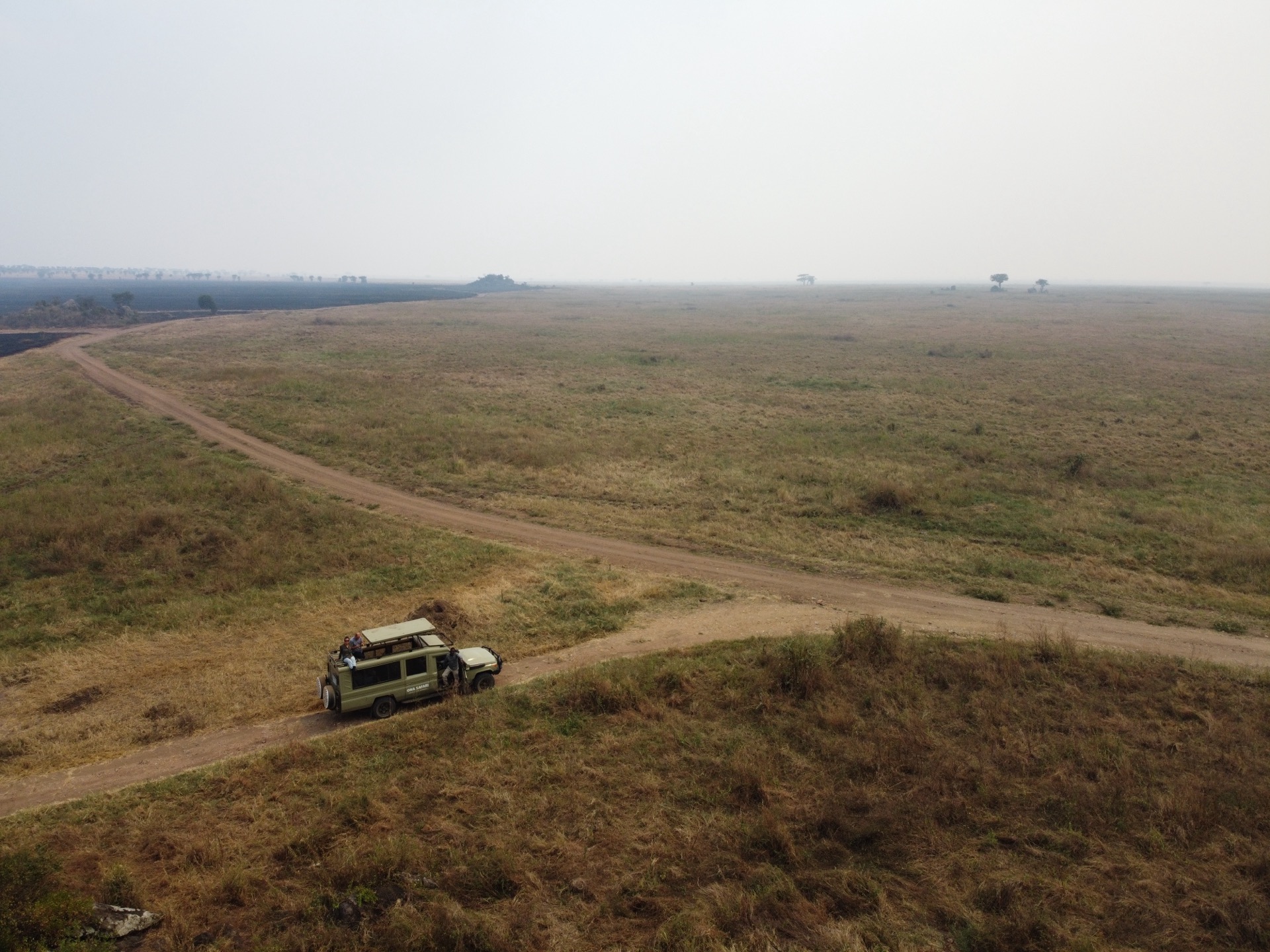
Katavi’s remoteness is not a flaw in the product. It is the product. You are genuinely in the bush — a real wilderness where the daily rhythms of the park are not shaped around tourist schedules. Lions do not move away from the road because there is no pressure from a convoy of vehicles. Game drives at first light through the Katisunga plains, with no other vehicles visible to the horizon, are a reminder of what African safari travel used to feel like before it became popular.
The park’s obscurity has another consequence: less than 2,000 visitors per year means infrastructure stays minimal, which means the operators who are here chose to be here because of the wildlife, not the footfall. The camps that exist in Katavi — most notably Chada Katavi from Nomad Tanzania — are serious wilderness operations run by people who know this park deeply. A three or four night stay at Katavi gives you a level of guide knowledge and personalised experience that is hard to replicate on a circuit that handles hundreds of vehicles daily.
I rate Katavi as one of the parks in Tanzania that changes how you think about safari. The experience resets what you expect from wildlife encounters. After Katavi, game driving behind a line of vehicles feels like a different activity entirely.
The Katuma River — the park’s heart
Katavi’s wildlife cycle is driven entirely by the Katuma River and its connected floodplain. Understanding the river explains why the park is dry-season only for serious wildlife viewing, and why August to October is the peak window.
Wet season (November–May): The Katuma floods. The park’s black cotton soil becomes impassable — camps close, roads disappear under water, and the landscape transforms into a vast shallow lake and wetland. Wildlife disperses across the flooded plain. The bird diversity is exceptional — over 450 recorded species use the wetland habitat. But the wildlife concentration that defines Katavi’s reputation does not exist during this period. The park is functionally inaccessible.
Dry season (June–October): As the rains end and the dry season takes hold, the Katuma River progressively recedes. By July the river has shrunk to a series of pools in its deeper channels. By August those pools are under serious pressure — hundreds of hippos and large crocodile populations competing for the same contracting water. By October the pools are at their minimum and the concentrations are at their maximum.
The pools become the only reliable water in the landscape. Everything that needs to drink — elephants, buffalo, zebra, topi — comes to the river. Everything that needs to eat comes to where the prey is concentrated. The result is a wildlife spectacle driven entirely by the mechanics of water stress, and it builds progressively through the dry season. A visit in August is very good. October, in a dry year, can be astonishing.
Wildlife in the dry season
The Katuma River pools in August to October represent one of Africa’s most spectacular concentrations of large mammals. The numbers from the facts database are not approximations — they are observed, documented aggregations.
Hippos: Pods of up to 600 hippos concentrate in a single pool at peak water stress. Documented aggregations at the Ikuu Springs in Katavi are described as the greatest mass gathering of hippopotamus in Africa. The dominance fights are continuous — the noise is audible from camp at night, a low-frequency rumble of hippos challenging each other for position in water that is no longer deep enough to support their numbers comfortably. If you have only ever seen hippos in a river or a deep lake, the Katuma pools in September are a completely different experience.
Elephants: Large herds concentrate around permanent water as the dry season reaches its peak. The Ruaha-Katavi landscape recorded 19,884 elephants in a 2013 WCS aerial survey. At Katavi’s remaining waterholes in October, individual herds coming in to drink can number in the hundreds.
Buffalo: The Katisunga plains documentedly support aggregations of 2,000 to 4,000 buffalo. Buffalo herds of more than 1,000 individuals are regularly observed during the dry season. For scale: large buffalo herds in the northern circuit are typically 200–400 animals.
Lions: With every prey species concentrated at the Katuma pools, lion prides develop territories around the water and feed well. What this means for the safari experience is that lions at Katavi are relaxed, well-fed, and largely uninterested in approaching vehicles. You can sit at a distance and watch a pride interact without the pressure of other vehicles cycling through.
Wild dogs: The Ruaha-Katavi ecosystem is a current WCS research priority for establishing baseline data on the African wild dog population. Katavi and Moyowosi hold some of the healthiest painted dog populations in western Tanzania. With fewer than 7,000 wild dogs surviving globally, this population matters. The Ruaha-Katavi landscape is identified by conservation scientists as one of the most critical remaining strongholds for the species in Africa.
Roan and sable antelope: Both species occur in Katavi and share the same habitat range — something unusual in Tanzania, where their ranges rarely overlap. This is a meaningful distinction for species-list travelers.
Birds: Over 450 species are recorded in Katavi. The floodplain supports exceptional waterbird diversity during and after the wet season, including shoebill stork, which uses the western Tanzania wetland habitat.
What makes Katavi different
Beyond the headline wildlife numbers, Katavi offers four things that are impossible to replicate on the main Tanzania circuits.
No crowds — genuinely none. A morning game drive in August at Katavi means leaving camp in a Land Cruiser and driving for four hours across open plains and along the Katuma floodplain without seeing another vehicle. This is not rare — it is the norm. The wildlife behaves differently without vehicle pressure. Predators move naturally rather than adjusting to the presence of a convoy. The experience feels closer to fieldwork than tourism.
Walking safaris on open terrain. Katavi’s open floodplain and miombo woodland gives excellent visibility for walking. Armed TANAPA rangers and camp guides lead walks that cover 4–8 km at dawn — the best time thermally and the most productive for bird activity and predator sightings. Walking in terrain where you can be genuinely close to buffalo and hippo concentrations is a different category of experience from walking in closed canopy forest. The scale of the floodplain — the ability to look across it and understand its geography on foot — changes how you understand the park.
Fly-camping. Nomad Tanzania’s Chada camp runs fly-camps — simple bush camps set up away from the main camp for a night in the open. Sleeping under canvas in Katavi in September, with hippo dominance fights two hundred metres away and lions vocalising on the opposite floodplain edge, ranks among the most immersive nights available anywhere in African safari.
The sound of the bush at night. At Katavi there is no ambient noise from other camps, no generator hum from a resort, and no traffic. The soundscape at night is exactly what a wild landscape sounds like when humans are not the dominant presence. That detail matters more than it sounds when you experience it.
The western Tanzania circuit
Katavi is almost always combined with Mahale Mountains National Park for what has become known as the western Tanzania circuit — one of Africa’s most rewarding two-park safari combinations.
Mahale Mountains is about 45 minutes by light aircraft from Katavi, or accessible by boat from Kigoma via Lake Tanganyika (speedboats take 4–6 hours; the MV Liemba ferry takes about 10 hours). Mahale is home to the M-group habituated chimpanzees — a wild chimpanzee community that has been habituated to human presence through decades of research, making close-range chimp tracking a reliable daily activity. The setting — forested mountains dropping directly to the white-sand beaches and warm water of Lake Tanganyika — is unlike any other park in Tanzania.
A typical western circuit itinerary runs 7 nights minimum: 3 nights at Katavi for dry-season wildlife concentration, then 3–4 nights at Mahale for chimpanzees and the lake. The contrast — ground-level hippo spectacle and open plains one week, great apes in mountain forest and lake swimming the next — is one of the most distinctive itinerary combinations in African safari.
Gombe Stream National Park is an optional addition. Jane Goodall’s original chimpanzee research site is accessible by boat from Kigoma (1–3 hours by charter boat). Gombe is smaller and less polished than Mahale but carries enormous historical resonance. Some western circuit itineraries run Katavi → Mahale → Kigoma → Gombe as a 10-day loop.
Charter logistics: Auric Air operates 3 times weekly in western Tanzania, connecting Arusha, Dar es Salaam, Ruaha, Mpanda (Katavi’s gateway airstrip), and the Kigoma area. Camp bookings at Katavi include charter coordination — you do not need to arrange this independently. Flight time from Dar es Salaam by charter is approximately 3–4 hours; from Arusha, longer.
Park entry fee: Katavi falls in TANAPA’s lowest tier at USD 35.40 per person per day — the same fee category as Ruaha and Mikumi, and significantly lower than Serengeti (USD 82.60) or Mahale (USD 94.40).
Practical information
Getting there: Charter or scheduled light aircraft is the practical option. Auric Air flies western Tanzania 3 times weekly. The overland route from Dar es Salaam is approximately 1,250 km — a two- to three-day drive requiring 4WD and at times low range on the approach to Mpanda. Katavi is 35 km southwest of Mpanda. Do not attempt the overland route without significant offroad experience and a fully equipped vehicle.
Best season: July–October. Peak concentration: August–October. Most camps open June 1 and close in late October or mid-November when the rains return. A few camps have been documented closing from end of February to July 1 — confirm opening dates with your operator.
Accommodation: The primary quality option is Chada Katavi (Nomad Tanzania) — a seasonal tented camp that faces the Chada floodplain. The camp runs walking safaris, fly-camping, and game drives. Southern and western Tanzania camps average USD 450–1,000 per person per night inclusive. Budget accommodation is available near the park gate at Mpanda for travelers willing to manage their own logistics, but Katavi is not a destination where budget-independent travel yields good wildlife results — the infrastructure for self-drive game viewing is minimal.
What to bring: Katavi is a full wilderness resupply stop. There is no pharmacy, no shop, no replacement gear available nearby. Bring: sufficient malaria prophylaxis for the full trip, any prescription medication, binoculars, camera batteries and a charger, a head torch, and warm layers for early morning game drives (July and August mornings can be cold). Quality camps supply most equipment but confirm in advance.
Health: Malaria prophylaxis is essential — western Tanzania’s wet low-lying areas carry consistent malaria risk year-round including the dry season. Yellow fever vaccination is required for entry to Tanzania for travelers arriving from yellow fever risk countries — confirm current requirements on the official entry rules page before travel.
Park communications: No mobile phone signal inside the park. Chada Katavi and similar operations have satellite communication for emergencies. Medical evacuation options exist but response time to western Tanzania is significantly longer than to the northern circuit — factor this into travel insurance decisions.
Is Katavi right for you?
Katavi is an honest answer to a specific question: where do I go after Serengeti and Ngorongoro? Not for everyone. The cost is real — charter flights into western Tanzania carry a minimum of USD 1,000 per person, and quality accommodation adds to that. The logistics are complex. The remoteness is total. None of those things are problems if you understand what you are buying.
What you are buying is one of the last genuinely uncrowded major national parks in Africa, a hippo spectacle that is simply not replicable anywhere else in Tanzania, a buffalo aggregation that most safari travelers have never seen at that scale, and a wilderness experience — walking, fly-camping, night sounds — that the northern circuit cannot offer in the same form.
First-time Tanzania safari travelers: go to Serengeti and Ngorongoro first. Do that well. Then, on a second trip, put western Tanzania on the itinerary — Katavi for the dry-season spectacle, Mahale for the chimpanzees. That combination, done properly over 7–10 days, is one of the most complete safari experiences available in Africa.
Tanzania is a big country with a lot of parks. Katavi is the one that most safari travelers never see, and the one that experienced travelers keep coming back to describe as the trip that changed their understanding of what Africa can be.
Related guides: Tanzania safari planning guide — how to sequence Katavi into a full itinerary. Tanzania wild dogs guide — the Ruaha-Katavi wild dog population and what makes painted dog sightings so distinctive. Katavi hippo pools guide — deep-dive on the dry-season pool spectacle: up to 600 hippos per pool, the Ikuu Springs mass gathering, peak timing, and photography strategy. Tanzania hippos guide — the full Tanzania hippo guide covering Nyerere, Ngorongoro, Serengeti, and hippo biology. full park fee schedule — complete TANAPA fee tables including Katavi’s USD 35.40 rate. Tanzania best national parks — how Katavi ranks in the full park comparison. Tanzania chimpanzees guide — great apes in Tanzania, including Mahale and Gombe.
Frequently asked questions
How do I get to Katavi National Park?
Charter flight is the practical option, though a scheduled alternative exists — Auric Air operates a 3-times-weekly service in the western Tanzania region, landing at Mpanda (35 km from the park); most visitors fly from Dar es Salaam or Arusha and connect. The overland alternative — approximately 1,250 km from Dar es Salaam by road — takes about 16 hours and involves rough tracks near Mpanda that require 4WD and low range. Your camp arranges charter logistics as part of the booking; Katavi is not a DIY destination. Once in the park there is no mobile phone signal and no road back to any major town — the remoteness is absolute.
When is the best time to visit Katavi?
July–October (dry season) is the only time worth visiting for the wildlife spectacle. As the dry season progresses the Katuma River shrinks to isolated pools and hippos, elephants, lions, and crocodiles concentrate in extraordinary density. The peak is August–October. The wet season (November–May) brings green scenery and excellent birdwatching but roads become impassable on Katavi's black cotton soil, wildlife disperses, and most camps close. Some camps open in June; most close by late October or mid-November.
What wildlife can I see in Katavi?
The dry-season Katuma River pools are the primary draw. Hippos: pods of up to 600 in a single pool at peak — the most dramatic hippo density in Tanzania. Elephants: large herds congregating around permanent water. Buffalo: herds that can exceed 1,000 individuals, with documented aggregations of 2,000–4,000 on the Katisunga plains. Lions: resident prides follow prey concentrations to the river pools; high density relative to visitor numbers means most game drives find lions. Wild dogs: Katavi and the wider Ruaha-Katavi landscape are a key WCS research priority and hold healthy painted dog populations. Over 450 recorded bird species.
Is Katavi suitable for first-time safari travelers?
Katavi is best for experienced safari travelers who have done Tanzania's northern circuit and want something completely different. The reasons: it is expensive (charter flight minimum USD 1,000 per person + high-end accommodation), remote (no mobile signal, no nearby town, limited emergency access), and offers an unstructured wilderness experience that rewards those comfortable in the bush. First-timers generally get better value and more reliable wildlife density on the northern circuit. Katavi is where you go for your second or third Tanzania safari.
Can you do walking safaris in Katavi?
Yes — Katavi is one of Tanzania's better walking safari destinations. The open floodplain and woodland landscape gives good visibility and experienced armed rangers lead walks that can approach wildlife at close range. Walking is typically included in full-board camp rates at quality operations. The best walks start at dawn before the heat, covering 4–8 km and returning to camp by midday. Fly-camping — spending a night in the bush in a mobile camp — is also available from operators like Nomad Tanzania. Sleeping in Katavi during dry season, with hippo dominance fights audible through the night, is a defining Africa experience.
How does Katavi combine with Mahale Mountains?
The western Tanzania circuit (Katavi + Mahale) is one of Africa's finest two-park combinations: great apes, hippo spectacle, Lake Tanganyika, and zero crowds. Mahale Mountains is accessible by light aircraft or boat from Kigoma. A typical western circuit runs 7–10 nights: 3–4 nights Katavi for dry-season wildlife, then 3–4 nights Mahale for habituated chimpanzees and the lake. Optional add-on: Gombe Stream National Park (Jane Goodall's original research site, 1–3 hours by boat from Kigoma). Auric Air flies western Tanzania 3 times weekly.