
Facts & prices checked: 2026-06-25
Tanzania’s two great wild dog parks are not interchangeable. Nyerere in the south and Ruaha further west both hold world-class wild dog populations — together forming part of the Nyerere-Ruaha-Rungwa corridor that is one of Africa’s most important meta-populations for Lycaon pictus. But the experience of finding and watching a wild dog pack in each park is substantially different. This is a comparison of every variable that affects your decision.
The population difference
Nyerere’s numbers are exceptional. A 2025 peer-reviewed camera-trap survey in the park recorded approximately 222 individually identified wild dogs, with a density of 2.14 ± 0.45 adults and yearlings per 100 km². Extrapolated across Nyerere’s 30,893 km², the total park population is estimated at 800–1,000 wild dogs — Africa’s single largest documented population within one protected area. The broader Selous-Niassa transboundary ecosystem (Nyerere combined with Mozambique’s Niassa Reserve) has been identified by a 2025 Scientific Reports paper as one of the most critical remaining strongholds for the species globally.
Ruaha holds Tanzania’s third-largest painted dog population. The Ruaha-Katavi ecosystem is a current WCS research priority for establishing reliable baseline data — meaning systematic camera-trap surveys of the kind that produced Nyerere’s 2025 numbers have not yet been completed for Ruaha. The Ruaha Carnivore Project, working with the University of Oxford, has reduced retaliatory killings of wild dogs, lions, leopards, and cheetahs by 80% in its core study area, which has created a significantly safer environment for the Ruaha population over the past decade.
Tanzania as a whole is estimated to hold over 2,300 wild dogs — Africa’s largest national population. Nyerere and Ruaha between them account for a significant proportion of that total. Both populations matter.
Verdict on numbers: Nyerere, by a wide margin. But Ruaha’s population is substantial and the experience of a sighting there is not diminished by having fewer dogs in the park.
The sighting reliability question
Reliability in wild dog viewing comes from one thing: knowing where the pack is before the game drive starts. Wild dogs range up to 3,000 km² and cover around 50 km on an active hunting day. Without current location intelligence, finding a pack is luck — and luck is not a planning tool.
Nyerere’s advantage here is its GPS collar network. Research teams and camps in Nyerere maintain active GPS collar programmes on alpha animals from known packs. Daily location data is shared across a network of guides and camp managers. Before the morning game drive, a good guide in Nyerere already knows which sector of the park active packs are operating in. This intelligence dramatically changes the sighting probability on a 3-night stay.
The denning season (May–July) further improves reliability in Nyerere. During this window, packs anchor to a fixed den site for 10–12 weeks while pups are young. A pack with an active den does not range widely. The camp radio network tracks which dens are active, and morning game drives head directly to the den area. Observations at an active den — the full pack returning from a hunt, pups emerging to mob the adults, regurgitation feeding in progress — are among the most complex and readable wildlife sequences in Africa.
Ruaha guides track packs by radio network and local knowledge, but the GPS collar coverage is less systematic. Ruaha’s saving advantage is the Great Ruaha River: in the dry season, prey concentrates at the river and wild dog territory naturally overlaps with the zone where vehicles already focus. A dawn game drive along the river with an experienced Ruaha guide has solid probability in July–October.
Verdict on reliability: Nyerere, particularly during denning season (May–July) or with a camp that actively maintains collar contacts. Ruaha is genuinely good in dry season but the intelligence network is thinner.
The season question
Both parks are at their best in the dry season: June to October. Wildlife concentrates on permanent water, vegetation thins and improves visibility, tracks are firm, and active-hunting conditions for wild dogs are optimal. For a combined southern circuit itinerary, you do not need to split your calendar to catch different peak seasons for each park.
The critical difference is what happens outside the dry season:
-
Nyerere closes from end of March to May 31 (hard closure). The long rains flood the tracks and camp operations stop entirely. There is no access during this window. June 1 is the reopening and it falls in the denning window — making it one of the most interesting entries of the year if you time it right.
-
Ruaha stays accessible through more of the year. Some camps operate December to February. Wet-season access in Ruaha is limited compared to dry season but not impossible. If your itinerary requires travel outside June–October, Ruaha is the more flexible option.
The denning window of May–June is an important wrinkle. Nyerere’s closure ends just as denning is peaking — June is arguably the single best month for wild dogs in the park: maximum pack predictability, park just reopened, camp rates still at shoulder-season pricing. If you can travel in June, lead with Nyerere.
Verdict on season: Nyerere in June for the denning-plus-dry-season convergence; Ruaha if you need October–November travel or dry-season access without Nyerere’s closure constraints.
The experience character
This is where the parks genuinely diverge.
Nyerere offers activities that no other Tanzania park can replicate at scale. Boat safaris on the Rufiji River are included as standard at most camps — river hippo pods, crocodiles hauled out on sandbanks, and wild dogs occasionally appearing on the opposite bank to drink or cross. Walking safaris in designated zones with armed rangers give access to terrain and perspectives that vehicles cannot. The ecosystem is vast, flat, and riverine — open enough for long-range following of a hunt, but complex enough that a pack can disappear into woodland within minutes.
I once watched a pack of wild dogs appear on the opposite bank of the Rufiji during a boat safari in Nyerere. They came to the water’s edge, a pack of 15, drank briefly, and were gone back into the riverine forest within about 45 seconds. The viewing conditions were unusual — eye level with the dogs across 40 metres of flat water, in silence, without the engine noise of a vehicle. It did not feel like a game drive. It felt like an accidental encounter with something that did not know I was there.
Ruaha offers something different: near-complete solitude. The park’s visitor density is significantly lower than Nyerere, and Ruaha’s visitor numbers are a fraction of any northern circuit park. A wild dog sighting in Ruaha is almost always an uninterrupted experience — guides routinely report 30–40 minutes with a resting pack, spread across a game drive or two, with no other vehicle in sight: the dogs rest in shade, a couple play briefly, the alpha leads a short walkabout around the edge of the group, and they settle again. There is no radio-called convoy. No pressure to move on. The observation lasts as long as the pack allows.
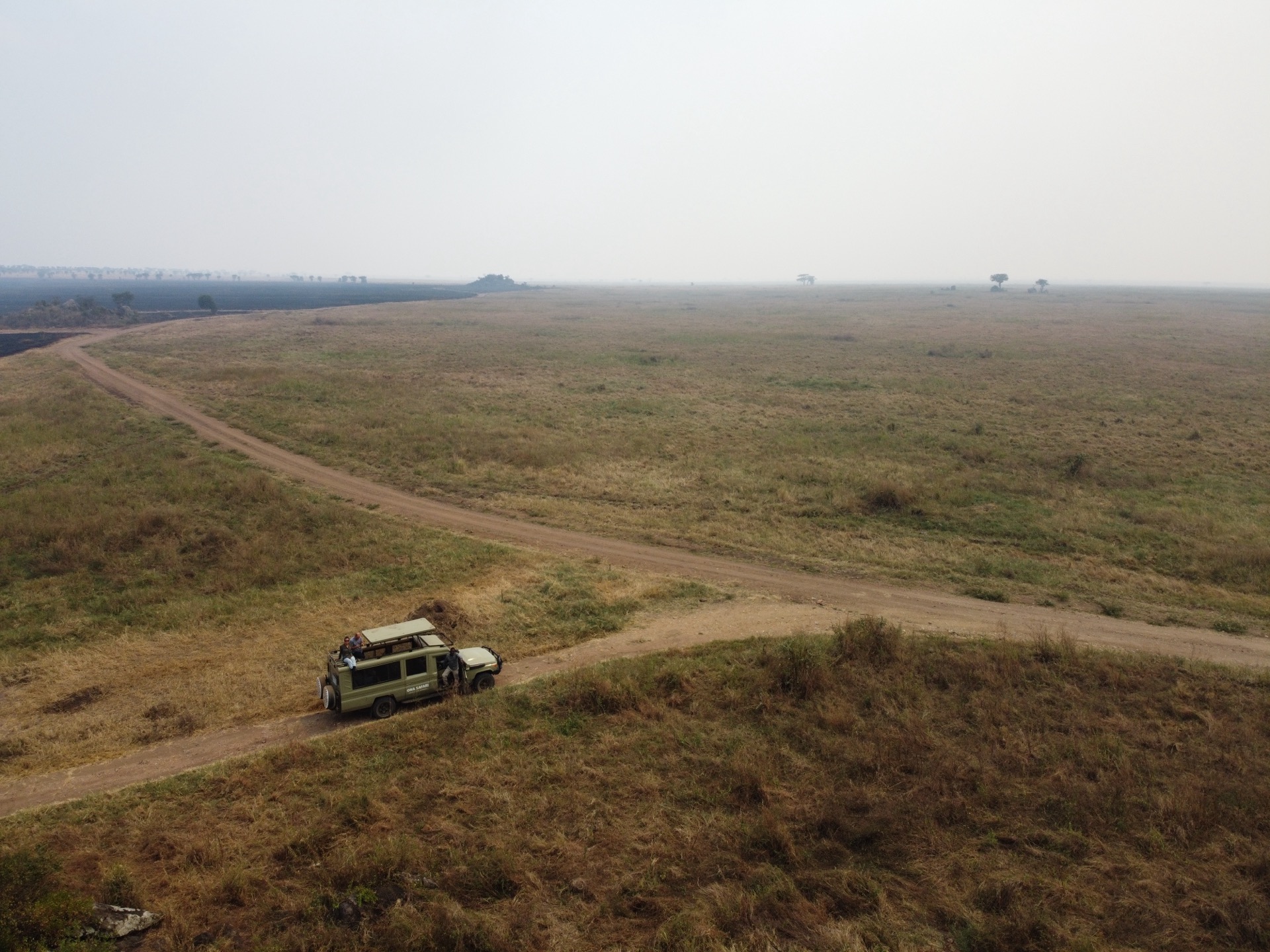
Ruaha’s terrain is also different from Nyerere — rockier highland miombo, dry river courses, dense jesse bush alongside open grassland near the Great Ruaha River. Wild dog territory in Ruaha crosses more topographically varied ground, and the scenery is more dramatic in its vertical character. The combination of Ruaha’s exceptional lion population (approximately 10% of the world’s lions according to WCS data) with wild dogs in the same ecosystem means a single morning game drive can produce two of the world’s rarest large carnivore experiences.
Verdict on experience: Nyerere for the multi-activity dimension (boat safari + game drive + walking safari in one stay); Ruaha for solitude and the rare-carnivore double (wild dogs + 10%-of-world’s-lions in one park).
The cost and access question
The southern circuit generally requires domestic light-aircraft access from Dar es Salaam. Both parks are fly-in destinations for most visitors, though Nyerere can technically be reached by road (approximately 230 km from Dar es Salaam, but road conditions are variable).
Park fees differ. TANAPA’s 2024/25 conservation fees: Nyerere charges USD 82.60 per adult per day (same tier as the Serengeti). Ruaha charges USD 35.40 per adult per day — significantly lower, a difference of USD 47.20 per person per day. For a typical 3-night stay (billed across 3-4 park days), that is roughly USD 140-190 per person saved in park fees alone at Ruaha.
Accommodation pricing follows the same pattern: Nyerere’s best camps command higher rates than equivalent Ruaha camps, partly because of the park’s higher profile and partly because of the infrastructure investment around the Rufiji River. Ruaha’s lower cost structure reflects its lower visitor density, not lower quality.
Return light-aircraft flights between Dar es Salaam and Ruaha run approximately USD 600–800 per person return. Flights to Nyerere are similar from Dar. If you are combining both parks, the 60–90 minute inter-park hop is an additional cost but is included in most specialist operator packages.
Verdict on cost: Ruaha is cheaper on park fees and accommodation. If budget is a factor, a Ruaha-only southern circuit itinerary delivers the wild dog experience at meaningfully lower total cost.
Who should go where
Choose Nyerere if:
- This is your primary wild dog trip and you want maximum sighting probability
- You are travelling in May–July (denning season convergence with park reopening)
- You want boat safaris on the Rufiji as part of the itinerary
- You want the reassurance of an active GPS collar network for pack location
- You have more budget flexibility
Choose Ruaha if:
- Solitude and minimal vehicle density at sightings is your priority
- You are also targeting lions and want to combine two globally important carnivore populations in one park
- You need travel dates outside June–August when Nyerere’s closure is a constraint
- You are working within a tighter budget (lower park fees, lower camp rates)
- You prefer dramatic highland terrain over riverine floodplain
Do both if: The standard southern circuit of 7–8 nights (3–4 nights each) combining Nyerere and Ruaha is the benchmark itinerary for a dedicated wild dog safari in Tanzania. You see two different ecosystems, two different wild dog experiences, and the rest of the southern circuit’s exceptional wildlife alongside them. The inter-park flight is the right solution — the distances by road are long and rough.
The biology of the hunt — what makes wild dogs Africa’s most watchable predator
Wild dogs hunt cooperatively as a pack, coordinated through a vocalisation sequence called the “twittering rally” — a rapid, high-pitched contact call that builds until the alpha pair leads the group’s departure. The hunt is a sustained relay chase: pack members take turns at the front, forcing prey into exhaustion over several kilometres rather than catching it in a sprint. The result is one of the highest hunt success rates of any large African predator.
The implications for viewing are significant. A hunt once started rarely pauses. Pack members communicate continuously through body language and vocalisation. The entire group moves and pivots as a unit. A single game drive that catches a pack at rally can yield 20–40 minutes of continuous activity — the full sequence from vocalisation to departure to chase to kill is faster and more complete than almost any other predator hunt you can follow by vehicle.
Three facts determine whether you catch a hunt:
- Wild dogs range up to 50 km on an active hunting day
- A pack’s home territory can cover up to 3,000 km²
- The morning hunt window runs from first light to approximately 08:30 — after that, temperature drives the pack to shade until the late afternoon
A GPS-collared alpha animal narrows the search area from 3,000 km² to roughly 5–10 km² on the morning of any given drive. This is why Nyerere’s collar network is such a decisive advantage: you are not searching a wilderness the size of Belgium for a 10-animal pack. You are driving to a known sector, at the right time, with a guide who has been on the radio since before you woke up.
Dawn hunts unfold differently in each park. In Ruaha there is no collar intelligence to lean on — just an experienced guide working the river road at first light, finding the pack by smell and tracks. A hunt there can run 30 minutes or more through jesse bush and open grassland without ever producing a kill, the pack vanishing into drainage the vehicle can’t follow. It isn’t a failure — watching a wild dog pack move at full professional intensity for half an hour is one of the most purely exciting things a safari can offer, kill or no kill.
The conservation picture — how these populations survived
The African wild dog (Lycaon pictus) is classified as Endangered on the IUCN Red List. The latest comprehensive assessment puts the continental population at approximately 6,600 adults in 39 subpopulations — one of the lowest totals for any wide-ranging large carnivore in Africa. Tanzania alone holds the largest national population: over 2,300 wild dogs, a figure that represents a significant fraction of the global total.
That population nearly did not survive the 20th century. Wild dogs were systematically shot as vermin across most of their former range. Canine distemper and rabies, transmitted from domestic dogs, swept through fragmented populations. The species is now absent from 25 of its 39 historical range countries.
What preserved the Nyerere and Ruaha populations was a combination of ecosystem scale and, in Ruaha, sustained active conservation:
- The Ruaha Carnivore Project — implemented by the Ruaha Carnivore Project, the University of Oxford, and the Wildlife Conservation Research Unit — reduced retaliatory killings of lions, leopards, cheetahs, and African wild dogs by 80% in its core study area over more than a decade. The mechanism was direct engagement with livestock-herding communities around the park boundary: compensating for losses, promoting livestock-guarding methods, and building the economic case for keeping carnivores alive rather than poisoning them.
- In Nyerere, the Selous-Niassa transboundary corridor connecting Tanzania’s park to Mozambique’s Niassa Reserve was identified in a 2025 Scientific Reports paper as one of Africa’s most critical remaining strongholds for the species globally. The scale of the ecosystem — too large for any single disease event or poaching network to eliminate — is the primary structural protection.
- The Wildlife Conservation Society (WCS) has flagged establishing reliable baseline population data for wild dogs in the Ruaha-Katavi ecosystem as a current research priority. Systematic camera-trap surveys comparable to Nyerere’s 2025 study are still in progress for Ruaha, meaning the full picture of Ruaha’s wild dog population will sharpen over the next two to three years.
Both populations are what conservationists call “source populations” — large and stable enough to potentially export individuals into smaller, recovering areas elsewhere on the continent. Visiting either park funds the community programmes and research infrastructure that keep both alive.
Beyond game drives: the complete activity menu
Nyerere offers four distinct safari modes in a single stay, which is unusual for any Tanzanian park:
- Boat safaris on the Rufiji River — the Rufiji is Tanzania’s largest river, draining most of southern Tanzania. A typical river cruise runs approximately 1.5 hours. Wildlife along the banks includes large hippo pods, Nile crocodiles hauled out on sandbanks, and resident birdlife including African fish eagle, pied kingfisher, and goliath heron. Wild dogs occasionally appear at the water’s edge to drink or cross — a sighting format that vehicle safaris cannot replicate.
- Walking safaris in designated zones with armed rangers. Walking allows track interpretation, quiet pre-dawn approach to active den areas, and the kind of close-range stillness that vehicles, however well-positioned, cannot offer. The twittering rally of a pack heard at 200 metres on foot is something I have not found a way to describe adequately. You hear it before you see the dogs, and by the time you see them they are already moving.
- Fly camping — lightweight tent set-ups in the wilderness, used as multi-day walking safari extensions. A format that requires fitness and the right operator, but gives access to terrain well away from the normal game drive circuits.
- Night game drives — regulated and offered by most camps as an optional add-on. The park’s nocturnal community includes civets, genets, African wildcat, lesser galago, and resting carnivores that are far easier to approach after dark.
Ruaha is primarily a game drive park, but well-structured game drives with pre-dawn departures and afternoon/evening drives along the Great Ruaha River are substantive. Walking safaris are available from some camps but not all — Ruaha’s high elephant density creates safety constraints in certain zones. Confirm before booking.
Secondary wildlife: what else you will see
Neither park is a single-species destination.
Nyerere holds four of the Big Five — lion, leopard, elephant, and buffalo. No rhinoceros. The Rufiji River delivers reliable hippo and crocodile sightings throughout the year. Bird diversity is exceptional: Nyerere is consistently rated among Tanzania’s top birding parks, with over 400 recorded species including Southern Circuit specialists absent from the northern parks.
Ruaha is one of the most important lion parks on the continent. Approximately 10% of the world’s lion population lives in Ruaha — a WCS figure that places the park among a handful of truly global lion strongholds. Tanzania as a whole holds approximately 17,000 lions, Africa’s largest national population. Ruaha’s prides are numerous, frequently observed hunting along the Great Ruaha River banks in the dry season, and rarely shared with more than one or two other vehicles.
The park also holds one of Africa’s largest elephant populations, confirmed cheetah habitat across the broader Ruaha-Rungwa ecosystem (~50,000 km² conservation complex, per a peer-reviewed African Journal of Ecology study), and a bird checklist of over 550 species. Ruaha’s 80 recorded mammal species round out a wildlife inventory that makes it one of the most diverse parks on the continent for a single stay.
A dry-season morning game drive in Ruaha routinely produces wild dogs, lions, and elephants before 10:00. For a visitor who has done the northern circuit’s Serengeti and Ngorongoro and wants something with comparable wildlife density but far less vehicle traffic, Ruaha is the destination that most frequently produces that reaction: “I did not expect it to be this good.”
Both parks have given me wild dog encounters I have not forgotten. Nyerere gave me 45 seconds from a boat on the Rufiji that felt like an accident and was better for it. Ruaha gave me 40 uninterrupted minutes with a pack and no other vehicle. They are not the same experience. That is the point.
The Tanzania wild dog guide covers the full biology, conservation context, hunting method, and how to find a den — the foundation before you commit to a park. If you are ready to plan the itinerary, the Nyerere best time guide and Ruaha best time guide break down every month in each park.
Frequently asked questions
Which park has more wild dogs — Nyerere or Ruaha?
Nyerere (formerly Selous) holds the larger population. A 2025 peer-reviewed camera-trap survey identified 222 individuals in the study zone, with the extrapolated park-wide total estimated at 800–1,000 wild dogs — Africa's largest documented wild dog population within a single protected area. Ruaha holds Tanzania's third-largest painted dog population; the Ruaha-Katavi ecosystem is a current WCS research priority, meaning precise numbers are still being established, but the population is significant. Both parks are among the best wild dog destinations in Africa.
When is the best time to see wild dogs in Nyerere?
May through November is the recommended window, with May to July the peak for denning season observations. During denning, packs anchor near a fixed den site — making sightings significantly more predictable than at any other time of year. The park closes from end of March to May 31, so June is the first opportunity after the closure, and it falls within the denning window. Dry season (June–October) combines peak dog activity with excellent game drive conditions as wildlife concentrates near the Rufiji River.
When is the best time to see wild dogs in Ruaha?
June to October (dry season) is the best time. As the Great Ruaha River drops, prey concentrates on the permanent water and wild dogs follow. Vehicle conditions are optimal and morning game drives starting at first light give the best chance of catching a pack during its dawn hunt. Ruaha stays open through more of the wet season than Nyerere — some camps operate December through February — but dry season is the overwhelming recommendation.
Is it worth combining Nyerere and Ruaha in one itinerary?
Yes, if wild dogs are your primary goal. The standard southern circuit is a 3–4 night stay in each park, with a domestic light-aircraft flight of 60–90 minutes between the two. The ecosystems are different — Nyerere is riverine woodland centred on the Rufiji, Ruaha is rockier highland terrain centred on the Great Ruaha River — so wildlife overlaps are limited and you genuinely see two distinct places. A 7–8 night combined itinerary is the benchmark for a southern circuit wild dog trip.
Are there vehicle crowds at wild dog sightings in Nyerere or Ruaha?
Ruaha has almost no vehicle density at any sighting. In practice, a wild dog encounter in Ruaha is often experienced alone or with at most one other vehicle, even on a popular dry-season morning. Nyerere has more visitors than Ruaha, but significantly fewer than the northern circuit — a radio-called wild dog sighting in Nyerere might attract two or three vehicles, not the convoys of ten to fifteen that form at a Seronera lion in the Serengeti. Both parks are dramatically quieter than any northern circuit park in peak season.
Can I do a walking safari for wild dogs in both Nyerere and Ruaha?
Yes in both parks, but with different character. Nyerere walking safaris are conducted in designated zones with an armed ranger and are particularly effective for tracking and den approaches. Ruaha's high elephant density means not all camps operate walking safaris — confirm before booking. In both parks, a walking safari adds dimensions that vehicle safaris cannot: you read tracks, listen for vocalisations, and approach areas silently. The pre-dawn twittering of a wild dog pack rallying for a hunt is best experienced on foot.
What is the global wild dog population and why do Tanzania's parks matter so much?
The latest comprehensive assessment puts the African wild dog global population at approximately 6,600 adults in 39 subpopulations — one of the lowest totals for any large African carnivore. Tanzania holds the single largest national population, estimated at over 2,300 dogs. Nyerere and Ruaha together account for a substantial share of that total, and both ecosystems — Selous-Niassa and Ruaha-Katavi — are identified by researchers as among the most critical remaining strongholds for the species globally. Losing either Tanzanian population would represent a measurable and irreversible reduction in the continental total.
What secondary wildlife should I expect alongside wild dogs in Nyerere and Ruaha?
Nyerere holds four of the Big Five (lion, leopard, elephant, buffalo — no rhino), exceptional hippo and crocodile viewing on the Rufiji River, and over 400 recorded bird species including Southern Circuit specialists absent from northern Tanzania. Ruaha holds approximately 10% of the world's lion population (a WCS figure reflecting one of Africa's most important lion strongholds), one of Africa's largest elephant populations, confirmed cheetah habitat across the Ruaha-Rungwa ecosystem, and over 550 recorded bird species. A single morning game drive in Ruaha in dry season routinely produces wild dogs, lions, and elephants before 10:00 — wildlife diversity per game drive is one of Ruaha's strongest practical arguments.