
Facts & prices checked: 2026-06-25
Tanzania is a better solo travel destination than the travel anxiety before departure suggests. The gap between reading the U.S. State Department Level 3 advisory and the actual experience on the ground is significant — in the right direction. That said, Tanzania is not a destination where preparation is optional. Here is what actually matters, from someone who lives on Zanzibar’s east coast year-round.
The safari question: the most important logistics decision
For many would-be Tanzania solo travellers, the real question is not “is it safe?” but “how do I manage safari logistics alone?” Understanding this resolves the anxiety.
Tanzania’s national parks require a licensed guide and vehicle — there is no equivalent of taking a bus to a park gate and walking in independently. This is actually good news for solo travellers: you are always in a structured environment, in a vehicle with a guide, operating within a camp system. The safari itself is among the most structured and secure travel environments in Tanzania.
Your core decision is between two models:
Group joining safari: Most operators in Arusha sell seats in shared vehicles — typically a Land Cruiser accommodating 4 to 7 travellers. You book an individual seat, share the vehicle and itinerary with strangers, and split the vehicle cost. This is how the majority of independent solo travellers experience Tanzania’s northern circuit. The advantages: no single supplement on the vehicle cost, natural social environment, and significantly lower per-person cost than private. The trade-off: you don’t control the itinerary or the pace.
Private safari: You book an entire vehicle and guide for your own use. Per-person cost is higher, but you control the schedule, the parks visited, the pace at each sighting. For solo travellers with specific photographic or wildlife goals, private makes sense. This is where the single supplement on lodge accommodation becomes a real factor.
Group safaris are cheaper than private safaris because costs are shared — a group of 4 to 7 people splitting 4x4 rental and guide costs is the standard model on the northern circuit. Joining a group safari is the standard recommendation for solo travellers and couples specifically because the shared-cost structure makes individual travel economically viable.
The single supplement reality
Most safari lodges and tented camps charge a single supplement for solo room occupancy. The extent varies significantly:
- Some operators advertise single supplements of approximately USD 590 per week on premium photography tours (Wild Images, published rate)
- Expert Africa notes that some camps offer a very low or even waived single supplement
- Yellow Zebra Safaris states that no single supplement applies at Elewana and Lemala properties during low and shoulder seasons
The most effective way to avoid the supplement entirely: book a group joining safari from Arusha, where accommodation is typically booked individually and the vehicle cost is already shared. Budget camping safaris in particular do not carry the same solo-occupancy penalty because camping sites charge per person rather than per tent.
The single supplement is real and worth budgeting. Tanzania is already a more expensive safari destination than southern Africa, and the solo premium is an additional layer. Factor it in rather than let it be a surprise.
Stone Town as a solo base
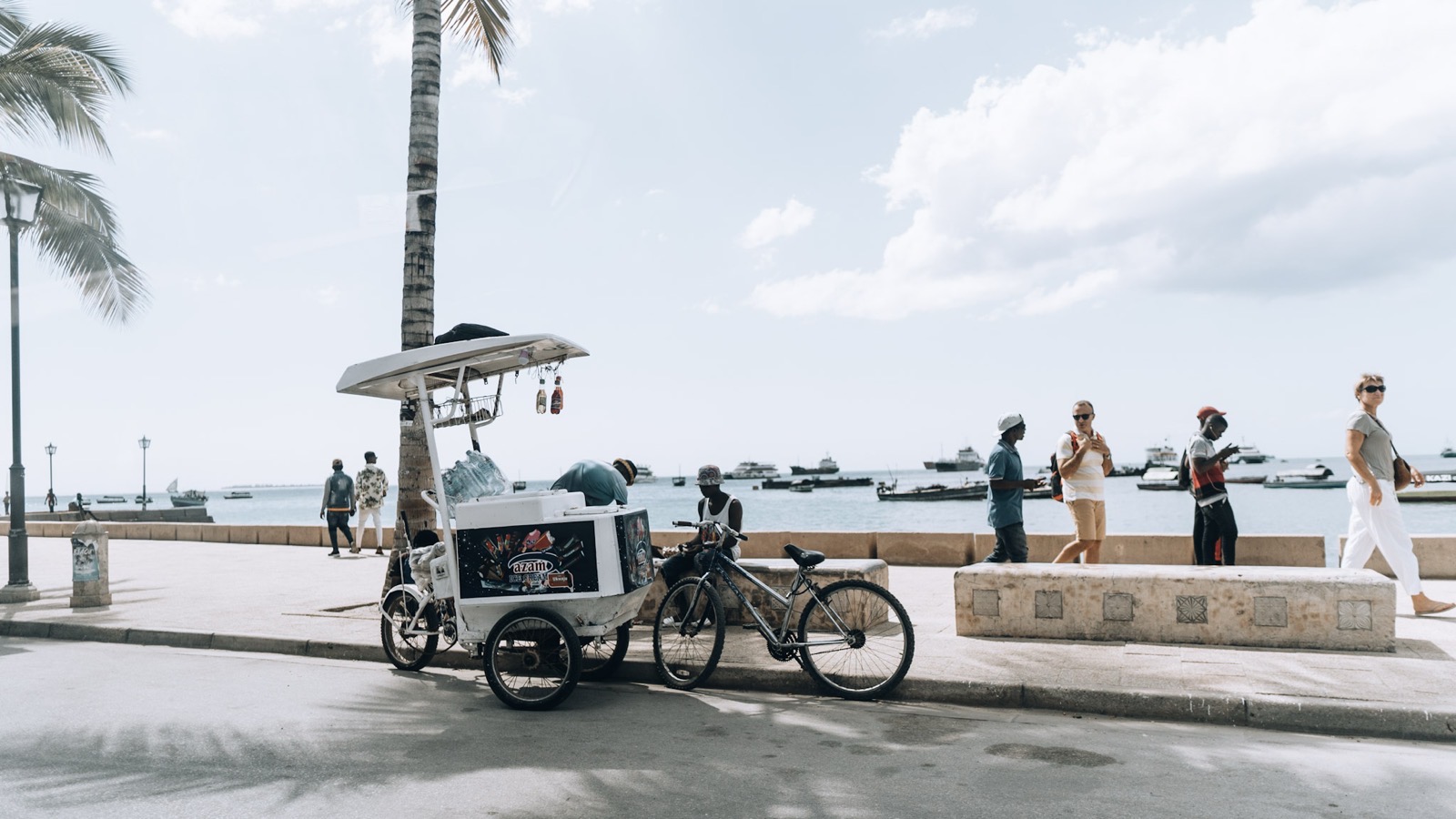
Stone Town is one of the better solo travel bases in East Africa. The reasons are specific: it is compact enough to walk (UNESCO World Heritage winding alleys take days to explore), it has strong independent traveller infrastructure from backpacker guesthouses through boutique hotels, the architecture and food markets reward solo exploration, and Forodhani night market is a genuinely easy place to eat alone and encounter other travellers.
The honest caveats: persistent touts and guides offering services are a daily reality in the tourist areas. This is a business tactic, not a threat — firms, brief responses without engaging work better than long explanations. Walking with purpose reduces approaches. “Hapana asante” (no thank you in Swahili) is useful and signals cultural awareness.
After dark in Stone Town: the areas around Forodhani seafront, the Anglican Cathedral, and the main market alleys are busy enough into the evening. Forodhani Gardens Night Market runs from approximately 18:00 to 21:00 — it is the standard solo dinner spot and a genuinely social environment. The narrower back alleys in the medina are best avoided alone after 21:00 — not because of violent risk, but because they are poorly lit and disorienting. Petty theft has been documented in the alleys at night.
The dress code genuinely matters in Stone Town. The majority population is Muslim — over 99% of Zanzibar’s population is Muslim — and conservative dress in the old town is the everyday norm, not an occasional preference. Visitors in sleeveless tops or shorts in the medina attract significantly more attention than those covering shoulders and knees. This applies to all visitors, not only women.
Female solo travel: what actually happens
The experience of solo female travellers in Tanzania divides cleanly by environment.
On safari: Safari camps and lodges are excellent environments for solo female travellers. You’re in a vehicle with a guide for game drives; the camp is fenced and staffed; other guests meet at dinner and at the campfire. The single woman at a dinner table of eight is immediately included in the group dynamic — the shared experience of watching wildlife creates natural common ground. Most solo female travellers report that the social aspect of safari camps is considerably easier than they expected.
In Stone Town: The specific challenge is persistent male attention and tout approaches in the tourist alleys. It is not threatening; it is a high-volume sales environment where every passing visitor is an opportunity. Confident body language — not stopping, not engaging with open-ended questions, a firm brief response — is significantly more effective than trying to explain or negotiate. The same approach that works for solo male travellers works here, with the additional adjustment of covering shoulders and knees, which measurably reduces attention.
On the east coast beaches (Paje, Jambiani, Michamvi): These are comfortable and social environments for solo female travellers. Paje is Zanzibar’s kite-surfing hub — multiple kite centres and water-sports operators draw an international crowd and create natural social mixing. Jambiani, south of Paje, is markedly quieter and more relaxed, with a cluster of boutique guesthouses and good restaurants that make solo travel social by default. Guesthouses on the east coast often have communal dining.
Transport: Book vetted transfers rather than random vehicles, particularly for airport arrivals late at night. Bolt and Uber operate in Dar es Salaam — much safer than unmarked taxis. Dala-dalas (shared minibuses) are used by solo travellers routinely; the U.S. State Department advises against them, but the more realistic risk assessment is that they are crowded and complicated, not dangerous. A woman with luggage on a dala-dala to a new destination is a logistical challenge — private transfer for those legs is worth the cost.
Getting around Tanzania: the honest transport map
Tanzania has more transport options than most first-time visitors expect — and fewer than some guides imply. Match the mode to the leg.
In Dar es Salaam:
- Bolt: Fully working in Dar es Salaam. Verifiable pricing, the driver’s face and registration visible in the app before you board, no negotiation required. The standard recommendation for solo travellers at Julius Nyerere International Airport. Do not take unmarked taxis at the terminal; request a Bolt from inside the arrivals hall.
- Ferries to Zanzibar: Azam Marine runs daily fast ferry crossings from Dar es Salaam to Zanzibar — the crossing takes approximately 90–120 minutes. Typical morning departures at 07:00 and 09:30. Book in advance during busy periods; the terminal is chaotic at departure time.
Between cities:
- The Kilimanjaro Express luxury bus connects Arusha and Moshi to Dar es Salaam — First Class runs about USD 30 one-way, takes roughly 10 hours overnight, and is air-conditioned with charging points. A genuine option for solo travellers on a budget who have time.
- Domestic flights between Zanzibar (ZNZ) and Kilimanjaro International Airport (JRO) take approximately 1 hour 5 minutes over 389 km. Precision Air and Air Tanzania operate this route. If your itinerary connects Zanzibar to the northern safari circuit, this is the most time-efficient routing.
On safari: Your safari operator handles all logistics within the national parks. You do not arrange your own transport within the parks — the guide and vehicle are the mode.
Money and exchange:
- Best exchange rates in Tanzania are at bureau de changes in Arusha, Dar es Salaam, and Zanzibar — not at airport exchange desks.
- ATMs are available in all major towns; plan for cash-only environments in national parks and smaller villages — a 2026 law now requires electronic payment at hotels and restaurants nationwide, but the villages and park gates this applies to are exactly where card infrastructure lags furthest behind, so don’t count on it changing anything for you. Bank withdrawal fees run approximately TZS 7,000–15,000 per transaction.
- Rough Guides specifically advises against street cash exchange — inflated rates and short-changing are the documented pattern. Use ATMs or licensed bureau de changes.
When I first arrived in Dar at midnight, the Bolt queue took less time than negotiating at the taxi rank had for a friend the week before. The app price was displayed before I confirmed. That is what vetted transport actually looks like in practice.
Health preparation: malaria, vaccinations, and water
Malaria is the most important health consideration for Tanzania. Transmission occurs in all areas below 1,800 metres elevation — which covers Zanzibar, Dar es Salaam, and all the major safari parks. The CDC and NaTHNaC both recommend antimalarial medication:
- Atovaquone/proguanil (Malarone): Start 1–2 days before arrival, continue 7 days after departure. Most popular choice for shorter trips.
- Doxycycline: Start 1–2 days before, continue 4 weeks after departure. Cheapest option; sun-sensitivity side effect is relevant for beach travel.
- Mefloquine: Weekly dose, start 2–3 weeks before. Not recommended for everyone — consult your GP.
Consult a travel clinic at least 4–6 weeks before departure. No antimalarial is 100% effective — combine medication with mosquito bite avoidance: 20–30% DEET repellent applied at dusk, long sleeves and trousers in the evenings, mosquito nets in budget accommodation without air-conditioning.
Water: Drink bottled or treated water for all uses in Tanzania and Zanzibar, including brushing teeth. Better safari camps provide filtered or bottled water; budget guesthouses may not. Do not use ice in settings where water safety is uncertain.
Yellow fever: Required proof of vaccination only for travellers arriving from or transiting through yellow fever endemic countries (transit over 12 hours). Flying directly from Europe or North America: no certificate required.
Routine vaccinations: Hepatitis A and typhoid are standard for Tanzania travel. Tetanus and diphtheria boosters if not up to date.
What solo Tanzania actually costs
Tanzania is not a cheap destination relative to other East African countries — conservation fees, safari infrastructure, and island resort prices all add up. These are realistic numbers:
Safari:
- Budget camping group joining safari (northern circuit: Tarangire, Ngorongoro, Serengeti): approximately USD 1,800–2,400 per person in low season; USD 2,200–3,500 in peak season (July–September). Vehicle, licensed guide, park fees, and camping accommodation included.
- Guide tip: budget USD 10–20 per person per day. Expert Africa recommends USD 8–10 per guest per day on premium safaris; USD 25–40 per vehicle per day combined is the private safari norm. Tips are expected and are a meaningful portion of guide income.
- Safari operator deposit: most operators require 30% to confirm a booking, balance due 60 days before departure.
Zanzibar:
- 3-star hotel average on Zanzibar: approximately USD 161 per night (Booking.com mid-2026). Stone Town budget guesthouses run lower. East coast bungalows in Jambiani tend to run cheaper than Paje resort-strip pricing.
- Hotel rates drop roughly 30% outside peak season (roughly June–September).
Entry costs:
- Tanzania single-entry tourist visa: USD 50 (most nationalities); US citizens require a multiple-entry visa at USD 100, valid 12 months.
- Zanzibar ZIC inbound insurance: USD 44 per adult (children aged 3–17: USD 22; under 3: free). Purchased at inbound.visitzanzibar.go.tz before arrival.
The total picture: A 10-day solo trip — budget camping safari, 3 nights Zanzibar, domestic flight within Tanzania — is realistically USD 3,000–4,500 all-in before international flights at budget-to-mid range. Tanzania rewards the investment. Go in knowing the real numbers.
Practical safety checklist
Travel insurance: Two separate requirements. First, comprehensive travel insurance with medical evacuation coverage — Tanzania’s remoteness makes this non-negotiable. AMREF Flying Doctors’ Extended Regional plan covers Tanzania and Zanzibar at USD 30 per person for 14 days, with 24-hour medical helpline access. Second, for Zanzibar specifically: the mandatory ZIC inbound travel insurance (USD 44 per adult, valid up to 92 days) purchased only at visitzanzibar.go.tz before arrival. The ZIC policy is checked by QR code at Zanzibar immigration and does not replace your own comprehensive insurance — get both.
Emergency numbers: Tanzania emergency: 112. Police: 999. Your lodge, guide, or camp is your first point of contact in any situation — they operate within established protocols.
Local SIM card: A Vodacom Tanzania or Airtel Tanzania SIM card with data is worth buying on arrival in Dar es Salaam or Arusha. A SIM plus a one-week data package costs approximately TZS 11,000 (Vodacom: includes 5GB data). This gives working navigation, messaging, and access to Bolt in Dar without relying on international roaming.
ATMs and money: ATMs are available in Dar es Salaam, Arusha, and Stone Town. Not in or near the national parks. Bank withdrawal fees in Tanzania run approximately TZS 7,000–15,000 per withdrawal (roughly USD 3–5). Split cash between bags; don’t carry all of it on your person in market areas.
Street money exchange: Rough Guides and other independent sources specifically advise against changing cash on the street in Tanzania — inflated prices and short-changed transactions are the documented pattern. Use ATMs or hotel exchange desks.
LGBTQ+ travellers
Tanzania (mainland) criminalises same-sex relationships under the Penal Code. Zanzibar has a separate legal framework with its own penalties. The U.S. State Department specifically cites LGBTQ+ targeting in its Tanzania Level 3 advisory (raised October 2025). Tanzania is not a destination I can recommend for open LGBTQ+ travel, and I would not describe it as safe for that community.
The connecting guides
The solo travel experience in Tanzania divides into two distinct destinations — the safari circuit and Zanzibar. Each has its own full guide:
- Tanzania solo female travel — detailed coverage of the female solo travel experience: how Stone Town harassment actually works, safari camp social dynamics, the dress code in practice, LGBTQ+ situation, and the single supplement breakdown.
- Zanzibar solo travel — full guide to Zanzibar as a solo base: east coast vs north coast social scenes, Stone Town navigation, transport options, the mandatory ZIC insurance detail, and Tim’s honest assessment of each beach area for independent travellers.
Tim’s honest note
The pattern I see consistently among solo travellers arriving on the east coast: the anxiety was higher before arrival than the experience warranted. The Stone Town learning curve is two days — day one feels relentless, day two you have calibrated your responses and the experience shifts. Safari camps are genuinely warm environments for solo visitors; the other guests are usually curious and welcoming. The practical preparations — insurance, vetted transfers, dress code, group joining trip for the safari — resolve most of what people worry about in advance.
Tanzania rewards independent travellers who put in the preparation. The preparation is not complex. It just needs to be done.
Related guides: Tanzania safari costs 2026 · Tanzania solo female travel · Zanzibar solo travel · Zanzibar entry requirements · booking sequence and camp etiquette · the full country planning guide
Frequently asked questions
Is Tanzania safe for solo travellers?
Moderately safe by East African standards. The U.S. State Department currently rates Tanzania at Level 3 (Reconsider Travel) citing unrest, crime, and terrorism — particularly in the Mtwara Region in the far south. This rating does not apply to the northern safari circuit, Dar es Salaam's tourist areas, or Zanzibar island. Violent crime against tourists is uncommon; petty theft in Stone Town and opportunistic scams in tourist areas are the more realistic concerns. The main practical adjustment: book vetted transfers in advance, don't walk late at night in unlit areas, and keep valuables split between bags.
Can you do a solo safari in Tanzania?
Yes — Tanzania's national park safaris actually suit solo travellers well because you are always in a vehicle with a licensed guide. You cannot enter the parks independently on foot or in an unguided vehicle. Your choice is: join a group safari (shared Land Cruiser, typically 4–7 people, eliminates single supplement, connects you with other travellers, cheaper overall); or book a private vehicle (full schedule control, higher per-person cost). Most Arusha-based operators offer joining trips for solo travellers and couples.
What is the single supplement on a Tanzania safari?
Most safari lodges and tented camps charge a single supplement for solo room occupancy. The supplement varies: a photo tour operator such as Wild Images lists a supplement of approximately USD 590 per week; Expert Africa notes that some camps charge a very low supplement or waive it entirely. Yellow Zebra Safaris states that no single supplement applies at certain properties during low and shoulder seasons. The practical workaround: book a group joining safari from Arusha, where you share a vehicle and the accommodation costs are structured around individual travellers.
Is Zanzibar safe for solo travel?
Yes. Petty theft exists in Stone Town — busy alleys, unattended bags on cafe tables — but violent crime against tourists is rare. The UK FCDO has no specific warnings for Zanzibar island (as of mid-2026). The east coast beach areas (Paje, Jambiani, Michamvi) are relaxed and comfortable for solo travellers. The main calibration: dress conservatively in Stone Town and local villages (shoulders and knees covered); avoid walking alone late at night in the back alleys of the medina. The mandatory ZIC travel insurance of USD 44 per adult must be purchased at visitzanzibar.go.tz before arrival — checked by QR code at immigration.
What should female solo travellers wear in Zanzibar?
Two zones, two dress standards. At the beach and in resort areas: normal beachwear is appropriate. In Stone Town, markets, local villages, and anywhere off the beach: cover shoulders and knees. A lightweight linen scarf or long dress serves both environments. Dressing modestly in Stone Town significantly reduces the frequency of persistent male attention — this is practical advice, not just cultural courtesy. A sarong from beach to accommodation is the standard pattern for women moving between zones.
What travel insurance do I need for Tanzania and Zanzibar?
Two separate requirements. First: your own comprehensive travel insurance with medical evacuation coverage — Tanzania's distances make evacuation planning essential; AMREF Flying Doctors' Extended Regional plan covers Tanzania and Zanzibar at USD 30 per person for 14 days. Second, specifically for Zanzibar: the mandatory ZIC inbound travel insurance (USD 44 per adult, valid up to 92 days) purchased only at visitzanzibar.go.tz. The ZIC policy does not replace your own travel insurance — it supplements it, and has a medical limit of approximately USD 50,000.
What vaccinations do I need for Tanzania?
Antimalarial medication is the priority — Tanzania below 1,800 metres (which covers Zanzibar, Dar es Salaam, and all the safari parks) has year-round malaria risk. The CDC and NaTHNaC recommend atovaquone/proguanil, doxycycline, or mefloquine; consult a travel clinic at least 4 weeks before departure. Routine vaccinations — hepatitis A, typhoid, tetanus — are standard. Yellow fever proof is required only for travellers arriving from or transiting through yellow fever endemic countries. If flying directly from Europe or North America, no yellow fever certificate is required.
What does solo travel in Tanzania actually cost?
A budget camping group joining safari on the northern circuit costs approximately USD 1,800–2,400 per person in low season, rising to USD 2,200–3,500 in peak season (July–September). Budget USD 10–20 per person per day for guide tips — Expert Africa recommends USD 8–10 per guest per day on premium safaris. The Tanzania single-entry visa costs USD 50 for most nationalities. Zanzibar ZIC inbound insurance adds USD 44 per adult. A 10-day solo trip combining Zanzibar and the northern circuit typically runs USD 3,000–4,500 all-in before international flights at budget-to-mid range.