
Facts & prices checked: 2026-07-18
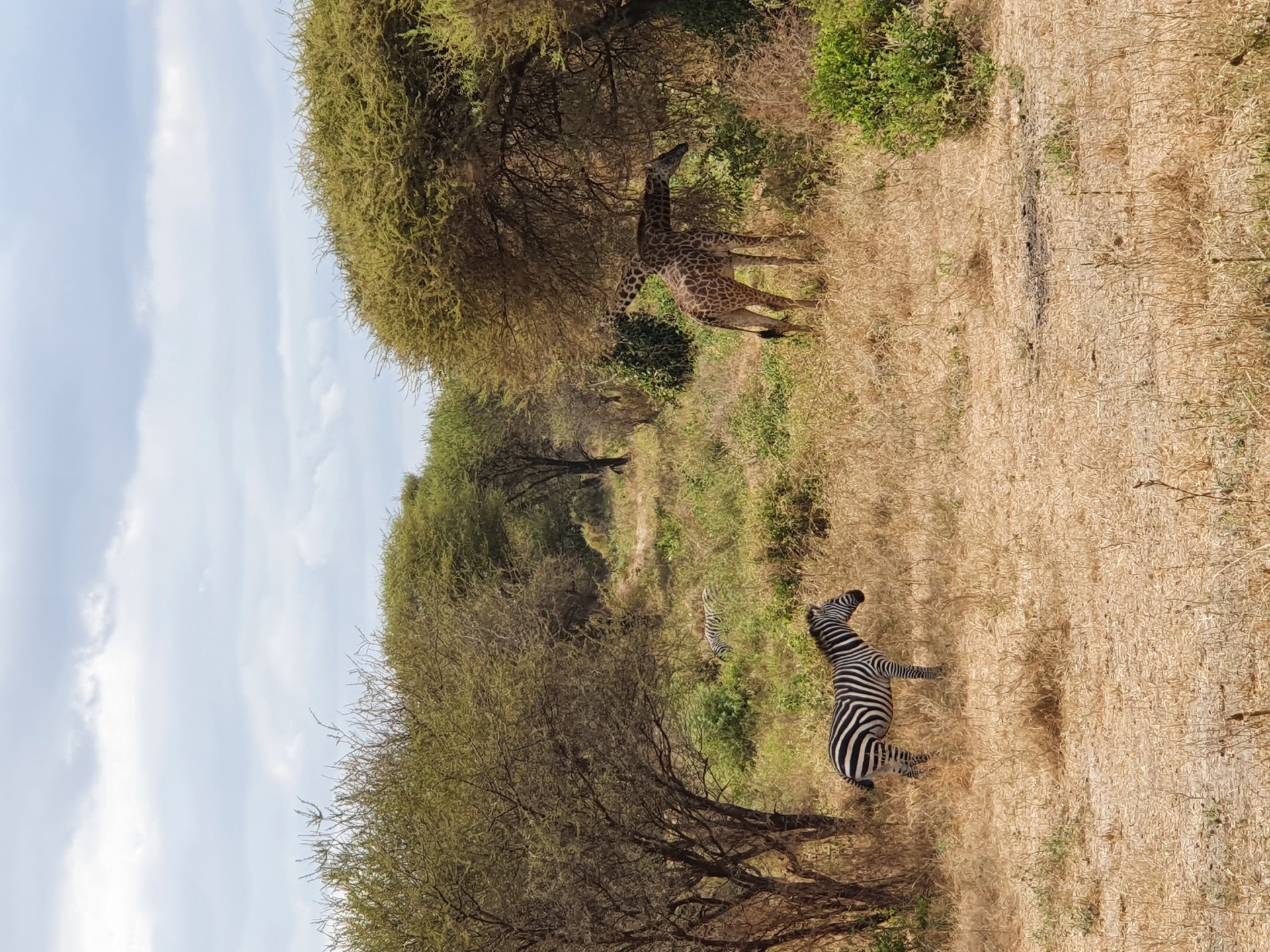
Tarangire isn’t just Tanzania’s best park for elephants — it’s also the country’s most reliable giraffe country. While visitors often focus on the elephant herds, they miss that the Wild Nature Institute monitors over 3,500 individual Maasai giraffes here — one of the most ambitious giraffe research programs in the world, playing out in front of every safari guest’s lens.
Why Tarangire is unique for giraffes
The number explains everything: the Wild Nature Institute has identified and documented over 3,500 individual Maasai giraffes in the Tarangire ecosystem across more than 25,000 square kilometres. Every animal is recognizable by its unique spot pattern — like a fingerprint — and tracked with computer software over years.
What this means for visitors: no other Tanzania park offers giraffe encounters at this density and with this reliability. Herds of 20–40 animals in the Tarangire area aren’t a fluke — they’re the expected norm, not the exception.
The explanation lies in the landscape. Tarangire offers exactly what Maasai giraffes need:
- Acacias in high density — the species’ preferred food source, with young leaves and shoots between long thorns
- Old baobab trees — giraffes occasionally eat baobab foliage and use the trees as landmarks
- The Tarangire River — the only permanent water in the region during the dry season, where all the large mammals converge
- Low tourism pressure — compared to the Serengeti and Ngorongoro, Tarangire sees markedly fewer vehicles, allowing calmer, less disturbed observation
The white giraffe calf documented in Tarangire in 2015 due to leucism is the best-known single event — an extremely rare phenomenon that shows just how well the Wild Nature Institute’s individual monitoring works in the park. Not every visit brings such a surprise, but the scientific density of observation makes Tarangire Tanzania’s best-documented giraffe habitat.
The drinking sequence: Tanzania’s most striking non-hunting drama
I watched a giraffe’s drinking sequence at a Tarangire waterhole — and the image has stayed with me in a way no hunting scene has matched.
The giraffe approached from a distance. A large female, an estimated 4.5 metres tall, with a calf in tow. Both approached the small pool of water hesitantly. Then: 20 minutes of stillness. Watching. Stepping back. Approaching again. The calf seemed ready to drink; the mother held it back. They looked in every direction. Nothing happened — no predator, no noise. And still this hesitation, this systematic caution.
When the mother finally splayed her front legs wide and lowered her neck, that was the moment: the 1,000-kilogram animal, which normally radiates health and strength above all, was completely vulnerable for 15 seconds. Fully focused on the act of drinking, every escape route limited. The calf drank alongside her, smaller but similarly exposed.
Then it was over. Both upright again, an immediate retreat.
This sequence takes patience. Wait 20 minutes and you get 15 seconds of drama. For some safari guests, that’s not enough. For others, it’s the moment they take home from Tanzania.
The best zones in Tarangire
Not every part of Tarangire offers equally good giraffe viewing. The most productive areas:
Tarangire riverbanks (northern section) The banks of the Tarangire River between the main gate and the Silale Swamp are the best zone in the dry season. The river is the only permanent water — all the large mammals converge here, and giraffes are regularly seen along the banks.
Silale Swamp area The Silale Swamp in northern Tarangire is a wildlife concentration point. In the dry season, elephant herds, buffalo, zebra, and giraffes regularly gather here. The open visibility in the swamp area allows good observation.
Baobab savanna east of the river For the classic photo subject — a giraffe in front of an ancient baobab trunk — the savanna east of the river is the best address. Baobab density is highest here, and the light is best in the morning.
Guidori Zone (southern Tarangire) The southern part of the park sees markedly less traffic. Giraffes are rarer here, but when you find them, encounters are often more exclusive — no other vehicle in sight.
Observing biology up close
Tarangire is the right place to study the Maasai giraffe’s extraordinary biology directly.
The ossicones The horn-like skull extensions — ossicones — are present in both sexes. From the vehicle, they’re identifiable: in males, the ossicones are often bald on top and thickened from repeated “necking” (using the neck as a weapon in combat). In females, they usually stay haired. In the field, you can distinguish sexes from a distance this way.
Necking: combat with the neck When you see several adult males together, it’s worth watching: bulls establish rank through “necking” — rhythmically swinging the neck against a rival’s body. Mild forms are ritual dominance gestures. Serious fights can briefly knock an opponent unconscious. In Tarangire, with its large male population, necking observations aren’t rare.
Watching acacia feeding up close The precise way a Maasai giraffe reaches between the long acacia thorns — using its long, extensible lips and prehensile tongue — is easy to observe from a safari vehicle. Tarangire’s giraffes are habituated to vehicles and often allow observation from distances of 20–30 metres.
Social structure Tarangire’s large giraffe population allows observation of the loose social structure: females with calves in small groups, young bulls in bachelor groups, old males often solitary. In the dry-season waterhole context, these groups occasionally come together — temporary concentrations of 15–20 giraffes at one spot are possible.
Giraffe photography in Tarangire
Tarangire offers the best combination of density, light, and backdrops for giraffe photography anywhere in Tanzania.
The classic shot: a giraffe against an ancient baobab trunk, golden side-light, early morning or shortly before sunset. Location: the baobab savanna east of the Tarangire River. Time: 6:00–8:00am (gate opens at sunrise) or 5:00–6:30pm.
Focal length: a 200–400mm telephoto lens allows portraits of the head showing the spot pattern, long eyelashes, and ossicones. Focus point: the eye nearer the viewer. Giraffes have unusually large, expressive eyes — close portraits work very well.
Wide angle (16–35mm): when a giraffe approaches the vehicle — which happens regularly in Tarangire — a wide-angle lens lets you show the animal in relation to the landscape. A shot that captures the contrast between the animal’s enormous size and the vastness of the savanna.
The drinking stance: this shot takes patience and positioning. Wait at a waterhole early in the morning, camera ready. The drinking stance (front legs splayed wide, neck at a 45-degree angle down) is one of the rarest giraffe images to actually capture — because the moment is brief and the sequence beforehand is long.
Sunlight: Tarangire’s light in the dry season (July–September) is exceptionally clear — no humidity, no haze. The golden light of the first and last hour is more intense than in the wet season. The reddish-brown savanna contrasts strongly against the giraffe’s pattern.
Tarangire as part of a northern-circuit safari
Tarangire is the first park on the classic Northern Circuit — roughly 120 km from Arusha, a two-hour drive. Anyone planning the Northern Circuit (Tarangire → Ngorongoro → Serengeti) should know:
Giraffes across the whole circuit:
- Tarangire: highest density, best photo conditions, best drinking sequences — Tarangire is the giraffe stop
- Ngorongoro Conservation Area: giraffes on the crater rim and in the NCA, but not on the crater floor (walls too steep)
- Serengeti: a large, widely dispersed population — less concentrated than Tarangire, but reliable in the Seronera area
For travellers who specifically prioritize giraffes: plan at least 2 nights in Tarangire (morning drive plus afternoon drive = 2 game drives per day). One night is only enough for a single full safari day.
The Tanzania giraffes guide covers every park in comparison, the full biology of the Maasai giraffe including its IUCN Endangered status, and the best viewing strategies for the entire Northern Circuit.
Conservation status and research
Tanzania is home to the largest giraffe population of any African country — an estimated 28,580 Maasai giraffes nationwide, according to TAWIRI surveys. The global giraffe population fell from 151,702–163,452 animals in 1985 to 97,562 by 2015 — a loss of nearly 40 percent in thirty years. The Maasai giraffe is classified by the IUCN as Endangered.
Tarangire’s importance for the species’ conservation is direct: the Wild Nature Institute program, which documents over 3,500 individual giraffes in the ecosystem, is one of the most important data sources for conservation strategies worldwide. Every safari in Tarangire — through park fees and concession charges — helps fund this protection.
The white giraffe calf documented in 2015 due to leucism was a scientifically significant event: leucism in Maasai giraffes is extremely rare, and the documentation was only possible thanks to the park’s ongoing monitoring program. The animal was tracked for several more years afterward.
Tarangire in practice: entry, fees, and logistics
Tarangire is logistically the simplest park on the Northern Circuit — it’s the first stop on the route from Arusha and makes a good first safari day.
Distance and drive time:
- From Arusha: roughly 118–140 km on a paved road, about a 2-hour drive
- Arrival point: Kilimanjaro International Airport (JRO), about 30 minutes from Arusha town
- The park is the first stop on the classic Northern Circuit: Tarangire → Lake Manyara → Ngorongoro → Serengeti
Park fees (non-residents, 2024/2025, TANAPA rates):
- Adult entry: USD 59 per person per day
- Concession fee for in-park accommodation: USD 59 per person per night
- Children 5–15: reduced rate
- East African citizens: TZS 10,000 per adult
- Vehicle entry fee additional — handled by the operator
All fees apply to a 24-hour window, not a calendar day. If you enter at 9:00am, the window runs until 9:00am the next day — not until midnight. This is a common planning mistake for self-bookers.
When to book:
- Dry season (July–October): 3–6 months ahead for popular tented camps inside the park
- School holiday period (July/August): highest demand, book early
- Rainy season (March–May): cheaper, fewer vehicles — but the park’s dirt tracks can get difficult
I’ve visited Tarangire both in the dry season (September) and the short rains (November). September is unmatched for animal density at the river — but November has its own appeal: fresh vegetation, no dust, and often no other vehicles in sight.
The baobab savanna: Tarangire’s second calling card
Tarangire is sometimes called the “baobab capital of the world” — and for giraffe photography, that’s no coincidence, but a direct advantage.
Old baobab trees (Adansonia digitata) can live for several hundred to over a thousand years. The specimens in Tarangire are some genuinely ancient giants — trunks 5–10 metres in circumference, gnarled surfaces, almost no leaves in the dry season, but an extraordinary presence. A Maasai giraffe beside or behind one of these trees: that’s the photograph you take home from Tarangire.
Why giraffes and baobabs go together:
- Giraffes occasionally eat baobab foliage and bark, especially in dry periods
- Baobab fruit is nutritious — the pulp contains roughly 175 mg of vitamin C per 100 g, more than many citrus fruits
- The trees are landmarks: giraffes return repeatedly to the same baobabs
- Photographically, a baobab acts as a natural scale reference — it makes the 5–6 metre body height of an adult giraffe visually legible
Best photo spots for giraffe-baobab combinations:
- The savanna zone east of the Tarangire River, especially between the main gate and the Silale Swamp
- Light: early morning from the east (sun behind you), or afternoon against the sun for silhouette shots
- Dry season: baobabs lose most of their leaves — trunks and giraffe both become more sharply visible
Birdlife: Tarangire is also a top-tier birding destination
Most visitors come for elephants and giraffes — and miss that Tarangire is one of East Africa’s best bird sanctuaries.
Tarangire has documented over 550 bird species across the ecosystem, including two near-endemics — the ashy starling and the yellow-collared lovebird, found essentially nowhere else on earth outside the Tarangire-Manyara ecosystem. That’s an ornithological density that impresses even non-birdwatchers.
Species regularly seen from a safari vehicle:
- Yellow-necked spurfowl (common in the dry areas)
- Yellow-bellied weaver (large colonies in acacias)
- Dickinson’s shrike-flycatcher
- Northern white-crested turaco
- Azure kingfisher along the Tarangire River
- Ostrich (year-round on open savanna)
The nice thing about Tarangire’s birdlife: you don’t need to be a dedicated birder to be impressed. The sheer size of some species — marabou storks, saddle-billed storks, migrating white storks — and the colour of the weavers and kingfishers is visually striking even for casual observers.
For me personally, the first morning in the park was a surprise: I had come for the giraffes and elephants, and then a northern white-crested turaco flew right past the vehicle — an intense blue I didn’t recognize from any field guide.
Wet season vs. dry season: what really differs
The question “when to go to Tarangire?” can’t be answered with a single simple recommendation — because it depends on what you’re looking for.
Dry season (July–October):
- Elephants, giraffes, zebra, and buffalo concentrate at the Tarangire River
- Vegetation is low — visibility is at its best
- Classic dry-season drinking sequences at the waterhole
- The most other vehicles, but still far fewer than the Serengeti or Ngorongoro
- Dust — tracks away from the river can get very dusty in dry conditions
- Predictable, dry days: clearer photo light than in the wet season
Short rains (November–December):
- Animals disperse across the whole ecosystem — including outside the park boundaries
- Fresh vegetation, intense greens — a striking contrast against the red laterite soil
- Giraffe calves more often visible (births cluster after the first rains)
- Almost no other vehicles
- Dirt tracks can occasionally become impassable — worth checking with your operator
Long rains (March–May):
- Cheapest prices, but actually the toughest conditions
- Tracks are often hard to drive; some lodges close for renovation
- Not suited for dry-season experiences (waterhole scenes)
The scientifically confirmed fact: elephants and other ungulates concentrate at the Tarangire River from July to October and disperse onto the surrounding plains outside the park boundaries from November onward. The same applies to giraffes. If you want maximum animal density, come in the dry season — if you want the quieter, more personal experience, come in November or December.
Related guides
Frequently asked questions
Why is Tarangire the best park for giraffes in Tanzania?
Tarangire has the highest giraffe density of any Tanzania park — a combination of food supply (acacia, baobab bark), permanent water (the Tarangire River), and one of the world's largest giraffe research programs. The Wild Nature Institute monitors over 3,500 individual Maasai giraffes in the ecosystem across more than 25,000 km². That means you encounter well-researched animals habituated to vehicles here — and more often than in any other Tanzania park.
When is the best time to see giraffes in Tarangire?
The dry season from June to October is optimal. The Tarangire River is the only permanent water in the region at that time — giraffes, elephants, zebra, and buffalo all concentrate along the river. Giraffes are also reliably seen in the wet season (November–May); food supply is actually greater then, but the animals spread out more widely. For the classic waterhole drinking sequence: dry season, early morning.
What makes a giraffe's drinking sequence so remarkable?
Drinking is the most vulnerable moment in a giraffe's life. To lower its head far enough, the front legs must be splayed wide or bent — a position that massively limits its ability to flee or react. Giraffes therefore often hesitate for 20–30 minutes at a waterhole before deciding to drink. The act itself usually lasts only 15–30 seconds. Anyone patient enough to wait experiences one of the most striking behavioural scenes Tanzania has to offer — without any hunting involved.
Can you see a white giraffe calf in Tarangire?
In 2015, a white giraffe calf was documented in Tarangire due to leucism — reduced melanin pigmentation that makes the coat appear whitish-cream. Leucism in giraffes is extremely rare. There's no guarantee of seeing such an animal, but Tarangire's well-documented individual-tracking program run by the Wild Nature Institute increases the chance of relocating known individuals.
Which zones in Tarangire are best for giraffes?
The best zones: the Tarangire River area (the Silale Swamp region and the riverbanks north of the main gate) for dry-season concentrations; the baobab-rich savanna east of the river for classic photo subjects; and the open bush savanna south of the Silale Swamp for rare encounters with large groups. Early morning (5:30am–8:00am) is when giraffe activity is highest.
Are giraffe calves visible in Tarangire?
Giraffe calves are possible in Tarangire year-round. Birth rate isn't strictly seasonal, but newly born calves are seen more often after the wet season (November–May). Calves are already about 1.8 m tall at birth and can walk within a few hours. They stay in close proximity to the mother for the first months — separations are rare.
What is the entry fee for Tarangire National Park?
The non-resident entry fee is USD 59 per adult per day. Children between 5 and 15 years pay a reduced rate; under 5 is free. On top of park fees, there may be concession fees for accommodation inside the park (also USD 59 per person per night) plus vehicle entry fees. Tanzanian and East African citizens pay considerably less — TZS 10,000 per adult.
How far is Tarangire from Arusha and how do you get there?
Tarangire is roughly 118–140 km southwest of Arusha — about a 2-hour drive on a well-maintained road. The park is the first stop on the classic Northern Circuit (Tarangire → Lake Manyara → Ngorongoro → Serengeti). Arrival is almost always by private safari vehicle from your operator. Kilimanjaro International Airport (JRO) near Arusha is the standard arrival point.