
Facts & prices checked: 2026-06-25
Tanzania’s Maasai giraffe is the most-watched large mammal on the planet that most visitors still fundamentally misunderstand. People see the size and the pattern and assume slow, placid, and purely decorative. The behaviour tells a different story: a highly complex social life built around dominance contests that can knock rivals unconscious, a drinking posture that makes every visit to the waterhole a genuine predation risk, and a calf birth that begins with a 2-metre vertical drop to the ground. The main Tanzania giraffe guide covers where to see them across Tanzania’s parks. This guide covers what to look for when you find them.
The fission-fusion society: why the tower keeps changing
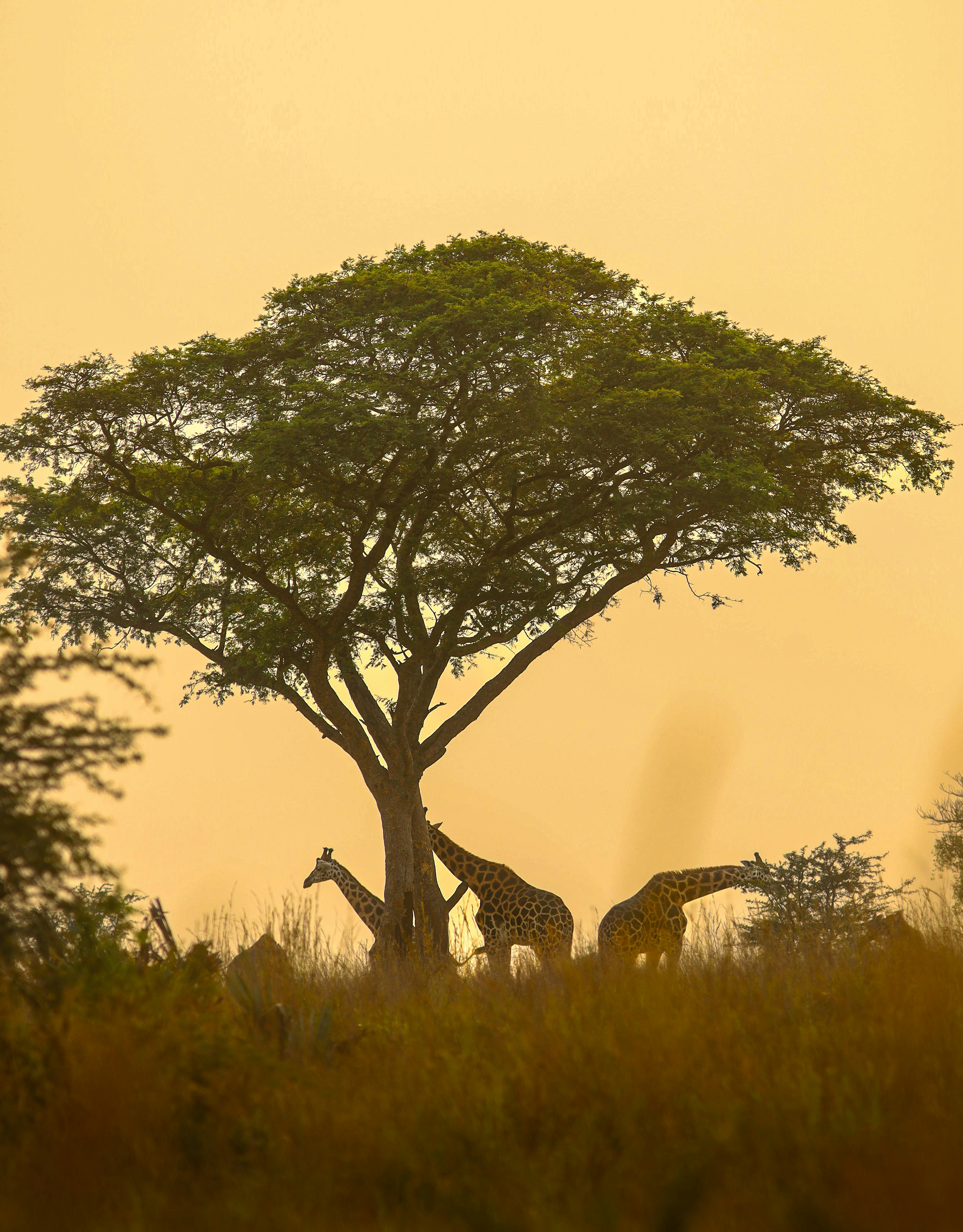
The Maasai giraffe does not live in a fixed herd. It lives in what ecologists call a fission-fusion society — a loose social network where individuals move between aggregations continuously. The tower you are watching today may have a completely different composition next week, even if it occupies the same stretch of Tarangire riverbank. Individuals join and leave freely based on food availability, reproductive status, and individual preference.
This fluidity is part of why the Wild Nature Institute’s individual recognition research in Tarangire — using the patch pattern of each giraffe’s coat as a unique identifier, the same way a human fingerprint works — was so important. Once you can track individuals, the structure emerges. What looked like random aggregation turns out to have social preferences within it: females with calves associate preferentially with other females with calves. Young males form loose bachelor groups where they practise necking. Adult dominant males range more widely and alone, only overlapping with female groups when females are in oestrus. The research in Tarangire, monitoring more than 3,500 individually identified giraffes across 25,000 km², is building the dataset that reveals how this works at population scale.
For visitors, the practical implication is this: the groups you see are real social aggregations, not accidental collisions. The tower of twenty giraffes moving along the Tarangire River in July is a real social event, not just twenty animals who happen to be at the same waterhole.
Necking: the primary language of male dominance
Male giraffes compete for access to females and resources primarily through necking — a form of combat using the neck as both weapon and shield. Two males position themselves side by side, at an angle, or facing opposite directions, and swing their necks to deliver blows. The ossicones — the horn-like protuberances on the head, which are ossified cartilage covered in skin rather than true horns — and the dense bone of the skull are the impact points.
Sparring between young males is exploratory and relatively gentle. Combat between adult bulls is a different matter. The neck of an adult male Maasai giraffe can be over 2 m long and weigh 270 kg or more. A full-force blow lands with substantial impact. Serious necking bouts can knock the recipient off balance, drive them to the ground, or render them briefly unconscious. It is not the slow-motion performance it appears at distance; at close range, the sound of impact is audible.
The visible record of combat history is written on older males’ ossicones. Young males’ ossicones are covered in hair. As males age and fight repeatedly, the ossicones become bald, thick, and calcified — the hair worn off by repeated impacts. Some older dominant bulls also develop a third central ossicone from scar tissue at an impact site. If you want to identify a dominant adult male quickly, look at the ossicone tips: bald and calloused means experienced.
I have watched two adult male giraffes necking in the open woodland east of the Tarangire River, in early morning light, for approximately 12 minutes. The sound carried 200 metres across the grass. The smaller male retreated. The larger one watched him go, then browsed the nearest acacia as if nothing had happened. Both were individually tracked animals in the WNI dataset, which is a detail that only registers later but changes how you understand what you are watching.
Drinking: the most dangerous 30 seconds of a giraffe’s day
Nothing in Tanzania safari produces quite the same sustained attention as watching a giraffe approach a waterhole.
The physics of the problem: an adult male Maasai giraffe stands approximately 5.5 m tall. Getting its head to ground-level water requires lowering the head by more than 3 m. There are two ways to do this: splay the front legs laterally by 1.5–2 m, creating a wide stance that drops the torso; or kneel on both front legs, which is rarer. Both methods achieve the same thing: a position from which recovering to a running stride takes several seconds. In those seconds, the giraffe cannot sprint. It knows this.
The approach to a waterhole reflects the risk calculation in real time. A giraffe will typically stop 30–50 m from water and stand. It scans. It may remain motionless for 5 minutes, then approach another 10 metres and stop again. This is not indecision — it is active predation-risk assessment. The giraffe is reading the vegetation for concealed lions, checking the water surface and banks for crocodile presence, assessing where other animals are and how they are behaving. At Tarangire’s dry-season waterholes, where lions know exactly what giraffes are doing at this spot every day, the extended assessment makes sense. There is evidence the lions know this too — they position in cover near drinking sites and wait.
When a giraffe finally commits, the descent is deliberate: front legs stepping out wide in stages, neck lowering in corresponding increments. At full stretch, the giraffe typically drinks for 15–30 seconds before beginning the slow recovery to full height. Then it often moves immediately away from the water before stopping again. The entire waterhole visit may have taken 45 minutes of approach and assessment for 20 seconds of actual drinking.
I have watched this sequence three times with different guests at Tarangire waterholes, and it is the best 30-minute wildlife sequence in Tanzania that does not involve a kill. The giraffe’s vulnerability and the visible calculation of risk in a 1,000 kg animal is a different kind of drama than a predator chase — slower, quieter, and in its own way more revealing.
The cardiovascular problem of being very tall
The drinking posture creates a cardiovascular problem that is worth understanding. When a giraffe stands normally, the heart — which weighs approximately 11 kg and generates blood pressure approximately twice that of a human — pumps blood up the neck (approximately 2 m of vertical travel from heart to brain) against gravity. It has evolved a massively enlarged, thick-walled heart to maintain adequate cerebral perfusion at standing height.
When the giraffe lowers its head to drink, gravity now assists rather than opposes blood flow to the brain — blood pressure in the cerebral circulation would become dangerously high if uncontrolled. Giraffes have evolved a specialised network of small blood vessels called the rete mirabile (Latin: wonderful net) at the base of the brain that acts as a pressure buffer, preventing the head-rush of blood that would otherwise occur when the head drops 3 m. They also have specialised venous valves in the jugular vein that prevent blood pooling in the head.
This vascular engineering is the reason the giraffe can survive a posture that, in any mammal without these adaptations, would cause arterial rupture or fainting. It is also why recovering from the drinking position is not instant — the cardiovascular system needs a moment to readjust. In that readjustment window, the predation risk is at its highest.
Calves: a 2-metre birth and an immediate walk
Giraffe calves are born after a gestation of approximately 14–15 months. The birth itself is startling in its mechanics: the mother stands throughout, and the calf falls approximately 1.8–2 m to the ground, landing typically on its head and neck. The fall stimulates breathing and breaks the amniotic sac. The calf’s neck and joints are flexible enough to absorb the impact without injury.
Within 20–30 minutes, the calf begins attempting to stand. The process looks improbable — the legs are so long relative to the body, and the coordination is not yet there, so the first attempts collapse repeatedly. But within two to three hours, most calves are walking. They are born at approximately 1.8–2 m tall — already as tall as an adult human — but they are the most vulnerable they will ever be. The coat is the same pattern as adults (the patch pattern that individually identifies each animal is present from birth), but the body is slight and the legs still uncertain.
Neonatal mortality in the Maasai giraffe is high, though the Wild Nature Institute’s individual tracking data from Tarangire is building the precise dataset — calf survival rates remain an active research question. What is documented: lions, spotted hyenas, and leopards all take calves in the first weeks of life. The mother stays close, and will kick at predators approaching a calf with force sufficient to seriously injure a lion. Adult female giraffes with newborn calves are more alert and more spatially separated from large aggregations than females without calves.
The best window to see very young calves in Tarangire is the green season (November–February), when a significant proportion of births are concentrated. A newborn calf in the first 48 hours of life — still uncertain on its feet, damp from the amniotic sac, staying directly under its mother — is one of the most striking things in Tanzania safari.
Diet: the acacia specialist
The Maasai giraffe is primarily an acacia browser. The height advantage is precisely calibrated: at 5.5 m, an adult male can reach the topmost branches of acacias — the foliage that no other browsing species can access. This creates a distinct vertical niche. In Tarangire’s mixed acacia-baobab woodland, you will see giraffes feeding at heights where impala, kudu, and elephants cannot reach, even though all of them are browsing the same acacia trees at different levels.
The tongue — approximately 45–50 cm long, prehensile, and dark blue-black in colour — strips leaves and small branches from acacia thorns with precision. The dark colouration is thought to be UV protection: the tongue spends many hours each day in direct equatorial sunlight stripping thorny branches, and the melanin pigmentation may prevent the cellular damage that pale tissue would accumulate. A giraffe feeding against the light, tongue extended around an acacia branch, is the close-range photograph you should be ready for: the colour of the tongue photographs vividly at 200mm.
The acacia’s thorns — some exceeding 8 cm on certain species — are navigated by the tongue’s grip and the angle of approach. The giraffe draws leaves inward against the thorns rather than pushing against them. Even watching this at close range, the apparent indifference to thorns that would draw blood from a human finger is striking.
What the conservation numbers mean for what you are watching
The Maasai giraffe’s population has declined by approximately 39% — from around 71,000 individuals to approximately 43,200. The IUCN classifies the species as Endangered. Tanzania holds more Maasai giraffes than any other country: approximately 28,580 (TAWIRI Systematic Reconnaissance Flight data), with independent estimates suggesting more than 35,000 across parks, reserves, and wildlife management areas.
This context changes something about the watching. The behaviour is the same as it was when populations were higher. The necking is the same, the drinking sequence is the same, the calf is as improbable. But you are watching it in a population that has lost nearly 40% of its numbers within living memory. The Wild Nature Institute’s individual tracking project in Tarangire exists because each giraffe matters individually to population dynamics — the data is needed to understand why some survive and others do not.
That is the background worth carrying when you are parked at a Tarangire waterhole watching a giraffe that has been standing still for 25 minutes. The animal is doing something specific and difficult and irreplaceable.
For the full species guide — where to see giraffes across Tanzania’s parks, Ngorongoro Crater absence, Ruaha’s Giraffe Skin Disease, and photography strategy — see the Tanzania giraffe guide.
Related guides
- Tanzania giraffe guide — where to see giraffes in all Tanzania’s major parks
- Tarangire National Park — Tanzania’s best park for giraffe viewing, dry-season elephant concentrations, and baobab landscape
- Northern Circuit safari guide — Tarangire, Ngorongoro, Serengeti in one itinerary
- what lives in Tanzania’s parks — complete species guide to Tanzania’s major parks
- Ruaha National Park — Tanzania’s second-largest park, significant giraffe population, and Giraffe Skin Disease context
Frequently asked questions
What is giraffe necking and why do they do it?
Necking is the primary combat method between male Maasai giraffes. Two males stand side by side or at an angle and swing their necks to deliver blows using the ossicones and the solid bone of the skull as impact points. The goal is to throw the rival off balance, knock them to the ground, or force them to retreat. Serious necking bouts can knock an opponent unconscious. Males who win consistently gain access to females and feeding sites. Older dominant males typically show the evidence: bald, calcified ossicones from years of combat, and often a third central ossicone formed from scar tissue. At Tarangire or the Serengeti, two young bulls sparring is a relatively common sighting — it looks slow and exploratory compared to adult competition, which is fast and genuinely violent.
Why is drinking so dangerous for giraffes?
To get its head to water level, an adult Maasai giraffe must splay its front legs approximately 1.5–2 m apart, lowering the head by more than 3 m from its normal height. This position compromises the giraffe's ability to sprint immediately — recovering to a running posture takes several seconds. In that window, it is vulnerable to ambush by lions and, at river crossings, to large Nile crocodiles. The result is that giraffes are extraordinarily cautious at waterholes. You can watch a single giraffe approach a waterhole, stand and assess for 20–30 minutes, retreat, return, and repeat this cycle multiple times before committing. When it finally commits, it typically drinks for only 15–30 seconds before recovering to full height. Watching this sequence at Tarangire's dry-season waterholes is one of the most compelling slow-motion behavioural sequences in Tanzania.
What does a giraffe sound like? Do they vocalise?
Giraffes were long thought to be largely silent, but research has established that they vocalise infrasound — frequencies too low for human ears to detect without equipment — as well as humming, particularly at night. The hum has been recorded at Tarangire and in the Serengeti and appears to be a contact call used when the group is resting. Giraffes also produce snorts, grunts, and hissing sounds in alarm or close-range communication. Calves bleat loudly when separated from their mothers. In the field, you rarely hear a giraffe: the hum is inaudible, the alarm calls are brief, and the walking is completely silent. The silence is one of the strangest things about them — a tower of twelve giraffes moving through Tarangire woodland at dusk arrives and leaves without a sound.
How do giraffe calves survive being dropped 2 metres at birth?
The birth drop is real — a giraffe calf falls approximately 1.8–2 m from its standing mother to the ground, typically landing on its head and neck. The calf's joints and neck are flexible enough to absorb the impact, and the fall appears to stimulate breathing. Within 30 minutes, the calf is attempting to stand. Within a few hours, it is walking. The calf arrives at 1.8–2 m tall — already taller than most adult humans — but it is the most vulnerable it will ever be. For the first weeks of life, spotted hyenas, lions, and leopards are real threats. The mother stays close and will kick at predators, but neonatal giraffe mortality is high. If you see a very young calf in Tarangire, the wobbling walk and knob-kneed legs are unmistakable — it looks like a giraffe assembled from spare parts, and it usually stays directly under its mother.
Do giraffes sleep? How do they lie down?
Giraffes sleep, but rarely and briefly — typically less than 30 minutes of deep sleep in a 24-hour period, usually taken in very short intervals. For deep (REM) sleep, they fold their front legs and rest their neck and head against their own body or rump. The fully recumbent position — neck laid along the ground — is used for the deepest sleep phases, but briefly, because rising from that position is slow and dangerous. A giraffe that rises from full recumbency is potentially vulnerable for several seconds. In practice, most resting is done standing, with one or both eyes partially open. If you see a giraffe lying down in the field — which is unusual and brief — you are seeing something that rarely lasts more than a few minutes.
What is the best park in Tanzania to observe giraffe behaviour?
Tarangire National Park gives the best combination of giraffe density and viewable behaviour. The dry-season waterhole sequences (giraffe approach, assessment, drinking posture, withdrawal) are the most accessible behavioural sighting in Tanzania that does not require predator activity. The Tarangire River banks concentrate giraffe in July–September, and the Wild Nature Institute's long-term monitoring project means you are watching the best-documented giraffe population in Africa — more than 3,500 individually tracked individuals. For necking, bachelor groups in Tarangire's open woodland areas are the most common setting. For calf observation, the green season (November–February) when many births occur gives the best chance of seeing a very young calf.