
Facts & prices checked: 2026-06-25
Tanzania’s first safaris were camping safaris. Before lodges existed, before tented camps with plunge pools and butler service, before the word “glamping” was invented — the only way to see the Serengeti was to drive in, set up a tent, and sleep inside the park with the animals around you. That original version of the safari still exists. It is cheaper, more immersive, and stranger than anything a lodge can offer. This guide explains exactly how it works.
Why camping safari is the original experience
The permanent lodge came to the Serengeti decades after the safari came to the Serengeti. The original model — vehicle, tent, cook, campfire — was the only option for early wildlife expeditions, and it remains the purest version of the experience.
The price difference between camping and lodge safari is significant. Lodge safaris from mid-range operators run USD 350–600 per person per day. Budget camping safaris, including a mobile operator’s tent and kitchen, run USD 150–250 per person per day for a shared northern circuit itinerary. A 7-day northern circuit camping safari costs approximately USD 1,800–2,400 per person in low season versus USD 2,400–4,200 in peak season — at least four times less than a comparable lodge trip for the same parks and nights. The facts database confirms this ratio: one safari comparison guide states lodge safaris cost at least four times as much as camping safaris.
The experience difference cuts both ways. Lodges offer hot showers, proper beds, bar service, and staff who bring coffee to your veranda before dawn. Camping gives you something lodges cannot: the sound of the bush from inside a tent with no walls between you and the night. You hear the hyenas. You feel the cold. You know the lion is close not because someone told you at dinner but because you heard it twenty minutes ago and the sound has not moved far enough away.
Who camping safari is for: travelers who are comfortable in basic outdoor conditions, who want the most immersive possible engagement with Tanzania’s wildlife, and who understand that “basic” means basic — not uncomfortable by design, but designed for the experience rather than the comfort.
Tanzania’s three camping tiers
Tanzania National Parks (TANAPA) operates three formal camping categories inside the parks. Understanding the difference before you book determines what your nights actually look like.
Public campsites
Public campsites are shared facilities inside national park boundaries. At Serengeti and Ngorongoro Conservation Area, the fee is USD 35.40 per adult per night (children USD 5 per night). Most national parks — Serengeti, Tarangire, Lake Manyara, Mikumi, Ruaha — have at least one public campsite.
What public campsites provide: a designated camping area, a basic toilet block (pit latrines at most, flush toilets at a few), sometimes a cold communal shower, and a water point. What they do not provide: any tent, any bedding, any cooking equipment, any food, any guide, or any guarantee of solitude. Multiple groups — sometimes four or five separate operator setups — share the same campsite simultaneously.
For the lowest-cost Tanzania safari, self-supplied public campsite camping (you bring your own tent and food) is the entry point. More commonly, a budget mobile operator sets up camp on your behalf at a public campsite: they provide the tent, the cook, the camp kitchen. You show up, the camp is ready. The campsite fee is paid on top of park entry fees and the operator’s service cost.
The Seronera public campsite in the central Serengeti — the most-used and most wildlife-active public campsite in Tanzania — is a flat, treeless area with a concrete toilet block. It is also, consistently, one of the most extraordinary places to spend a night in Africa. More on that below.
Special campsites
Special campsites are exclusive-use sites: you book the entire location, and no other group can use it simultaneously. At Serengeti, the fee is USD 70.80 per adult per night — double the public campsite rate, paid for privacy.
The crucial difference from public campsites: special campsites have no facilities whatsoever. There is a GPS coordinate, sometimes a basic pit latrine (not at all sites), and that is it. You bring literally everything — water included. There are no other campers. In the Serengeti, special campsites are distributed across the ecosystem, including areas that public campsite visitors never reach. The privacy and location quality justify the higher per-person cost.
Mobile tented camps — the seasonal camps that follow the Great Migration — use special campsites. This is why mobile camps require booking months in advance: TANAPA special campsites are finite, and the prime positions are reserved well ahead. Special campsites in the Serengeti are described by operators as booked months in advance during peak season.
Fly camping and wilderness camping
The third tier sits outside any facility infrastructure. Fly camping — the term used across Tanzania’s southern and western circuits — is a single-night bush camp set up specifically for one group, reached by walking rather than driving. A guide leads you out from a fixed camp in the afternoon; a small crew has gone ahead to establish a minimal camp at a scenic location (a kopje, a riverbank, a raised viewpoint). There is no other infrastructure: a bedroll or lightweight cot, a flysheet or open sky, a campfire, a cook. The next morning you walk back.
This option is most available in Ruaha, the Nyerere ecosystem, and Katavi — areas where walking safaris are a standard camp activity and operators have the ranger certification required to lead guests on foot. It is rarely available in the northern circuit’s national parks, where TANAPA walking safari rules are more restrictive. As a reference point, Asilia Africa’s Naboisho Camp (Kenya’s Masai Mara conservancy, not Tanzania) prices its fly camping extension at approximately USD 175 per person per night — a useful benchmark, though Tanzania southern-circuit operators set their own rates.
Fly camping is not beginner-friendly. You are sleeping in unfenced bush with no separation from the night, relying entirely on a ranger’s experience and judgment. It is also, for travelers who are ready for it, the most stripped-down version of the safari that exists.
Mobile tented camping — the organised option
The gap between “self-supplied public campsite” and “fly camp in Ruaha” is filled by mobile tented safaris. This is the standard budget safari camping format: everything you need is provided by the operator, who sets it up for you at a public or special campsite inside the park.
A reputable mobile tented safari operator brings: dome tents (two-person, with ground sheet and full pole kit), sleeping bags rated to cold conditions, foam or self-inflating mattresses, a folding camp table and chairs, a camp kitchen setup (gas stove, pots, plates, cups, cutlery), a cook who prepares three meals per day, and sealed food storage containers that go into the vehicle at night.
Budget shared camping safaris in Tanzania typically cost USD 150–250 per person per day all-inclusive for a group of 4–6, including park fees, guide, vehicle, all meals, and camping equipment. Private camping safaris (your own vehicle and guide, not shared) start around USD 300 per person per day. A 6-day northern circuit camping safari advertised for a group of 3 comes in at approximately USD 1,515 per person — a representative sample of what the category actually costs on the ground.
This is not wilderness roughing-it. The cook makes real food. The sleeping bags are warm. The tent goes up quickly and comes down in the morning before the game drive. What you give up compared to a lodge: a private bathroom, hot running water, and a bed frame. What you gain: immediacy. At 3am inside a Serengeti public campsite, the distance between you and the hyenas calling outside is the width of a nylon tent wall.
Wildlife in camp at night
This is what camping safari visitors remember most, and what no amount of lodge description can prepare you for.
Tanzania’s public campsites are inside the national park boundaries. There are no fences. The animals that roam the Serengeti during the day also move through the campsite area at night — and they follow food smells with precision.
Hyenas are the most common camp visitors, and the most persistent. Serengeti campsite veterans consistently report hyenas circling food storage at night — a circling, calling, increasingly frustrated patrol once they detect that food is present but inaccessible. The rule is absolute: every item of food, every cooking smell, every used plate goes into a sealed container in the locked vehicle before you sleep. Not under the camp table. Not in the tent. In the vehicle. Operators who run regular camps enforce this without exception.
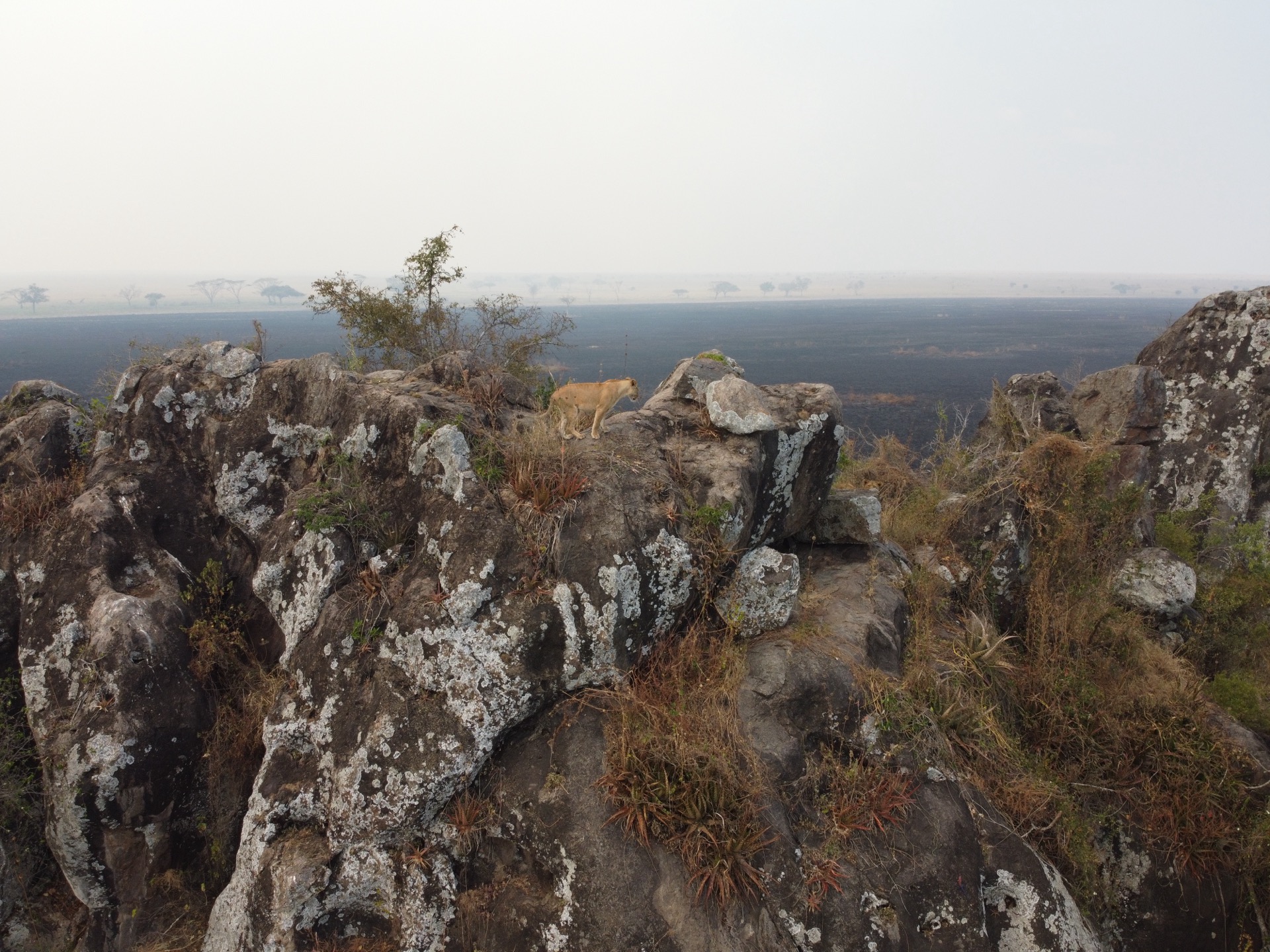
Lions are rarer visitors to the immediate campsite, but not unusual near Seronera. The central Serengeti’s Seronera public campsite sits in one of Tanzania’s highest lion-density zones. Lions have been recorded walking through the campsite — not hunting, not approaching tents, simply moving through on whatever route the terrain suggests. Your guide will brief you on what to do if this happens (stay still, stay quiet, do not block the animal’s path).
Elephants visit water points near several campsites, particularly in Tarangire. This is one of those facts that sounds improbable until it happens — a four-ton animal appearing at the water tap twenty metres from your tent, drinking, and walking away as though you are not there. Guides treat it as routine. The first time you experience it, it is not routine.
The sounds at 2am from a tent inside the Serengeti are not a feature you read about in a brochure — they are an experience that reorders your understanding of where you are. The sounds arrive from beyond the tent walls: hyena calls (a rising whoop that carries several kilometres), buffalo movement in dry grass, the deep resonance of a lion calling from the direction of the river. You are inside the ecosystem, not adjacent to it.
The classic camping circuits
7-day northern circuit — the standard option
The standard Tanzania camping safari is the 7-day northern circuit: Lake Manyara (1 day) → Serengeti (3–4 days) → Ngorongoro Crater floor (1 day). This covers Tanzania’s most recognisable wildlife highlights — Lake Manyara’s tree-climbing lions and flamingos, the central Serengeti’s lion prides and cheetah coalitions, the Ngorongoro Crater’s dense wildlife concentration — at a fraction of the lodge price.
Budget for the northern circuit camping: approximately USD 1,800–2,400 per person in low season, or USD 2,400–4,200 per person in peak season (July–October), including park entry fees, camping fees, vehicle, guide, all meals, and accommodation. Park fees are the unavoidable floor: Serengeti entry runs USD 82.60 per person per day in peak season, Ngorongoro conservation fee is USD 70.80 per adult per day plus USD 295 per vehicle for the crater descent.
Book a northern circuit camping safari at least 6–12 months ahead for peak season (July–October). Shoulder season (October–November, January–February) allows 3–6 months’ notice. Special campsites in prime migration zones — Mara River area, Ndutu during calving — can be fully reserved well before that window.
Tarangire and Lake Manyara — the short circuit
A 3–4 day Tarangire + Lake Manyara camping safari is the best-value short option. Tarangire’s elephant concentrations are at their peak from July through October, when hundreds of elephants converge on the Tarangire River — the only permanent water in a dry-season landscape. Lake Manyara offers tree-climbing lions (genuinely unusual big-cat behaviour), resident flamingos on the alkaline lake, and dense vegetation that produces the closest-quarter leopard sightings in the northern circuit. Entry fees at both parks are significantly lower than Serengeti, making this the most affordable northern circuit combination.
Southern circuit — wilder, less visited
Ruaha and the Nyerere ecosystem (the former Selous Game Reserve) represent Tanzania’s true wilderness character. Ruaha is one of Africa’s largest national parks (Tanzania’s second-largest); lion populations are among the highest on the continent. Nyerere offers an experience available nowhere else in the northern circuit: boat safaris on the Rufiji River alongside hippos and crocodiles, walking safaris with armed rangers, and true remoteness. Camping is the dominant accommodation format in both areas precisely because permanent lodge infrastructure is sparse. The southern circuit camping circuit of 7–10 nights is consistently described by operators as the more adventurous, less commodified alternative to the north.
Camping vs lodges — the honest comparison
Price: Camping wins decisively. Budget mobile camping costs USD 150–250 per person per day; mid-range lodges start at approximately USD 350 per person per day; high-end lodges run USD 600–2,000+ per person per night. Lodge safaris cost at least four times more than camping safaris on a like-for-like park comparison.
Comfort: Lodges win. A good lodge has a hot shower, a proper bed, a private flush toilet, and bar service at 7pm. A well-run mobile camp has a functioning camp kitchen and a sleeping bag that keeps you warm. These are different things.
Immersion: Camping wins decisively. No lodge, however perfectly positioned, puts you inside the park the way a tent does. The lodge roof silences the night. The canvas walls of a tent do not. You hear everything.
After-dark experience: This is the sharpest difference. Lodges have curfew policies — you do not walk unescorted after dark, activities end, the night is something you look at through a mesh window. Inside a Serengeti tent, the night is not something you look at. It is what you are inside.
Weather: Camping in sustained rain is genuinely uncomfortable and potentially miserable if equipment is poor. The long rains (April–May) and short rains (November) carry real risk for camping. The dry season (June–October) is ideal for camping: firm ground, cold-but-manageable nights, no mud.
Social aspect: Public campsites can be social in a way that lodges rarely are. The shared campfire, the cook’s camp kitchen visible to neighbouring groups, the quiet acknowledgment between two tents both listening to the same hyena — there is an informal fellowship in camping that lodge safari lacks.
Star-gazing inside the Serengeti
One of the most underrated aspects of camping safari, and one that almost nobody puts in their itinerary because it sounds minor until you are standing under it.
Tanzania’s national parks have virtually zero light pollution. The Serengeti is one of the largest areas of darkness in East Africa: no towns, no roads with permanent lighting, no agricultural settlements inside the boundary. On a clear night, the sky from a Serengeti campsite is not what most travelers have ever seen before.
The Milky Way is visible as a solid band from horizon to horizon — not a faint smear visible in the periphery but a bright, structured band with visible colour gradations. The Magellanic Clouds (satellite galaxies of the Milky Way) are visible to the naked eye in the southern sky. The Southern Cross is clear enough to navigate by. On nights around the new moon, when there is no lunar interference, the density of visible stars approaches what nineteenth-century astronomers described when they wrote about African skies before any electric light existed.
The best conditions: deep inside the Serengeti at a special campsite or a public campsite away from the Seronera area (which has some residual light from concentrated lodge and vehicle activity). June–October dry season, when cloud cover is minimal. A new moon phase within 3–5 days either side. The combination produces one of the best dark-sky experiences available anywhere in East Africa.
This is a feature of camping that lodge guests — who sleep in solid-walled rooms and do not habitually sit outside at 2am — almost never experience. It is not an add-on to the camping safari. It is part of what the camping safari is.
Tim’s 3am hyena account
I spent three nights in a mobile tented camp inside the Serengeti on what was supposed to be a recce trip — I had guests asking about the budget camping option and I wanted to know the difference from firsthand experience rather than from operator brochures.
The first night, I was woken at 2am by hyenas calling outside the tent. Loud, very close, circling. The cook had made sure everything was sealed and locked in the vehicle before we slept — he had done this dozens of times and did not leave it to chance. There was no incident. I lay still and listened for about forty minutes. The calls moved gradually, returned, moved again. By 3am they had settled somewhere to the south and gone quiet.
At 5am I unzipped the tent. The sky was still dark enough to see the Milky Way clearly — the first stars were dimming but the band across the centre was still visible. The cook had the fire going already. There was coffee. I stood there in the cold with a cup in my hand, watching the light change from grey to pale yellow over the plains, and I thought: I have stayed in lodges that cost twenty times what this mobile camp cost. I have eaten better dinners. I have slept in better beds. I have not felt this particular thing.
An hour later, before we drove out, a female lion walked through the campsite area. Not running, not hunting — moving through on a route that happened to pass us. She was within about forty metres of where I was standing with a cup of coffee. The guide said nothing. He had seen this before. She walked out to the east and was gone.
The guests who asked about the budget camping option went. They sent me a message from the Seronera campsite a month later. One line: “Why didn’t you tell us it was this good?”
→ Related guides: Tanzania budget safari — what it actually costs · Tanzania safari accommodation — lodges, tented camps, mobile camps explained · Serengeti — season, zones, what to see · Ngorongoro Crater — fees and what you see · Tanzania northern circuit — park sequence and logistics · Tanzania when to go — month-by-month guide · Tanzania safari costs — full budget breakdown · Kilimanjaro Umbwe route — six nights in a tent on the steepest climb on the mountain
Frequently asked questions
How much does a camping safari in Tanzania cost?
Tanzania camping safari cost depends on the tier and format. TANAPA public campsite fees are USD 35.40 per adult per night; special campsites (exclusive use) are USD 70.80 per adult per night at the Serengeti. Mobile tented operator safaris — where the operator provides all camping equipment, kitchen, and a cook — typically run USD 150–250 per person per day for a shared northern circuit itinerary, compared to USD 350–600+ for mid-range lodges. A 7-day northern circuit camping safari (Lake Manyara, Serengeti 3–4 nights, Ngorongoro) costs approximately USD 1,800–2,400 per person in low season, or USD 2,400–4,200 in peak season including park fees.
Is it safe to camp in Tanzania national parks?
Camping inside Tanzania national parks is safe with appropriate precautions. Public and special campsites are within park boundaries — there are no fences, and wildlife moves freely through them. The key safety rules: store all food sealed inside the vehicle overnight (never in tents), zip tent doors completely, use a headlamp when moving around camp at night, and follow your guide's instructions precisely. Hyenas are the most common camp visitors and are primarily attracted by food smells, not people. Lions do pass through campsites — they are generally moving through rather than targeting the camp. Your guide manages the safety protocol and will be alert through the night.
What is the difference between a public campsite and a special campsite in Tanzania?
Public campsites in Tanzania national parks are shared areas with basic facilities — typically a toilet block, sometimes a cold shower and water point — where multiple groups camp simultaneously. They cost USD 35.40 per adult per night at Serengeti and Ngorongoro. Special campsites are exclusive-use sites: your group has the entire location to itself, with no other vehicles or tents. Special campsites cost USD 70.80 per adult per night but have no facilities at all — a GPS coordinate in the bush. You bring everything, including water. The exclusivity often means better wildlife locations, deeper inside the park, and away from other visitor traffic.
What equipment do I need for a camping safari in Tanzania?
For self-supplied public campsite camping: a dome tent with full peg and pole kit, sleeping bag rated to at least +5°C (Serengeti plains nights are cold — forum campers consistently flag this), sleeping mat, gas stove with fuel, cooking pots, plates, cups, all food and sealed water containers, headlamp, comprehensive first aid kit. For a mobile tented operator safari: the operator provides tent, sleeping bag, mattress, tables, camp kitchen, and a cook — you bring personal clothing, sunscreen, insect repellent, camera, and personal medication.
What is star-gazing like on a camping safari in Tanzania?
Exceptional. Tanzania's national parks — particularly the Serengeti and Ruaha — have virtually zero light pollution. On a clear night in the dry season (June–October), the Milky Way is visible from horizon to horizon; the Southern Cross is bright; the Large and Small Magellanic Clouds are visible to the naked eye. This is something no lodge can replicate — even lodges inside the same park have enough generated light to reduce dark-sky quality. The best experience is at a special campsite deep inside the Serengeti, away from the Seronera area, on a moonless night around the new moon.
When is the best time for a camping safari in Tanzania?
June–October (dry season) is the best time for camping in Tanzania. The ground is dry and firm, nights are cold but manageable in a +5°C sleeping bag, and wildlife concentrations peak around water sources. The wildebeest Migration's Mara River crossings peak in August — the best possible time for a Serengeti camping safari if crossing sightings are a priority. October–November (short rains) is a strong shoulder alternative: rates are 15–25% lower, roads remain passable, and the Serengeti begins to green up. April–May (long rains) is the one season I would not recommend for camping — tracks can become genuinely impassable, tents can leak in sustained rain, and long grass reduces game drive quality significantly.