
Facts & prices checked: 2026-06-25
A Tanzania walking safari is not a nature ramble. It is a guided walk in genuinely wild bush — led by a professional guide with an armed ranger in escort — where your understanding of what you are looking at changes entirely because you are at the same level as everything that lives there. You walk at 2–4 km/hour. You move in silence. Your guide reads the landscape the way a book is read, and by the time you return to camp, you know the difference between a lion track from this morning and one from three days ago, and why that matters.
What makes a walking safari different
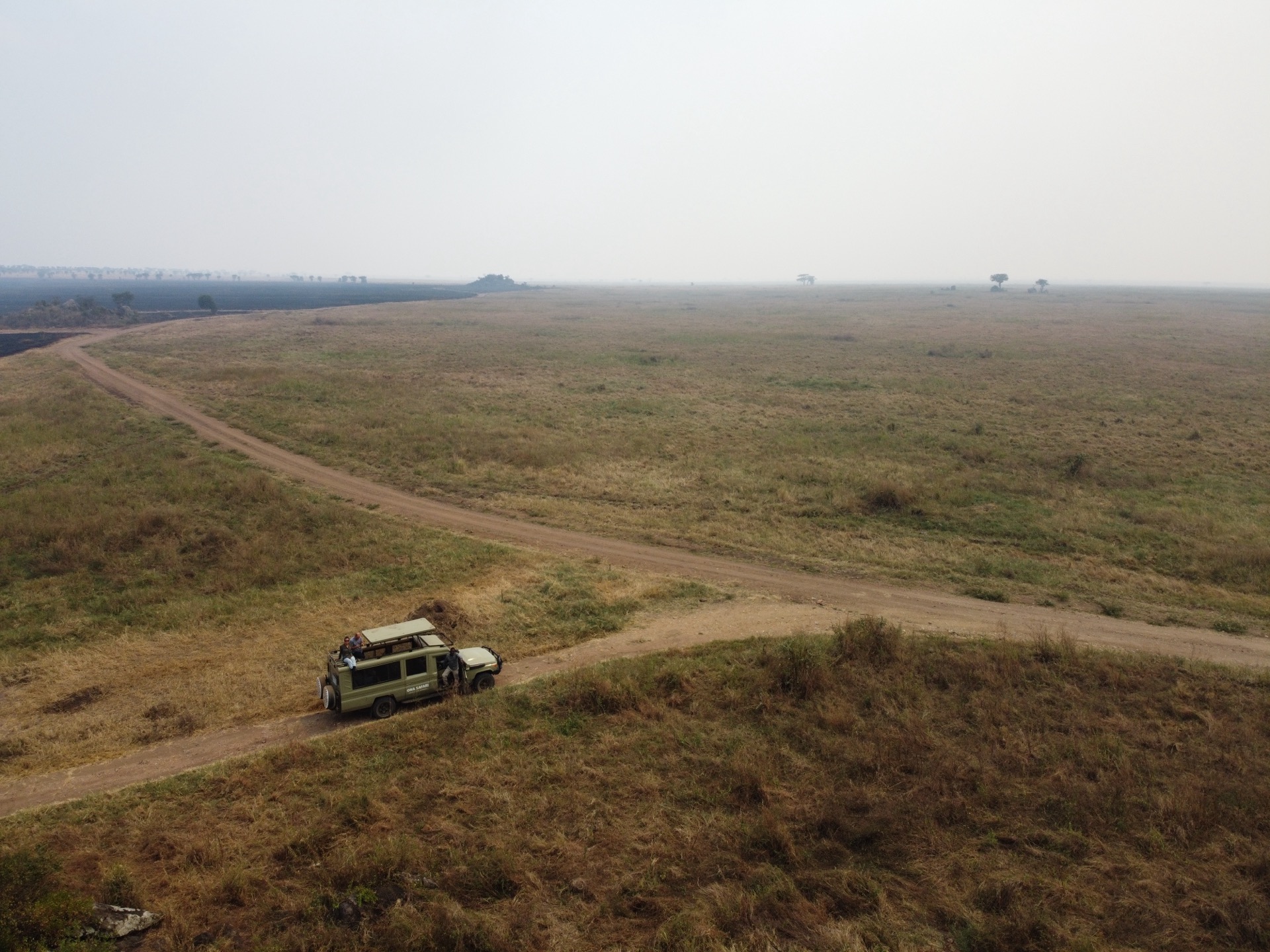
In a vehicle, you are elevated, insulated, and moving at engine speed. Wildlife has learned to ignore safari vehicles — elephants graze next to them, lions barely raise their heads. The vehicle grants access but it creates a glass wall between you and what you are watching.
Walking removes the wall.
When you move through the bush on foot, every sensory input is direct. You smell a fresh elephant dung pile before you see it — heavy, vegetative, still warm. You hear the alarm call of a lilac-breasted roller and learn that the bird has seen something you have not yet registered. You notice the ground: a dung beetle rolling a perfect sphere across a sand track; the scuff marks of a porcupine; the impression of a leopard’s foot in clay, precise enough that the guide can determine it was walking, not running, and heading toward the drainage line to the left.
A walking safari covers 3–6 km in a typical morning session. You might see only one large mammal in that time — or none — but you will have read more of the landscape than a full day of vehicle driving would have taught you. The observation is different. The detail is different. The memory of what you saw from five metres away, at ground level, in silence, lasts longer than anything seen from a Land Cruiser.
The sensory engagement is total: smell (fresh lion scat has a sharp, ammonia-heavy quality that carries a surprising distance downwind), sound (the guinea fowl alarm call that reveals a predator you haven’t yet located), and the visual reading of ground-level detail that no vehicle can replicate. You might spend fifteen minutes watching a dung beetle working before the guide quietly raises a fist — the stop signal — and gestures that there is a buffalo fifty metres ahead in the acacia shade, and you back away quietly, upwind, without the animal ever knowing you were there.
The difference between watching wildlife and experiencing wildlife is the difference between a game drive and a walking safari.
The safety reality
Walking safaris in well-managed Tanzania areas with licensed guides and armed ranger escorts are a legitimate, safe activity. They are not extreme safaris, gap-year stunts, or activities reserved for professional hunters. They are regulated, professional, and designed to be safe from the start.
Tanzania regulations require that walking safaris be accompanied by at least one qualified armed ranger. Group size is controlled — TANAPA limits standard walks to a maximum of 4 guests, though some private camps and conservancies run larger groups up to around 8 — as a matter of both safety and experience quality. A mandatory safety briefing takes place before every walk. The guide manages route, pace, upwind/downwind positioning, and stops and reversals when large predators are present. The protocol for a dangerous animal encounter is specific and practised: stop, stand together, back away slowly, make no sudden movements. The incidence of serious incidents in properly managed Tanzania walking safaris is very low.
The minimum age for walking safaris is typically 12, though some fly-camp circuits raise this to 16 given the terrain demands and the longer distances. Different operators apply different rules — ask specifically before booking with children.
The adrenaline is real. You are at ground level, in wild country, with predators present. The guide’s job is to manage that reality professionally, not to sanitise it. The experience should feel genuinely wild, because it is. But wildness and danger are not the same thing, and professional walking safaris are built on the distinction.
Before booking, ask the operator: what is the guide’s certification and years of walking experience? Is an armed ranger always included? What is the maximum group size? What is the pre-walk briefing protocol? The quality of the guide is the quality of the walking safari — more so than on a game drive, where the vehicle does some of the work for you.
The best walking safari areas
Nyerere National Park
This park covers 30,893 km² — roughly twice the size of the Serengeti — and is Tanzania’s largest national park. It is one of the few Tanzania parks that offer walking safaris alongside its other signature activities: boat safaris on the Rufiji River and night drives.
Walking safaris in Nyerere operate from the permanent camps concentrated along the Rufiji River and its tributaries. The terrain is excellent for walking: riverine forest transitions to open floodplain, baobab groves punctuate the miombo, and the diversity of habitat means the guide has multiple environments to read within a single morning. The game density in the Rufiji-Ruaha watershed is high — buffalo, elephants, lions, wild dogs, hippos — but the vast scale of the park means walking routes cover areas that no vehicle has visited for weeks.
Nyerere is also one of the few Tanzania parks offering fly-camp walking circuits. These multi-day walks — typically 3–5 nights — move between mobile tented camps set up ahead of you while you walk. Each evening camp arrives with warm bucket showers and a full hot dinner. The format is the most immersive walking safari product in Tanzania.
Walking is best June to October, when vegetation is lower, tracks are clear in the dry dust, and the dry season concentrates game around the permanent water sources of the Rufiji and its tributaries.
Ruaha National Park
This reserve covers 20,226 km², making it Tanzania’s second-largest national park by official area. The surrounding Ruaha-Rungwa ecosystem spans approximately 50,000 km² — one of Africa’s most important conservation complexes.
The landscape is genuinely different from Nyerere: open miombo woodland, rocky kopje outcrops rising from the plains, seasonal rivers in steep-sided drainage lines. This terrain is exceptional for walking — the guide can use the topography to approach game from upwind, work along ridgelines for visibility, and demonstrate the relationship between landscape feature and animal behaviour in ways the flat Rufiji floodplain doesn’t always allow.
Ruaha holds approximately 10% of the world’s lion population — its large prides, often 15–20 animals, specialise in buffalo hunting, which creates a different predator-prey dynamic than the wildebeest-focused lions of the Serengeti. Walking in Ruaha with the guide reading buffalo tracks and lion movements is an education in ecosystem function that no vehicle-based game drive replicates. Walking safaris here are conducted by licensed guides from the park’s camps and private concessions.
The park also records over 550 bird species and 80 mammal species. It receives far fewer visitors than the northern circuit parks, which means walking routes feel genuinely unspoiled.
Katavi National Park
Katavi is Tanzania’s fourth-largest national park at 4,471 km², in the remote southwest. Fewer than 2,000 visitors reach it each year. It is among the least-visited national parks in Tanzania, and the walking routes here are, in the most literal sense, untouched — you will not encounter footprints from yesterday’s group, because there was no yesterday’s group.
The Katavi dry season (June to mid-November — the park is largely inaccessible in the rains when roads become impassable and most camps close) is when walking has its greatest rewards. As the Katuma River shrinks, wildlife concentrates around the remaining water: hippo pools that host hundreds of animals, buffalo herds of 1,000+ individuals on the Katisunga Plains, lions moving between water sources. Walking from the camps across the open plains to the hippo pools — with the guide managing distance and wind — gives you a proximity to genuinely wild concentrations of wildlife that the vehicle can often not achieve.
Katavi is accessed by 3-times-weekly scheduled flights from Dar es Salaam, or by charter. The remoteness is real and is part of the appeal — getting to Katavi is work, but the payoff is a park that works the way Tanzania’s parks worked before they became well-known.
Mahale Mountains National Park
Mahale is a different kind of walking safari. There are no vehicle roads in the park. All movement is on foot. The walk is not to a game drive location but to find the habituated M-group of chimpanzees — one of the best-studied chimpanzee populations in the world, habituated over decades by researchers — in the montane forest rising above Lake Tanganyika.
The search takes 1–3 hours each way depending on where the M-group has moved to sleep. The walk itself passes through layered forest, with the guide reading signs — knuckle prints, bent vegetation, the sound of chimps calling — to close the distance. When you find them, you spend one hour with the group at close range, watching behaviour that mirrors human social interaction in a way that is difficult to process.
Mahale’s chimp permit costs USD 150 per person. The park is accessed by light aircraft to Kasunga airstrip followed by a mandatory boat transfer across Lake Tanganyika — there is no road route in. The combination of the approach, the forest walking, and the chimpanzee encounter makes Mahale a walking-centred experience unlike any other in Tanzania.
Walking near the northern circuit
The situation in the northern circuit is more constrained. Walking safaris in Serengeti National Park are limited to designated wilderness zones and permitted only by a small number of specialist operators with specific TANAPA concessions — it is not a standard activity available at most northern circuit camps. The Ngorongoro Crater floor is prohibited for walking entirely under conservation rules.
Within the northern circuit, Tarangire National Park is the most walking-accessible. The Tembo Njia walking trail at Tarangire runs 6 km, and guided walking safaris typically take 2–3 hours, with a guide fee of USD 20 per group per day. Lake Manyara and some Tarangire-area camps also offer short bush walks. These are worthwhile introductions but are shorter and more constrained than the southern circuit walking programmes.
The best walking experience accessible from the northern circuit is in the private conservancies adjacent to the parks. Singita Grumeti Reserve (~1,416 km²) in the western Serengeti corridor offers full walking programmes on land where none of the TANAPA park restrictions apply. The private-reserve walking guide covers the full range of options for walking near the northern ecosystem.
Format options
Morning walk from a fixed camp (2–4 hours)
The standard entry point. Departure at first light — 6:00–6:30 AM — when temperatures are coolest and predators are most active post-dawn. The guide covers 3–6 km, reads tracks, identifies bird calls, and manages the encounter with any large mammals encountered on route. Return for breakfast. This is the format at most camps that offer walking as one option alongside game drives and boat safaris.
In Nyerere, the in-camp walking option covers 45–60 minutes; the full bush walk outside the reserve runs 2.5–3 hours and covers 9–15 km for more experienced walkers.
Half-day walk (4–6 hours)
A longer outing — typically departing at dawn and covering more terrain before returning for lunch. The extra time allows the guide to move between habitat types, read a wider area, and — if game permits — settle into a longer observation when something interesting is found. A fly-camping lunch stop under shade is common on longer half-day formats.
Multi-day fly-camp circuit (3–5 nights)
The highest-end walking safari format in Tanzania. Each morning you walk; your luggage travels ahead by vehicle or light aircraft; each evening a new camp has been assembled in a different location with warm bucket showers and a full dinner under canvas. You cover territory no day-walk from a fixed camp could reach.
Nyerere and Ruaha have well-established fly-camp circuits. The format requires a well-organised operator, some flexibility (weather and wildlife may change the route), and a minimum fitness level adequate for 8–12 km per day on mixed terrain.
Walk-focused camps vs walking as an add-on
The quality of a walking safari depends more on the guide than the format. Camps that position walking as a primary activity — where the guides’ primary expertise is on foot rather than in a vehicle — consistently deliver better walking experiences than camps where a morning walk is simply one checkbox on a daily activity menu. When researching operators, ask whether guides are dedicated walking guides or general guides who also walk. The distinction matters.
What to bring and expect
Clothing: Earth tones — khaki, beige, olive green, brown. Avoid white (bright against bush backgrounds), black (attracts tsetse flies in some areas), and any vivid colour. A long-sleeved shirt and long trousers are better than shorts and a t-shirt even in heat — they protect from sun, thorn scratches, and insects. Sturdy closed shoes with ankle support are essential; the terrain in Ruaha’s kopje country and Katavi’s floodplains demands more than a lightweight trainer.
Pace and distance: Walking safaris move at 2–4 km/hour. A typical morning covers 3–6 km. This is not a fitness challenge — it is a tracking and observation exercise. The terrain in some areas (Ruaha’s rocky ridgelines, Mahale’s forest slopes) will make you work; the Nyerere floodplains are flat and physically easy. Most fit adults can complete a standard morning walk with no preparation.
Silence and signals: The guide communicates by gesture. A raised fist means stop immediately. A flat palm means crouch. The guide will not speak unless whispering directly in your ear. Mobile phones must be on silent and kept in your pocket — camera shutters should be on silent mode if available.
Minimum age: Tanzania regulations and most operators set the walking safari minimum age at 12. Some fly-camp operators set 16 as the minimum due to terrain and distance demands. Confirm the specific operator’s policy before booking with children.
Fitness: No special fitness is required for a standard 2–4 hour morning walk on flat terrain (Nyerere, Katavi plains). Multi-day fly-camp circuits and Mahale’s forest slopes require the ability to walk 8–12 km per day on mixed terrain. Ruaha’s kopje areas are steeper but the distances are manageable.
The lion print
The tracker stopped and held up a fist. We all stopped immediately. He dropped to one knee and pressed his palm flat on the sandy track, then looked up at our guide and made a small movement with his head to the left. The guide leaned in to me and whispered, directly into my ear, “big male, ten minutes old.”
I could not see the track until the guide put his hand next to it. A lion’s front paw pressed into the sand — about 25 cm across. The guide pointed to the edge: still crisp, no wind-rounding on the lip, no moisture evaporation from the surface. The tracker pointed with his chin toward the acacia tree line fifty metres to our left. We circled the vegetation upwind, moving in single file, placing feet where the guide placed feet. Three minutes of silence and careful footwork.
We found him in the shade of an acacia on the edge of the floodplain — a large adult male, belly full, sleeping on his side with his tail flicking slowly. Forty metres away. We watched for ten minutes before the guide gave the hand signal and we backed away in single file.
That is the walking safari experience. Not the lion at 15 metres through the windscreen with seven other vehicles behind you. A lion at 40 metres that you tracked, that you walked to, in a place you reached on foot, with a guide whose knowledge of that land made it possible.
Continue planning your Tanzania safari: Tanzania private conservancies — private reserves where walking safaris are available alongside the northern circuit parks. Tanzania southern circuit guide — Nyerere and Ruaha in full, with logistics, park fees, and how to combine them. Tanzania Nyerere National Park guide — Rufiji boat safaris, walking safari camps, wild dogs. Tanzania Ruaha National Park guide — lion country, fly-camp walking, the miombo ecosystem. our Mahale chimp-trekking guide — chimpanzee trekking and the mandatory forest walks above Lake Tanganyika. If a foot-level challenge on the mountain rather than the savanna appeals to you, the Kilimanjaro Umbwe route is the steepest, most direct climb on Kilimanjaro — a different kind of walking altogether, built for experienced high-altitude trekkers rather than first-timers.
Frequently asked questions
Is a Tanzania walking safari safe?
Walking safaris in properly managed areas with licensed professional guides and armed ranger escorts are a legitimate, safe activity — not an extreme sport stunt. Professional guides train in wildlife behaviour, terrain management, and emergency protocols. Group size is controlled (TANAPA limits standard walks to a maximum of 4 guests; some private camps and conservancies run larger groups up to around 8), minimum age limits apply (12+ at most operators; some fly-camp circuits require 16+), and pre-walk safety orientations are standard. The adrenaline is real — you are at ground level in genuinely wild country with predators present — but serious incidents in well-managed Tanzania walking safaris are rare. Ask operators for their guide certification, years of experience, and armed escort policy before booking.
What is the best area for walking safaris in Tanzania?
The three standout areas are Nyerere National Park (Rufiji River camps; 30,893 km²; riverine forest and open plains; buffalo, elephant, lion, wild dogs; multi-day fly-camp circuits available), Ruaha National Park (20,226 km² of miombo woodland, rocky kopjes, seasonal rivers; Ruaha holds approximately 10% of the world's lion population), and Katavi (the most remote — fewer than 2,000 visitors per year; 4,471 km²; genuinely untouched walking routes; dry-season hippo pools and elephant herds). Mahale is a fourth option for a different walking experience — mandatory walking to habituate chimpanzees in montane forest above Lake Tanganyika.
What should I wear on a Tanzania walking safari?
Neutral earth tones — beige, khaki, olive green, brown. Avoid bright colours, white, and black (which attracts tsetse flies in some areas). A long-sleeved shirt and long trousers protect from sun, thorns, and insects; even in hot weather, long clothes are better than bare skin in the bush. Sturdy closed shoes with ankle support are essential — sandals or flip-flops are not permitted on any professional walking safari. Bring a small daypack for water, sunscreen, and binoculars. Your phone should be on silent; the guide uses hand signals, not words.
How is a walking safari different from a game drive?
In a game drive, you are insulated from the bush — elevated, in a vehicle, with an engine noise that wildlife has learned to ignore. On a walking safari, you are at ground level, moving at animal speed (2–4 km/hour), in silence. The sensory engagement is total: you smell fresh lion scat, hear the alarm call of guinea fowl before you see the reason for it, and watch a tracker press his palm to a footprint and calculate time elapsed from moisture and edge definition. Seeing a lion from 40 metres that you tracked and walked to is a different experience from watching the same lion from a vehicle at 15 metres with nine other cars alongside.
What is a fly-camp walking circuit?
A fly-camp circuit is a multi-day walking safari where your luggage and the next night's camp are moved ahead of you — either by vehicle or light aircraft — while you walk through the bush during the day. At the end of each day's walk, a tented camp has been set up in a new location, typically with warm bucket showers and a full hot dinner. Nyerere (Selous) and Ruaha both have well-established fly-camp routes. Typical duration is 3–5 nights. The logistics require a well-organised operator and some flexibility for weather and wildlife — you walk where the bush takes you, not on a fixed route.
Can I walk in Serengeti or Ngorongoro?
Walking safaris are permitted only in designated wilderness areas of Serengeti National Park, and only by a handful of specialist operators with specific TANAPA concessions — access is very limited, not a standard activity. The Ngorongoro Crater floor is off-limits to walking. Short guided bush walks are possible from some Tarangire and Lake Manyara camps (Tarangire's Tembo Njia trail is 6 km). For the most consistent walking safari experience near the northern circuit, private conservancies adjacent to the parks — such as Singita Grumeti Reserve (~1,416 km²) in the western Serengeti corridor — offer guided walks without the national park restrictions. The [Tanzania private conservancies guide](/en/tanzania/private-conservancies/) covers the options in detail.