
Facts & prices checked: 2026-06-25
The Serengeti calving season is the most concentrated wildlife spectacle on earth. Roughly 500,000 wildebeest calves are born across a 3–4 week window each January and February, and every predator in the southern Serengeti knows it. Cheetah, lion, spotted hyena, African wild dog — they all converge on the Ndutu plains for what amounts to the annual feast. This is not a metaphor. February in Ndutu is the one month in Africa where you can watch three separate predator species make kills in a single morning.
What calving season actually is
The wildebeest calving is not a random scattering of births across the wet season. It is one of the most precise biological events in the natural world: approximately 500,000 wildebeest calves are born over a roughly 6-to-8-week season, with peak intensity producing around 8,000 calves per day. The timing is not accidental — it is evolutionary strategy.
This is called predator swamping. If half a million wildebeest calve over six months, predators can hunt methodically and calf mortality is catastrophic. If they all calve in a 6-to-8-week season, even a large predator population — hundreds of lions, thousands of hyenas, a thousand-plus cheetahs — cannot consume the surplus. The herds overwhelm the predators numerically. Most calves survive not because they are fast enough or strong enough, but because there are simply too many of them to kill.
The calves themselves are born precocial — able to stand within minutes and run within hours. This is not an exaggeration. A wildebeest calf born at 07:00 will be running alongside its mother by 07:20. The first 72 hours carry the highest mortality risk, after which survival odds improve sharply. If a calf reaches day three, it has a reasonable chance of reaching adulthood.
The short-grass plains of Ndutu are not accidental either. The volcanic soils here produce mineral-rich grass that sustains lactating mothers through peak demand. The short sward gives calves stable footing on their first uncertain legs. And the open, flat terrain gives mothers the sightlines they need to detect predators approaching from a distance and react early. This combination — nutrition, terrain, and visibility — is why the wildebeest have gravitated to this specific corner of the greater Serengeti ecosystem for calving for thousands of years.
When and where: the Ndutu plains
The calving zone is the Ndutu area, a stretch of open short-grass plains straddling the southern edge of Serengeti National Park and the Ngorongoro Conservation Area. These are not the same entity. The Serengeti is a national park under TANAPA; the NCA is a separate conservation area under the Ngorongoro Conservation Area Authority, with different fee structures and different rules. Most of the Ndutu camps sit technically within the NCA, meaning they charge NCA fees rather than Serengeti park fees. Game drives operate freely across both areas.
The timing follows the rains. The short rains of November green up the southern plains, and the herds begin filtering south from the central Serengeti around December. By mid-January the calving is in full swing. February is the peak: maximum calf density, maximum predator activity, and the most sustained wildlife drama. By March the calves are old enough to travel and the herds begin their long northward drift. Late December through early March is the window; mid-January through February is the heart of it.
The geography is important. The Ndutu area is southwest of the Serengeti’s main gate and south of the Seronera hub. Camps here are not convenient to the central Serengeti — they are positioned specifically for the calving plains. If you are coming for the calving, you should be basing in or very near Ndutu. A central Serengeti camp with a day trip to Ndutu is a pale substitute.
The calving itself
I watched a wildebeest calf born on a February morning in the Ndutu plains. The mother moved away from the herd, found a patch of open ground, and delivered in about twenty minutes. She cleaned the calf methodically while it lay still, not yet understanding what it needed to do. Within four minutes it was attempting to stand — those legs are impossibly long for a newborn, and the first attempts end in collapse. By the time we had been watching for fifteen minutes it was upright, wobbling, nosing at her flank. Within twenty minutes it was running beside her at full pace as a spotted hyena moved in from the east, attracted by the smell. The mother did not flee. She positioned herself between the calf and the hyena, lowered her head, and held her ground. The hyena tested the standoff, circled twice, and moved on. The calf survived.
This is the texture of calving season: not cinematic death every few minutes, but the continuous mathematics of survival. A calf born. A predator arriving. A mother deciding whether to stand or run. The calculation playing out in front of you in real time.
The intensity during peak calving is real, but it is also more complex than a simple predator reel. You will watch births and survival as well as kills. You will see mother wildebeest making the same decision — hold ground or flee — with different outcomes across the same morning. The Serengeti Cheetah Project, which has monitored individual cheetahs on the southern plains since 1974, documents that about 90% of cheetah cubs die before they are one month old — the pressure runs in every direction on the calving plains.
Predators: all of them, at once
The calving plains in February carry the highest predator density in the Serengeti ecosystem at any point in the year. These are the species you will find.
Cheetah. The short-grass plains are their ideal terrain. Cheetah hunt by sight at speed, and they need open ground with clear sightlines and room to run. A cheetah can maintain top speed for roughly 300 metres — which means the approach matters as much as the sprint. In February, with wildebeest calves everywhere, cheetah hunts are daily events rather than rare encounters. The Serengeti ecosystem holds an estimated 1,200–1,500 cheetahs, and a significant proportion are concentrated on the southern plains during calving. February is genuinely the best month in Africa to watch a cheetah stalk, chase, and make a kill.
Lion. Prides that ordinarily make one or two kills per week will make three to five during peak calving. The short grass means little cover for stalking adults, but wildebeest calves in their first three days are essentially incapable of outrunning a lion. Prides with cubs time their own breeding cycle to align with calving — cubs old enough to eat meat in February means the pride’s protein requirement and the prey surplus coincide. The Serengeti holds an estimated 3,000–3,500 lions in around 300 prides, and the calving plains concentrate a substantial portion of them.
Spotted hyena. Hyena clans hunt cooperatively and are capable of outrunning wildebeest calves easily. They are also the predators most likely to test a mother’s defensive stand — a single hyena will probe, retreat, and probe again until it finds an opening or gives up. A large clan can separate a calf from its mother within minutes. During calving season, hyena are active day and night, and clan sizes can be enormous.
African wild dog. Wild dogs range across vast territories and are not always on the Ndutu plains during calving, but when a pack is present, calving season means near-guaranteed sightings and kills. Wild dogs hunt with extraordinary efficiency — documented kill success rates far above lions or cheetah — and wildebeest calves in their first week represent easy targets for a coordinated pack.
Leopard and jackal. Leopards are present and active but harder to observe on open plains than in the riverine woodland further north. Jackals are consistently present at kills and at births, opportunistic at every stage.
The predator density in February means vehicle scheduling matters. A guide who reads the plains — watching the horizon for vultures descending, noting hyena posture, tracking a cheetah’s scan direction — will put you at a kill or a hunt long before it is over. An inexperienced guide who navigates by radio report alone will arrive to a finished scene. Ask how your camp’s guides work.
The game drive experience
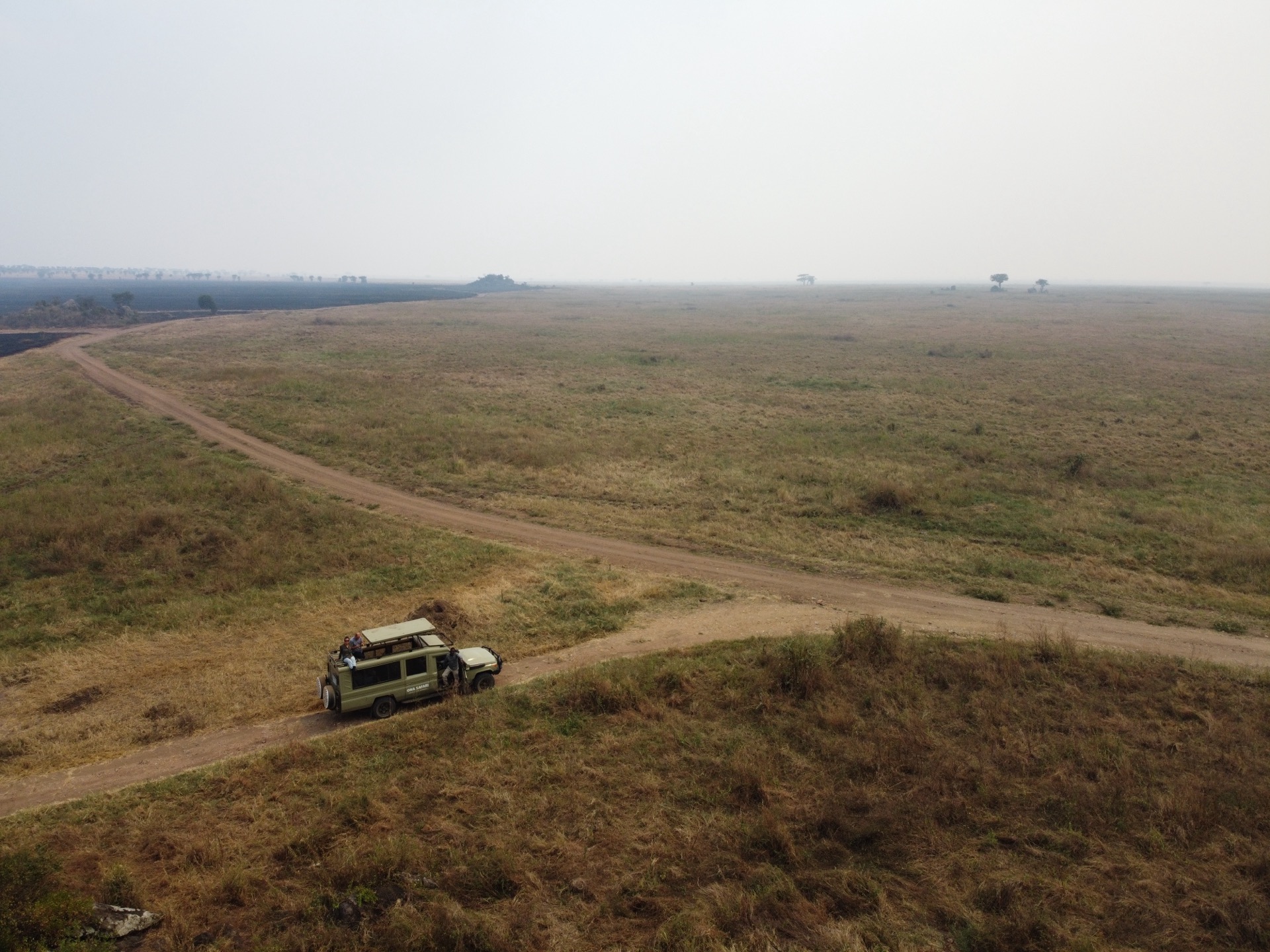
Calving season drives have a different rhythm from the dry-season drives further north. The plains are open, the sightlines are long, and good guides work by scanning rather than driving to reported sightings. The technique is to position early and watch broad areas rather than triangulating in on a single known animal.
Morning drives start at first light — 05:30 to 06:00 departure is standard, and the first two hours are the most productive. This is when the previous night’s activity is still visible: kills are fresh, predators are finishing their meals, and the low-angle light makes silhouettes readable at distance. By 10:00 the temperature rises and animal activity drops. Midday returns to camp for lunch and rest. The afternoon drive runs from around 15:00 to 19:00 and picks up again as the heat drops.
The open terrain is an asset for observation. In the riverine woodland of central Serengeti or the dense bush of the western corridor, animals disappear into cover. On the short-grass calving plains, everything is visible. A cheetah lying in the grass 400 metres away is findable. A lion pride moving with purpose shows up against the horizon. A hyena clan assembling is visible before any action begins. If you have wanted to understand how predators work — how they read the terrain, how they approach, how prey animals respond — February in Ndutu is where that becomes clear.
Where to stay for the calving season
The Ndutu area camps position you directly in the calving zone. Most are within the NCA boundary rather than the Serengeti proper, and they charge NCA conservation fees accordingly.
Ndutu Safari Lodge is the historic permanent option and the most centrally located for the calving plains. It has been operating in the area for decades, sits directly on Ndutu Lake, and its guides have deep institutional knowledge of the plains. It fills well in advance for January and February.
Sanctuary Kusini camps in the remote south of the Serengeti National Park itself (as opposed to the NCA side where Ndutu Safari Lodge sits) and is described as the only permanent camp inside the park’s actual southern plains. It positions specifically for calving-season access.
Mobile and semi-permanent camps are common in the Ndutu area and follow the herds’ position more precisely than fixed lodges. They set up for the calving season and close or relocate when the herds move north. These tend to be smaller — six to twelve tents — which means fewer vehicles at sightings and more attentive guiding. They also fill fastest for peak dates.
When evaluating camps, ask two questions: where exactly are their game drive areas, and where will the herds be during your specific dates. A camp on paper positioned for Ndutu may in practice drive areas 30–40 kilometres from the main calving concentration. The best operators answer this question with specifics, not generalities.
Getting to the calving zone
Internal flight is the practical choice for most visitors. Light aircraft connect Arusha (or Kilimanjaro International) to Ndutu/Lake Ndutu airstrip in approximately 45–60 minutes. Coastal Aviation and Auric Air both serve the route, with some seasonal variation in schedule. Flying saves the better part of a day each way compared to overland travel and avoids the rough final track.
Overland from Arusha takes approximately 5 hours 30 minutes (261 km) depending on road conditions, via Ngorongoro. The route passes through the Ngorongoro gate and crosses the conservation area — it is a legitimate option and some operators include it as part of a northern circuit by road. The last 30–40 kilometres to the Ndutu camps are on unsurfaced track and in good condition during the dry conditions of early February, but can deteriorate with heavy rain. If your itinerary already includes Ngorongoro Crater, the overland connection is convenient and avoids a backtrack.
Flying in from the central or northern Serengeti is an option if you are combining a calving season stay with time in another Serengeti zone. Internal light-aircraft hops between Serengeti airstrips run throughout the day and can be booked through your operator. Adding a central Serengeti leg before or after Ndutu is a sound structure for a 7–10 night Serengeti-focused itinerary.
Cost and booking: what to expect
Calving season in the Ndutu area is high season for the camps that operate there. January and February represent peak demand — calving season is one of the most sought-after experiences in African safari travel, and the limited camp inventory in the Ndutu area means supply genuinely cannot meet demand at good camps during peak dates.
Booking lead time. 6–12 months for the best options at the best dates. The top mobile camps and Ndutu Safari Lodge for February are typically full by mid-year of the preceding year. If you are planning a February trip and reading this in September, contact operators immediately. Some flexibility — mid-January rather than peak February, or slightly peripheral camp locations — opens more options.
Camp rates reflect the demand. True budget Tanzania safaris (camping-based, USD 150–250 per person per day) exist, but the Ndutu/southern-plains calving-season camps are almost entirely mid-range tented to luxury properties, running roughly USD 600–1,500+ per person per day — the upper end reaching well beyond that at the most exclusive mobile camps. All-inclusive rates typically cover accommodation, game drives, meals, and local drinks, but confirm whether park/NCA fees are included — at the NCA, per-person conservation fees and per-vehicle crater service fees (if you are adding a Ngorongoro Crater descent) are substantial.
Calving season is worth the premium. If your aim is to witness the most sustained predator-prey action available anywhere in Africa, the Ndutu plains in February are it. The density of wildlife, the visibility, and the predictability of the experience — calving is more reliably observable than Mara River crossings, which are famously unpredictable day to day — justify the cost and lead time.
Combining calving with other Serengeti experiences
The calving season and the Mara River crossings (July–October) are the two headline migration experiences, and they are not easily combined in a single trip — the geography and timing are opposite ends of the year and of the Serengeti. Plan for one on each trip, or build a year-spanning itinerary if both are priorities.
Adding central Serengeti. A logical structure is 3–4 nights in the Ndutu area for calving, then a light-aircraft hop to the central Serengeti (Seronera area) for 2–3 nights. The central Serengeti in January–February has resident game year-round — leopards in the riverine fig trees, lions on the kopjes, elephants, buffalo, hippo in the Seronera River — and provides a contrast to the open calving plains without requiring a long journey.
Adding Ngorongoro Crater. Many visitors combine Ndutu with a Ngorongoro Crater descent, which makes geographic sense since the camps are on the NCA boundary. The Crater descent fee is USD 295 per vehicle plus USD 70.80 per person per day for NCA entry. The crater’s enclosed ecosystem — black rhino, dense lion and hyena populations, flamingo on the soda lake — is different in character from the open plains and worth the detour. Add 1–2 nights on the Ngorongoro rim.
Preceding parks. The classic Northern Circuit runs Arusha to Tarangire, then Ngorongoro, then Serengeti. In January–February, reversing the order slightly to hit Ndutu at its peak (mid-January to February) before moving to Ngorongoro and Tarangire on the way back can be more flexible timing-wise. Discuss with your operator which order best matches your exact dates.
Calving season compared to the Mara River crossings
This question comes up often. The honest answer: they are different experiences with different strengths.
Calving is more predictable. The window (mid-January to mid-February) is reliable, the location (Ndutu) is specific, and the wildlife density during peak calving is extraordinary. You can plan a calving trip and be confident you will find it.
Mara River crossings are not predictable on a given day. Herds can stand at the bank for hours and not cross, or cross at dawn before most guests are awake. You need multiple nights in the north to give yourself reasonable odds. When you do witness a crossing, it is an extraordinary concentration of drama in a few minutes. But the waiting can be frustrating on a short trip.
If you are choosing for a first Serengeti visit, calving season generally delivers a more sustained, reliably excellent experience. If you have done calving and want the specific spectacle of a crossing, plan the northern trip separately.
For a full overview of the Serengeti’s four zones — which to choose and when — see the four-zone breakdown. For the complete year-round migration calendar and month-by-month breakdown, see the month-by-month migration timeline. For the full Tanzania wildlife calendar — Big Five locations, wild dogs, chimpanzees, and endemic species — see the species-by-species field guide. For what to pack, health preparations, and vaccination requirements before a Tanzania safari, see our pre-safari checklist. For costs across Tanzania’s parks — park fees, typical camp rates, and sample budgets — see the full cost rundown. For combining a calving-season Serengeti visit with a Zanzibar beach finish, see the Zanzibar transfers guide for how the internal flights route. For a full day-by-day Northern Circuit plan with real costs and timing, see the Tanzania 7-day safari itinerary.
Frequently asked questions
When is calving season in the Serengeti?
Calving runs from approximately late December through March, with peak activity in mid-January through February. The herds arrive in the Ndutu area (southern Serengeti/NCA) following the short-grass plains that emerge after the short rains in November. February is typically the densest calving month — approximately 8,000 calves born per day at peak. By March, calves are strong enough to move and the herds begin shifting northwest toward the central Serengeti.
Where exactly is the calving zone?
The calving zone is centred on the Ndutu area — the open short-grass plains straddling the boundary of Serengeti National Park and the Ngorongoro Conservation Area (NCA). Most calving camps are technically within the NCA, not inside the park, which means they carry NCA conservation area fees rather than Serengeti gate fees. Game drives operate across both areas. The key location is the Ndutu Lake area and the adjacent plains — ask your camp specifically where their drives focus.
Why do wildebeest calve in such a short window?
Synchronised birth is an evolutionary predator-swamping strategy. If a million wildebeest calve over 6 months, predators can hunt steadily and calf mortality is high. If 500,000 calves arrive in a 6-to-8-week surge, predators literally cannot eat all of them — they are overwhelmed by numbers. Most calves survive simply because there are too many to kill. The short-grass plains also give calves stable footing and mothers clear sightlines to detect predators approaching at distance.
What predators are active during calving season?
All of them — at higher density and activity than any other time of year. Cheetah: the flat, open short-grass plains are their ideal hunting terrain and February is often the best month in Africa to observe a cheetah hunt. The Serengeti ecosystem holds an estimated 1,200–1,500 cheetahs. Lion prides that normally make 1–2 kills per week make 3–5 during peak calving. Spotted hyena clans hunt in large groups and can outrun calves. African wild dog packs, if present, find calving season means near-certain kills. Leopard and jackal are also present and active.
How far in advance do I need to book for calving season?
6–12 months for the best camps at the best dates. January and February in the Ndutu area are among the most sought-after dates in African safari travel — demand significantly exceeds supply at the top camps. Mobile camps with limited tents fill even faster. Budget for peak-season pricing: calving camps command premium rates reflecting the demand, often above standard rates at the same properties.
Is calving season suitable for first-time safari visitors?
Yes — and in many ways it is the ideal first safari. The concentration of wildlife is at its highest, the drama is immediate, and the short-grass plains mean excellent visibility with unobstructed sightlines. The one adjustment: predator kills are frequent and visible. Children under 7–8 may find the predator-prey sequences distressing. Adults who prefer to observe wildlife without the hunting dimension might find February more intense than they expected. If this is your first safari and you want to see Africa at its most raw, calving season is the answer.