
Facts & prices checked: 2026-06-25
Leopard viewing on safari is usually described as a probability — here is a 30% chance, there a 40% chance, depending on park and season. Seronera in the central Serengeti operates in a different register entirely. Expert Africa’s operator data puts the sighting rate at roughly 75% of game drives in the central Serengeti. That means three visits in four produce a leopard encounter — a figure that holds regardless of season, weather, or beginner’s luck.
Understanding why Seronera achieves this, and what specifically distinguishes it from the other Tanzania leopard destinations, is the difference between arriving at random and arriving prepared to make the most of it.
What makes Seronera different
Tanzania has approximately 1,000 leopards in the Serengeti ecosystem. Camera-trap studies have recorded densities of 5.72 per 100 km² in the wet season and 5.41 per 100 km² in the dry season — one of the highest measured leopard densities in East Africa. Those animals are distributed across the full 14,763 km² of the park. Seronera Valley, in the central Serengeti, concentrates sightings because it concentrates leopards.
Three elements explain the concentration:
Permanent water. The Seronera River carries water through the central Serengeti year-round. Permanent water sustains a permanent prey base — impala, Thomson’s gazelle, and warthog are resident in the valley throughout the year, not seasonally. Leopards in prey-rich environments hold smaller territories and move less, making them more consistently findable within a defined area.
The sausage tree canopy. The Seronera River is lined with Kigelia africana — sausage trees, named for their heavy pendulous fruits. These trees produce exceptionally wide, robust horizontal branches at heights of 4–8 metres. A leopard can haul prey up to three times its own body weight into the fork of a sausage tree and leave it secured above the reach of lions and spotted hyenas. The fruits’ weight makes the branches thick enough to support both carcass and leopard simultaneously. A kill cached in a sausage tree typically anchors the leopard to within 500 metres of that tree for 2–4 days — making the tree itself a sighting predictor.
Resident habituated individuals. Seronera’s leopards have lived around safari vehicles for multiple generations. The individuals born and raised in the valley have no fear response to vehicles — they rest in their trees, feed on kills, and move along the riverbank without modification of behaviour. Experienced guides working the valley year-round know individual leopards by their facial spot patterns (rosettes are unique to each animal, equivalent to fingerprints), which tree types they favour, and the approximate boundary of their territory. When a guide says “the female with the ear notch is using the second fig tree past the river crossing this week,” that is not guesswork — it is accumulated field knowledge.
The Seronera guide radio network
One element of Seronera leopard viewing that does not exist in most other Tanzania parks is the information network among guides. In the central Serengeti, when one guide locates a leopard — particularly a female with a kill in a tree, which is the highest-value sighting — that information moves immediately through the vehicle radio network. Within 10–15 minutes, other guides in the area route toward the sighting.
The practical implication: your guide’s radio contacts significantly affect your leopard sighting odds. An experienced Seronera guide with strong network relationships will often know, before leaving camp, whether a leopard has been located by the pre-dawn scouts. Guides who work the central Serengeti regularly also share unprompted — a culture of information exchange that has developed over decades of cooperative wildlife guiding.
The visible consequence is that confirmed sightings at Seronera typically attract multiple vehicles. This is neither unusual nor disruptive — the leopard in a sausage tree is uninterested in the vehicles below, and experienced operators position vehicles with enough space that photography is not compromised. The multi-vehicle dynamic is itself a reliable indicator: if you see four vehicles parked near the same cluster of trees with binoculars raised, there is almost certainly a leopard in one of those trees.
The kopjes: a different kind of leopard encounter
The sausage tree encounters along the Seronera River are the most photographed leopard situations in Tanzania — and for good reason. But the kopjes offer something different.
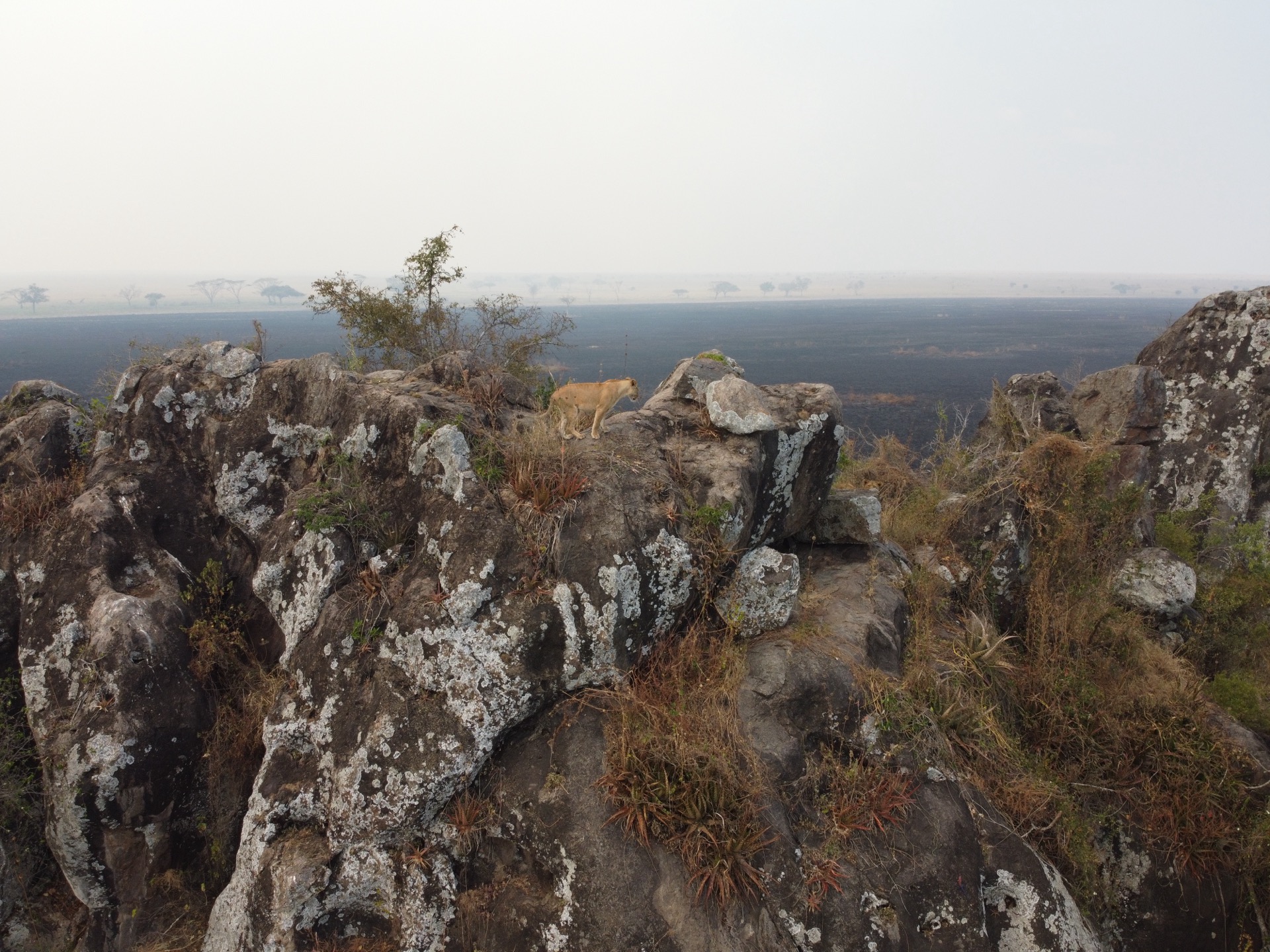
Kopjes are ancient granite outcrops rising up to approximately 20 metres above the Serengeti plains. They formed where volcanic ash eroded over millions of years and the harder granite beneath became exposed. The rock formations — sometimes single boulders, sometimes clusters of columns and overhangs — create a microhabitat within the open grassland: shade, crevices, water catchment, and elevated sightlines unavailable anywhere else on the flat plains.
The Moru Kopjes (south-central Serengeti) and the Simba Kopjes (near Seronera) are the main leopard kopje zones. Leopards use kopjes for four distinct purposes:
- Territory marking. Males spray-mark the rock faces and scratch-mark the trees at the base of kopjes. A kopje within a male’s territory will show his scent marks on specific rocks that he visits regularly — guides who know these sites can sometimes predict when a male will pass through.
- Shade. The overhanging rock faces and deep crevices provide shade in midday heat that simply does not exist on the open plain. A male leopard in a crevice is essentially invisible until he moves.
- Elevated vantage. From 20 metres above the plain, a leopard can scan hundreds of metres in every direction. The same trait that makes kopjes useful as lookout points for lions also makes them useful for leopards scoping prey movement.
- Denning. Kopje crevices are primary den sites for females raising cubs. The inaccessibility of the deep rock crevices protects cubs from lions and hyenas in the first weeks when they cannot yet move at adult speed.
A kopje encounter is typically different in character from a sausage tree encounter. In the tree, you often find the leopard stationary, resting or feeding, with good sightlines from the road. At a kopje, the leopard may be moving — walking across the granite surface, marking, scanning — or visible in the open on an elevated rock. These are the encounters that produce the classic Tanzania leopard portrait: animal on stone against sky, in morning light, completely relaxed.
Seronera leopard viewing strategy
The practical approach for maximising your Seronera leopard experience:
Tell your guide on the first evening. State explicitly that a leopard encounter is your top priority. This changes the guide’s route planning, timing, and radio engagement on the morning drive. A guide who does not know your priorities will give you an excellent all-round game drive; a guide who knows leopard is the mission will be operating differently from 05:45.
Arrive at trees before the heat. Morning drives in Seronera should begin at gate opening — typically around 06:00. The window from 06:00 to 09:00 is when leopards that have been active overnight are still moving, when light is ideal for photography, and when the sausage trees along the river have the most activity. A leopard that made a kill overnight may still be feeding at dawn; one that rested in a tree will be visible before retreating to deeper shade.
Stay with a sighting. This is the most important practical instruction in Seronera leopard viewing. A leopard that appears to be asleep in a tree at 07:30 has often finished a morning feed and may move, descend, or resume feeding within 20–30 minutes. Vehicles that arrive, photograph for five minutes, and leave miss the second act. A leopard that climbs down, adjusts the carcass, scent-marks the trunk, drinks from the nearby river, and climbs back up gives you multiple photographic moments — but only if you are still present for each one.
Use the radio actively. Ask your guide at the start of each drive whether any radio contacts have reported a leopard. In Seronera, this often means you know before you leave the camp gate whether there is an active sighting to route toward.
Check the Moru and Simba kopjes early. A morning circuit that combines the kopje zones with the riverine forest covers both leopard habitat types. The kopjes are worth a slow pass in the first 30 minutes of the drive — male leopards on territory patrols are sometimes visible moving across the granite at first light.
Seronera vs the rest: putting it in context
The 75% sighting rate at Seronera is significantly higher than the general Tanzania leopard baseline. Comparison:
- Lake Manyara: A different encounter character — the groundwater forest creates very close road-side encounters, and the compact park (much of it lake surface) means a guide with current knowledge of resident animals has a structured route. But Manyara is a half-day park, not a multi-night base, and the habitat is denser and harder to photograph in. Best used as a northern circuit addition, not a leopard-specific destination.
- Ngorongoro Crater: The crater floor is primarily open short-grass habitat — better suited to lions than leopards. The resident leopard population uses the Lerai Forest and rocky sections, but encounters are unexpected rather than structured. The crater’s high spotted hyena density does push leopards to cache kills in trees, which improves sighting probability when a kill is present.
- Ruaha: Lower vehicle pressure, and the option of night drives changes the calculation fundamentally. Night drives in Ruaha allow access to leopards in hunting mode — a fundamentally different experience from the daylight sausage-tree encounters at Seronera. Ruaha’s riverine corridors along the Great Ruaha River produce close encounters. For guests whose primary goal is a leopard actively hunting, Ruaha’s night drives are the strongest option in Tanzania.
- Nyerere (Selous): The highest measured leopard densities in Tanzania — up to 8.08 ± 1.54 leopards per 100 km² in the Matambwe sector. Night drives permitted. Remote, requires fly-in access. For volume and density, Nyerere is the technical answer; for accessibility and guide network quality, Seronera delivers results more consistently for mainstream itineraries.
Seronera’s advantage is not density — it is the combination of density, guide expertise, radio network, and habituated animals that cannot be replicated elsewhere in Tanzania’s national park system.
Photography at Seronera: what the sausage tree situation actually looks like
The definitive Seronera leopard photograph is a spotted cat draped across a thick horizontal branch, sometimes with a cached kill visible in the fork above, in morning or late-afternoon light filtered through the canopy. Understanding what you are working with technically:
The challenge: A leopard in a sausage tree presents a mixed lighting situation. The canopy creates dappled light above; the cat is often in partial shade; the sky beyond is bright. Automatic matrix metering will average the scene and typically underexpose the cat or overexpose the sky. Use spot metering on the animal’s face, or bracket exposures and recover in RAW.
Focal length: At a typical Seronera sausage tree sighting, distances range from 15 to 40 metres. A 400mm full-frame equivalent gives adequate subject size; 500–600mm is significantly better for frame-filling images and working at longer distances. A tail hanging below the branch requires reach to resolve cleanly into a frame.
Focus: When the leopard is partially obscured by leaves — common in fig trees and in the denser sausage tree canopy — use a single focus point placed precisely on the animal’s eye rather than relying on wider area focus, which will lock on nearer foliage. Move the focus point manually to the eye position and re-acquire.
Patience over reaction. A leopard on a kill will feed intermittently over a 45–60 minute window. The most photogenic moments — the climb down, the feeding posture, the moment of looking directly at the vehicle — cannot be predicted but can be waited for. Set exposure conservatively, select the focus mode for subject tracking, and let the sighting come to you.
I found my first Seronera leopard by following the rule guides repeat but that most first-time visitors do not actually follow: I stopped looking for a whole leopard and started looking for a tail. Specifically, I was scanning the sausage trees along the river at around 07:15 when my guide stopped the vehicle and said nothing — just pointed. I looked directly where he pointed and saw only branches. A full minute passed. Then a tail twitched, and what had been a branch arrangement became a large female, flat on a horizontal limb, completely at rest, watching us with the mild interest of an animal that had been doing this for years. We stayed 55 minutes. In the last ten, she shifted position, cleaned her paws, glanced once toward the bush on the far bank, and descended the trunk with a speed that seemed inconsistent with how relaxed she had appeared. That was it. But those 55 minutes — the anticipation, the slow realisation that the tree was occupied, the accumulated detail — are what a Seronera leopard encounter actually is.
For how Seronera fits into a full Serengeti visit — zones by season, where to stay, and how the riverine area compares to the northern kopjes and the Mara River sector — see the how the riverine area compares to the north. For the full Tanzania leopard picture — all parks, sighting rates by park, Nyerere’s night drives, and how to choose between the northern and southern circuits for leopard — see the Tanzania leopards guide. For the Manyara encounter in detail — tree-climbing lions, the groundwater forest, and how to structure a half-day visit — see the the tree-climbing lion encounter there. For how leopards interact with Tanzania’s other large predators — lion, cheetah, and the competitive hierarchy — see the Tanzania big cats guide.
→ Related: Tanzania leopards — all parks, sighting rates, Ruaha night drives · Serengeti zones — where to stay by season · Lake Manyara — tree-climbing lions, flamingos, groundwater forest · Tanzania big cats — lion, leopard, cheetah comparison
Frequently asked questions
Why is Seronera the best place to see leopards in Africa?
Seronera has three advantages that compound each other: reliable habitat (the Seronera River lined with large sausage trees and fig trees gives leopards permanent resting and caching positions), resident individuals known to guides (Seronera leopards have grown up around safari vehicles and tolerate them closely, and experienced guides track specific animals over years by facial spot patterns), and a guide radio network (when one vehicle locates a leopard, the information flows instantly across the central Serengeti). Expert Africa's operator data records a sighting rate of roughly 75% of game drives in the central Serengeti — higher than any other Tanzania park.
What are the Seronera leopard trees?
The most reliable leopard trees at Seronera are the large Kigelia africana — sausage trees, named for their enormous pendulous fruits hanging on long cables from the branches. The fruit clusters make the branches exceptionally robust, capable of supporting both a carcass and the leopard feeding on it. The wide horizontal limbs are the preferred caching position: a kill wedged into the fork of a sausage tree 4–6 metres up is out of reach of lions and spotted hyenas. Fig trees (Ficus sycomorus) along the river system are the second habitat type — Seronera leopards also rest in the fig canopy during midday heat. Experienced guides in the valley know which specific trees individual animals favour.
What are the kopjes near Seronera and how do leopards use them?
Kopjes are ancient granite outcrops rising up to approximately 20 metres above the Serengeti plains — formed where volcanic ash eroded and granite bedrock became visible. The Moru Kopjes in the south-central Serengeti and the Simba Kopjes near the Seronera valley are the most established leopard zones. Leopards use kopjes differently from sausage trees: kopjes serve for territorial scent-marking (spray-marking the rock faces and scraping trees at the base), shade during midday heat in the crevices and overhangs, and as elevated vantage points for scanning prey across the surrounding plains. A male leopard on a kopje can survey hundreds of metres of grassland. A kopje encounter is typically a solitary male — more exposed, more directly watching the vehicles, and different in feel from the tree-kill encounters in the riverine forest.
How do Seronera guides find leopards?
Four methods: (1) The radio network — when any guide locates a leopard, the information is transmitted and other vehicles route toward the sighting. In a well-connected morning drive, this means a sighting that begins with one guide is shared rapidly across the valley. (2) Known individual territories — experienced Seronera guides track specific leopards over years, learning which female uses which section of riverine forest and where the males' territory boundaries run. (3) Tree inspection — guides systematically check known sausage trees and fig trees for kill caches, since a fresh kill in a tree means the leopard is within 500 metres. (4) Vulture behaviour — vultures sitting in or near a tree without feeding, or circling without descending, often signals a cached kill above that they cannot access.
How does the Seronera leopard experience compare to Lake Manyara?
Seronera and Lake Manyara offer different types of leopard encounter. At Seronera, the standard sighting is a leopard in a sausage tree in open riverine woodland — often with a kill, at a height of 3–6 metres, with good sightlines and other vehicles present. At Lake Manyara, the encounter happens in denser groundwater forest with the park road running through it — trees grow close to the track, sightings can be very close, but the vegetation is thicker and the park is much smaller. Manyara is a half-day park where you drive through a narrow strip of forest between the Rift Valley escarpment and the lake; Seronera is a multi-night base where guides can dedicate every morning drive to locating specific known animals. For maximum leopard viewing time, Seronera is the stronger bet. Manyara adds a different habitat type and a different encounter character.
When is the best time of year to see leopards at Seronera?
Seronera leopards are present and viewable year-round — they do not migrate and their riverine habitat is relatively constant across seasons. The dry season (June–October) gives an additional advantage: shorter grass improves sightlines, and prey species concentrate near the permanent water of the Seronera River, bringing leopard prey (and therefore leopards) into the riverine zone more reliably. The wet season (November–May) has fractionally higher leopard density in camera-trap studies — 5.72 per 100 km² vs 5.41 in the dry season — but visibility is more challenging in long grass. The practical best time is dry season for sighting ease; any time of year with 3+ nights based in Seronera and a dedicated guide will produce results.