
Facts & prices checked: 2026-06-25
Tanzania’s Serengeti ecosystem holds one of the densest predator communities on Earth. The Serengeti alone holds approximately 3,000–3,500 lions and 1,200–1,500 cheetahs, while Ngorongoro Crater hosts approximately 400 spotted hyenas in eight clans with groups of up to 130 members. The food web connecting these species is more complex — and more surprising — than most visitors expect. Spotted hyenas actively hunt the majority of their own food. African wild dogs achieve an approximately 80% hunt success rate, roughly three times the lion’s success rate. Lions steal from hyena kills at least as often as hyenas steal from lions. Understanding how the predator community actually functions transforms every kill sighting from a single observation into a layered social drama.
The Serengeti food web — who actually hunts what
The simplified version most visitors arrive with: lions are apex predators, hyenas and jackals are scavengers who steal what lions leave behind. The actual picture, as decades of field research has documented:
Lion: Cooperative hunters working in pride coalitions. The Serengeti’s approximately 300 prides are the highest concentration of lions in any single ecosystem in Africa. Lions are dominant enough to displace all other predators from kills — but their own hunt success rate is limited by their ambush-only approach. Lions sleep 18–20 hours per day and hunt primarily at night.
Spotted hyena: The most underestimated predator in the ecosystem. Spotted hyenas are cooperative hunters who work in clan teams — they are not primarily scavengers. Well-studied hyena clans actively hunt 70–95% of their own food. The Ngorongoro Crater hyena population of approximately 400 animals is organised into eight clans, each with up to 130 members. Lions frequently steal from hyenas at fresh kills when lion numbers give them a size advantage; when hyenas outnumber lions, the reverse happens and hyenas mob-reclaim the carcass.
African wild dog: The most efficient large carnivore in Africa by hunt success rate. African wild dogs (also called African painted dogs or painted wolves) hunt cooperatively in packs and achieve an approximately 80% success rate through endurance — they run prey to exhaustion rather than relying on ambush. Tanzania holds the continent’s largest wild dog population, with Nyerere National Park alone supporting 800–1,000 animals at approximately 2.14 per 100 km².
Cheetah: The pure sprinter. Anatomically optimised for speed at the cost of strength — slender frame, smaller jaw muscles, semi-retractable claws for traction. Cheetahs hunt alone or in small male coalitions and are frequently displaced from their own kills by lions, hyenas, jackals, and even large aggregations of vultures. Their strategy is to eat fast before being displaced.
Leopard: Solitary, largely nocturnal, and the solution to the kill-theft problem is structural — drag the carcass into a tree. Serengeti leopard density sits at approximately 5.72 leopards per 100 km² in the wet season, making them genuinely abundant despite being the hardest of the large predators to see reliably.
Jackal and other small predators: Black-backed jackals and side-striped jackals are opportunistic generalists — they follow larger predators to kills, hunt small mammals, birds, and reptiles independently, and are fast enough to grab scraps during the chaos of group feeding. Bat-eared foxes occupy the insectivore niche, eating primarily termites and dung beetles rather than competing with larger carnivores.
Spotted hyena — the misunderstood apex predator
The most significant correction to the standard safari narrative is about hyenas. Early wildlife researchers, observing hyenas at carcasses already occupied by lions, concluded hyenas were primarily scavengers. Later research with direct observation of hunts reversed this: spotted hyenas in well-studied ecosystems actively hunt the majority of their own food.
The Ngorongoro Crater provides the most detailed population data. Approximately 400 spotted hyenas live in the crater, organised into eight clans. Individual clans can include up to 50 adult females, 40 adult males, and 40 offspring. The spotted hyena is a female-dominant society: females are larger than males, lead clan hunts, and determine social rank. The characteristic “laugh” vocalization is a communication signal conveying social status information between clan members, not a response to prey.
Spotted hyenas in the Ngorongoro Crater are active for approximately 53% of darkness hours (19:00–06:00), with 96.2% of all observed activity occurring between 18:00 and 09:00. They are most effective on night drives, though daytime resting groups near kill sites or den areas are reliably located by experienced guides.
Where to see spotted hyenas: Ngorongoro Crater is the highest-density location in Tanzania — eight established clans in a contained ecosystem with good road access. Central Serengeti (Seronera) has reliable hyena activity year-round. Night drives in private conservancies adjacent to the Serengeti or in Ruaha offer the best chance of watching active hunts rather than resting animals.
The lion-hyena reversal in practice: I watched a clan of approximately 30 hyenas mob four lions off a fresh zebra kill in the Ngorongoro Crater. The lions were not in charge of the situation — they retreated incrementally as the clan numbers increased, without the fight most visitors would expect. The hyenas ate. When people ask “do hyenas really steal from lions?” the honest answer is that the theft goes both ways, and which species ends up eating depends on the ratio of numbers at that specific moment, not a fixed ecological hierarchy.
African wild dogs — the most efficient hunters
Fewer than 6,000–6,600 African wild dogs remain in the wild globally, with Tanzania holding the largest national population. Tanzania’s total is estimated at over 2,300 individuals, with some estimates reaching higher. Nyerere National Park holds 800–1,000 alone — Africa’s single largest population — and the broader Selous-Nyerere landscape, spanning 48,913 km², has been confirmed by a 2025 Scientific Reports study as one of the most important remaining wild dog strongholds on the continent.
African wild dogs are classified as Endangered by the IUCN. Only approximately 6,600 adults remain across 39 subpopulations globally. Tanzania’s importance to the species’ survival is not theoretical.
Pack structure and cooperative raising: Wild dogs have the most cooperative pup-rearing system of any African carnivore. The alpha pair breeds; every adult in the pack — including non-breeding individuals — participates in raising pups by regurgitating food for them and remaining at the den to guard. If an adult is injured and cannot hunt, other pack members feed it the same way. Pack territory can cover up to 3,000 km², which is why wild dog sightings in a single park are unpredictable — the pack may be 40 km away.
The hunt: Wild dogs run prey to exhaustion at sustained speeds over distances of several kilometres. Some Tanzania packs number more than 40 individuals, according to WWF research. The prey — typically impala, gazelle, or wildebeest calves — is run until it can no longer escape. The efficiency of this method, combined with genuine pack coordination (individuals take different roles in the chase), produces an approximately 80% success rate.
Where to see wild dogs in Tanzania:
- Nyerere National Park: The most reliable location in Africa. 800–1,000 wild dogs, open-ish miombo and flood-plain habitats that make visual contact feasible. Best season: May–November, with the denning peak in May–June when packs are stationary. The park closes March to end of May, so June is typically the first access after denning.
- Ruaha National Park: Tanzania’s third-largest wild dog population. The Ruaha Carnivore Project has reduced killings of wild dogs, lions, leopards, and cheetahs in the buffer zone by 80%. Best in the dry season, June–October.
- The Serengeti: Wild dogs disappeared from the park in the 1990s, likely because increasing lion and hyena pressure combined with disease eliminated the resident packs. Occasional individuals or small groups have been recorded near the eastern Serengeti and Ndutu area in recent years, but sightings are genuinely unusual rather than rare-but-possible.
- Tarangire: Rare sightings in the park’s more remote corners, but not a reliable wild dog destination.
I watched a wild dog pack in Nyerere start a hunt at 17:45 and return 20 minutes later with a fresh impala. After years of watching lion hunts fail at a 70–80% rate, the efficiency was genuinely striking — coordinated, fast, total.
Cheetah — the trade-offs of speed
The Serengeti ecosystem’s approximately 1,200–1,500 cheetahs make it one of the two largest cheetah populations remaining in Africa (ZSL identifies only two populations still above 1,000 individuals; the Serengeti-Mara-Tsavo complex is one of them). ZSL’s Serengeti Cheetah Project has been running continuously since 1991 — the longest-running single-population cheetah study in Africa. Tanzania’s national cheetah estimate across all areas is 569–1,007 individuals from peer-reviewed assessment, with the Serengeti-Mara portion comprising the majority.
Every cheetah adaptation that enables speed creates a structural trade-off:
- Slender, greyhound-like body builds explosive acceleration but reduces the mass needed to hold a kill against larger animals
- Smaller jaw muscles compared to lions or leopards — cheetahs cannot crack bone the way hyenas can
- Semi-retractable claws optimised for traction, not grip strength — insufficient for wrestling prey the way a leopard does
The consequence: cheetah kills are frequently stolen. Lions, leopards, hyenas, jackals, and even large vulture aggregations can displace a cheetah from a freshly caught prey item. Cheetahs respond by eating quickly — they prioritise speed of consumption over thorough feeding.
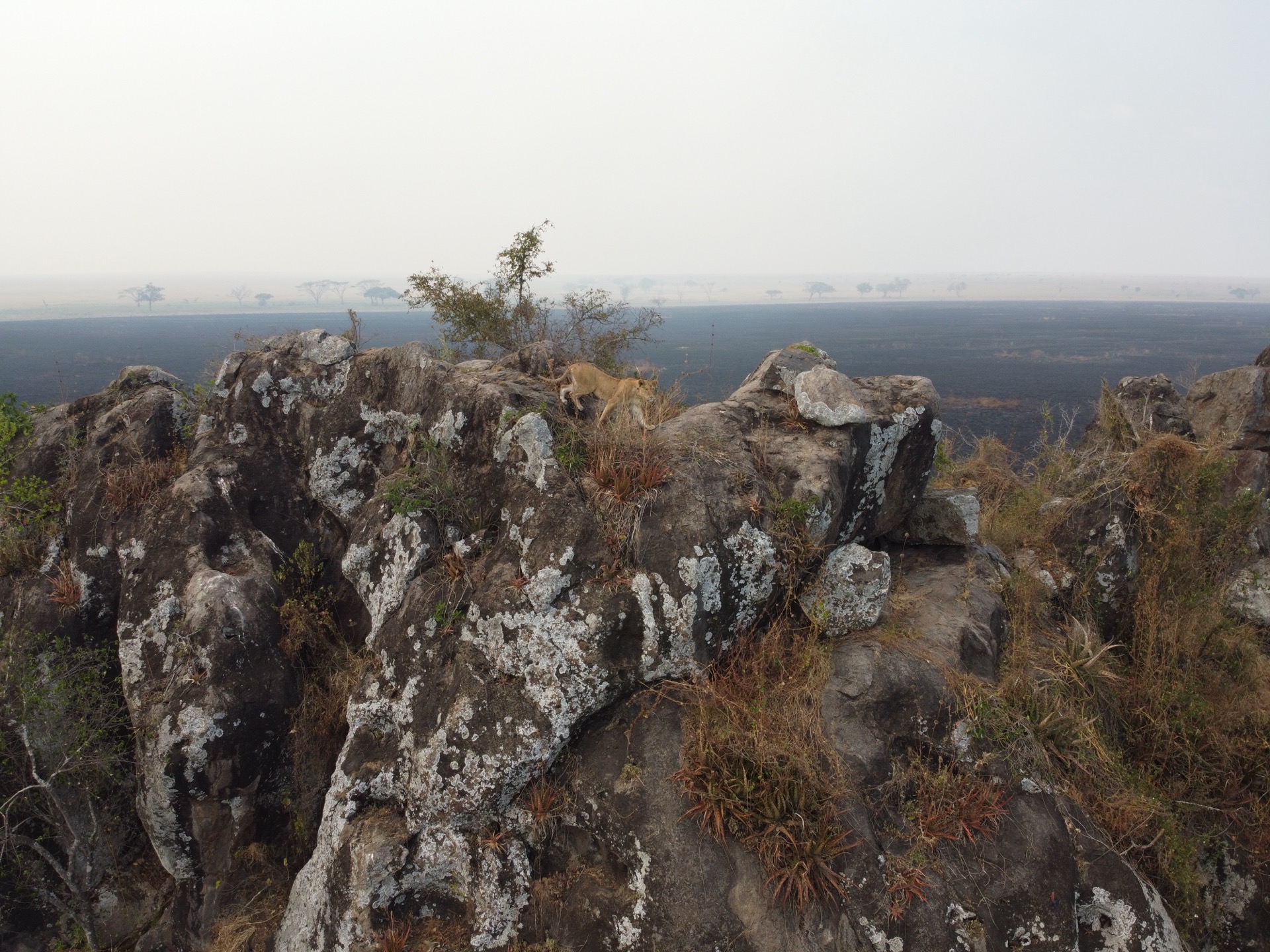
Cheetahs are daytime hunters, which distinguishes them from every other large predator in this guide. They use the light to spot prey at distance from kopjes (rocky outcrops) or elevated termite mounds, select a target, and execute a sprint from concealment. Seeing a cheetah hunt is described as extremely rare relative to how often visitors encounter resting or walking cheetahs — the chase covers ground fast and is over in seconds.
Best viewing zones:
- Southern Serengeti plains and Ndutu (December–March): The highest cheetah density, coinciding with the calving season. Male coalitions hold territory on the open plains; mothers with cubs are frequently visible near the wildebeest concentrations.
- Naabi Hill area: Worth a slow pass at any time of year — cheetahs use the elevated ground for scanning.
- Ruaha-Rungwa ecosystem: A 2025 peer-reviewed study confirmed cheetahs across approximately 50,000 km² of the Ruaha-Rungwa landscape.
Leopard — the tree-climbing solution
Leopards solve the kill-theft problem that cheetahs cannot: they drag carcasses into trees. A leopard can bring down prey up to three times its own body weight and haul it vertically into branches that lions and hyenas cannot reach. The carcass can be cached for days, eaten incrementally.
Serengeti leopard density is approximately 5.72 per 100 km² in the wet season and 5.41 per 100 km² in the dry season — figures that make the Serengeti one of the densest leopard populations recorded anywhere. Nyerere’s Matambwe sector reaches 8.08 ± 1.54 leopards per 100 km², among the highest density measurements in Africa.
Despite high density, leopards are the hardest of the five large predators to see. They are solitary, primarily nocturnal, and extremely good at using cover. Experienced Serengeti guides check specific fig tree branches along the Seronera River — individual leopards return to the same trees repeatedly, and the guide’s knowledge of those individuals and their patterns is what produces reliable sightings.
Best viewing conditions: Dry season (June–October) when sparse vegetation removes hiding cover; early morning first light or late afternoon before dark; Seronera River fig tree forest for the Serengeti; private conservancy night drives for hunting behaviour.
Vultures — the essential cleanup crew
Five species are regularly recorded in the Serengeti ecosystem:
- Lappet-faced vulture: The largest species; dominant at carcasses; strong enough to tear through hide that smaller vultures cannot open
- Rüppell’s Griffon vulture: Large, high-soaring; locates kills from altitude
- White-backed vulture: The most numerous species in the Serengeti; typically the first to arrive in numbers
- Hooded vulture: Smaller; often displaced by larger species; waits at the periphery
- Egyptian vulture: The smallest; uses tools (dropping stones on ostrich eggs); often the last to access a carcass
Vultures locate kills primarily by watching other vultures descend, not by smell. A circling aggregation dropping altitude is the visible signal that a kill has happened — experienced guides read this from kilometres away. A coordinated feeding aggregation can strip a wildebeest carcass down to bare bones in under an hour, with 200 birds competing simultaneously.
The ecological role is direct: vultures consume carcasses that would otherwise spread anthrax, botulism, and other disease agents across water sources. The conservation concern in Tanzania is significant: three vulture-poisoning incidents in the Serengeti over 16 months killed approximately 400 vultures. Poisoning occurs when poachers or farmers place toxins in carcasses to kill predators — vultures die in large numbers as secondary victims. BirdLife International documents that belief-based killings account for approximately 29% of vulture mortalities across Africa, making it the second-largest cause after poisoning.
Where to see predators in Tanzania by park
Ngorongoro Crater: The highest predator density of any confined habitat in Tanzania. Eight spotted hyena clans, resident lion prides that have held crater territories for generations, a substantial cheetah population on the crater floor, and black-backed jackals visible on almost every drive. No wild dogs inside the crater. The crater is a closed ecosystem — prey cannot leave, which concentrates predators but also creates unusual pressure on prey populations.
Central Serengeti (Seronera): The best year-round base for broad predator diversity. Resident lion prides with stable territories and guides who know individuals by sight. Leopards in the Seronera River fig trees. Hyenas at the river pools. Cheetahs on the open ground toward Naabi Hill. Best predator activity before 10:00 and from 16:00 to sunset.
Southern Serengeti plains and Ndutu (December–March): The calving season peak. Lion prides hunt in full daylight with prey so abundant that multiple kills per morning are genuinely possible. Cheetah density at its highest — coalitions and mother-cub families concentrated on the short-grass plains. Maximum predator density anywhere in Tanzania during this window.
Northern Serengeti, Kogatende (July–October): Migration-following predators in large coalition numbers. Resident prides augmented by prey concentrations at the Mara River crossings. The best window for watching large lion coalitions.
Nyerere National Park: Wild dogs at the highest density in Africa. Lion prides in a wilderness context with few other vehicles. Boat safaris on the Rufiji River provide a different predator angle — Nile crocodiles as ambush hunters. The park’s miombo woodland setting makes sightings feel genuinely remote. Best season June–October; park closes March to end of May.
Ruaha National Park: Wild dogs, large lion coalitions hunting Cape buffalo, and leopards in a remote setting that the northern circuit’s infrastructure cannot match. The Ruaha Carnivore Project’s conflict-mitigation work has maintained predator populations in the buffer zone. June–October dry season is the peak for all large predators.
Planning your predator-focused safari
The single most impactful variable is vehicle type. In a shared vehicle with four to six other guests, the least patient person determines how long you stay at a sighting. In a private vehicle, you can hold position through the full sequence of a hunt — the stalk, the chase, the kill, the feeding sequence, the arrival of jackals and vultures, the eventual displacement by hyenas. That full sequence at a single sighting can take three hours. On a private vehicle, that is available. On a shared vehicle, you leave after twenty minutes.
Night drives are unavailable inside Tanzania’s national parks (Serengeti, Ngorongoro, Nyerere, Ruaha, Tarangire). Private conservancies adjacent to parks — some Serengeti and Ruaha operators have them — permit night drives. Spotted hyenas, active for 53% of darkness hours, are categorically different animals to observe at night versus the resting clumps seen at midday.
For wild dogs specifically: the May–November window gives the best combination of denning-season predictability and open-habitat visibility. The first week of June, when Nyerere reopens after the long rains, is often exceptional — packs have been denning and are predictably located, and the vegetation is not yet at dry-season maximum clearance.
How vehicle costs compare across circuits covers what private versus shared vehicles actually cost across the main park circuits, and which budget tiers give you a private vehicle in Nyerere for wild dogs.
For the complete predator picture broken down by park and season — including how the Serengeti’s cheetah concentration interacts with the wildebeest calving, Ngorongoro’s enclosed hyena clans, and the Nyerere wild dog search logistics — the complete Tanzania species guide covers the full species inventory. For lion-specific park positioning by month, see the Tanzania lions guide. For how the migration affects predator density zone by zone across the year, see the seasonal zone map.
Frequently asked questions
What predators can you see in the Serengeti?
The Serengeti ecosystem holds approximately 3,000–3,500 lions organised into roughly 300 prides, 1,200–1,500 cheetahs (one of only two cheetah populations in Africa above 1,000 animals), leopards at a density of about 5.72 per 100 km², spotted hyenas in eight clans in the Ngorongoro Crater alone, and African wild dogs in the wider ecosystem. Jackals, bat-eared foxes, and five vulture species complete the scavenger tier.
Do hyenas really steal from lions?
The dynamic is genuinely bidirectional. Spotted hyenas actively hunt 70–95% of their own food in well-studied ecosystems — they are not primarily scavengers. Lions, particularly when outnumbered by a hyena clan, are regularly displaced from kills by massed hyenas. Both theft directions occur; the 'hyena is only a scavenger' framing comes from early research and has been significantly revised.
Where can I see African wild dogs in Tanzania?
Nyerere National Park (formerly Selous) holds 800–1,000 wild dogs — Africa's largest single population — at a density of approximately 2.14 per 100 km². Ruaha is the third-largest African painted dog population on the continent. The Serengeti historically lost its wild dog population in the 1990s; occasional individuals move through the eastern Serengeti near Ndutu, but Nyerere and Ruaha give by far the most reliable sightings, particularly May–November.
What is the hunt success rate of African wild dogs?
African wild dogs have an approximately 80% hunt success rate — roughly three times higher than lions. They achieve this through endurance hunting: packs run prey to exhaustion over several kilometres at sustained speeds rather than relying on ambush, and every adult pack member participates. Whole packs also regurgitate food for pups and injured members, the highest level of cooperative food-sharing among African carnivores.
Are there wild dogs in the Serengeti?
Wild dogs disappeared from the Serengeti in the 1990s, likely due to competition from increasing lion and hyena populations combined with disease. Recent years have seen occasional sightings in the eastern Serengeti near Ndutu, but sightings remain unusual. For reliable wild dog encounters, Nyerere National Park is Africa's best option, with 800–1,000 animals and the park's relatively open habitat making visual contact far more likely than in Selous's historically thick bush.
How many cheetahs are in the Serengeti?
The Serengeti ecosystem holds approximately 1,200–1,500 cheetahs, making it one of only two cheetah populations in Africa above 1,000 individuals (the other is the Serengeti-Mara-Tsavo complex). ZSL's Serengeti Cheetah Project, running since 1991, is the longest-running single-population cheetah study in Africa. The southern short-grass plains — particularly Ndutu during January–March calving season — are the most productive area for cheetah sightings.
What vulture species are in the Serengeti?
Five vulture species are regularly recorded in the Serengeti ecosystem: Lappet-faced (largest), Rüppell's Griffon, White-backed (most common), Hooded, and Egyptian. Vultures locate kills primarily by watching other vultures descend rather than by smell, and a coordinated aggregation can strip a wildebeest carcass in under an hour. Three vulture-poisoning incidents in the Serengeti over 16 months killed approximately 400 vultures — a significant conservation concern.