
Facts & prices checked: 2026-07-18
Most of my hotel guests who add a mainland safari onto their Zanzibar stay ask me some version of the same question: which operator do I actually book? Tanzania has thousands of companies selling near-identical itineraries through the same four parks, and the difference between a good one and a bad one almost never shows up in the marketing photos. It shows up in the licence number, the vehicle parked outside, and the fine print of the quote nobody reads twice.
This is the checklist I actually work through when a guest forwards me two or three quotes and asks which to pick: what TALA and TATO mean and why they aren’t the same thing, what a legitimate vehicle looks like, how a quote should be broken down, and the specific questions that get a straight answer out of a real operator — or expose one that isn’t.
The quick version: what to check before you book
| Check | What “legitimate” looks like | Red flag |
|---|---|---|
| Government licence | Valid TALA operator’s licence + TTLB Class C tourism business licence | Can’t produce a licence number on request |
| Trade association | TATO membership (one of 300+ operators) — verify directly on TATO’s own site | Claims membership you can’t independently confirm |
| Vehicle | 4x4 Land Cruiser or Land Rover, working pop-top roof, 6–7 passengers max | Minibus, a dead pop-top, or a 7th middle seat with no window |
| Guide | TALA guide licence + first-aid certificate + recognized wildlife-training diploma | Vague or evasive answers about the guide’s training |
| Deposit | Roughly 30% of trip cost, balance due around 60 days out, card or bank transfer | Cash-only or Western Union demanded |
| Quote | Itemized: park fees, guide, vehicle, accommodation, meals, transfers — each its own line | One lump number, nothing broken out |
| Track record | Several years trading, hundreds of independent reviews (SafariBookings alone lists over 2,100 Tanzania operators) | No verifiable history beyond the operator’s own website |
Every row on that table gets its own section below — this is the summary, not the whole story.
TALA and TATO: the two credentials that actually matter
A legitimate Tanzania safari operator carries two separate credentials, and travelers frequently confuse them.
TALA is the Tour Operator’s Licence, issued by the Ministry of Natural Resources and Tourism. It is the actual legal permit to run safaris — not optional, not a nice-to-have, a requirement regardless of how long a company has been trading. A parallel requirement sits alongside it: a Tourism Business Licence (Class C) from the Tanzania Tourism Licensing Board, the TTLB. Guides need their own version of this — a TALA guide licence, separate from the operator’s licence.
TATO, the Tanzania Association of Tour Operators, is different. It’s a trade body — voluntary, not a government requirement — that currently represents more than 300 operators across the country. TATO membership is a real credibility signal precisely because the association vets applicants before letting them join, including checking their licences. But membership itself doesn’t authorize anyone to operate; a company can be a TATO member and still need to hold the separate TALA and TTLB paperwork, and — more troublingly — a company can display a TATO badge that isn’t real.
The fix is almost embarrassingly simple: TATO says membership can be verified directly through its own website or by contacting the association. It takes two minutes and it’s the single highest-value check on this whole list. I ask every guest who’s already deep into planning a safari to do exactly this before they send a deposit, not after.
For climbers, the same logic runs even stricter: Kilimanjaro requires a licensed guide and a licensed operator by law, and the sister trade body up there is KIATO, the Kilimanjaro Association of Tour Operators — worth knowing if your Tanzania trip includes a mountain as well as a park circuit.
Reading a quote properly: what should be broken out
Sentence one, because it matters most: a real quote is itemized, not a single number.
A properly built Tanzania safari quote lists park fees, the driver-guide fee, the vehicle fee, accommodation, meals, and transfers as separate lines. That’s not bureaucratic pedantry — it’s the only way to actually compare two offers, because operators bundle these costs differently and a lower headline price sometimes just means one of these pieces got quietly dropped.
Labour costs are a useful sanity check on their own. An experienced driver-guide in Tanzania runs in the region of €40 a day currently, rising to €50 from 1 January 2027 on some routes — so if a “budget” quote is dramatically undercutting competitors on the total, ask directly which of guide, vehicle, or park fee got shaved to make that number work. The full Tanzania safari cost breakdown covers the park-fee layer in detail — the three-layer structure that trips up almost every first-time quote comparison.
I’ve sat with guests staring at two PDFs that were, on paper, thousands of dollars apart — until we laid the line items side by side and found one operator had quietly excluded the Ngorongoro crater descent fee entirely. Not fraud, exactly. Just an incomplete quote wearing a complete-looking price tag.
What I tell people to ask outright: “Can you send me an itemized version with park fees, guide, vehicle, and lodging on separate lines?” A serious operator produces this in minutes. One that stalls is telling you something.
Private vehicle or shared group vehicle
This decision changes your safari more than almost anything else on the quote, so make it deliberately rather than by default.
A private vehicle — your group and nobody else — typically costs somewhere in the US$350–500 per person per day range for a dedicated 4x4 and driver-guide. A shared vehicle, carrying up to 6–7 passengers split across other travelers your operator has grouped together, brings the per-person cost down but hands over control of pacing, photo stops, and how long you linger at a sighting.
For solo travelers or couples, the private-vehicle premium is often smaller than it first appears once you account for what you’re actually buying: your own schedule, no waiting on strangers to finish photographing the same lion, and a driver-guide whose full attention is on your interests rather than negotiating six different priorities at once.
For a group of four to six who already know each other, a private vehicle at the group rate frequently lands close to shared-vehicle pricing per person — with none of the trade-offs. That’s the case where the decision is easy.
What to ask either way: how many passengers will actually be in the vehicle, and does every seat get a window. A 6-seat Land Cruiser configured as 7 seats — one of them in the middle with no window access — is a compromise worth knowing about before you’re in it for six hours a day.
What the vehicle itself should look like
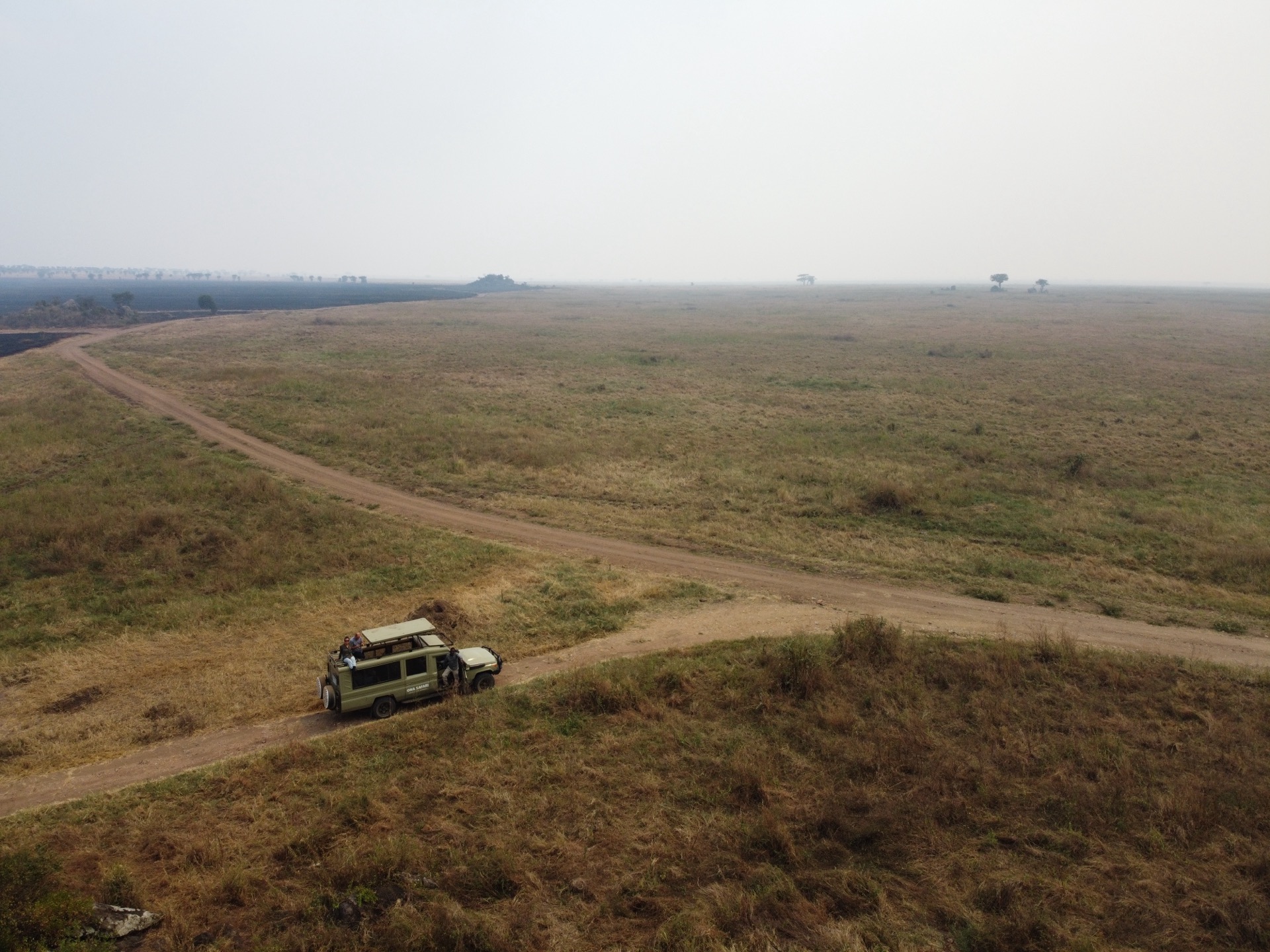
The industry standard across Tanzania is a 4x4 Land Cruiser or Land Rover, and for good reason: low-range four-wheel drive handles deep sand, wet clay, and washed-out bush tracks that a standard vehicle simply can’t.
A legitimate operator’s vehicle should have:
- A working pop-top roof — the hinged panel that lifts to give standing passengers a 360-degree view over long grass and low bush. Ask directly whether it opens fully and whether it’s mechanically sound; a jammed or rusted panel that technically “opens” but doesn’t in practice is a real and common complaint.
- 6–7 passengers maximum, each with genuine window access. More than that and photography, sightlines, and comfort all suffer together.
- No minibuses. Operators who state outright that they never run minibuses on safari are describing the real industry baseline, not a sales pitch — a minibus lacks the ground clearance, 4x4 capability, and roof configuration a national park actually requires.
- A charging point and a cool box for full-day drives — not essential to safety, but a fair proxy for how well-equipped the rest of the vehicle is.
Accessible options exist too: at least one Tanzania operator runs an in-house workshop converting Land Cruisers for wheelchair users, with a published starting rate of around US$220 per day in shoulder season. If mobility is a factor in your planning, ask early — this needs more lead time than a standard booking.
The deep dive on Tanzania safari vehicles covers seat-row configuration, photographic vehicles with beanbag rests, and the difference between a pop-top and a fully open vehicle in more detail than fits here.
Guide qualifications: what a licence actually certifies
A driver-guide’s licence isn’t a formality — it’s the difference between someone who can find a leopard and someone who can also read what it’s about to do next.
A properly qualified Tanzania safari guide holds three things: a TALA guide licence, current first-aid certification, and wildlife-training from a recognized institution. None of these are unusual to ask about, and a guide who’s actually been through the training talks about it comfortably — the specific school, the certification body, roughly when it was renewed.
I’ve watched the gap in practice. A veteran guide reads a herd’s body language from 200 metres and repositions the vehicle before anything happens; a newer or unlicensed one is still reacting once the moment has already passed. Neither is a character flaw — it’s training and hours in the seat, and it’s exactly what the licence is meant to certify.
What to ask: not “is your guide licensed” — almost everyone says yes to that — but “what’s your guide’s TALA licence number, and how many years has he or she been guiding in this specific park?” Specificity in the answer is the tell. A guide with genuine tenure in, say, the Serengeti’s Seronera valley will tell you unprompted; one reciting a rehearsed line usually won’t go further than the yes.
Red flags: pricing, payment, and vague answers
Two patterns account for most of the trouble travelers report with Tanzania safari operators, and both are checkable before you pay anything.
Payment method. An operator that insists on cash only or Western Union, with no card or bank-transfer option, is a genuine red flag. Legitimate companies with real offices and real banking relationships can take a bank transfer or a card, even if they charge a small processing fee for it.
Price gap. A quote priced 40–50% below every other comparable offer you’ve received deserves a direct question, not an automatic decline. Sometimes there’s an honest reason — a smaller operator with lower overhead, an off-season discount, a shorter route. But that gap is also exactly where corners get cut: an older vehicle, an unlicensed guide, park fees quietly left off the total.
Beyond pricing, general Tanzania travel-scam patterns are worth knowing regardless of how you book — fake safari operators and tours sit alongside currency scams, inflated souvenir “deals,” and ATM tampering as the most commonly reported issues. None of it is exotic; it’s the same handful of patterns that show up in most tourism economies, just with a safari-shaped version.
The honest reassurance: nothing here requires forensic investigation. A TALA licence number, verifiable TATO membership, a bank transfer option, and an itemized quote — if all four check out, you’ve eliminated the overwhelming majority of what actually goes wrong.
Ground operator, Western agent, or booking through your lodge
There are three practical routes into a Tanzania safari, and each trades money for a different kind of convenience.
Booking directly with a Tanzania-based ground operator is usually the cheapest route — often 30–50% cheaper than the identical itinerary sold through a Western agent, mainly because the ground operator owns its vehicles and employs its guides directly rather than subcontracting through layers of resellers. The trade-off is that you do the vetting yourself: the licence checks, the review reading, the itemized-quote request, all of it on you.
Booking through a Western travel agent costs more, but the agent has usually already done a version of this vetting, carries their own reputation on the line, and gives you someone in your own time zone and language if something goes sideways mid-trip. For a first-time visitor with no interest in comparing licence numbers, that premium buys something real.
Booking through your Zanzibar or Arusha lodge sits in between — most established lodges have a small shortlist of ground operators they’ve used repeatedly and will vouch for. It’s not independent verification, but a lodge with its own reputation to protect rarely refers a bad operator more than once. Worth asking directly: “how long have you been sending guests to this specific operator, and would you use them yourself?”
None of these is objectively correct. It’s genuinely a question of how much of the vetting you want to do yourself against how much you’re willing to pay someone else to have already done it.
Deposits, balances, and cancellation terms
Most reputable Tanzania safari operators ask for a deposit around 30% of the total trip cost to confirm your dates — though luxury tented camps with limited availability sometimes require up to 50%, since they’re holding scarce inventory on your behalf. One operator’s own published policy, as an example of the standard structure: 30% deposit to confirm, with the balance due roughly 60 days before departure.
What to get in writing before you send anything: the exact deposit percentage, the balance due date, and — critically — the cancellation and refund terms if your plans change. A written policy costs the operator nothing to provide and tells you plenty about how they’ll behave if something goes wrong later.
This is also where the payment-method check from earlier becomes concrete: pay a deposit by card or bank transfer, never cash-in-advance or Western Union, and keep every confirmation email. If a dispute ever arises, a paper trail is the only leverage you have from another continent.
Nine questions to ask before you pay a deposit
Ask these directly, in writing, before any money changes hands:
- What is your TALA operator’s licence number?
- Are you a TATO member, and can I verify that independently?
- What make and model is the vehicle, how many passengers, and does every seat have a window?
- Does the pop-top roof open fully, and is it mechanically sound?
- What is your guide’s TALA licence number and how many years guiding in this specific park?
- Can you send an itemized quote — park fees, guide, vehicle, accommodation, meals, and transfers as separate lines?
- What is the deposit percentage, and when exactly is the balance due?
- What are your cancellation and refund terms if my dates change?
- Do you own your vehicles and employ your guides, or subcontract to another company for part of the trip?
A legitimate operator answers all nine without friction, usually within one email. Hesitation, deflection, or a vague non-answer on any single one of them is worth taking seriously — it’s rarely just one question that’s the problem, it’s the pattern across all nine.
What I’d actually do
If a friend asked me to shortcut this whole process, here’s the honest version: verify TATO membership directly on TATO’s own site, ask for the TALA licence number, and request an itemized quote. That’s three checks, fifteen minutes total, and it clears out the overwhelming majority of operators worth avoiding.
Everything past that — vehicle configuration, guide tenure, private-versus-shared economics — is about getting a better safari, not a safer one. Once the licensing checks out, the rest of this guide is really about matching the operator to how you actually want to travel: elbow room in the pop-top roof, a driver-guide who knows one specific valley rather than the whole circuit, a payment schedule you’re comfortable with months before departure.
I still ask guests to send me their shortlist before they book, mostly because I like seeing which operators keep showing up on other people’s good-experience lists. That repetition is its own kind of verification — better than any single review, because it’s accumulated across people who never talked to each other.
Once you’ve chosen an operator, the planning shifts to logistics: what to actually pack, which vaccinations matter, and what to book in advance versus arrange on the ground — the pre-trip checklist for vaccinations, packing, and booking order picks up exactly where this one leaves off. If you want to see how the licensing and vehicle standards above play out across an actual week in the bush, the 7-day northern circuit itinerary prices the whole route day by day. And once you’re in the vehicle with a licensed guide, Tanzania safari safety covers the one rule that actually matters once the engine’s off: stay in the vehicle until your guide says otherwise.
→ Related guides: Planning your Tanzania and Zanzibar trip · Tanzania’s first safari guide · Tanzania budget safari
Frequently asked questions
What is a TALA licence, and why does a Tanzania safari operator need one?
TALA is the Tour Operator's Licence issued by Tanzania's Ministry of Natural Resources and Tourism — the legal permit that allows a company to run safaris at all. A separate Tourism Business Licence (Class C) from the Tanzania Tourism Licensing Board (TTLB) is also required. Ask for the licence number directly; a legitimate operator gives it to you without hesitation.
Is TATO membership the same as being licensed?
No. TATO — the Tanzania Association of Tour Operators, which represents over 300 operators — is a voluntary trade association, not a government licence. A company can list a TATO badge and still lack the TALA operator's licence and TTLB business licence the law actually requires, so check both rather than just the logo on the homepage.
How do I verify TATO membership myself?
TATO states that verification can be done directly through its official website or by contacting the association, and that it checks a company's licences before accepting it as a member. A short check against TATO's own membership list settles the question before you send anyone a deposit.
Should I book a private vehicle or a shared group vehicle?
A private vehicle (your group only) typically runs US$350–500 per person per day for a dedicated 4x4 and driver-guide, against a lower per-person rate on a shared vehicle carrying up to 6–7 passengers. For two people travelling together, the price gap is often smaller than it first appears once you weigh in the flexibility of setting your own pace at every sighting.
What vehicle should a legitimate operator be running?
The standard is a 4x4 Toyota Land Cruiser or Land Rover with a working pop-top roof, seating capped at 6–7 passengers so nobody is stuck in a windowless middle seat. Operators who volunteer that they never run minibuses are describing the actual industry standard, not a marketing line — ask to see a photo of the specific vehicle if anything in the answer feels vague.
What should a legitimate quote actually include?
Park fees, driver-guide fee, vehicle fee, accommodation, meals, and transfers should each appear as separate line items, not folded into one number. A driver-guide alone typically costs in the region of €40 a day (rising to €50 from January 2027 on some routes), so if a quote can't tell you what portion is guide, vehicle, or lodge, it isn't a finished quote yet.
What are the biggest red flags when comparing safari quotes?
Two patterns come up repeatedly: an operator that will only accept cash or Western Union, and a quote priced 40–50% below every other comparable offer you've received. Neither automatically means fraud, but both deserve a direct question before you send money — a legitimate operator has nothing to lose by explaining an unusually low price honestly.
Is it cheaper to book directly with a Tanzania ground operator than through a Western agent?
Often, yes — a local Tanzanian operator can run 30–50% cheaper than a Western agent reselling the same itinerary, mainly because of lower overhead and owning the vehicles rather than subcontracting them. The trade-off is that you do more of the vetting yourself instead of leaning on a home-country brand name, which is exactly what the checks in this guide are for.