
Facts & prices checked: 2026-06-25
Most Tanzania safari booking sites list vehicle type as a single line in the itinerary: “4x4 Land Cruiser.” They leave out everything that actually matters — how many people share that vehicle, whether the roof opens properly, which seat you will be in, and what a guide with 12 years in one park does differently from a guide rotating through their first year. This guide explains the vehicle configurations, the practical differences between options, and the specific questions to ask before you sign anything.
The standard Tanzania safari vehicle
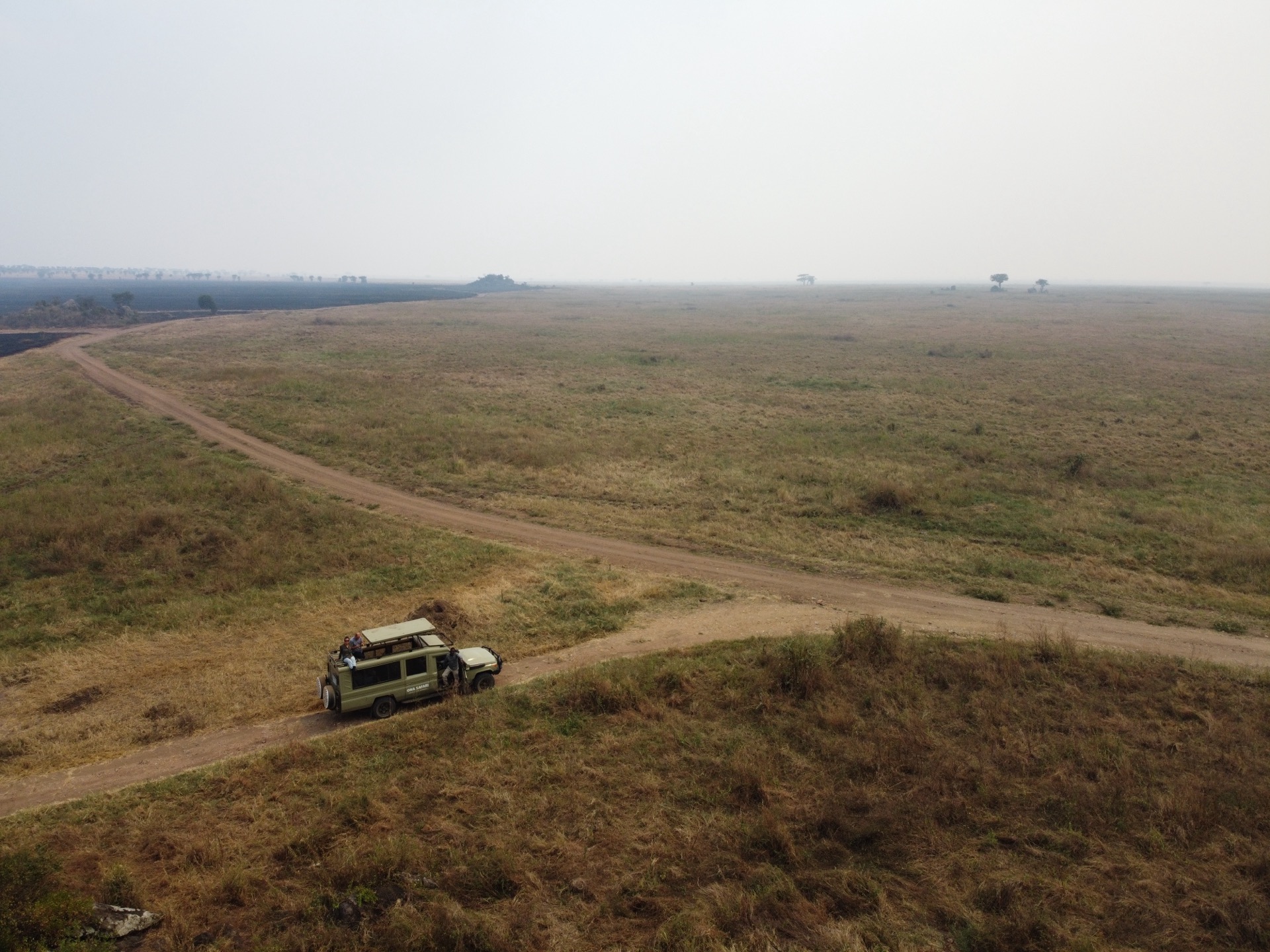
The Toyota Land Cruiser Series 70/76 is the dominant safari vehicle in Tanzania — it is what the majority of operator fleets consist of, what TANAPA-registered guides are trained in, and what you will almost certainly be in unless you book an explicitly premium or specialist operator.
The base vehicle is a 3-door pickup or station wagon built for heavy terrain. For safari use, the body is modified: a reinforced roof conversion replaces the standard roof with a hinged panel that opens for wildlife viewing (the pop-top), seat rows are added in a 3-row configuration, and wide side windows replace standard door glass. The result is a purpose-built game drive vehicle that has been refined over decades of African bush use.
Why the Land Cruiser dominates:
- The 70 Series has been in production since 1984 with consistent mechanical architecture — guides and mechanics know the vehicle deeply
- 4WD with low-range transfer case and high ground clearance handles river crossings, deep sand, and rutted clay tracks
- Long-term parts availability across Tanzania means a mechanical issue on the Serengeti plains can usually be fixed the same day
- The vehicle is tall enough that seated passengers can see over long grass without the roof being open
One Tanzania operator states flatly: “We never use minibuses.” That is the correct position. A minibus (the budget alternative used by some lower-end operators) lacks the 4WD capability and ground clearance required for off-track bush navigation, and has no pop-top equivalent. Any quoted safari that doesn’t specify Land Cruiser or Land Rover configuration is worth querying.
Understanding the pop-top roof
The pop-top (sometimes called pop-up roof) is the hinged panel that replaces the standard Land Cruiser roof. Most safari vehicles in Tanzania have one — it is the configuration standard for game drives, not a premium add-on. The panel is typically mounted on a gas strut or hinge system that allows it to open fully, with a fabric or hard-panel wind deflector at the front edge.
What it enables:
When the panel opens, passengers can stand upright with their upper bodies clear of the vehicle, providing 360-degree unobstructed views. This is not primarily a photography feature — it is how you actually see wildlife. Through a side window, you are limited to a roughly 90-degree field of view in one direction. Standing in the pop-top, you see the full landscape, spot the wildebeest dust cloud 2 km away, and watch the guide’s pointing signal without turning your head.
For photography specifically, the pop-top allows you to use a telephoto lens over a wide arc without a door frame in the shot, shoot down at animals that are lower than the vehicle (crucial for large elephant herds), and stabilize a camera or beanbag against the open roof edge. A pop-top roof is described by specialist photo safari operators as essential for any serious wildlife photography vehicle.
What to verify before booking:
Ask specifically: “Does the pop-top open fully?” and “Is it mechanically reliable?” Some older vehicles have damaged gas struts, seized hinges, or roof panels that open only partially. A pop-top that opens 30 centimetres instead of fully is nearly useless for photography or proper viewing. This is a basic maintenance signal — an operator who cannot confirm roof functionality is telling you something about vehicle upkeep generally.
The roof stays closed when driving at speed on tarmac and during heavy rain. On game drives in the bush, it should be open whenever there are animals visible. A guide who keeps the roof closed “for safety” at a stationary sighting with wildlife nearby is either following bad operator policy or is unfamiliar with the vehicle.
Seat configuration and the window seat rule
A 6-passenger Land Cruiser has 3 rows of seating:
Row 1: Driver (guide) + front passenger seat. The front passenger position is sometimes occupied by a co-guide, sometimes available to a traveler.
Row 2: 2 passengers with direct access to large side windows and the open roof section.
Row 3: 2 passengers. In a pop-top configuration, rear-seat passengers have equal or better access to the roof opening than row 2, because they are positioned directly under the centre of the panel.
The window seat rule: In a properly configured 6-seat safari vehicle, every seat is a window seat. There is no middle seat — the layout is 1+1 across, not 2+1. If an operator adds a 7th or 8th passenger in a centre-row position with no window, this is a quality failure: that person has no sightlines, no pop-top access, and is in a seat that should not exist in a game drive vehicle. One Tanzania operator explicitly states that vehicles accommodate up to 7 clients plus the driver — the 7th seat typically a fold-down position that compromises at least one passenger’s experience. Ask how many people will be in your vehicle and whether every paying passenger has a window seat.
The front passenger position: Being in the front seat alongside the guide is neither the best nor the worst position. Advantages: excellent forward visibility for spotting animals ahead, direct conversation with the guide, good windscreen view at dawn when big cats are most active. Disadvantages: when the vehicle stops and everyone stands in the roof, the front passenger is below the main viewing group and may miss the guide’s back-pointed signals; you also cannot easily reach the roof opening. Row 2 or 3 is the better photography position.
A note on vehicle condition: Ask about the vehicle age and last service date. A well-maintained 2018 Land Cruiser is preferable to a 2023 minibus with no service history. Responsible operators guarantee proper maintenance of their Land Cruiser fleets — and should be willing to state this directly.
Shared vs private vehicle: what the difference actually means
Shared vehicle: Your operator fills remaining seats with other travelers. In budget and mid-range safaris, shared vehicles are standard. You share the guide, the sightings, and the roof space with people you may not have met before.
Private vehicle: Your party books exclusive use of the vehicle and guide. A private vehicle typically costs USD 250–400 per day for exclusive use, in addition to park fees and accommodation.
The practical difference is significant and not just about comfort:
Positioning: When a leopard is in a tree, a guide managing six strangers with different photography levels and attention spans is making different positioning choices than a guide working with two people who both have telephoto lenses and want 10 minutes at the sighting. A private guide positions the vehicle for your specific needs.
Pace: Shared vehicles follow a schedule that works for the average of the group. A private vehicle can spend 45 minutes at a cheetah hunt and nothing at a herd of impala; a shared vehicle does the reverse if four of the six passengers have been waiting for something.
Photography: The roof space in a 6-passenger vehicle is shared. Two people standing under a pop-top with telephoto lenses have flexibility that six people do not. For wildlife photography specifically, a private vehicle is not a luxury — it is a practical tool.
When private is worth it: For 1–2 travelers, always. A private safari is often only 20–30% more expensive per person than a group booking and delivers fundamentally different experience control. For two people, the Ngorongoro crater descent fee of USD 295 per vehicle is split two ways instead of six — a cost argument for private that also applies here. For groups of 4–6 who know each other and book together, a full group booking is effectively a private vehicle anyway. The strangers-in-the-vehicle problem only applies when an operator fills remaining seats.
Private vehicle entry fees: Tanzania national parks charge a separate vehicle entry fee for private vehicles — USD 20 per day for Land Cruisers. This is additional to the person entry fee and should be included in any transparent private safari quotation.
Other vehicle types in Tanzania
Land Rover Defender: Less common in Tanzania than in Kenya or southern Africa. Some premium operators and private camps — particularly in Ruaha, Katavi, and Mahale — use Defender 110s for private guiding. The original Defenders have cult status among experienced bush guides for their mechanical simplicity and terrain capability. The newer Defender (2020+) is capable but less field-serviceable. Defenders used in the southern circuit are sometimes preferred by operators for walking-safari support because of their lower-profile footprint in remote areas.
Toyota Land Cruiser 78 Troop Carrier (Troopy): The 78-series is a longer-wheelbase vehicle with bench seating down both sides, facing inward. Less suited for game drives than the 70/76 Series: passengers face each other rather than the windows, which eliminates the side-window sightline advantage. Binocular use and camera stability are both harder on a bench seat. The Troopy is sometimes used for family or group transfers rather than game drives.
Land Cruiser Prado / 200 Series: Occasionally used for airport-to-lodge transfers. The standard road configuration lacks the pop-top conversion and window layout required for game drives. Fine for point-to-point transfers; not a substitute for a game drive vehicle.
Open vehicles in private conservancies: Fully open vehicles — no roof, minimal or no doors — are used in some private concessions for night drives and exclusive-territory daytime drives. Open-sided safari vehicles are only used within park and conservancy boundaries; they are prohibited on Tanzanian public roads. Singita Grumeti Reserve and similar private concessions use modified open Land Cruisers or custom-built open game-viewing vehicles for night drives, where spotlights and the absence of a roof create a fundamentally different encounter with nocturnal wildlife. The experience is more immersive than any closed vehicle — there is no barrier between you and the bush, which changes the atmosphere of every sighting.
Custom-built photographic safari vehicles exist at the specialist end of the market: open-sided designs or pop-up roofs with dedicated camera bean bag mounts, charging points, and stabilization rails. These are bespoke products from specialist operators rather than standard fleet vehicles.
7 questions to ask before you book
Vehicle type is underspecified in most safari marketing. These seven questions cut through the ambiguity:
-
How many seats in the vehicle, and how many will be occupied on my game drives? The target is 6 or fewer. Ask whether your party will share with strangers or have exclusive use.
-
Does the pop-top open fully and is it in good mechanical condition? Non-negotiable. A non-functional pop-top is a significant quality failure. Ask the operator to confirm it was last serviced.
-
Does every passenger get a window seat? There should be no middle seats. In a shared vehicle, confirm that your party has direct window access for every person.
-
What is the seat allocation for my party? If you are 3 people in a 6-seat vehicle, who occupies the other 3 seats? When is that confirmed?
-
What is the vehicle year and last service date? A breakdown in Katavi or Ruaha is a serious situation. Ask about the fleet age and maintenance schedule. Responsible operators maintain their Land Cruisers rigorously and can confirm this.
-
Does the vehicle have a 12V charging socket for camera batteries? Most modern safari Land Cruisers do. Confirm in advance; a flat battery on day 3 in the Serengeti is avoidable.
-
Does the vehicle have a cooler box for all-day drives? Essential for full-day game drives in temperatures that can reach 35°C by mid-morning. Most operators provide water and sometimes cold drinks; ask what is included so you know what to carry.
These seven questions also tell you something about the operator. An operator who answers all seven quickly and confidently maintains their fleet and manages bookings transparently. An operator who deflects or doesn’t know the answers is telling you something important before you have paid anything.
A dawn crossing in Ruaha
The best game drive I have had in Tanzania was in a vehicle with two people — my partner and me — and a guide who had driven the same routes in Ruaha for twelve years.
He knew exactly where the sun would be at 6:30 AM and positioned us on the east bank of the Mwagusi Sand River before first light. We had the entire pop-top to ourselves. When a pride of seven lions crossed thirty metres in front of us at dawn — five adults and two juveniles, moving single-file from the riverbed into the acacia scrub — we both had our cameras out simultaneously. No one was in anyone’s shot. No one called out “stop, I can see it!” from a middle seat that had no sightline. The guide killed the engine the moment the first lion appeared.
In a shared vehicle of six strangers with mixed photography experience and different ideas about how long to stay, the same crossing would have been a different experience. The lions would have been the same. The light would have been the same. The guide’s knowledge would have been the same. The vehicle and the people in it would not.
For the broader context on what Tanzania’s southern parks offer — including Ruaha’s remoteness advantage and its predator density relative to the northern circuit — see the southern-circuit cost comparison and our Ruaha vehicle and terrain notes.
Related guides
- What a Tanzania safari really costs — transparent breakdown of park fees, accommodation tiers, and total budgets by category
- Budget Tanzania safari — how group tours with shared vehicles work, which parks are best for tight budgets, and what you actually give up
- What to prepare before departure — what to pack, health and insurance requirements, and how to prepare for the physical realities of game drives
- Tanzania photographic safari — specialist vehicle configurations, guide expertise requirements, and the specific equipment setup for serious wildlife photography
- Kilimanjaro Rongai route — the remote northern gate near the Kenyan border needs the same 4WD repositioning logistics as a southern-circuit safari transfer
Frequently asked questions
What is the standard Tanzania safari vehicle?
The Toyota Land Cruiser Series 70/76 with a pop-up roof conversion is the dominant Tanzania safari vehicle. The base is a 3-door pickup or station wagon; the roof is replaced with a hinged panel that folds back or lifts on a gas strut, creating an open standing position that allows 360-degree wildlife viewing without obstruction. Seating is typically 6 passengers in 3 rows of 2. Every seat should provide direct window access — verify this before booking, as some operators squeeze in a 7th seat with no window. 4WD with low-range transfer case is standard; the Land Cruiser 70 Series is specifically built for rough bush terrain. Responsible operators keep vehicles to 6 or 7 passengers maximum.
What is a pop-top roof and why does it matter?
A pop-top roof is a hinged panel that opens to allow passengers to stand upright with unobstructed 360-degree views during wildlife sightings. It is not just for photography — it allows you to see over long grass, spot animals at distance, and experience the bush in a way that is impossible through side windows alone. A vehicle without a functioning pop-top limits the experience significantly. Ask specifically: 'does the pop-top open fully?' and 'is it mechanically reliable?' before booking. It is a basic quality check that tells you whether the operator maintains their fleet properly.
What is the difference between a shared and private safari vehicle?
A shared vehicle means your operator fills the remaining seats with other travelers — you may share with strangers in a 6-seat vehicle. A private vehicle means your party (however small) occupies the entire vehicle and has exclusive use of the guide. Private vehicles typically cost USD 250–400 per day for exclusive use, and give you real practical benefits: the guide can position the vehicle for your specific photography preferences, you control the pace and timing of sightings, and you have the full roof space. For 1–2 travelers, a private vehicle is worth the premium. For groups of 4–6 who know each other, a full group booking is essentially a private vehicle anyway.
Is the front passenger seat the best seat in a safari vehicle?
Not necessarily. The front passenger seat (alongside the guide/driver) gives excellent forward visibility while driving and a clear windscreen view for spotting animals ahead. However, when the vehicle stops at a sighting and everyone stands in the pop-top roof opening, the front passenger is in the wrong position to join the roof crowd and may miss the guide's pointing signals. Row 2 or 3 with a window seat and direct access to the open roof is typically the better position for photography and wildlife viewing. The front seat is excellent for conversations with the guide and seeing how a guide reads the bush — educational but different from the open-roof experience.
What open vehicles are available in Tanzania?
Open vehicles — no roof, minimal or no doors — are used in private conservancies for night drives and exclusive-territory drives. Open-sided safari vehicles are only used within park and conservancy boundaries and are not allowed on Tanzanian public roads. They are specifically a private conservancy product: the experience is far more immersive than a pop-top Land Cruiser, but only appropriate where vehicle traffic is minimal. The absence of any barrier between you and the bush changes the atmosphere of a sighting completely — and requires a guide with genuine terrain expertise and safety judgment.
What should I bring for a full-day game drive?
For a full-day drive (typically 5:30 AM departure, back 12:30 PM, out again 4:00–7:00 PM): sunscreen (the open roof means direct sun for hours), sunglasses, a light fleece or jacket (mornings can be 12–16°C at dawn even in warm months), binoculars (8x42 focal range is most versatile for safari), and a charged camera battery. Most modern safari Land Cruisers have a 12V charging socket — confirm this when booking. A cooler box is standard on most vehicles for all-day drives but worth checking in advance. For long days, a packed bush breakfast or lunch is sometimes included — ask specifically.