
Facts & prices checked: 2026-06-25
The short answer: visit both if you can
Serengeti and Ngorongoro are not rivals. They are adjacent, they complement each other completely, and almost every Northern Circuit safari includes both. The “vs” question only bites when itinerary time is genuinely short — three or four days total, one park only.
If that is your situation: 3–4 days with no fixed Migration timing → Ngorongoro first. You will see more wildlife per hour in a confined setting. Migration season (July–October, Mara River crossings) → Serengeti, northern zone. The crossings only happen in the Serengeti ecosystem, not in the crater. 7 or more days → both, with Ngorongoro as a 2-night midpoint and the Serengeti taking the majority of nights.
Everything else in this guide is context for that decision.
The Serengeti: scale, migration, and open grassland
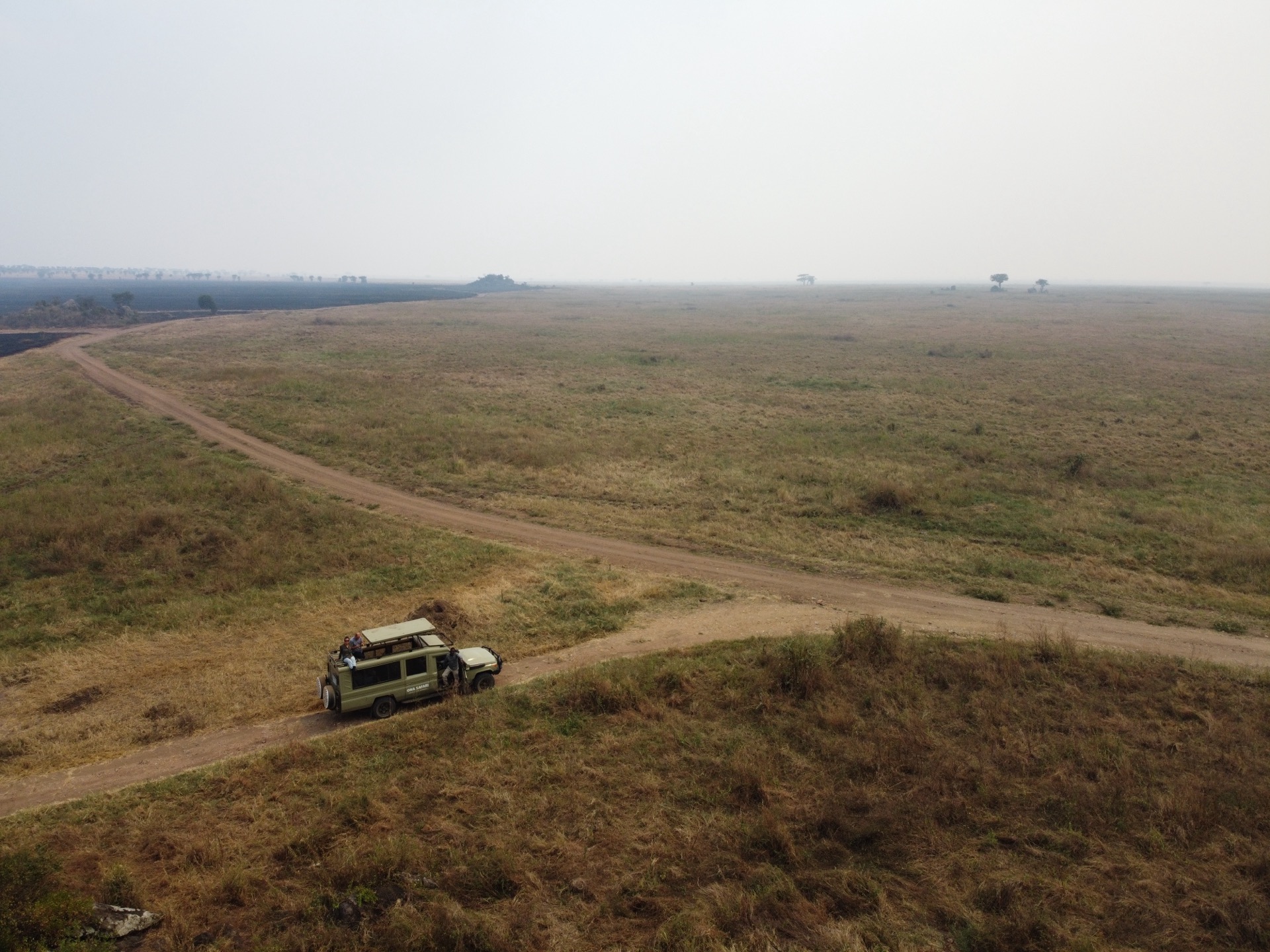
The Serengeti covers 14,763 km² — Tanzania’s largest national park, sitting at altitude between 1,140 and 2,099 metres. The landscape is open short-grass plains in the south, shifting to acacia woodland and granite kopjes (isolated rock outcrops) in the central and western areas, and long-grass savanna in the north. The scale is the point: you can drive for an hour between sightings in certain zones, which is both the Serengeti’s character and its challenge for a first-timer with limited time.
The park’s defining feature is the Great Migration — the 800 km circular annual movement of wildebeest between the Serengeti and the Maasai Mara in Kenya. The 2023 TAWIRI aerial census counted 1,366,109 wildebeest (± 231,741) in the Serengeti–Mara ecosystem, though a 2025 Oxford AI satellite study published in PNAS Nexus suggests the real figure may be under 600,000. The honest position: traditionally cited at ~1.3 million, with the actual number under active scientific debate. Either way, when the herds move through a zone, the density of animals is extraordinary.
The Migration has four distinct phases, each in a different part of the park:
- Ndutu and the southern plains (January–March): Calving season, peaking in February. Up to 8,000 calves born daily during peak weeks. Predators — cheetah, wild dog, lion, hyena — concentrate for the easiest hunting of the year. This is arguably the most dramatic wildlife viewing of the Serengeti year.
- Central Serengeti / Seronera (year-round): The most-visited zone. Reliable big cat sightings around the Seronera Valley. Not Migration-dependent — resident lion prides and leopards are here regardless of season.
- Western Corridor / Grumeti (June–July): The herds move northwest; Grumeti River crossings happen here before the main Mara crossings. Less visited than the north, fewer vehicles.
- Northern Serengeti / Kogatende (July–October): The Mara River crossings. Thousands of wildebeest plunging into crocodile water at unpredictable moments — this is the image most people associate with the Migration. Plan 3–4 nights in the north; crossings cannot be predicted by the day.
The Serengeti’s weakness for a first-timer: because the area is enormous, wildlife is dispersed between hot spots. You can have a slow morning. The park rewards longer stays and strategic zone selection.
Ngorongoro Crater: the contained world
Ngorongoro is a Conservation Area under the Ngorongoro Conservation Area Authority (NCAA), not a national park — the fee structure is entirely separate from TANAPA. The crater itself is the world’s largest intact, unflooded volcanic caldera, formed approximately 2.5 million years ago by volcanic collapse. The floor covers 260 km² at roughly 1,700 metres altitude, enclosed by walls roughly 600 metres high.
Why the crater is different to every other safari destination:
The animals cannot easily leave. The caldera walls create a natural enclosure, which means year-round resident populations of lion, hyena, zebra, wildebeest (a separate non-migratory population), elephant (mostly bulls), hippo (in the crater lake), flamingo (seasonal), and a small but monitored group of black rhino. You do not need Migration timing to see a wide variety of species — they are always there.
Black rhino: the main reason to specifically prioritise Ngorongoro
Tanzania’s total black rhino population grew from 162 in 2015 to 263 in 2024, and the Ngorongoro–Serengeti ecosystem holds one of the largest free-ranging black rhino populations in Africa. In the Serengeti itself, rhino numbers are negligible. The crater is your realistic option. Sightings are not guaranteed — the animals are shy and the floor is 260 km² — but Ngorongoro is the only place in Tanzania where a rhino encounter is a plausible outcome on any given day. An early descent (before 07:30) and some patience around the south and western sections of the floor improve the odds.
Fees: USD 70.80 per adult per day (conservation fee) + USD 295 per vehicle for the crater descent. Only 4×4 vehicles with a tare weight under 3,500 kg are permitted on the floor.
What Ngorongoro does not have:
- The Great Migration — the crater’s resident wildebeest population does not move
- Large breeding elephant herds (bulls come down, but cows and calves rarely descend)
- The open-horizon landscape of the Serengeti
Head-to-head comparison
| Factor | Serengeti | Ngorongoro Crater |
|---|---|---|
| Area | 14,763 km² | 260 km² crater floor |
| Wildlife predictability | Zone-dependent; dispersed | High — animals contained in the bowl |
| Black rhino | Almost none | Best realistic chance in Tanzania |
| Great Migration | Yes — all four phases | No — separate resident population |
| Big cats | Reliable in Seronera year-round | Lions, hyena; leopard very rare in crater |
| Vehicle density | High at popular sightings in peak season | High (all vehicles converge on one floor) |
| Entry fee (non-resident adult) | USD 82.60/day (TANAPA) | USD 70.80/day + USD 295/vehicle descent |
| Best timing | Zone-specific; Migration Jul–Oct | Year-round; early morning best |
| Drive from Arusha | 3–4 hours to gate; 7–9 hours by road or a short flight to Seronera/Grumeti camps deep in the park | ~3 hours to rim |
| First-timer efficiency | Lower (large area) | Higher (compact area) |
| UNESCO status | Yes | Yes (1979) |
The vehicle density point deserves elaboration. At a popular lion sighting in the Serengeti in peak season, you might share it with 15–20 vehicles. Inside the crater, with all game-drive traffic concentrated in 260 km², vehicle numbers at a sighting can be similar — despite the vehicle cap system. The advantage Ngorongoro has is that even when a particular sighting is crowded, you are never far from the next one.
When the Serengeti is the clear choice
If the Migration is the primary goal. The Serengeti is the only place to see it. Ngorongoro has resident wildebeest but no migrating herds. The specific timing matters: calving season in Ndutu (January–March), river crossings at Kogatende (July–October). If your travel dates fall in those windows, and the Migration was the reason you booked Tanzania, do not trade Serengeti days for extra Ngorongoro time.
If you have 7 or more days. Longer trips allow proper zone coverage. Three or four nights in the Serengeti — ideally crossing between two zones — gives a genuinely different experience in each: the intimacy of a Ndutu mobile camp during calving season is nothing like the drama of a northern camp during crossing season. The Serengeti rewards length in a way the crater, excellent as it is, does not.
If big-cat immersion is the goal. The Serengeti’s cheetah population in the southern plains and the lion territories around Seronera are world-class. Leopard sightings in the riverine trees along the Seronera River are reliable. The crater has lions, but the open country for cheetah is limited by the crater’s enclosed topography.
If you want space. The Serengeti’s scale means quiet mornings are possible, especially in less-visited zones (western corridor, far north in the shoulder season). Some visitors find that appealing after the concentrated intensity of the crater.
When to prioritise Ngorongoro
If you have 3–4 days and no fixed Migration goal. The crater delivers more wildlife per hour than any other Tanzania destination for a first-time visitor. On a single full day on the floor, most visitors see lions, elephants, hippos, flamingos, zebra, wildebeest, and a wide variety of birds. That concentration is not available anywhere in the Serengeti unless you happen to be in exactly the right place at Migration peak.
If black rhino is a specific goal. The crater is your only realistic option. Allocate the full morning to the western and southern sections of the floor, depart the rim at 06:30, and give it the entire day.
If it is your first Africa safari. First safaris benefit from certainty. The crater’s guaranteed wildlife density — animals that do not require Migration timing to be visible — means almost no day goes badly. The Serengeti can produce slow mornings, especially for first-timers who do not yet know how to read the terrain.
If the itinerary is short and Zanzibar follows. A 5-night Tanzania safari can include two nights in Ngorongoro (one full crater day) and two or three nights in a single Serengeti zone. Prioritising the crater in this format makes practical sense: you get concentrated wildlife early in the trip, then the Serengeti’s open scale afterward before flying to the coast.
The Northern Circuit: how Serengeti and Ngorongoro fit together
The standard Northern Circuit runs Arusha → Tarangire → Lake Manyara → Ngorongoro → Serengeti, usually ending with a light-aircraft flight from a Serengeti airstrip to Kilimanjaro Airport or directly to Zanzibar. A 10-day itinerary typically allocates: 2 nights Tarangire, 1–2 nights Lake Manyara, 2 nights Ngorongoro rim, 4 nights Serengeti (1–2 zones).
The Ngorongoro-then-Serengeti order is not arbitrary. Ngorongoro sits geographically between Arusha and the Serengeti, so driving through it is the natural route. More importantly, many visitors find that the crater — with its contained, high-intensity wildlife viewing — is an excellent orientation for the Serengeti’s more open, zone-specific game. The crater teaches you how to read animals; the Serengeti rewards that skill with more space to apply it.
Olduvai Gorge sits between Ngorongoro and the Serengeti on the main road — an optional but worthwhile 90-minute stop for the palaeontology context. One of the most important early human fossil sites in the world, it is a natural pause point on the drive between parks.
I have run guests through this circuit many times from my hotel on Zanzibar, and the pattern I see most often is that visitors allocate too many nights to the Serengeti and not enough to Ngorongoro — then arrive with one morning on the crater floor and leave wishing they had stayed. Two nights on the rim is the minimum that does it justice. The first evening you arrive tired from the drive; the second morning is when you descend at dawn and have the floor largely to yourself before the mid-morning rush.
The Ngorongoro Crater is not a stop. It is a destination.
Practical costs: what a visit to each park actually costs
Both parks involve more than the headline entry fee, and the totals add up quickly.
Serengeti fees and accommodation: Non-resident adults pay USD 82.60 per person per day (TANAPA 2024/25 rate). A 3-night stay means USD 247.80 in fees before a single night of accommodation. Mid-range lodge accommodation runs approximately USD 350–600 per person per night; luxury-plus camps start at roughly USD 600–2,000 per person per night. Namiri Plains, in the eastern Serengeti and one of the best big-cat zones, lists from USD 740 per person per night. A budget camping safari covering the full 7-day Northern Circuit — Tarangire, Ngorongoro, and Serengeti, with park fees, guide, and transfers — runs approximately USD 1,800–2,400 per person in low season and USD 2,200–3,500 in peak season.
Ngorongoro fee structure: The NCA fee is more complex than TANAPA’s. Non-resident adults pay USD 70.80 per person per 24 hours (conservation area entry). Every crater descent adds USD 295 per vehicle, regardless of passenger count — split across four passengers that is USD 73.75 each. A half-day crater stop costs USD 143.80 per person before accommodation. Only 4×4 vehicles with a tare weight under 3,500 kg are permitted on the crater floor. Rim lodges run USD 200–500 per person per night across most properties; top lodges exceed this considerably.
Balloon safari (Serengeti only): The shared balloon safari costs USD 599 per person, including the USD 40 TANAPA ballooning fee, transfer to the launch site, the 50–70 minute flight, and a champagne bush breakfast after landing. Flights depart daily at 06:00 from four seasonal launch sites that follow the migration’s movement across the park. A private balloon starts at USD 1,200. There is no equivalent balloon experience at Ngorongoro — ballooning only operates within the Serengeti. The dawn flight over the open plains at altitude is an experience that a vehicle cannot replicate; for most visitors, the USD 599 is well spent.
Wildlife in numbers: what you will realistically see at each park
The question is not which park has more wildlife — it is which park puts wildlife in front of you most reliably given your time.
Serengeti wildlife profile: The park is estimated to contain over 2 million ungulates, 3,000–3,500 lions, 1,000 leopards, 550 cheetahs, and approximately 500 bird species. The 2023 TAWIRI aerial census counted 1,366,109 wildebeest (± 231,741) in the Serengeti–Mara ecosystem; a 2025 Oxford AI satellite study put the estimate at 502,917–533,137. The honest position: the traditionally cited figure of ~1.3 million is under active scientific debate. Either way, when the herds move through a zone in Migration season, the density is extraordinary. Wildebeest grew from roughly 250,000 in 1960 to approximately 1.4 million by 1977, then stabilised near 1.3 million. Cheetahs are well represented in the southern plains during calving season; leopard sightings along the Seronera River are reliable year-round.
Ngorongoro wildlife profile: The caldera walls create year-round resident populations: lions, hyenas, zebra, wildebeest (a separate non-migratory population distinct from the Serengeti herds), hippos in the crater lake, flamingos (seasonal), and a small monitored black rhino population. Tanzania’s total black rhino population grew from 162 in 2015 to 263 by end of 2024 — one of Africa’s genuine conservation successes. Africa-wide there were approximately 6,788 black rhinos at end of 2024. The Ngorongoro–Serengeti ecosystem holds one of the largest free-ranging black rhino populations on the continent. Elephant bulls descend into the crater regularly; cow-and-calf breeding herds rarely make the descent due to the steep caldera walls.
The practical consequence: in the Serengeti you may drive 30 minutes between sightings even in a productive zone. Inside the crater, with everything contained in 260 km², you rarely wait more than 15 minutes for something to watch. First-timers almost always have a better headline sightings count at Ngorongoro; experienced safari-goers often prefer the Serengeti’s space and variety.
When to go: matching your travel dates to the right park
Ngorongoro is genuinely year-round. The resident wildlife does not move, so there is no bad month. Early morning descents (before 07:30, ideally rim departure at 06:30) are the single most important timing decision — by 10:00 vehicle numbers on the crater floor peak. A minority safari view (Go2Africa) argues April–May brings fewer vehicles and rain-greened grass on the crater floor; the dominant position is that the dry season June–October offers better visibility.
Serengeti timing is zone-specific:
- January–March (Ndutu, southern plains): Calving season; peak in February with up to 8,000 calves born daily. Predator concentration — cheetah, lion, hyena, wild dog — is the highest of the Serengeti year. Wet but worth it for the wildlife spectacle.
- June–July (Western Corridor, Grumeti): Herds move northwest; Grumeti River crossings happen here before the main Mara crossings. Fewer vehicles than the northern Serengeti.
- July–October (Northern Serengeti, Kogatende): Mara River crossings. The dry season June–October is the best overall window for wildlife visibility; July–October is the driest. Plan 3–4 nights in the north — crossings happen unpredictably, and leaving after one night is the most common northern Serengeti regret.
- November–December: Short rains; herds begin moving south toward Ndutu. Average annual rainfall across most of the Serengeti is 900–1,000 mm, rising to 1,400 mm in the wetter north.
I have watched guests leave the northern Serengeti after one night having seen nothing at the river, only to hear from the camp that a crossing of thousands happened the following morning. If the Mara River crossings are the goal, three nights minimum is non-negotiable.
For the Serengeti in detail — zones, calving season logistics, Migration month-by-month timing, and how to choose a camp by zone — see the Serengeti guide. For the full Ngorongoro experience — rim lodges, what to bring for the descent, rhino sighting strategy, and fee breakdown — see the Ngorongoro Crater guide. For the complete Northern Circuit with days per park and real costs, see the Tanzania 7-day safari itinerary. For a detailed Serengeti zone-by-zone breakdown tied to travel month, see the Serengeti zones guide. For Migration timing specifically — which month to be where — see the Great Migration guide and the Serengeti: when to go guide. For Tanzania park fees in full — including how the NCA levy, crater service fee, and TANAPA fees compare — see the Tanzania park fees guide. If you are weighing Tanzania against Kenya for the Migration, see the Serengeti vs Masai Mara comparison.
Frequently asked questions
Should I go to Serengeti or Ngorongoro first?
Most itineraries travel west from Arusha, so the logical order is Tarangire → Lake Manyara → Ngorongoro → Serengeti, ending at the Serengeti for the most dramatic wildlife, then flying back from a Serengeti airstrip to Arusha or Zanzibar. If the Migration is the primary goal (July–October), the northern Serengeti should get your longest stay. Ngorongoro works well as a day or two midway through a Northern Circuit safari — early arrival (07:00 descent) and a full day on the crater floor before continuing to the Serengeti.
Is Ngorongoro worth visiting without Serengeti?
Yes — if Ngorongoro is your primary destination (rhino, efficiency, limited days), a 2-night stay on the rim with full days on the crater floor is a genuinely excellent safari. The concentration of wildlife in the crater is extraordinary; most visitors see lions, elephants, hippos, flamingos, zebra, wildebeest, and if lucky, black rhino in a single day. Without the Serengeti, you miss the migration's scale and the big cat territories — but you gain a more focused, predictable experience.
Can you see the Great Migration at Ngorongoro?
No. The wildebeest at Ngorongoro are a separate resident population that does not migrate. The Great Migration — traditionally cited at around 1.3 million wildebeest moving in a circular pattern through the Serengeti and Maasai Mara — is strictly a Serengeti-ecosystem event. Ngorongoro has year-round wildebeest on the crater floor, but they stay in the crater rather than migrating north. For the Migration crossings (July–October at the Mara River in northern Serengeti), you need to be in the northern Serengeti specifically.
Where is the best chance of seeing a rhino in Tanzania?
Ngorongoro Crater. Tanzania's black rhino population has grown from 162 in 2015 to 263 in 2024, and the Ngorongoro–Serengeti ecosystem holds one of the largest free-ranging black rhino populations in Africa. Sightings are not guaranteed — the crater floor is 260 km² and rhinos are shy — but Ngorongoro is by far your best chance in the country. The Serengeti has almost no rhinos. An early morning descent (before 07:30, before peak vehicle numbers) is the best strategy.
How many days should I spend at each?
As a minimum: Ngorongoro needs at least 1 full day on the crater floor (2 nights is better — first evening to settle in, second morning for the crater, departure early afternoon). Serengeti needs at least 3 nights to cover one zone adequately; 5–7 nights to move between zones meaningfully. The Migration requires zone-specific timing (Ndutu Jan–Mar, Grumeti June, northern Serengeti July–Oct) and at least 3 nights in the right area. Rushed crater visits (half-day as a stop en route) are among the most common safari regrets.
Which is more expensive: Serengeti or Ngorongoro?
Both can be expensive but in different ways. Ngorongoro costs include: rim accommodation (often USD 200–500 per person per night), plus USD 70.80 per adult per day in conservation fees and USD 295 per vehicle for the crater descent. Top rim lodges are among Tanzania's most expensive properties. The Serengeti (USD 82.60 per adult per day, TANAPA) has a wider range of accommodation — from mobile tented camps to luxury bush camps at USD 1,500–2,000 per person per night. The Serengeti ecosystem offers more variety; Ngorongoro's rim lodges are fewer but uniformly premium.
Is a balloon safari worth it, and which park is better for it?
The Serengeti balloon safari costs USD 599 per person for a shared flight, including the USD 40 TANAPA ballooning fee, transfer to the launch site, and a champagne bush breakfast after landing. Flights depart daily at 06:00 from four seasonal launch sites across the park and last approximately 50–70 minutes. Private balloon rides start at USD 1,200 per person. There is no balloon experience inside Ngorongoro Crater — ballooning only operates within the Serengeti. For most visitors, the dawn flight over the open plains is worth the price: the scale and silence from altitude cannot be replicated from a vehicle.
Should I stop at Olduvai Gorge between Ngorongoro and the Serengeti?
Yes — it adds roughly 90 minutes to the drive between parks and is one of the most important early human fossil sites in the world. Olduvai Gorge provides the most continuous known record of human evolution during the past 2 million years; deposits span approximately 2.1 million to 15,000 years ago and have yielded fossil remains of more than 60 hominins, including Homo habilis. It sits naturally on the road between Ngorongoro and the Serengeti, making it a logical pause point. For travellers with any interest in archaeology or human origins, skipping it is a genuine missed opportunity.