
Facts & prices checked: 2026-06-25
The honest cost question
Budget travellers asking “Serengeti or Masai Mara” are really asking three separate questions: which has lower park fees, which has lower logistics costs, and which delivers more wildlife per dollar spent. The answers differ.
Here is the short version: the Masai Mara wins on logistics cost for visitors coming from Nairobi on a short trip. The Serengeti wins on park fees and per-wildlife-day value for longer Tanzania-based itineraries. If you are planning 7+ days and starting from Arusha or Kilimanjaro, the Serengeti is almost always the better budget choice. If you are in Nairobi for 3 nights and want to see big cats, the Mara is the cheaper option.
Park fees: what you actually pay
This is where most comparison articles get it wrong by quoting only the headline reserve entry fee.
Serengeti: TANAPA charges USD 82.60 per person per day for non-resident adults (2024/25 tariff). That is the full national park fee — there are no additional conservancy fees inside the park boundary. Public campsites cost an additional USD 35.40 per person per night. So a 3-night Serengeti stay at a public campsite costs roughly USD 354.00 in park and camping fees alone (USD 247.80 park fees + USD 106.20 camping fees), before any vehicle or guide costs.
Masai Mara: The Masai Mara National Reserve’s own entry fee is USD 100 per person per day from January to June and USD 200 per person per day from July to December (2024 fee increase; ticket validity is now 12 hours, not 24) — that is the full reserve fee, not a base tier with extras stacked on top. Travellers who instead stay in one of the private conservancy zones surrounding the reserve — Naboisho, Olare Motorogi, Mara North, Ol Kinyei — pay a separate conservancy fee of USD 60–120 per person per day to that conservancy, generally without also paying the reserve fee. Either way, the real daily cost for a Mara trip runs roughly USD 60–120 per person per day for a conservancy stay, or USD 100–200 per person per day for a reserve stay in peak season.
Kenya’s Masai Mara entry fees increased in 2024, narrowing the historical cost advantage that the Mara held over the Serengeti. At today’s rates, the Serengeti’s park fees are genuinely lower for non-resident adults staying in the main park.
Logistics cost: the variable nobody mentions
Park fees are fixed. Logistics are where the real cost difference lives, and they depend entirely on where you are flying from.
From Nairobi to the Masai Mara:
- Road transfer: 5 hours. Long, but doable, and many budget operators use it.
- Charter flight: USD 150–250 one-way from Nairobi Wilson Airport to a Mara airstrip (Safarilink, Air Kenya). Return flights are USD 300–450. Budget travellers often drive one way and fly the other.
- Net logistics cost for a 3-night Mara trip from Nairobi: roughly USD 0–250 per person depending on road versus flight.
From Arusha or Kilimanjaro to the Serengeti:
- Road to the gate: 3–4 hours from Arusha. Free with your safari vehicle.
- Bush flight to Seronera: around 45 minutes, budget USD 200–300 one-way on a scheduled service (Precision Air, Coastal Aviation, Auric Air). Not essential, especially for central Serengeti.
- Bush flight to northern Kogatende (river crossings): approximately 1h15 from Arusha, USD 200–400 one-way.
- Net logistics cost for a 7-day Serengeti circuit from Arusha without internal flights: included in your safari vehicle cost.
The critical insight: a budget Serengeti safari from Arusha can be done entirely by road. A budget Nairobi-to-Serengeti trip requires a cross-border move, additional logistics, and is almost never the efficient choice. Stick to Tanzania or Kenya — crossing the border for budget purposes makes no financial sense.
All-in cost comparison: what a real trip costs
Let me put numbers on this using facts from reliable operators rather than headline rates.
Budget Serengeti, 7 days (group of 6, shared vehicle, public campsite):
- Group camping safari all-inclusive: USD 1,800–2,400 per person in low season, USD 2,400–4,200 in peak season.
- Per-day rate: USD 250–300 per person, or USD 180–250 for larger shared groups.
- 3-day budget Serengeti group tour (6 people): from USD 450 per person.
- 6-day Northern Circuit camping tour: USD 1,515 per person for a group of 3, USD 1,800 for 2, USD 2,700 solo.
Budget Masai Mara, 3 nights (from Nairobi, group tour, basic lodge):
- Standard budget Mara group package from Nairobi (road transfer, basic accommodation): typically USD 400–600 per person for 3 nights.
- Park/conservancy fees alone: USD 60–200/day depending on which zone.
- Budget flight adds USD 150–250 each way.
- Total 3-night budget Mara trip: USD 400–800 per person including transport and accommodation.
Kenya budget safaris are generally cheaper than Tanzania’s on an absolute price basis, particularly for shorter trips — the Mara’s proximity to Nairobi and its small size reduce vehicle operating costs significantly.
The group safari route to saving money
Both parks have one clear path to affordability: join a group tour rather than booking private.
A private budget safari in Tanzania starts at about USD 300–350 per person per day. A shared group camping tour brings that to USD 180–250 per person per day. The difference on a 7-day trip is USD 350–1,400 per person — real money.
Groups are typically 4–6 people per Land Cruiser. You share the game drives, guide, vehicle, and sometimes accommodation. For the Masai Mara, group tours are similarly structured, with the smaller area meaning less time spent driving between sightings.
The honest trade-off: in a group, you do not control the pace or direction. If the group wants to leave a cheetah at 11am and you want to stay, you leave. For the migration crossings, this matters — crossings are unpredictable, and sometimes the right call is to wait two hours at a bend, which is easier to do in a private vehicle.
What the budget route means for wildlife
Budget camping sacrifices comfort, not wildlife. You are in the same parks, seeing the same animals, with the same guide quality at a good operator. The difference is you sleep in a tent rather than a permanent lodge.
What it does affect:
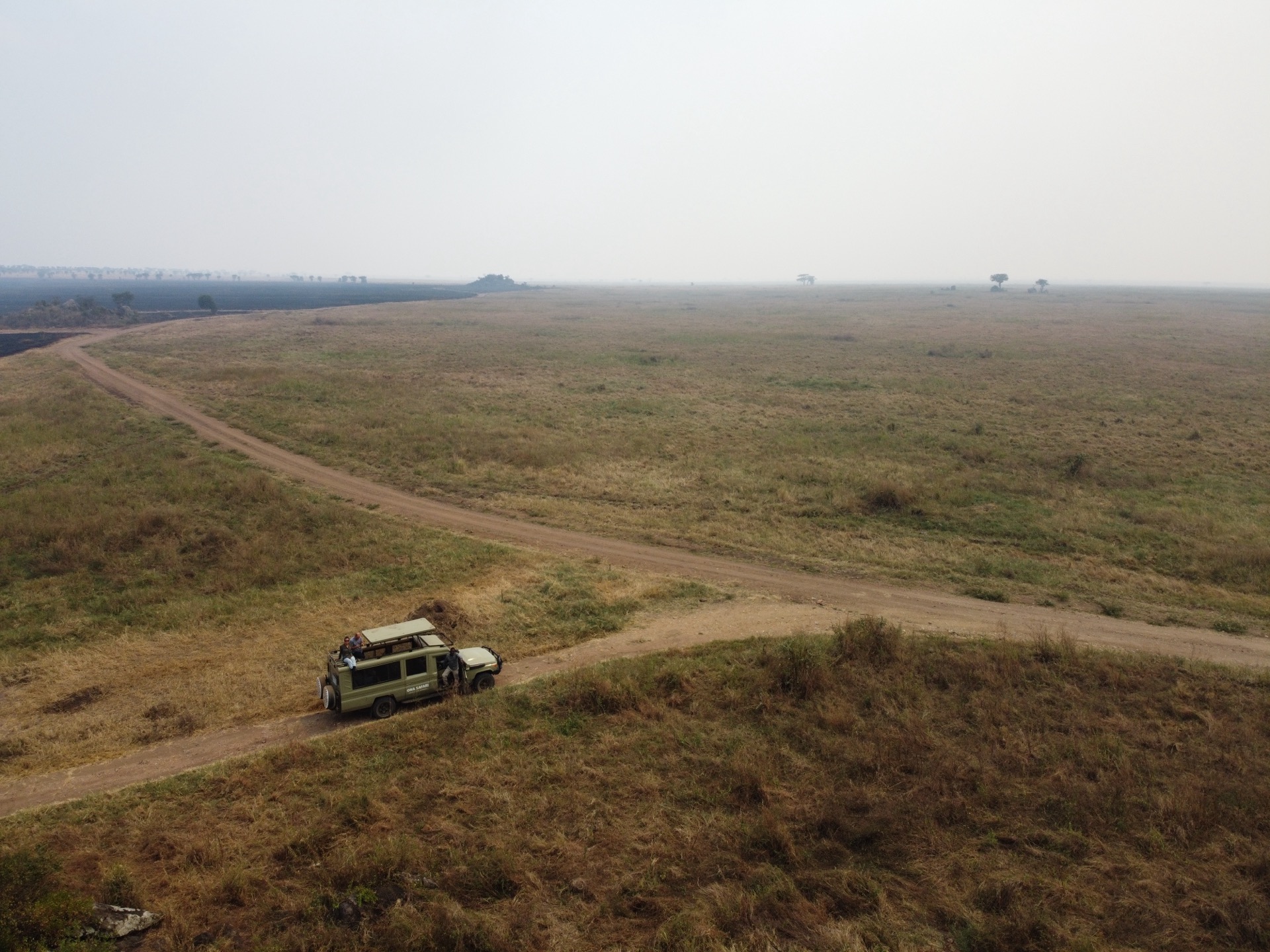
In the Serengeti: A budget road trip from Arusha centres on central Seronera — good for year-round lion, leopard, and cheetah, decent for general game. The northern Serengeti (Kogatende, Lamai) is harder to reach by road in peak crossing season, because you lose game drive time to the 7–9 hour road journey or pay for a bush flight. Budget travellers targeting the crossings should factor in either the flight cost or an extra day of driving.
In the Masai Mara: Budget means staying outside the premium conservancy zones, which typically means a standard-zone lodge or camp inside or near the National Reserve boundary. You still see the migration. What you lose is off-road driving, night game drives, and the strictly limited vehicle numbers at sightings that the premium conservancies enforce. In peak season at the Mara, vehicle numbers at a good sighting can reach 40–60 trucks. Budget visitors inside the reserve get this. Premium conservancy visitors pay more and see fewer vehicles.
The three things that actually move the needle
After a couple of trips to both ecosystems, these are the factors that genuinely affect budget outcomes:
1. Trip length. Short trips (3–4 nights) favour the Mara from Nairobi. Longer trips (7+ days) favour a full Tanzania northern circuit. The Serengeti’s park fee per day is not dramatically different from the Mara’s, but the Serengeti’s size means you are actually using your time and money across a large, varied ecosystem — rather than paying to see the same relatively small reserve area repeatedly.
2. Timing. Both parks are expensive in July–October. The Serengeti in October–November (short rains) offers rates 15–25% below peak with good big-cat activity. The Mara in June is lower-cost than July–September peak, with herds still in the area. If your goal is to minimise spend while still seeing the migration in the north, October in the Serengeti is the sweet spot — herds starting to move south, lower lodge rates, and far fewer vehicles than August.
3. What you skip. The Serengeti budget play is to go to Seronera and skip the northern crossing camps entirely in July–September — you see lions, leopards, and cheetahs year-round without the premium charged for crossing-season northern camps. The Mara budget play is to stay in the standard reserve rather than a private conservancy, accepting more vehicles at sightings in exchange for lower fees.
January–February: the calving season budget window
The cheapest period for the Serengeti that still delivers extraordinary wildlife is not October — it is January and February, the wildebeest calving season in the Ndutu Plains.
Why this matters for budget planning:
- Lower rates than peak. Accommodation rates in January–February are below the July–October peak. Not dramatically cheaper in every camp, but the combination of lower cost and exceptional wildlife is rare in the Serengeti calendar.
- Wildlife concentration at Ndutu. The wildebeest calving season in the southern Serengeti typically occurs from late January through early March, with February as the peak month. The 2023 TAWIRI aerial census counted over 1.3 million wildebeest in the Serengeti–Mara ecosystem; when this herd concentrates on the Ndutu Plains for calving, predator density — cheetahs, hyenas, wild dogs — converges with them. It is one of the most wildlife-dense periods of the Tanzania year.
- Road access, no flight required. Ndutu is 261 km from Arusha by road, approximately 5 hours 30 minutes by overland vehicle. Budget operators reach it without bush flights. For the northern Serengeti in July–August, road from Arusha takes 7–9 hours each way and eats a game-drive morning; Ndutu in February does not have this problem.
- Fewer vehicles than crossing season. The July–October Mara River crossing season attracts the highest vehicle numbers of the Serengeti year. Ndutu in February has excellent wildlife with a fraction of the competition for sightings.
- No Mara equivalent. The wildebeest calving spectacle happens in the Serengeti only. The Masai Mara in January–February is in its low season — the herds have returned south into Tanzania, and the Mara is quiet. This is the one period in the calendar when the Serengeti clearly outperforms Kenya for wildlife, at lower-than-peak rates.
I tell guests who are flexible on dates: if you can travel in February, go in February. The calving plains produce a quality of abundance — newborn calves, predators at work, vultures circling, hyena packs visible from 06:00 — that August’s migration crossings match but January’s rates do not.
Balloon safaris: the one upgrade worth considering on a budget trip
Budget safaris sacrifice comfort, not wildlife. There is one paid upgrade worth considering even on a tight budget: the balloon safari.
Serengeti balloon:
- Cost: USD 599 per person for a shared flight, including the TANAPA ballooning surcharge of USD 40, camp transfer, and a champagne bush breakfast after landing
- Timing: Flights depart daily at 06:00 from four rotating launch sites within the national park: Seronera (year-round); Ndutu (25 December–15 March); Western Corridor (June–October); northern Serengeti (May–October)
- Duration: 50–70 minutes of flight, depending on wind and conditions
- What it adds: The Serengeti’s scale is invisible from a vehicle. From altitude, the plains extend unbroken to the horizon, and during migration or calving season the extent of the herds becomes legible in a way that ground-level game drives never quite convey. The perspective is genuinely different, not just visually.
Masai Mara balloon:
- Cost: Approximately USD 450–470 per adult for a shared flight, with peak-season pricing higher than green-season
- Timing: Camps provide pick-up from approximately 05:00 for first-light launches
- What it adds: The Mara’s smaller size means a balloon covers a larger proportion of the reserve in a single flight. During crossing season, the view of the herd from above shows the full extent of the movement in a way that ground-level bank positions cannot.
The honest budget case: On a USD 250/day Serengeti camping budget, adding USD 599 is roughly 2.5 days of trip cost for a single activity. That is a real spend. The case for doing it anyway: it is a fundamentally different experience of a landscape you are already paying to visit, and it has no equivalent in a standard vehicle safari. If the budget has one flex point, this is the one worth taking.
Private conservancies: what the fee actually buys in the Mara
The single clearest budget decision in the Masai Mara is whether to enter the private conservancy zones or stay inside the national reserve. The conservancy fee — USD 60–120 per person per day — is either worth it or not, and the honest answer depends on what you value most.
What conservancies give you that the reserve does not:
- Off-road driving. The Masai Mara National Reserve prohibits leaving the tracks. Conservancies (Naboisho, Olare Motorogi, Mara North, Ol Kinyei) allow your vehicle to leave the road and approach a sighting from any angle. For photography during a crossing or a lion hunt, the positioning difference is significant.
- Strictly controlled vehicle numbers. Mara Naboisho, for example, has approximately 70 beds across all its camps — a conservancy of 50,000 acres with fewer than 100 guests at any time. At a lion sighting in the main reserve during crossing season, 40–60 vehicles may be present simultaneously. At the same sighting inside Naboisho, the number is 2–4. This is the core of what you are paying the conservancy fee for.
- Night game drives. Not permitted inside the Masai Mara National Reserve. Permitted inside private conservancies. Night drives reveal leopard, hyena, civet, genet, and aardvark activity that daylight safaris entirely miss.
- Walking safaris. Permitted in conservancies. Prohibited in the main reserve.
The budget calculation in practice:
Not every Mara trip in every season justifies the conservancy premium. In October, when crossing season winds down and vehicle numbers drop across the reserve, the gap between reserve and conservancy quality narrows substantially. The conservancy fee is hardest to justify on a tight budget in October or June — the wildlife quality difference shrinks while the fee remains the same.
In July and August, during active crossing season, the conservancy is the only route to a sighting without a vehicle queue. If the Mara crossing is the reason you are making the trip, and budget is genuinely tight, the most cost-efficient approach is to stay inside the reserve, target first light (06:30–09:00) when vehicle numbers are at their minimum, and accept the conditions that come with the price.
My honest assessment
I run a hotel on Zanzibar, and I send guests to both parks depending on their itinerary. Here is what I tell them plainly.
If you are flying into Nairobi for a short trip and have 3–4 days for wildlife, the Mara is the financially sensible choice. Quick logistics, small area, immediate wildlife, and competitive total cost. Add the coast or head north and it is a clean trip.
If you are flying into Kilimanjaro or starting in Arusha and have 7+ days, forget the Mara. The Serengeti paired with Ngorongoro is better wildlife for a similar total spend — and Ngorongoro adds the black rhino sighting and crater floor density that Kenya has nothing to compete with. The Tanzania northern circuit as a 7-day camping safari, booked through a reputable budget operator in Arusha, genuinely delivers. I have watched guests go on this trip and come back changed. The Mara for the same money is a fine trip. It is just a smaller experience.
The budget case for combining both — which is what some guides recommend — does not actually work well below a certain spend. Once you start factoring in cross-border logistics, duplicate park fees, and the time lost in transit, you need 10+ days and a budget above USD 3,500 per person for it to make sense. At that point you are not in the budget category any more.
Getting your money’s worth: practical tactics
- Book in Arusha directly. Walking into a budget operator’s office in Arusha town and booking a group departure 3–7 days out often undercuts online booking prices significantly. Not always, but often.
- Go in green season for Serengeti. October–November and the first half of December: shoulder rates, passable roads, excellent big cats on the southern plains. The January–February calving season at Ndutu is genuinely spectacular and lower cost than peak migration.
- Skip Ngorongoro if you must cut one park. The crater descent fee of USD 295 per vehicle adds a large fixed cost regardless of group size. If budget is the constraint and you must choose, the Serengeti gives more wildlife diversity per dollar spent on an extended trip.
- Compare total packages, not just park fees. The park fee headlines are only part of the story. A Mara conservancy fee looks lower than Serengeti park fees until you add accommodation and the Nairobi flight. Run the full number.
For the full Tanzania park fee breakdown across all TANAPA parks, see the Tanzania park fees guide. For how to plan the Serengeti efficiently at different price levels, see the Serengeti zones guide for where to position by season. The full head-to-head ecosystem comparison — wildlife, size, crowds, and timing — is in our Serengeti vs Masai Mara guide. For month-by-month migration timing that affects both pricing and where to be, see the Great Migration calendar.
Frequently asked questions
Is the Serengeti or the Masai Mara cheaper?
It depends on where you are flying from. From Nairobi, a Masai Mara trip is cheaper for a 3–4 night trip — short road transfer, no expensive bush flights, and the reserve is small enough to cover in a few days. From Arusha or Kilimanjaro, the Serengeti is the cheaper choice because you avoid cross-border logistics. Park fees favour the Serengeti at USD 82.60/person/day against the Mara's USD 100–200/day peak rates.
What are the actual park fees for each?
TANAPA charges USD 82.60 per person per day for the Serengeti (2024/25 non-resident adult rate). The Masai Mara National Reserve itself charges USD 100 per adult per day from January–June and USD 200 per adult per day from July–December (2024 fee increase, ticket validity now 12 hours rather than 24) — that is the reserve fee alone, before any conservancy stay. Travellers who stay in a private conservancy (Naboisho, Olare Motorogi, Mara North, Ol Kinyei) pay a separate conservancy fee of USD 60–120/person/day on top of that, and are usually not also charged the reserve fee. Mara fees increased sharply in 2024, ending the Mara's historical cost advantage over the Serengeti.
How much does a 7-day budget Serengeti safari cost?
A 7-day northern circuit budget camping safari runs USD 1,800–2,400 per person in low season and USD 2,400–4,200 in high season for a quality group tour. Shared group tours with budget camping bring per-day costs to roughly USD 250–300/person all-inclusive. A 3-day budget Serengeti group tour (6 people, budget camp) starts from about USD 450 per person.
Can I do the Serengeti without expensive internal flights?
Yes, but it adds driving time. Arusha to the Serengeti gate is 3–4 hours on road, then 1–3 more hours to your camp depending on zone. Budget operators use overland vehicles rather than charter flights. The tradeoff is time — you lose at least one game-drive morning to driving. For the northern Serengeti (Kogatende, river crossings), road takes 7–9 hours from Arusha; a bush flight is USD 200–400 and saves most of the day.
Which is the best budget season for each park?
For the Serengeti, October–November (short rains) offers rates 15–25% below peak with passable roads and good big-cat activity on the southern plains. For the Masai Mara, June or October gives lower conservancy fees than July–September peak. Both parks are expensive in July–October (crossing season) — that is simply the price of the migration spectacle.
Is Kenya or Tanzania better value for money?
Budget safaris in Kenya tend to be cheaper than Tanzania's on a like-for-like basis, according to travel industry comparisons. The Masai Mara's smaller size means less driving and shorter game drives needed to hit wildlife. Tanzania offers more for longer trips — the Serengeti, Ngorongoro, and Tarangire each add depth that Kenya's single-park Mara itinerary cannot match. For 3–4 days, Kenya often wins on value. For 7–10 days, Tanzania usually wins on variety.
Is January or February a good budget time for the Serengeti?
January–February is one of the best budget windows for the Serengeti — lower rates than peak season and some of the year's most productive wildlife. The wildebeest calving season in the southern Serengeti peaks in February, when the herd concentrates on the Ndutu Plains southwest of the park and predator density — cheetah, hyena, leopard — follows the birthing. Ndutu is 261 km from Arusha by road (approximately 5 hours 30 minutes), accessible by overland vehicle without any bush flight. The Masai Mara in January–February is in low season with herds absent, making this the one period when the Serengeti definitively outperforms Kenya on wildlife at lower cost.
Are there off-road drives and night drives in both parks?
Neither Serengeti National Park nor the Masai Mara National Reserve permits off-road driving or night game drives inside the main park or reserve boundary. In the Mara, private conservancies (Naboisho, Olare Motorogi, Mara North) permit off-road driving, night drives, and walking safaris — but these require a conservancy fee of USD 60–120 per person per day on top of accommodation. In the Serengeti, night drives are not permitted inside the national park at all; they are available at some private concession areas adjacent to the park at premium camps. Budget travellers staying inside the main reserve or park in either destination get tracks only, no night drives — a meaningful difference from Tanzania's southern parks like Nyerere and Ruaha.