
Facts & prices checked: 2026-06-25
Most travelers arrive in Zanzibar, spend a week on the main island, and leave. That is a reasonable trip. But the Zanzibar archipelago is not one island — it is several, each with a genuinely different character and a different marine environment. The difference between Unguja and Pemba is not a matter of degree; it is categorical. Adding Pemba or Mafia to an itinerary is not a luxury add-on. It is accessing a different kind of experience entirely.
This guide covers how to combine the islands, what the logistics actually look like, and which combination makes sense for which traveler.
The Zanzibar archipelago: four islands, four experiences
The Zanzibar archipelago consists of Unguja (the main island), Pemba, Mafia, and a scatter of smaller islands including Chumbe and Mnemba. Each has a completely distinct personality.
Unguja is what most people mean when they say “Zanzibar.” It is the largest island in the archipelago, and it carries the full range of infrastructure: international airport, Stone Town, Nungwi beach, Paje kite beach, resort hotels, dive schools, spice tours, nightlife. The east and north coasts have genuinely beautiful beaches. The diving at Mnemba Atoll is good. Stone Town’s architecture, spice market, and food scene are not overstated — they are the real thing. Unguja can fill a week without repetition, and it is the natural base for any multi-island itinerary because most flights into Tanzania land here first.
Pemba is 988 km² of hilly, densely vegetated island sitting ~124 km north of Unguja in the Pemba Channel. It has almost none of Unguja’s tourist infrastructure. There are no resort strips, no nightlife, no beach bars. What Pemba has is the underwater environment: wall dives with 30–60m visibility, strong channel currents that bring pelagic fish, dramatically less fishing pressure than the main island, and a reef system that serious divers come specifically to access. The Pemba flying fox — endemic to this one island, with an estimated 25,000–27,000 individuals — roosts in the forest here. Ngezi Forest Reserve covers 1,440 hectares of genuine old-growth forest in the north. I have been to Pemba twice, and it is the quietest inhabited island I have encountered in the Indian Ocean region. It earns its reputation among divers.
Mafia Island sits 220 km south of Zanzibar off the Rufiji Delta. The Mafia Island Marine Park covers 822 km² — the first marine park established in Tanzania — and includes some of the most intact reef habitat in East Africa. Mafia has one specific draw that no other island in the region matches: whale shark aggregations in the channel from October to March, peaking December to February. A snorkeling trip with whale sharks costs USD 60–100 per person and typically runs 2–5 hours. Outside that season, Mafia has excellent diving and snorkeling in the Marine Park, but the island is remote, the infrastructure is thin, and the journey requires careful planning. For whale shark season, it is worth it.
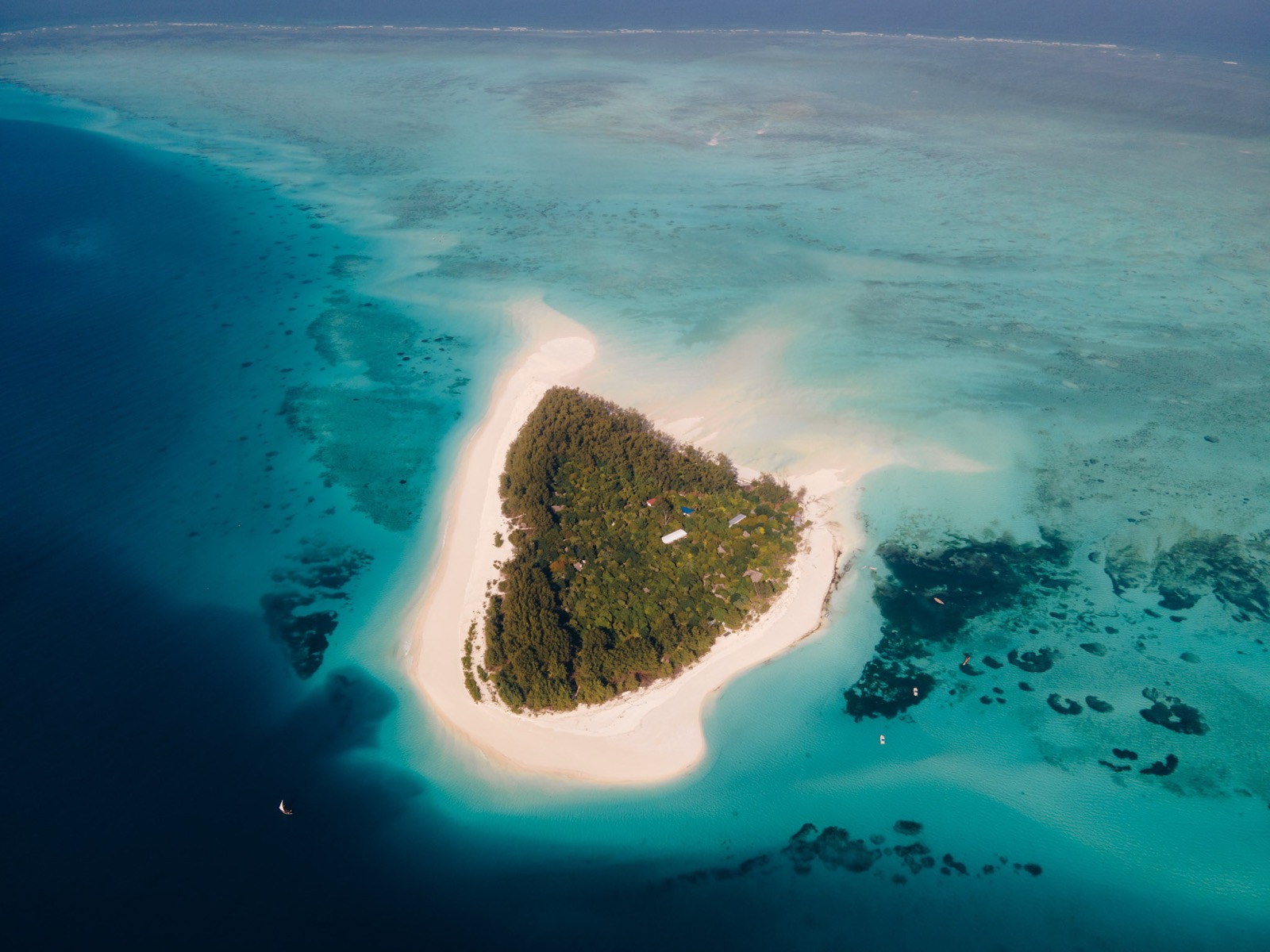
Chumbe Island is a small (~0.2 km²) reef island 12 km south of Stone Town, accessible by a 30–40 minute private boat transfer. Chumbe Island Coral Park is the first privately managed marine protected area in the world and a no-take zone since the early 1990s. What this means in practice is that the reef around Chumbe looks like the Zanzibar coast did before fishing pressure stripped most reefs of their fish and coral density. The island has 7 eco-bungalows and operates on strict low-impact principles. Chumbe functions as a day trip from Stone Town rather than a separate island leg, which makes it easy to add to any Unguja itinerary.
Mnemba Island is the atoll reef north of Matemwe, where &Beyond operates their 12-banda lodge with a maximum of 24 guests. Mnemba is accessible as a snorkel and dive day trip from the north coast, or as a very expensive stay. It is not a separate island-hopping destination in the same sense as Pemba or Mafia — it is an atoll reef with a private lodge attached.
Getting between islands
This is the most important practical section. The geography creates constraints that many travelers do not expect.
Unguja → Pemba: Flight only. There is no passenger ferry between Zanzibar main island and Pemba. Three airlines — Auric Air, Coastal Aviation, and FlexFlight — operate scheduled flights. There are approximately 3 non-stop flights per day. Flight time is 30 minutes. Flights depart between 08:25 and 15:20 daily. Book at least 2–3 months ahead for high season (July–October, December–February) — these are small aircraft with limited seat counts, and they fill.
Unguja → Mafia: No direct public ferry. The most common route is Zanzibar → Dar es Salaam → Mafia, which involves one transit. Auric Air runs daily flights connecting Mafia with both Dar es Salaam and Zanzibar. Direct Zanzibar–Mafia flights exist but are not always scheduled; verify with operators at the time of booking. Total transit time from Zanzibar to Mafia is typically around 60 minutes.
Stone Town → Chumbe: Private boat transfer by arrangement with CHICOP (Chumbe Island Coral Park). The crossing takes 30–40 minutes. Day trips depart in the morning and return in the afternoon. Day-trip cost runs USD 90 per person plus a USD 25 conservation levy — USD 115 total. Overnight guests pay an all-inclusive rate covering accommodation, meals, and guided activities. Daily visitor numbers for snorkeling are strictly limited — book weeks ahead in peak months.
Luggage note: Light aircraft on island routes enforce a 15 kg total bag limit per person (carry-on included), and soft-sided bags only. If you are carrying dive equipment, discuss this with the operator at booking — an XL seat upgrade allows approximately 30 kg on Coastal Aviation.
The ferry from mainland to Zanzibar: This connects Dar es Salaam to Stone Town only (not to Pemba or Mafia). The fastest Azam Marine crossing takes 1 hour 20 minutes; economy fares start around USD 35 (higher classes run up to USD 100 for Royal). This is useful for Mafia itineraries where you route through Dar.
Unguja: the main island
Every island-hopping itinerary starts and ends on Unguja. The international airport is here. Stone Town — the historical Swahili trading city on the western coast — is the natural first night and worth 2 nights at minimum to cover the Old Fort, Forodhani night market, and the labyrinth of alleys properly. The northern coast (Nungwi, Kendwa) has the best swimming on calm-water beaches. The east coast (Paje, Jambiani, Michamvi) has the best kitesurfing conditions and the longest stretches of sand at low tide.
For a Zanzibar island-hopping itinerary, treat Unguja as the base layer: 5–7 nights covering Stone Town plus at least two beach areas, with satellite trips to Chumbe and Mnemba. The specialist islands — Pemba and Mafia — are added as separate legs rather than day trips.
Full details on areas, beaches, and accommodation are in the Zanzibar main island guide.
Pemba Island: world-class diving
Pemba is the answer to a specific question: where can you dive in the Western Indian Ocean at a reef that is genuinely less touched, with bigger fish and cleaner water, without going to a remote atoll that takes three flights to reach?
The diving credentials are real. Visibility in the Pemba Channel typically reaches 30–60 metres. The eastern and southern coasts have stronger currents and are suited to experienced divers; the western coast is more accessible. Scientific surveys from 2019 recorded average hard coral cover of 26% on western Pemba sites — better than most of the Zanzibar main island’s inshore reefs. Misali Island, a small nature reserve off Pemba’s western coast, has sea turtle nesting with green turtles outnumbering hawksbills 3:1 at peak season.
Above water, Pemba has Ngezi Forest Reserve (1,440 hectares, established in the 1950s) in the north, where Pemba flying foxes roost in the canopy in the tens of thousands. The island grows the spice farms that actually supply the Zanzibar spice trade — the “spice farm tours” on Unguja are largely tourist reconstructions; Pemba’s clove and nutmeg farms are working operations. There is a slower pace here that takes a day to adjust to, and then becomes difficult to leave.
Accommodation is limited to a handful of dive-oriented lodges and guesthouses. This is the right island for a 4-night minimum — arrive, rest, dive three or four days, move on.
Read the full Pemba Island guide for dive site specifics, where to stay, and the endemic wildlife.
Mafia Island: Marine Park and whale sharks
Mafia Island is the most remote of the three main islands and has the highest barrier to entry — not in cost, but in logistics. Getting there requires a flight, either direct from Zanzibar or via Dar es Salaam. The island has limited electricity, intermittent internet, and a cash-only economy — Tanzania’s 2026 electronic-payments law technically applies here too, but Mafia is about as far from formal card infrastructure as this country gets, so don’t expect that to change your trip. Bring TZS (Tanzanian shillings) and a working attitude toward power cuts.
The reason to go is whale sharks. Mafia Island is the only known location in the world where whale sharks are present year-round, and the October–March season (peak December–February) produces reliable aggregations in the channel. A guided snorkeling trip costs USD 60–100 per person and typically lasts 2–5 hours depending on conditions. Whale sharks in Tanzania are legally protected under IUCN ISRA designation. The Mafia Island Marine Park, covering 822 km² of reef, seagrass, and open water, is the setting.
Outside whale shark season, Mafia’s Marine Park has strong diving and snorkeling on its own terms. The reef is underpressured compared to Zanzibar main island. But the logistics are the same regardless of season, which means the cost-benefit calculation tilts strongly toward October–March.
I visited Mafia during whale shark season and saw three sharks on a single morning trip — two juveniles under 5 metres and one adult considerably larger. The experience is low-infrastructure in the best sense: you are in open water with animals that have no reason to avoid you.
Plan for a minimum 3-night stay to get 2 full days of water activity and absorb the logistics of arrival and departure. Five nights is better if you are targeting whale sharks and want a buffer day.
Read the Mafia Island guide for dive site details, accommodation, and logistics.
Chumbe Island: the day-trip coral reserve
Chumbe adds no extra nights to an Unguja itinerary. The boat leaves Stone Town in the morning, you are on the reef by 09:00, back in Stone Town by mid-afternoon. The day includes: guided snorkel session (one guide per four snorkelers), a walk through the coral rag forest, lunch on the island. Day-trip cost is USD 90 plus a USD 25 conservation levy per person — USD 115 total.
The reef justifies the cost. Chumbe Island Coral Park has been a no-take marine protected area since the 1990s — the first privately managed marine protected area in the world. The result is a reef with 200+ coral species and 370+ fish species at a density that is genuinely different from the heavily fished reefs off most of Unguja’s coastline. Napoleon wrasse, blacktip reef sharks, hawksbill turtles, and large grouper are routine sightings, not occasional ones. The coral coverage — table corals, brain corals, staghorn — is structurally intact in ways that take years of protection to produce.
Daily visitor numbers are limited. Book 4–6 weeks ahead for July–October and December–January. CHICOP’s booking site is the only place to book — there are no third-party platforms.
The 7 eco-bungalows on Chumbe offer overnight stays at significantly higher cost (approximately USD 280–400 per person per night, all-inclusive including mandatory government levies). For travelers who want to be the only people on the island after the day-trip boat leaves — and for the turtle nesting season (November–March) — an overnight stay is a strong option.
Read the full Chumbe Island guide for reef species details, bungalow logistics, and snorkeling conditions by season.
Sample itineraries: 7, 10, and 12 nights
7 nights — Unguja only (with Chumbe day trip)
This is the standard Zanzibar trip done well, without spreading too thin.
- Night 1–2: Stone Town (Old Fort, Forodhani market, spice market)
- Day 3: Chumbe Island day trip from Stone Town
- Night 3–5: North coast — Nungwi or Kendwa (beach, snorkeling, sunset dhow)
- Night 6–7: East coast — Paje or Michamvi (kitesurfing, beach walking, reef at low tide)
Under 7 nights, adding a second island introduces more logistics than experience. Keep it focused.
10 nights — Unguja + Pemba (divers and those seeking quiet)
The standard island-hopping combination for travelers who want substantially more than beach time.
- Night 1–2: Stone Town
- Night 3–4: North coast (Nungwi/Kendwa)
- Day 5: Fly Unguja → Pemba (Auric Air / Coastal Aviation / FlexFlight, ~30 min)
- Night 5–9: Pemba (4 nights minimum: 3–4 dive days, Ngezi Forest walk, Misali Island)
- Day 10: Fly Pemba → Unguja, afternoon/evening departure home
Book Pemba flights before booking accommodation — they are the binding constraint.
12 nights — Unguja + Mafia (whale shark season, Oct–Mar)
Built around the Mafia whale shark season. This itinerary works October to March only.
- Night 1–2: Stone Town
- Night 3–5: North coast or east coast (beach/snorkeling)
- Day 6: Fly Unguja → Mafia via Dar es Salaam, arrive evening (Auric Air daily)
- Night 6–10: Mafia Island (5 nights: 3–4 whale shark sessions, Marine Park snorkeling, buffer day)
- Day 11: Fly Mafia → Dar → Unguja
- Night 11–12: Unguja (Stone Town or beach), departure home
12 nights — Unguja + Pemba + Mafia (advanced)
Only consider this if you have flexible dates and are comfortable with logistical complexity. Two inter-island flights, two separate accommodation changes, and a transit through Dar es Salaam. Rewarding for a dedicated marine traveler; exhausting for someone who wants to relax.
- Night 1–2: Stone Town
- Night 3–4: North coast
- Day 5: Fly to Pemba (30 min)
- Night 5–8: Pemba (diving)
- Day 9: Fly Pemba → Dar → Mafia (~2.5 hrs total)
- Night 9–11: Mafia (whale sharks)
- Day 12: Fly Mafia → Dar → Zanzibar, depart
Practical notes: booking, timing, cash, and ZIC
Book flights first. Island flights are the constraint in any multi-island itinerary, not accommodation. Auric Air, Coastal Aviation, and FlexFlight all have limited seat counts. For high season (July–October, December–February), book 3 months in advance minimum.
Luggage limits are enforced. All island flights carry a 15 kg total limit (carry-on included) and require soft-sided bags. If you are carrying dive equipment, check with your operator at the time of booking — not on arrival day.
Mafia runs cash-only. ATMs are unreliable and card payment is rare — even where a place technically has a card machine, the mobile signal it needs is the first thing to drop out this far from Zanzibar’s main network. Carry enough Tanzanian shillings (TZS) for your full Mafia stay, purchased before you leave Zanzibar or Dar es Salaam. The Bank of Tanzania Foreign Currency Regulations 2025 (effective March 2025) mean local transactions must be priced in TZS — bring post-2013 USD bills for emergencies.
ZIC insurance covers Unguja and Pemba. The mandatory Zanzibar inbound insurance (ZIC, USD 44 per adult from 1 October 2024) applies to all visitors to Zanzibar, including Pemba. It does not extend to Mafia Island, which falls under mainland Tanzania rules. Your standard travel insurance should cover Mafia and the mainland transit. ZIC does not replace your own travel insurance — it is a mandatory supplement, not a replacement.
Tanzania visa covers all islands. A single Tanzania e-visa covers travel on Unguja, Pemba, Mafia, and the mainland.
High season and off season. July–October has the best diving visibility and calmest seas across all islands. December–February is peak whale shark season at Mafia and peak tourist season island-wide. April–May (long rains) is the period to avoid for island hopping: rough seas can delay or cancel boat crossings and small aircraft flights, and Chumbe runs reduced operations.
Chumbe bookings: Book directly through CHICOP at chumbeisland.com — no third-party platforms carry it. Day trips are strictly capacity-limited.
For a month-by-month breakdown of weather windows and seasonal conditions, see the Zanzibar when-to-go guide.
What each island is best for
| Island | Best for | Avoid if |
|---|---|---|
| Unguja (main) | Stone Town, beach holidays, kitesurfing, water sports variety, first-time Zanzibar visitors | You have already done Unguja and want something different |
| Pemba | Wall diving (30–60m visibility), endemic wildlife (Pemba flying fox), total quiet, experienced snorkelers | You do not dive or snorkel, or want resort amenities |
| Mafia | Whale shark swimming (Oct–Mar), Marine Park snorkeling, genuine remoteness | You are visiting outside Oct–Mar and are not a diver/snorkeler |
| Chumbe | No-take reef on a day trip from Stone Town, eco-lodge overnight, turtle nesting (Nov–Mar) | You want a beach day — Chumbe has no sand beach |
Planning to visit more than one island in the archipelago? For companion reading on the individual islands, see the Pemba Island guide, the Mafia Island guide, the Chumbe write-up, and the Mnemba Atoll page for the north-coast reef day trip.
Frequently asked questions
Can you take a ferry between Zanzibar islands?
Not between all islands. The main Zanzibar islands — Unguja, Pemba, and Mafia — are not connected by passenger ferry services. Unguja has a high-speed ferry connection to Dar es Salaam on the mainland (about 2 hours), but Pemba and Mafia are accessed by small aircraft only. Flight time from Unguja to Pemba is approximately 30 minutes; to Mafia is approximately 60 minutes via Dar es Salaam or direct depending on the operator. Book flights early for high season — these are small planes with limited capacity.
How do I get from Zanzibar to Pemba Island?
By small aircraft only — no passenger ferry connects Unguja and Pemba. Operators including Auric Air, Coastal Aviation, and FlexFlight run scheduled and charter flights between Zanzibar Airport and Pemba Airport. Flight time is approximately 30 minutes, with 3 non-stop flights per day. Flights book up quickly in high season (July–October and December–February). Budget-conscious travelers should note that flights are the only option; there is no cheaper alternative by sea.
Is Mafia Island worth visiting on a Zanzibar trip?
Yes, but with realistic expectations. Mafia is genuinely remote — limited electricity, limited internet, minimal infrastructure. It is worth visiting specifically for two things: whale shark swimming (October–March, peak December–February) and the Mafia Island Marine Park, which has 822 km² of largely undeveloped Indian Ocean habitat. Outside whale shark season, it is still good for diving and snorkeling, but the effort and cost of getting there are best justified by the whale shark season.
How many days do I need for island hopping in Zanzibar?
A minimum of 10 nights to combine Unguja and Pemba properly — 6 nights on Unguja (Stone Town plus beach) and 4 nights on Pemba (diving). Add 2–3 more nights if including Mafia Island (or use Mafia as a Pemba alternative for whale shark season). Chumbe Island works as a Stone Town day trip and does not require extra nights. Under 10 nights, the time spent flying between islands eats into beach and dive time — a 7-night trip is best spent entirely on Unguja rather than spreading thin across islands.
Which Zanzibar island is best for diving?
Pemba Island has the most spectacular diving — wall dives with 30–60m visibility, dramatic underwater topography, strong currents that bring pelagic life, much less visited than Zanzibar main island. Mnemba Atoll off Unguja is the most accessible top dive site on the main island. Mafia Island Marine Park is excellent particularly for whale shark encounters and reef diving. All three offer different experiences: Pemba for serious divers, Mnemba for accessible day trips, Mafia for the whale shark experience.
Is Chumbe Island worth visiting?
Yes, as a day trip from Stone Town. Chumbe Island Coral Park is the first privately managed marine protected area in the world and a no-take zone since the 1990s. Daily visitor numbers are strictly limited. Day trips cost USD 90 plus a USD 25 conservation levy per person — USD 115 total — and include guided snorkeling, a coral rag forest walk, and lunch. The boat crossing from Stone Town takes 30–40 minutes. Book weeks ahead in high season. There are also 7 eco-bungalows for overnight stays for those who want the island without day-trippers.