
Facts & prices checked: 2026-06-25
Tanzania’s Great Migration moves constantly. The 2023 TAWIRI aerial census counted 1,366,109 wildebeest in the Serengeti–Mara ecosystem — the largest wildebeest population on earth. They follow a clockwise loop of approximately 800 kilometres, driven entirely by rainfall and the grass it produces. There is no single migration season; the question is always which phase of the loop offers which experience. Two moments stand out above the rest: the Ndutu calving season (January–March) and the Mara River crossings at Kogatende (typically July–October). Everything else is movement between those poles.
The migration calendar — month by month
This is a calendar of tendencies, not timetables. Rain governs everything. A late wet season pushes every date back by weeks.
December–January (Southern Serengeti, beginning of calving) The herds arrive on the southern short-grass plains and the Ndutu area through December, with early calves possible from late December onward. By January the calving is beginning in earnest, though the February peak has not yet hit. The plains can hold enormous concentrations — if you are visiting over Christmas and New Year and want migration, position yourself south, not central.
February (Ndutu / Southern Plains — calving peak) February is the calving peak. The wildebeest concentrate on the Ndutu plains, on the boundary between Serengeti National Park and the Ngorongoro Conservation Area. Calving is synchronised over a 6-8 week season — a strategy called predator swamping, where the mass of vulnerable young calves overwhelms the predators’ capacity to kill them. The calves are on their feet within minutes of birth and must keep up with the herd or die.
Predator density in February is the highest of the year. Cheetah, lion, leopard, and spotted hyena all follow the calving. I have been in the southern Serengeti in February with five different cat sightings before 10am — the kind of morning that recalibrates what you expect from wildlife. It is underrated compared to the Mara crossings, partly because calving is quieter and more diffuse than the river theatre. Go for a dawn drive and you will find newborn calves, predators, and very few other vehicles.
March–April (Moving north and west / long rains) The herds begin moving north and west as the long rains arrive. April–May is the weakest migration-viewing window because the grass is long (hiding animals) and tracks are sometimes impassable. This is the period most operators advise avoiding for migration specifically. If you are on a tight budget, green-season rates are lowest. You will see herds in motion, but not the concentrated drama of calving or crossings.
May–June (Western Corridor / Grumeti River) The herds reach the Western Corridor of the Serengeti by May–June and must cross the Grumeti River. The Grumeti is smaller and calmer than the Mara, but the crocodiles are remarkable — approximately 3,000 Nile crocodiles are resident in the Grumeti. These are ambush predators adapted to waiting. The crossings are less dramatic visually than the Mara (the river is narrower and lower-banked), but a Grumeti crossing seen close is intense in its own right. The Western Corridor is also among the least-visited zones in the Serengeti, and the bush feels genuinely remote.
July–October (Northern Serengeti / Mara River crossings) This is the peak drama. The herds reach the northern Serengeti and the Mara River, which they must cross into Kenya’s Masai Mara and back multiple times during the season. The crossing points in Tanzania are in the Kogatende area and the Lamai Wedge, where the river bends and the banks funnel the herds.
A crossing is theatrical in a way that almost defies description: tens of thousands of wildebeest massing on the bank, waiting — sometimes for hours — before a trigger animal enters and the whole herd follows, the river churning, crocodiles rolling, the noise the herd makes unlike anything else in the wild. But they can also stand on the bank all morning and then turn back. The timing is genuinely unpredictable within a 3–6 week window each year depending on when the rains came and how the grass reads.
When within July–October? August and September are statistically the most active months for crossings. July crossings happen, but the peak has not always arrived. October crossings happen, but the herds are beginning to fragment and return south. If you can only go in one month, August gives the best probability.
November–December (Moving south via eastern corridor) The short rains (October–November) trigger the return south. The herds move back through the eastern Serengeti, through the Lobo area, and toward the southern plains for the next calving season. This is a good time to be in the northern or eastern Serengeti with fewer visitors than the July–September peak. The crossings are largely over, but the movement itself — enormous herds walking in single file across the open plains — has its own grandeur.
Where to be for each phase
Ndutu / calving (January–March): Stay in Ndutu-area camps or lodges just south of the Serengeti gate. The Ndutu plains straddle the boundary between Serengeti National Park and the Ngorongoro Conservation Area — note that NCA entry fees (USD 70.80 per adult per day) apply on the NCA side. Road access from Arusha is feasible: Ndutu is approximately 261 km from Arusha. Mobile camps that position themselves on the southern plains in this period put you closest to the action.
Western Corridor / Grumeti (May–June): Far fewer visitors than either the south or the north. Camps like Kirawira put you in position for Grumeti crossings and the transition zone between the long-grass western Serengeti and the northern corridor. This is a good choice for experienced safari travellers who have already done the calving and crossing windows.
Northern Serengeti / Mara crossings (July–October): The Kogatende area and Lamai Wedge are the prime crossing zones. Several permanent and seasonal camps operate here: Sayari Camp, Lemala Kuria Hills, and the June 2025-opened One Nature Kogatende are among the established options. Fly here from Arusha or connect via light aircraft from central Serengeti — the road from Seronera is 4–5 hours on rough tracks and burns a full day each way. Northern Serengeti accommodation is among the most expensive in Tanzania; budget roughly USD 1,000 per night for two people as a starting point for mid-range options.
Park fees for the Serengeti are USD 82.60 per adult per day (TANAPA 2024/25 tariff, inclusive of VAT). These are almost always included in your safari package, but confirm in writing.
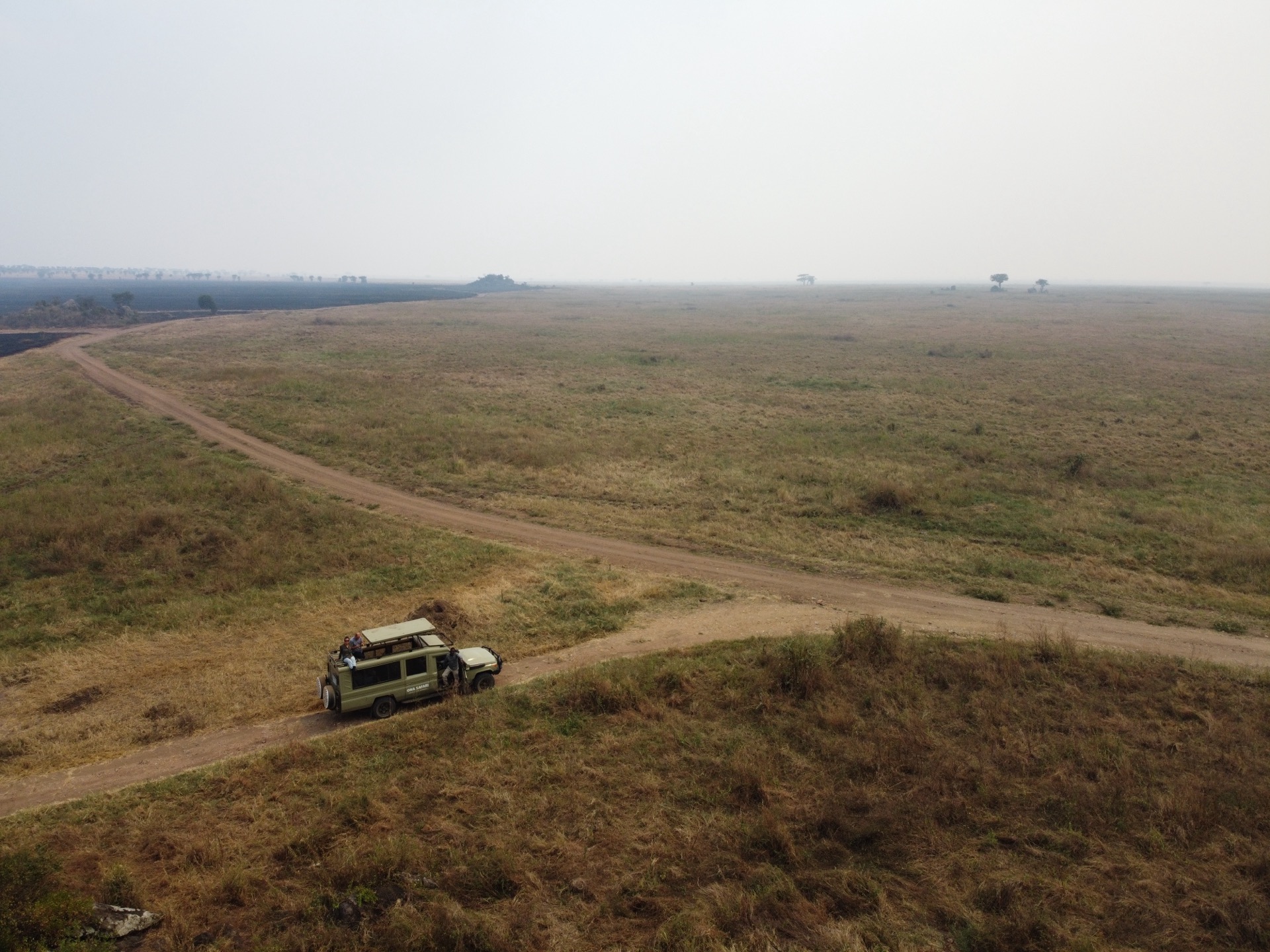
Central Serengeti / Seronera (year-round): Seronera is accessible year-round and holds excellent resident wildlife regardless of migration timing. It is the wrong base for river crossings (too far from the north) or calving (too far from the south), but an honest operator will tell you this. Choose Seronera if you want reliable predator sightings without committing to a specific migration phase.
Is it guaranteed?
The migration is always happening — the herds never stop. But specific events are not:
Mara River crossings: High probability if you spend 3–4 nights in the northern Serengeti during July–October. Not a certainty on any given day. The guides at your camp will track where the herds are each morning, and good operations will shift your game-drive routes accordingly. A single-night stop in the north and hoping for a crossing is possible but thin odds.
Calving: More predictable. Mid-January to February in Ndutu is reliably the window. You will see calves. You will see predators. The exact density of newborns on a given morning varies, but the season itself is consistent.
What you cannot plan around: the Mara River crossing is one of those wildlife events that may happen in the first two hours of your first game drive — or on the last morning of your fourth day. Both have happened to guests I have spoken with. That unpredictability is half the draw.
Migration versus resident Serengeti wildlife
A common misunderstanding: the migration is not the only reason to visit the Serengeti, and a visitor who misses the crossing windows is not seeing a lesser thing. The Serengeti holds 3,000–3,500 resident lions, the highest density of cheetah in East Africa, a large leopard population in the Seronera riverine forest, vast elephant herds, and more species of bird than most European countries have in total.
The calving season at Ndutu in February has, in my experience, higher predator-encounter density than a July week in the north where you spend hours waiting at the river bank. A visitor in June in the Western Corridor with good guides may see more diverse and intense wildlife than someone in August who got unlucky on crossings timing. The migration enhances the Serengeti; it does not define it.
This is the honest case for planning a Serengeti trip around zone and season more than around the specific river-crossing drama, especially for first-time visitors who do not want the weight of expectation on a single event.
What I actually remember
I have not spent a week waiting for a Mara crossing — I run a hotel in Zanzibar, not a camp in the north. But I have been in the southern Serengeti in February on a dawn drive that started with a cheetah on a termite mound, moved to a pride of twelve lions circling a wildebeest mother who had just calved, and ended with fifty thousand wildebeest moving silently westward across a plain that turned gold as the mist burned off. No other vehicles visible. No radio calls about the cat. Just the sound of the herd.
That morning has no river theatre, no dramatic plunge. It is the other migration experience — diffuse, vast, and oddly quiet for something involving several hundred thousand animals — and it is the one I think about more often.
The population count: two methods, two very different answers
Two independent scientific assessments of the wildebeest population in the Serengeti–Mara ecosystem in 2023 reached sharply different conclusions. Both deserve to be stated, because you will encounter both figures and the discrepancy is real.
TAWIRI 2023 aerial census: The Tanzania Wildlife Research Institute counted 1,366,109 ± 231,741 wildebeest using an aerial point survey across the ecosystem. This is the official Tanzania government figure and the basis for park management decisions. TAWIRI has tracked the population longitudinally since the 1960s.
Oxford / PNAS Nexus 2025 satellite study: A 2025 study used AI-based satellite imagery analysis to count individual wildebeest in the same ecosystem in 2023. It estimated fewer than 600,000, with model results of 502,917 and 533,137. The gap from the TAWIRI figure is not a rounding difference — it is a near-threefold discrepancy that the scientific community has not resolved.
Historical context from TAWIRI’s own longitudinal data is useful here: wildebeest grew from approximately 250,000 in 1960 to about 1.4 million by 1977 — a sixfold increase driven by rinderpest eradication — and have remained near 1.3 million since. If the Oxford satellite figure is accurate, it would imply a substantial population decline from that plateau. Whether that reflects a real biological change, a methodological gap in satellite counting (animals obscured by long grass or tree cover, or groupings counted differently), or both, remains the active scientific debate.
The methodology difference is the likely primary explanation: aerial point surveys count observed herd clusters and extrapolate across the ecosystem; AI satellite analysis attempts to identify individual animals across larger image sets but faces different detection challenges. Neither method is obviously superior for a moving, densely clustered, seasonally dispersed population.
For a visitor, the practical implication is zero. Even the lower Oxford estimate represents the largest wildebeest migration on earth, by a considerable margin. The calving density at Ndutu, the predator concentrations, the sound and scale of the Mara River crossings — none of it is diminished by which number is the more accurate one.
Hot air balloon safaris
Seeing the migration from altitude changes how the ecosystem reads. On the ground, a herd of ten thousand wildebeest fills your windscreen and your senses — and that is extraordinary. From a balloon at dawn, the herds appear as dark ribbons threading across grass that extends to every visible horizon, and the actual distance these animals travel in a year — the 800-kilometre loop — becomes a spatial fact rather than an abstraction.
Serengeti balloon flights depart daily at 06:00 from four launch sites, each positioned to follow the migration seasonally:
- Seronera — year-round
- Ndutu plains — 25 December to 15 March (calving season)
- Western Corridor — June to October
- Northern Serengeti — June to October (crossing season)
The shared flight costs USD 599 per person, which includes:
- The TANAPA ballooning fee (USD 40)
- Ground transfer to the launch site
- The flight itself (approximately 50–70 minutes, depending on wind conditions)
- A champagne bush breakfast after landing
I am not a balloon safari testimonial — I run a hotel on the Zanzibar coast, not a camp in the Serengeti. But I have heard more consistent and specific praise for this experience from returning guests than almost any other single item in a Tanzania itinerary. One pair who came through Matlai after three weeks of travel said the Ndutu calving-season balloon at sunrise was the one hour that made everything else feel like preparation for it. That is a consistent verdict from people who are not easily impressed.
Book through your safari operator or camp well ahead of travel. The Ndutu launch in February and the northern Serengeti launch in August and September sell out months in advance. Do not leave this to be arranged on arrival.
Resident wildlife — independent of migration timing
The migration is the right reason to care about when and where you go. It is not the only wildlife you will see, and on some trips it is not the most memorable.
The Serengeti ecosystem holds some of Africa’s most dense large-mammal populations across all seasons:
Lions: The ecosystem holds an estimated 3,000–3,500 lions in approximately 300 prides — one of the largest lion populations in Africa. Individual prides typically consist of 10–20 animals. Central Serengeti’s Seronera area has resident lions year-round with reliable sightings; northern Serengeti camps such as Lamai also report consistent lion activity independent of crossing season. Lions and hyenas conduct an estimated 70% of their hunting after dark, which is an argument for night drives where your camp permits them.
Cheetah: The broader Serengeti ecosystem holds an estimated 1,200–1,500 cheetahs — one of only two wild cheetah populations on earth estimated above 1,000 individuals. The Serengeti Cheetah Project, the longest-running in-depth survey of one wild cheetah population in Africa, has monitored individuals on the southern plains continuously since 1974. Open grassland and high prey density make the Serengeti the most reliable place in East Africa to see cheetah at close range. Namiri Plains in the eastern Serengeti has a particular reputation for cheetah sightings.
Leopard: Resident in the riverine woodland around Seronera. Territorial and predictable compared to their general reputation for elusiveness; a guide who knows the area well will usually locate one.
Serengeti National Park also holds an estimated 500 bird species, large resident elephant herds, buffalo, giraffe, zebra, and the full spectrum of East African plains wildlife regardless of where the wildebeest happen to be that week.
The calving season at Ndutu in February has, in my experience of speaking with guests after their trips, a higher predator-encounter density than many August weeks spent waiting at the Mara River bank. A visitor in the Western Corridor in June, outside the headline spectacle windows, can have a richer wildlife day than someone who positioned themselves for the crossings and the herds didn’t cooperate. Zone, season, and the quality of your guiding compound in ways no itinerary can fully determine in advance. The migration is a layer on top of an ecosystem that is already exceptional — and it works in your favour whatever month you go.
Practical planning notes
Booking lead time: Northern Serengeti camps in peak crossing season (August–September) book out 6–12 months ahead. Ndutu in February is somewhat more flexible but books quickly after November.
Flying versus driving: For the northern Serengeti, fly. Domestic flights from Arusha to Kogatende or Lamai airstrips take around 1–1.5 hours and cost roughly USD 220–265 one way per person. The road alternative is a 4–5 hour rough-track transfer from central Serengeti, burning a safari day each direction. The flight is almost always the better value when you factor in what a half-day at the river is worth.
Duration: For river crossings: 3–4 nights in the north is the sensible minimum. For calving: 2–3 nights in Ndutu is workable. For a trip that covers both: plan two separate legs, flying between them, rather than one long road circuit. The distance between Ndutu and Kogatende makes both meaningful only with flights.
Park fees: Serengeti USD 82.60 per adult per day. If your itinerary includes Ndutu on the NCA side: USD 70.80 per adult per day (separate from Serengeti fees). Both are typically included in package prices; get a written breakdown.
The wildebeest migration is the right reason to go to the Serengeti. It is also a reason that works in every month of the year — which is the main thing the marketing does not tell you.
Related guides: Serengeti National Park complete guide · Great Migration best time calendar · Serengeti Great Migration year-round guide · Inside Ngorongoro Crater · Wildebeest natural history and biology · Tanzania safari costs breakdown
Frequently asked questions
When is the best time to see the wildebeest migration in Tanzania?
It depends on what experience you want. For Mara River crossings — wildebeest plunging into a crocodile-filled river in their thousands — plan for July to October in the northern Serengeti, with August–September usually the peak. For calving season — hundreds of thousands of newborns and maximum predator density — visit Ndutu in January through February. Both are extraordinary; crossings are more dramatic; calving is more intimate and predator-rich. River crossing timing varies by 3–6 weeks each year depending on when the rains arrive.
How many wildebeest are in the Great Migration?
The 2023 TAWIRI (Tanzania Wildlife Research Institute) aerial census counted 1,366,109 wildebeest ± 231,741 in the Serengeti–Mara ecosystem. A 2025 Oxford AI satellite study estimated possibly under 600,000 — methodology differences remain debated. The honest answer is that the figure is in flux, but the spectacle is undiminished: even the lower estimate represents the largest wildebeest migration on earth.
Where exactly do the Mara River crossings happen in Tanzania?
The main Tanzania-side crossing points are in the Kogatende area of the northern Serengeti and the adjacent Lamai Wedge. This is where the herds funnel toward the river at the Kenya-Tanzania border. The Masai Mara side of the same crossings is in Kenya — some visitors combine both sides for a longer stay. Flying into northern Serengeti airstrips (e.g., Kogatende, Lamai) is strongly recommended; the road from central Serengeti takes 4–5 hours on rough tracks.
Is seeing the Great Migration guaranteed?
The migration itself is always happening — the herds never stop moving. But specific events like Mara River crossings are not guaranteed on a given day. Herds can mass on the river bank for hours and then turn back. Plan a minimum of 3–4 nights in the northern Serengeti to meaningfully increase your odds. Your camp's guides will track the herds daily. The calving season at Ndutu is more predictable — mid-January to February is reliably the window.
What is the calving season of the wildebeest migration?
Calving happens annually from around late January through March — a 6-8 week season, peaking in February. The location is the southern short-grass plains, centred on the Ndutu area on the Ngorongoro Conservation Area boundary. Calving is synchronised — hundreds of thousands of calves born in a compressed window — which overwhelms predators by sheer numbers (the survival strategy is called predator swamping). Predator density during calving is the highest of the year: lion, cheetah, leopard, and wild dog all converge.
How much does it cost to see the Great Migration in Tanzania?
Park entry fees: USD 82.60 per adult per day for Serengeti (TANAPA 2024/25), plus USD 70.80 per adult per day for Ngorongoro Conservation Area (if visiting Ndutu). Accommodation ranges widely: budget camping safaris from around USD 250–400 per person per day; mid-range tented camps USD 375–600; luxury and northern Serengeti camps well above USD 600 per person per day. Domestic flights from Arusha to northern Serengeti airstrips run from around USD 220–265 one way per person and are almost always worth taking over the road.
Can I do a hot air balloon safari during the migration?
Yes. Serengeti balloon safaris depart daily at 06:00 from four launch sites that follow the migration seasonally: Seronera (year-round), Ndutu plains (25 December to 15 March), the Western Corridor (June–October), and northern Serengeti (June–October). The shared flight costs USD 599 per person, including the TANAPA ballooning fee of USD 40, transfer to the launch site, approximately 50–70 minutes of flying, and a champagne bush breakfast after landing. The northern Serengeti and Ndutu launch sites sell out months ahead — book well before you travel.
What is the difference between the 2023 TAWIRI count and the 2025 Oxford satellite study?
Two independent studies assessed the same wildebeest population in 2023 and reached very different figures. The TAWIRI 2023 aerial census counted 1,366,109 ± 231,741 wildebeest — Tanzania's official government count, produced by aerial point survey. A 2025 Oxford AI satellite study (published in PNAS Nexus) estimated fewer than 600,000, with model results of 502,917 and 533,137. The methodology difference — aerial extrapolation from clustered counts versus satellite AI identification of individual animals — likely explains most of the gap. No scientific consensus has resolved it. For a visitor, neither figure changes the experience: even the lower Oxford number represents the world's largest wildebeest migration by a wide margin.