
Facts & prices checked: 2026-06-25
The question visitors most often get wrong is this: “when is the best time to see the great migration?” As if there is a single answer.
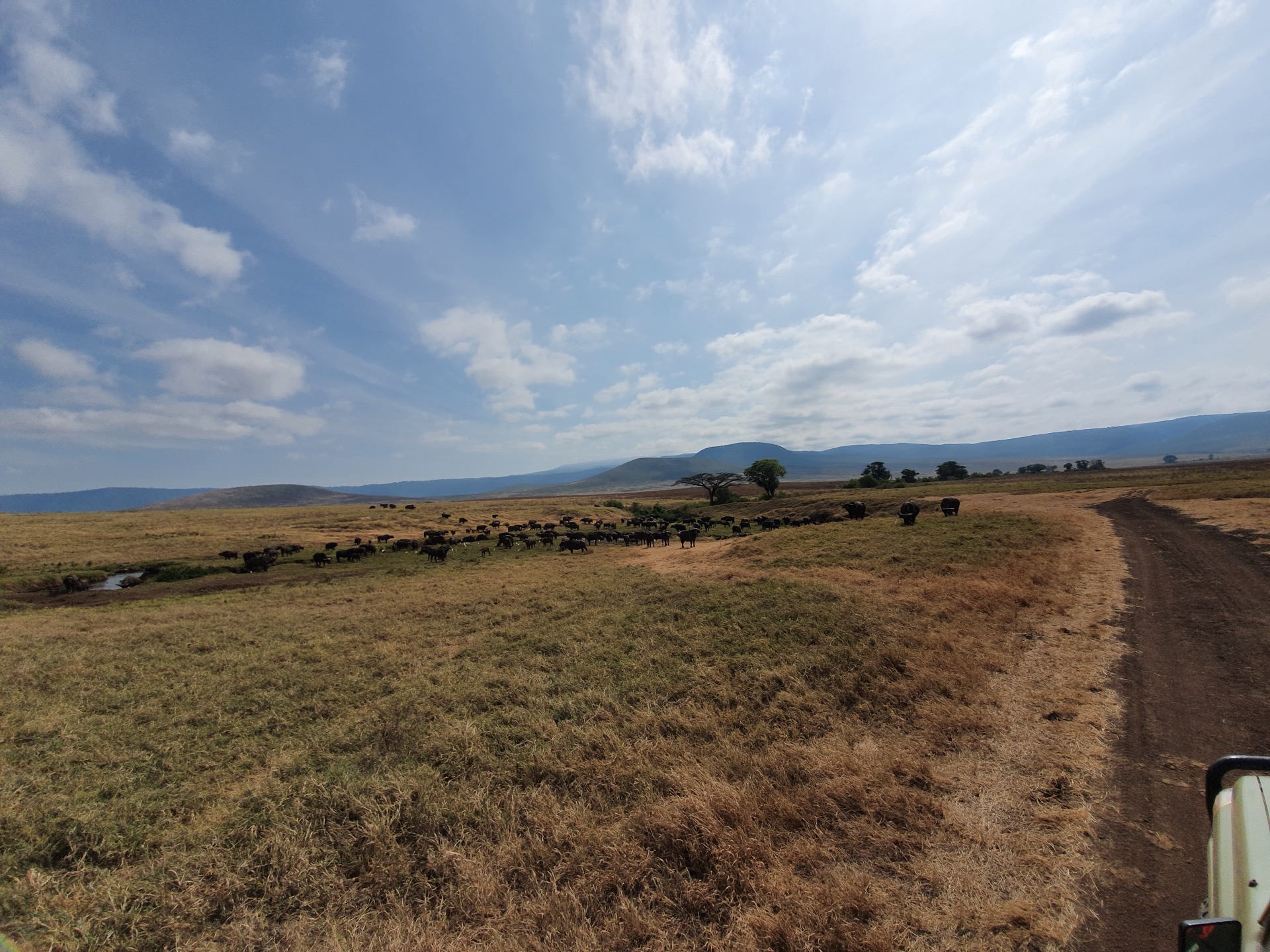
There isn’t. The wildebeest (1,366,109 counted in the 2023 TAWIRI aerial census) follow a year-round loop of roughly 800 kilometres through the Serengeti-Mara ecosystem. They have been doing this continuously for tens of thousands of years. The loop has no start and no finish — only phases. Every month offers something. The right month depends entirely on which phase you want to witness.
This guide gives you the honest breakdown: what happens in every month, where the herds are, and how to choose between the two headline events — the Mara River crossings and the calving season — without being misled by marketing that treats one as definitively better than the other.
The two headline events
Before the month-by-month breakdown, it helps to understand the two moments that drive most migration travel decisions.
Mara River crossings (July–October): The scenes that define the migration — thousands of wildebeest hurling themselves into the river, Nile crocodiles surging from the water, animals piling onto each other, calves being swept downstream. This is what most people picture when they hear “great migration.” The crossings happen at multiple points along the northern Serengeti’s Mara River, with Kogatende and Lamai being the main Tanzania-side positions. They are not predictable to the day.
Calving season (mid-January–March, peak February): Less famous, arguably more intense. Around 400,000 wildebeest calves are born over a compressed 6–8 week season on the southern Serengeti plains and the adjacent Ndutu area. Every predator in the ecosystem follows. The result is the most concentrated predator-prey action in Africa. Fewer crowds than peak crossing season. More predictable timing than the crossings.
Neither is objectively better. They are different in character. The crossings are explosive, violent, and intermittent. The calving season is sustained intensity across weeks — multiple kills per day across the plains, calves attempting to stand within minutes of birth, cheetahs and lions working the same area simultaneously.
The year-round loop: month-by-month
November–December: the return south
After the crossing season, the herds begin moving south and east through the Serengeti. The short rains arrive in November, bringing new grass to the southern plains. The wildebeest follow the rain, as they always do.
This is a transition period: herds are spread across a wide area, moving rather than concentrated. November can feel scattered for migration viewing. December improves significantly — by late December, animals are arriving on the Ndutu plains and concentrations begin to build in anticipation of calving. Fewer tourists than any other month. Camp rates are lower. The landscape turns green after the rains, which is genuinely beautiful even if the migration drama is limited.
If you travel in December, position yourself near Ndutu from mid-December onward — the calving action can begin earlier than the textbook January date in some years.
January–February: calving on the southern plains
This is the most underrated phase of the migration, and in my view the most compelling sustained wildlife experience in Africa.
The wildebeest arrive on the mineral-rich short-grass volcanic plains of the southern Serengeti and the adjacent Ndutu area (technically inside the Ngorongoro Conservation Area). Calving begins in mid-January and peaks through February, with roughly 400,000 calves born over a 6-8 week season.
The birth synchrony is an evolutionary strategy called predator swamping. If 400,000 calves arrive simultaneously, predators are literally overwhelmed — there are more calves than they can hunt. Most survive not because they are fast or well-hidden, but because there are too many of them. The wildebeest that calves earlier or later, outside the peak window, loses this protection — its calf is picked off efficiently. Natural selection has compressed births into the tightest possible window.
The consequence for safari visitors: the density of predator action is extraordinary. Cheetah coalitions sprint across the flat open Ndutu plains. Lion prides make kills multiple times per week — not once per week, multiple times per week. Spotted hyena clans hunt in coordinated groups and scavenge from lions within minutes. Jackals work the margins. If African wild dogs are passing through (not guaranteed but possible), their kill success rate near calving aggregations approaches 80%.
In February, most migration action concentrates in the Ndutu Plains in the southwestern corner of the ecosystem. Ndutu Lodge and a cluster of tented camps in the area sit on the Serengeti/NCA boundary — game drives range freely across both zones. NCA conservation fees apply rather than Serengeti national park fees.
What to expect: Wildebeest covering the plains in every direction. Small calves, some barely hours old, trying to stand and bond with their mothers. Predators working the edges constantly. Morning drives that feel almost overwhelming in the number of simultaneous events. Afternoons that produce sightings you will remember for decades.
The honest trade-off: The calving zone is in the south, far from the famous Kogatende crossing points. It is the “wrong” part of the Serengeti for first-time visitors who have the Mara crossings as their main goal. For those who understand what they are trading, it is the better experience.
March: late calving, transition begins
Calving continues through March, though with decreasing intensity as the peak of the calving season passes. Calves born earlier are now stronger and more mobile — predator success rates drop. The herds begin the gradual shift northwestward as the long rains approach and the southern plains dry.
March can be excellent in the first two weeks if you want a less crowded version of the calving drama. Road conditions begin to deteriorate toward the end of the month. The landscape is still green and photogenic.
April–May: western corridor and long rains
The long rains arrive in April. The herds string out across the central Serengeti and move northwest through the western corridor toward the Grumeti River. This is the least-visited period and the most challenging for driving — unpaved tracks become heavy mud, some camp access roads require 4x4 with lockers, and some seasonal camps close entirely.
The wildlife remains extraordinary — the resident predators don’t leave, big cats are breeding, and the green Serengeti is visually beautiful. But the migration itself is dispersed rather than concentrated, and the herds are moving rather than gathering.
The Grumeti River crossings begin in this period. Less famous than the Mara crossings, they are genuine — approximately 3,000 Nile crocodiles (some reaching 17 feet and living 70 years) wait in the Grumeti year-round, and wildebeest must cross to continue north. May–June is the best window for Grumeti crossing viewing. Some Western Corridor lodges offer significant off-peak discounts in April–May.
June: western corridor and central Serengeti — the sweet spot
June is the most underrated month on the migration calendar. I say this without reservation.
The long rains end. The herds mass in the central Serengeti around Seronera and continue moving through the western corridor. The concentrations in June can be genuinely vast — kilometre-long columns of wildebeest moving across the Serengeti grassland, zebra mixed in at the front of the column, Thomson’s gazelle trailing behind. Predator activity in the central Serengeti is at its best: the resident lion prides along the Seronera River are active, cheetah sightings on the open plains are frequent, and the herds draw everything in.
Grumeti River crossings are active. Camp prices remain below the July–October peak. Tourists are fewer. Roads have dried out after the rains. The air is clear. For value — measured in quality of experience per dollar — June often beats August.
The gap: if Mara River crossings are the non-negotiable goal, June delivers nothing on the Mara. The herds are still too far south. Position yourself in the western corridor or Seronera in June, not the north.
July–October: Mara River crossings
This is peak season. The herds reach the northern Serengeti in July and begin the Mara River crossings — into Kenya’s Maasai Mara, then back into Tanzania, sometimes multiple times in both directions.
July: The early part of the season. Some herds cross in late July — the crossing window can begin as early as late June in good years. The northern Serengeti camps (Kogatende, Lamai area) fill quickly. Game is excellent throughout, regardless of whether you witness a crossing. Kogatende camps typically open around May 20 and run through November 20 for the crossing season.
August: The peak. Most sources and experienced guides identify August as the single most consistent month for crossing frequency. Late July through August is when the majority of crossings at the main Tanzania-side points tend to cluster. The Lamai region along the Mara River, straddling the Kenya-Tanzania border, sees both Tanzania-side and Kenya-side activity. August is also the most expensive and most crowded month of the year.
September–October: Crossings continue, often at the main points and at secondary locations. Some crossings in late September and October represent the return south as the rains begin to fail in Kenya and the herds move back. October brings a different kind of drama — crossings in both directions simultaneously as different herds operate on different schedules.
How to maximise your crossing odds:
The single most important decision is where you stay. Base yourself in the northern Serengeti — Kogatende or Lamai area — not Seronera. From Seronera, the Mara crossing points are 2–3 hours drive away. That means you can visit once per day at most, and if nothing is happening, you have used your entire game drive on a single speculative trip. From a northern camp, you can be at the crossing points in 20–30 minutes and can make multiple visits per day based on radio reports from guides already at the bank.
Stay a minimum of 3 nights in the north. River crossings are not guaranteed on any given day. Herds can gather at the bank for hours and not cross — the decision appears random (it is responding to micro-cues that guides read better than tourists). Multiple nights dramatically improve your statistical odds.
Listen to your guide’s network. Experienced guides in the northern Serengeti have real-time radio contact with other guides at the crossing points. When a crossing is active, word spreads within minutes. When nothing is happening, they keep you in productive game country rather than waiting at an empty bank.
Do not sit at the river waiting if nothing is showing. The northern Serengeti has extraordinary resident wildlife — lions, cheetahs, leopards, and enormous concentrations of prey animals. A morning spent watching a coalition of cheetahs or a pride of lions is not a consolation prize. Return to the crossing point when the guide’s contacts report movement.
When a crossing does happen, it is one of the most overwhelming wildlife encounters on earth. Hundreds or thousands of wildebeest deciding simultaneously to enter the water. Nile crocodiles that have been motionless for hours erupting into motion. The noise — splashing, bellowing, the grinding of hooves on rock. The chaos of calves separated from mothers, animals piling onto each other at the bank, some turning back and running into the mass still coming forward. A crossing with 300 wildebeest that happens 15 metres from your vehicle is more visceral than a massive crossing a kilometre away. Proximity, not scale, is what you remember.
November: return south
The short rains arrive. The herds begin moving south and east through the Serengeti. The northern camps close around mid-November. The annual cycle resets as grass greens on the southern plains and the wildebeest follow it home.
Calving vs crossings: how to choose
Choose calving (January–February) if:
- You want sustained predator action over multiple days rather than a single explosive event
- You want a more predictable experience — calving timing is clustered in a known window; crossing timing is not
- You are travelling with children who will find repeated predator sightings more engaging than waiting hours at a river bank
- Budget matters — calving season is slightly cheaper than peak crossing season, and the Ndutu camp options include mid-range choices
- You want fewer vehicles at sightings — the calving season is underrated, and the crowds are noticeably lower than July–August in the north
Choose crossings (July–October) if:
- You specifically want the Mara River crossing experience — this is the one thing calving season cannot provide
- You can dedicate 3–4 nights to the northern Serengeti — without that flexibility, the crossing odds drop substantially
- You accept the unpredictability as part of the experience, not a frustration
- Budget is flexible — northern Serengeti camps in peak season are the most expensive safari accommodation in Tanzania, commonly USD 1,000+ per night for two
Neither — choose June if:
- You want vast migration herds in the central Serengeti, excellent big cat sightings, the Grumeti River crossing as a bonus, and prices significantly below peak — without the specific drama of either calving or Mara crossings
What the crossings actually feel like
I want to give you an honest account of a crossing morning, because the expectations can be badly calibrated.
I was at Kogatende in August. The guide had radio contact with three vehicles already at the main bank. Nothing by 07:00. We worked an area with two cheetah cubs and their mother for an hour — beautiful but separate from the crossing watch. At 09:30, the radio crackled. We drove to the bank. A group of around 3,000 wildebeest was gathered on the high ground above the water’s edge. They milled for 45 minutes. One wildebeest went forward, retreated. Another group pressed to the edge and stopped. The other vehicles were parked in a line.
Then, without any apparent trigger, the whole mass moved forward at once. The sound was immediate and overwhelming — the ground shook from hooves, the bellowing was continuous. The crocodiles in the water — which had been invisible — surfaced and moved toward the crossing point in a way that looked almost unhurried. The first wildebeest entered the water. Within 30 seconds, the bank was a mass of churning bodies. The crocodiles took animals — not as many as I expected, perhaps 3 or 4 visible takes in the chaos. Most crossed. The whole event lasted perhaps 25 minutes. When it was over, the bank was empty and covered in hoof prints and scattered dung.
The guide said this was a medium crossing — 3,000 animals, clean crossing point, 25 minutes. He had seen crossings of 10,000 animals lasting 2 hours.
I have been in the Serengeti for calving season too. The most memorable morning there was in February in the Ndutu area, when we watched a cheetah mother teach two sub-adult cubs how to hunt a Thomson’s gazelle at dawn, a hyena clan drive a lioness off a wildebeest calf 400 metres to the south, and a single male lion stride across the open plain completely unconcerned, moving toward the sound of bellowing. All within one morning game drive, without moving the vehicle more than two kilometres.
Neither experience was better. They were entirely different in character. That is the honest answer to “when is the best time.”
Booking lead times
For river crossings (July–October): book 9–12 months in advance for the best northern Serengeti mobile and semi-permanent camps. July and August in the Kogatende-Lamai area are the most sought-after dates in Tanzanian safari tourism. If you have a specific August departure, confirm availability a year ahead.
For calving (January–February): similar lead times for top Ndutu camps, though the overall pressure is lower than August peak. 6–9 months is usually adequate for good options.
For June and shoulder months: 3–6 months is typically sufficient, and last-minute availability is more common. The flexibility is one of the advantages of travelling outside the headline windows.
Related guides
For the complete overview of all migration phases, zone mapping, and camp types by season, see the Serengeti great migration guide. For the wider Serengeti planning context — zones, how many days, what to expect — see the full Serengeti planning page. The calving season overlaps with the Ngorongoro Conservation Area’s Ndutu plains — the Ngorongoro Conservation Area page covers the NCA access and what else is worth visiting in the wider conservancy. For north circuit planning that combines the Serengeti with Ngorongoro and Tarangire, see the complete northern circuit itinerary. Real costs — park fees, camp rates, flight transfers — are in our full cost breakdown.
Frequently asked questions
When is the Mara River crossing season?
Mara River crossings in the northern Serengeti typically run from mid-July to late October, with August widely identified as the single best month. Crossings can begin as early as June in some years and continue into early November during the return south. Critically, no crossing is guaranteed on a specific day — the herds can stand at the bank for hours without committing. Stay a minimum of 3 nights in the northern Serengeti (Kogatende or Lamai area) to give yourself realistic odds.
Is January good for seeing the Serengeti migration?
January is an excellent time, particularly from mid-January onward. The herds are on the southern short-grass plains and Ndutu area, calving begins, and every predator in the ecosystem follows — cheetahs, lions, hyenas, jackals, and wild dogs all hunt at peak frequency because the new calves are abundant and vulnerable. Fewer tourists than the July–October crossing season. Mid-January to February is the sweet spot for calving action.
What is calving season in the Serengeti?
Calving season runs from late January to early March, peaking in February, on the southern Serengeti plains and the adjacent Ndutu area (technically inside the Ngorongoro Conservation Area). Around 400,000 wildebeest calves are born over a compressed 6–8 week season — an evolutionary strategy called predator swamping. With that many calves arriving in such a short season, predators are overwhelmed and most survive. The concentrated births also drive the most intense predator hunting activity in Africa: lions, cheetahs, and spotted hyenas make multiple kills per day.
Can you see the migration all year?
Yes. The great migration is a continuous year-round loop of roughly 800 kilometres through the Serengeti-Mara ecosystem driven by rainfall and grass. There is no month when the herds have stopped moving or vanished. What changes is where they are: south for calving (December–March), west through the Grumeti (April–June), north for Mara crossings (July–October), south again (November). Even in April and May during the long rains, the herds are moving through the western corridor.
Where do wildebeest go in June?
In June, the herds are in the central and western Serengeti — moving through the western corridor and Grumeti River area toward the north. The Grumeti River crossings happen in May–June: smaller than the Mara crossings but genuine, and with approximately 3,000 resident Nile crocodiles (some reaching 17 feet). June is also one of the best months in the central Serengeti (Seronera area) for big cat sightings and offers camp prices below the July–October peak. I consider it the most underrated month on the migration calendar.
How long do Mara River crossings last?
A single crossing event typically lasts between 15 minutes and 3 hours from when the leading wildebeest enter the water to when the last animals have crossed or the herd retreats. But the waiting is unpredictable — a mass gathering at the bank can take 30 minutes or 4 hours to trigger. Herds sometimes gather, mull it, then turn back without crossing at all. Multiple crossings can happen at the same point in a single day, or nothing for two weeks. The chaos of a full crossing — crocodiles lunging, wildebeest piling on each other, calves being separated — can compress into 20 chaotic minutes of almost unbearable intensity.