
Facts & prices checked: 2026-06-25
The Great Migration has five distinct zones. Each requires a different camp, a different strategy, and a different mindset. Most visitors know about one zone — the Mara River crossings — and overlook the four that complete the circuit. This guide maps all five, with the timing, what to expect at each, and how to position yourself to actually intercept the herds.
The migration circuit — how it works
The Great Migration is a continuous, year-round clockwise loop of approximately 800 kilometres through the Serengeti-Mara ecosystem. There is no start, no finish, and no pause. The herds are always moving.
What drives them is simple: rainfall and grass. New rain produces short green grass. The wildebeest and zebra follow that grass as it springs up across the landscape, essentially tracking a moving lawn across hundreds of kilometres. When the grass in one area is exhausted or the soil dries out, the herds shift toward wherever fresh growth is emerging.
The 2023 TAWIRI aerial census counted 1,366,109 wildebeest in the ecosystem. Alongside them travel roughly 200,000 zebra and 300,000 Thomson’s gazelle — each species processing the grass in sequence. Zebra eat the taller, coarser growth first. Wildebeest follow and crop the shorter, sweeter growth underneath. Gazelle pick over what remains. The grazing facilitation between zebra and wildebeest is one of the reasons the two species move together across the same circuit.
The circuit is broadly consistent year to year. But “broadly” is doing real work in that sentence. Timing shifts by 2–4 weeks depending on when the rains arrive. In a late-rain year, the herds linger longer in the south. In an early-rain year, the northern crossing season can start several weeks ahead of the typical July window. The migration is predictable in sequence and unpredictable in exact timing — which is why current field intelligence from operators on the ground matters more than any fixed calendar.
Zone 1 — Ndutu and the southern plains (December–March)
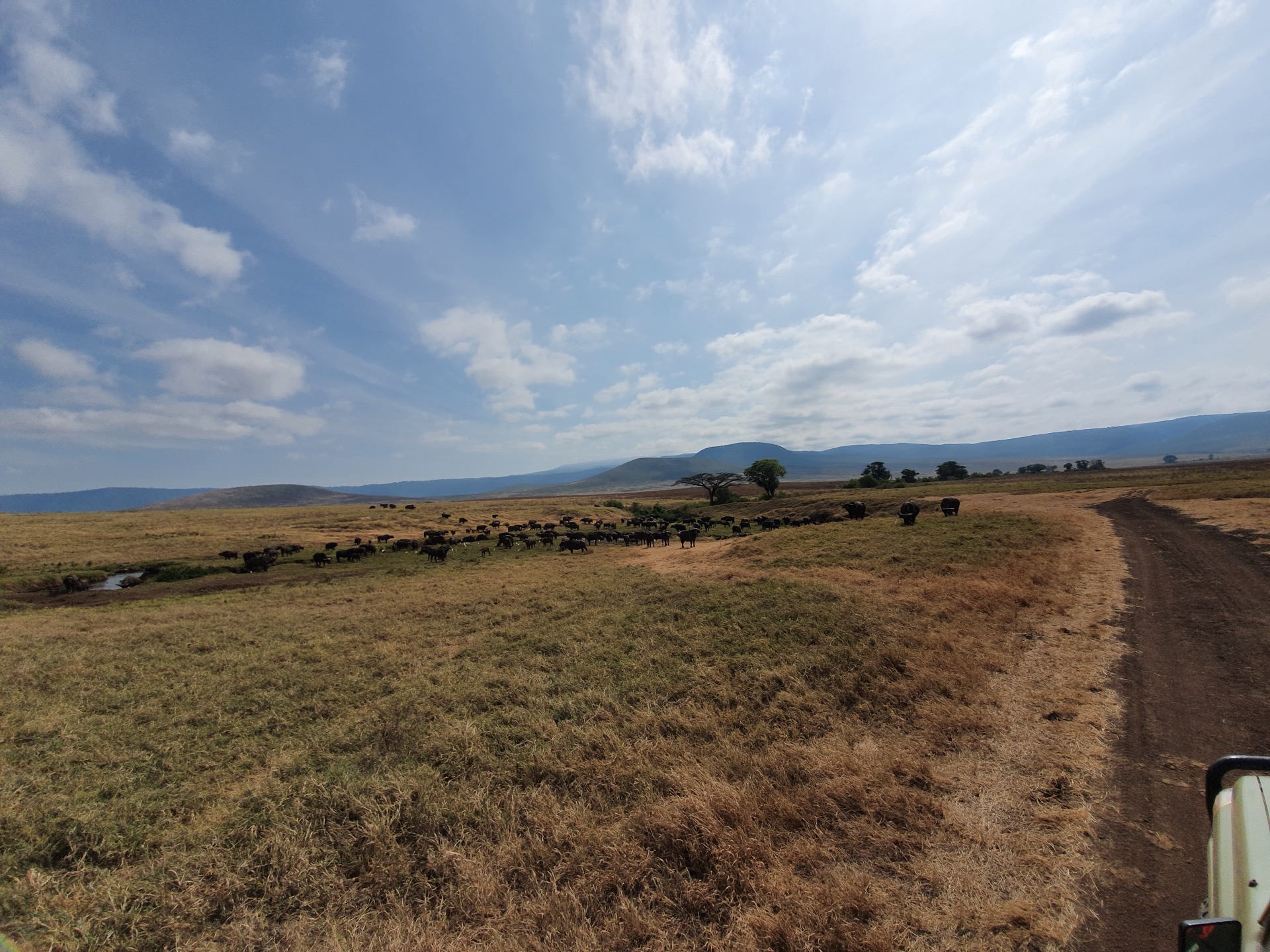
The short-grass volcanic plains of the southern Serengeti and the Ndutu area — straddling the boundary between Serengeti National Park and the Ngorongoro Conservation Area — are where the migration spends the calving season. This is where the year begins, or restarts.
The calving season typically runs January through March, with peak calving in February. The season produces upwards of 500,000 calves in total, born within a compressed 6-to-8-week season — a strategy ecologists call predator saturation. By flooding the landscape with tens of thousands of newborns in that short window, individual calves have a higher survival probability than if births were distributed across the year. Predators simply cannot eat enough to keep up with the volume.
Calves can stand within minutes of birth and begin moving within hours. This is an adaptation to the predator pressure that defines the calving plains. A calf that cannot walk quickly becomes a meal.
The short-grass plains of Ndutu and the southern Serengeti are optimal for predator visibility: no bush, no tall grass, open sight lines to the horizon. Cheetah density here during the calving season is among the highest in Africa. The Serengeti Cheetah Project has monitored individual cheetahs on the southern plains since 1974, and February — when newborns are in maximum concentration — is the peak hunting month for coalition males and mothers feeding cubs. Lion prides that have set up territories on the calving plains make multiple kills per week at this time. Spotted hyena clans move in coordinated groups.
I have watched three separate predator species make kills in a single morning game drive on the Ndutu plains during February. The density of simultaneous action is not replicated anywhere else I have been on the continent.
Practical note: February is peak Ndutu season. Camps sell out 6–12 months ahead. Dirt roads after heavy rain require 4WD and slow progress — expect some drives to be limited by conditions. The camps here are technically inside the NCA, not the national park, so NCA conservation fees apply rather than Serengeti gate fees.
Zone 2 — Central Serengeti and Seronera (March–May)
As the rains ease and the southern plains begin to dry, the herds start moving north and west. March to May is the dispersal phase — the wildebeest and zebra string out across the central Serengeti in a broad, diffuse movement rather than a concentrated mass.
Seronera sits at the centre of this movement. The Seronera River and its tributaries provide permanent water year-round, which is why the central Serengeti holds resident wildlife even when the migration is elsewhere. During March–May, the herds are present and moving through — not in Ndutu concentration, but in volumes that make game drives productive.
The April–May long rains are the practical constraint on this zone. Unpaved tracks in the western Serengeti can become impassable after heavy rain. Road conditions require 4WD and patience. However, tourist numbers drop significantly during April and early May, which means game sightings without the vehicle clusters common in August. A cheetah kill in April in the central Serengeti with two vehicles present is a different experience from the same kill with twelve.
Seronera’s permanent wildlife — leopards in the riverine fig trees, lions on the kopjes, hippos in the river pools — is worth time year-round. During May, as the long rains ease, the herds concentrate ahead of the westward movement and the first hints of the Grumeti crossing build. This is an underrated window: transitional, less crowded, and productive for both the migration herds and resident game.
Zone 3 — Western Corridor and Grumeti River (May–July)
The western corridor is a different ecosystem from the open plains of the south and centre. The land narrows toward Lake Victoria along the Grumeti River — woodland, riverine forest, and terrain that feels more enclosed than the broad horizons of Seronera or Ndutu.
The Grumeti River is the first major obstacle of the migration circuit. Unlike the Mara crossings in the north — which happen repeatedly over several months and are widely documented — the Grumeti crossing is more localised, harder to predict, and in some ways more extreme in its crocodile dynamics.
The Grumeti hosts approximately 3,000 Nile crocodiles (Crocodylus niloticus). Some individuals reach 17 feet in length and an estimated 70 years of age — among the largest specimens in Africa. These crocodiles are ambush predators who have been positioned at known crossing points since the previous season, waiting. The western corridor sees fewer tourists than the north, which makes a Grumeti crossing, when it happens, an extraordinarily intimate event.
River-crossing viewing at the Grumeti is most likely from May to September, with June and July typically the most active period as the herds move through on the way north. The Singita Grumeti Reserve — a private conservancy on the western Serengeti — has committed significant resources to wildlife protection in this corridor over the past two decades, with measurable results in reduced poaching and improved animal density.
Access: The western corridor is a longer drive from the central airstrips. Most visitors staying for the Grumeti crossing fly into the Grumeti airstrip directly or transfer by road from Seronera. It is worth the logistical effort.
Zone 4 — Northern Serengeti and Mara River (July–October)
The northern Serengeti is the most famous zone of the migration circuit, and the Mara River crossing is the most photographed wildlife event in Africa. The active window runs from July through October, with August and September typically the most intense months.
The Mara River marks the Tanzania-Kenya border. As the herds move north from the central Serengeti, they reach the Mara at the Tanzania-Kenya crossing points — primarily in the Kogatende area and the Lamai Triangle north of the river. The herds cross into Kenya’s Maasai Mara when the Kenyan rains green the northern grasslands, then cross back south when those rains fail, typically in October.
Here is what a crossing looks like from the bank. The herd assembles — sometimes thousands of animals — and mills nervously at the water’s edge. The leading animals approach, test the water, retreat. This can continue for hours. Nothing happens. Then, without obvious trigger, a group of animals breaks forward. The animals behind them have no choice: they follow. Within seconds, hundreds pour over the bank simultaneously. The ones at the back don’t know the ones at the front are already struggling. The ones at the front are being pushed by the weight of thousands behind them.
The Nile crocodiles positioned at known entry points lunge when the water churns. The crossing points are narrow — thousands of animals funnel through a gap measured in metres. Trampling at the entry and exit points accounts for as much mortality as the crocodiles themselves. Estimated 6,000–12,000 wildebeest die in each full crossing season from crocodiles, drowning, and crushing.
Many crossing attempts stall and reverse without completing. The leading animals wade in, lose nerve, turn back, and the entire mass reverses with them. I have sat on the Mara bank on days when five thousand animals were assembled and visible and nothing crossed. A herd can abort a crossing attempt dozens of times over several days.
Predicting which day a crossing will happen is not possible with precision. What experienced guides can read is the quality of the buildup — which bank is active, how the animals are approaching the water, whether the leading behaviour signals building momentum or retreat. Guide radio networks across the northern Serengeti share real-time information on which crossing points are active, which herds are on which bank, and when a crossing appears imminent.
Key camps and access: The Kogatende area has the most accommodation on the Tanzanian side. The Lamai Wedge (also called Lamai Triangle), north of the Mara River, is quieter with fewer vehicles and equally close to the crossing sites. Both areas are accessed by light aircraft to Kogatende airstrip from Arusha or other Serengeti airstrips. One Nature Kogatende opened in June 2025 as a seven-villa luxury option in this zone. ENVI Sisini Mara opened in February 2025 as another northern Serengeti option.
Minimum stay: Three nights is the published minimum for a crossing attempt. In practice, I’d say five nights is the realistic floor for genuine probability. The longer you stay, the higher your odds. A single night in the northern Serengeti is a lottery.
By October, the herds begin reversing south as Kenyan rains fail. The Lobo area of northern Serengeti sees the southward herds in October and early November.
Zone 5 — Return south (November–December)
November is underrated. The short rains begin in the southern Serengeti, producing the first fresh green grass of the season. The herds — which have been in the north all July–October — respond to the shift and begin the southward leg of the circuit.
The November movement passes through the central Serengeti. Tourist numbers are lower than during the crossing season. Rain is beginning but not yet heavy. Camp rates come down from the peak July–October pricing. And the herds are present and in motion — not in Ndutu-calving concentration, but large and visible on the plains heading south.
December closes the circuit. The herds regroup on the southern Serengeti short-grass plains and the Ndutu area, setting up for the January–March calving season that begins the next chapter of the loop. By late December, all five zones are represented simultaneously: late-moving herds still in the central area, advance herds already on the southern plains, scouts scattered across the western corridor. The migration is always happening everywhere. The zones describe where the concentration is highest, not where animals are exclusively.
How to intercept the migration
No fixed calendar can tell you exactly where the herds are on a specific date. What the zones give you is a framework for choosing which phase to plan around.
The variables that determine exact timing: rainfall in the southern plains (controls when calving grazing begins), rainfall in the western corridor (controls how long the herds linger before moving north), rainfall in Kenya’s Masai Mara (controls when the herds cross north and when they cross back). In a year when Kenyan rains persist late into October, the herds may not begin the return south until November. In a year when the Kenyan rains fail early, October crossings can be sparse.
The practical approach: Book a camp in the zone most aligned with your travel dates. Brief the operator explicitly on what you want to witness. Rely on your guide’s network for real-time intelligence once you’re on the ground. Stay longer than feels necessary — the extra night often produces the event.
What the migration is not: It is not a single column of animals marching in formation in one direction at one time. The herds are spread across hundreds of kilometres simultaneously. At any given day in July, there are wildebeest in the central Serengeti, wildebeest in the western corridor, and wildebeest in the northern Serengeti all moving. The “zone” is a shorthand for where the highest concentration and the most dramatic events are happening — not for where animals exclusively exist.
Seronera has wildebeest year-round. Kogatende has wildebeest outside July–October. Ndutu can have scattered herds in October. The zones map probability and intensity, not presence or absence.
Tim’s account — northern Serengeti, a Mara crossing
I spent four days in the northern Serengeti in August at a camp on the Kogatende side of the Mara River. The first three days, the guide had us at the crossing site by 6:00am. On each day, the herds came to the bank — thousands of animals in view, milling at the water’s edge, approaching the entry point, retreating. Day one, a group of perhaps fifty animals waded in and turned back before committing. Day two, nothing approached the water at all despite several thousand animals visible within sight of the crossing. Day three, the same pattern: assembly, approach, retreat.
The guide told me he had watched the same bank for six seasons. He said the reversals were part of the crossing — the herd was testing the approach, reading the crocodile movement, sensing something in the current or the smell of the water. He also said that on day four, the behaviour would likely be different. He had seen this before — a different quality to the energy at the bank.
On day four, we were positioned by 6:45am. The guide said nothing specific. He just angled the vehicle slightly differently and switched off the engine, which he had not done on the previous mornings. At 7:15am the first animals entered the water — not tentatively, but with commitment. Within thirty seconds there were fifty. Within two minutes there were five hundred. Within six minutes there were approximately four thousand wildebeest in the Mara River simultaneously at a fifty-metre crossing point.
The crocodiles were there. I counted at least six lunges in the water in front of me in the first ninety seconds. The noise — hooves on rock, the crash of bodies entering the water, the vocalisations of panicked animals — is something I had not expected. The dust on the approach bank. The way the animals at the back pushed without knowing the water was still crowded ahead.
The crossing lasted twelve minutes from first entry to last animal leaving the water on the far bank. The river returned to calm. The crocodiles settled. The herd on the far bank shook water from their coats and immediately began grazing, as if nothing had happened.
I have replayed it more times than I can count. There is no photograph that fully captures what happens in those twelve minutes.
For the full overview of what drives the migration and how to choose between calving and crossings as your primary target, see the Serengeti Great Migration guide. For the calving season specifically — what to bring, which predators are most active, and how Ndutu camps differ from park camps — see the what to pack for Ndutu. For which month to visit based on your priorities across the full Serengeti ecosystem, see the Serengeti when-to-go guide. For the full northern circuit plan with costs, see the northern circuit planning guide. For safari costs and what to budget per zone and season, see the our full cost breakdown by zone.
Frequently asked questions
Where are the wildebeest migration herds right now?
The migration follows a broadly predictable annual circuit. December–March: southern Serengeti and Ndutu for calving. March–May: dispersing northward through central Serengeti. May–July: western corridor and Grumeti River crossings. July–October: northern Serengeti and Mara River crossings (peak August–September). November–December: returning south through central Serengeti to Ndutu. Timing varies by 2–4 weeks year-to-year based on rainfall. For current herd location, contact a specialist operator with real-time field intelligence — the migration is too dynamic for a fixed calendar to be reliable without live ground information.
When is the best time to see the Mara River crossings?
July to October is the active window for Mara River crossings, with August and September typically the most intense months. The crossings are not predictable by day or hour — the herds can spend days assembled on the bank before a crossing begins, then abandon the attempt and turn back without a single animal fully crossing. A genuine crossing can involve hundreds to thousands of animals entering the river within minutes. The key is staying in the northern Serengeti (Kogatende or Lamai area) for a minimum of 3–5 days and working with guides who have radio networks tracking herd buildup. The longer you stay, the higher your probability of witnessing a major event.
What happens at a wildebeest river crossing?
A crossing starts when enough momentum builds in the herd on the bank — the leading animals wade in, which triggers those behind to follow in a cascade. A single event can involve thousands of animals entering the water at one point within minutes. The Mara River is fast, rocky, and patrolled by Nile crocodiles (Crocodylus niloticus) positioned at known crossing points. Wildebeest mortality comes from both crocodile predation and from drowning or trampling at the narrow entry and exit points where tens of thousands of animals funnel simultaneously. Crossings typically last 10–30 minutes from start to last animal leaving the water. Many crossing attempts stall and reverse without completing.
What is the calving season in Ndutu?
The calving season in the Ndutu area and southern Serengeti typically runs January to March, with peak calving in February. The season produces upwards of 500,000 calves in total, born within a compressed 6-to-8-week season — a strategy called predator saturation: flooding the landscape with new calves in such a short window means individual calves have a higher survival chance than if births were spread throughout the year. Calves can stand and move within minutes of birth. The concentration of newborns drives extraordinarily high predator density in the southern Serengeti — February in Ndutu is one of Africa's best windows for cheetah, lion, and hyena sightings.
Is the migration visible from the central Serengeti (Seronera)?
Yes, though not at peak concentration. Wildebeest are present in the Seronera area year-round. During the March–May dispersal period, significant herds pass through the central Serengeti moving northward. During November–December, herds return south through the same area. Seronera also has the most reliable year-round wildlife regardless of migration timing — the Seronera River and its tributaries support permanent lion prides, leopards in the fig trees, and resident elephant. If you can only choose one Serengeti base, Seronera gives you excellent game year-round even when the migration concentration is elsewhere.
What is the Grumeti River crossing?
The Grumeti River crossing is the first major water crossing of the migration circuit, typically May to July as the herds move through the western corridor. Unlike the Mara crossings which happen repeatedly over several months, the Grumeti crossing is more localised and harder to predict. The Grumeti hosts approximately 3,000 Nile crocodiles (Crocodylus niloticus) — some reaching 17 feet in length and estimated at 70 years of age — which have been positioned at crossing sites waiting since the previous season. The Singita Grumeti Reserve (a private concession on the western Serengeti) has worked to eliminate poaching from this corridor and significantly improved wildlife density in the area.