
Facts & prices checked: 2026-06-25
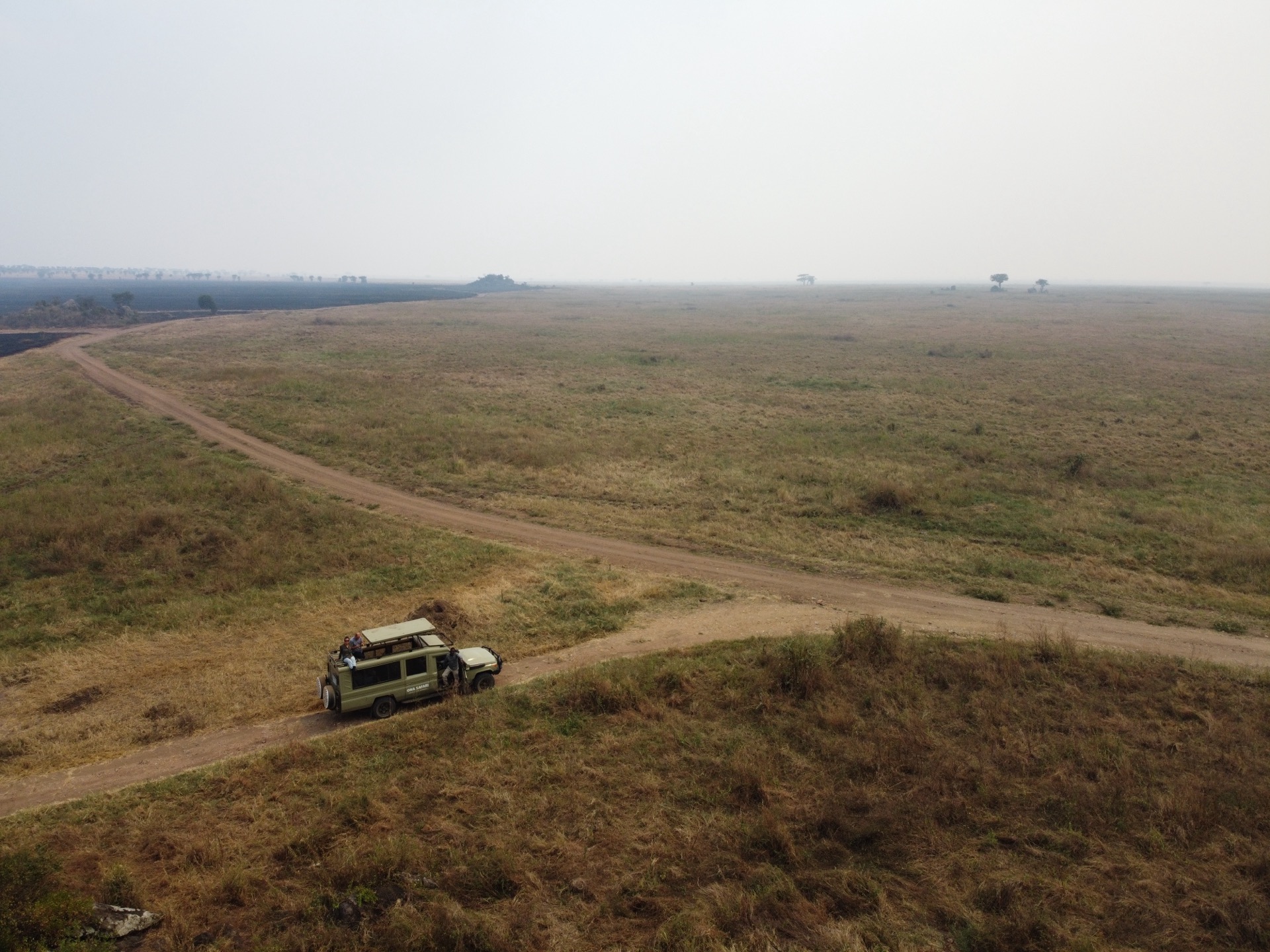
The game drive that morning across the Serengeti — the wildebeest moving in columns, a lion resting on a kopje, acacia trees against a flat horizon — already felt ancient. Then we stopped at Olduvai Gorge. Standing at the viewpoint, looking down into the exposed sediment layers, I understood I was looking at time in a way I had never experienced before. The layer visible at eye level was roughly 15,000 years old. The dark band below it was half a million. Deeper still, somewhere in the orange sediment the gorge calls Bed I, hominids were making stone tools as far back as 1.6 to 1.8 million years ago — and, at the Ewass Oldupa site further west in the same gorge, as far back as roughly 2 million years, the oldest tools yet found here. This is not metaphorical time. The rock is right there. You can see it.
Where human history begins
Olduvai Gorge — officially renamed Oldupai Gorge in 2005, after the Maasai word for the wild sisal plant (Sansevieria ehrenbergii) that grows in its ravines — sits within the Ngorongoro Conservation Area on the main road between Ngorongoro Crater and Serengeti National Park. Before Mary Leakey’s 1959 discovery here, the scientific consensus placed human origins in Asia. The fossils in this gorge changed that permanently.
The gorge’s deposits span from approximately 2.1 million to 15,000 years ago — an unbroken sedimentary record of climate shifts, ecological change, and hominin occupation. The site has yielded fossil remains of more than 60 hominins and holds the longest known archaeological record of stone-tool development anywhere on Earth. No other single site in the world packs more of the human story into one exposed geological column.
For a traveler on a Ngorongoro-Serengeti itinerary, this is not a detour. It is on the way. And the stop — 1 to 2 hours at the museum and gorge viewpoint — is one of the few experiences in safari travel that genuinely shifts your sense of scale. The animals you watched that morning? Their ancestors grazed on these same plains while our own ancestors chipped flint on the gorge floor below.
The Leakeys and the discoveries that rewrote human origins
Louis Leakey (1903–1972) was born in Kenya to British missionary parents and began working at Olduvai in the 1930s with a conviction that human evolution had happened in Africa, not Asia — a view that put him at odds with the scientific establishment of his time. He was right, but it took a fossil to prove it.
Mary Leakey (1913–1996) married Louis in 1936 and became the more methodical and rigorous field scientist of the two. On 17 July 1959, while Louis recovered from illness at camp, Mary found a fragment of palate with teeth eroding from a slope in Bed I. As she excavated, more of the skull appeared. Over several weeks, she and Louis assembled a near-complete cranium: a heavily built, robust hominid with a distinctive bony crest on top of the skull. They named it Zinjanthropus boisei — “Zinj” from the Arabic name for East Africa, “boisei” after Charles Boise, a supporter of their work.
The discovery, dated to approximately 1.75 million years ago, made international headlines and appeared in National Geographic. The publicity brought funding that transformed the Leakeys’ research programme. Although Zinjanthropus was later reclassified as Paranthropus boisei — a robust side-branch of the human family tree that eventually went extinct rather than a direct human ancestor — the discovery had done its work: Africa was now understood as the origin point of early human evolution.
The years following Zinj were equally significant. Fossil evidence found at Olduvai from 1959 through the 1960s allowed the Leakeys and their colleagues to define a new species: Homo habilis — “Handy Man” — considered the earliest member of the genus Homo. The species inhabited the region approximately 2.4 to 1.5 million years ago, with specimens at Olduvai dating to roughly 1.9 million years ago and lower Bed I specimens at about 1.8 million years ago. The classification was contested for decades — many paleoanthropologists questioned whether these fossils were truly Homo or a later Australopithecus — but the Olduvai evidence shaped every subsequent debate about the definition of our genus. Stone tools found in the gorge, dating 1.6 to 1.8 million years ago, are associated with Homo habilis occupation.
Together, Louis and Mary spent more than 30 years at Olduvai and unearthed the first well-dated fossils and artefacts of some of our earliest human ancestors. The work established Africa as the birthplace of the human lineage and fundamentally changed the discipline of paleoanthropology.
Olduvai Gorge — reading 2 million years in the rock
The physical gorge is part of what makes Olduvai uniquely legible as a site. The deposits exposed in the gorge walls cover a time span from approximately 2.1 million to 15,000 years ago — a nearly continuous sedimentary record divided into five main geological beds (Beds I through V). Each bed represents a different period of deposition, climate, and ecology. The different colours and textures of the rock — visible from the viewpoint above the gorge — are not decorative geology. They are chapters.
Bed I at the base is where the oldest and most significant fossils were found, including OH 5 (Zinjanthropus) and the earliest Homo habilis evidence. The Olduvai site has produced the fossil remains of more than 60 hominins in total — an extraordinary density for a single location. The gorge has also yielded fossil fauna of other extinct species, including a horned crocodile from Middle Bed I (dated to approximately 1.84 million years ago) that gives some indication of the ecosystem these hominids inhabited.
Excavation at Olduvai has been continuous in various forms since the 1930s. The site is now managed by the Tanzania government through the Ngorongoro Conservation Area Authority (NCAA). Most visitors spend their time at the small Olduvai Museum at the top of the gorge, which displays fossil casts (original finds are held at national museums in Dar es Salaam and Nairobi) and explanatory panels covering the key discoveries and the geological record. The museum is modest in size but well curated.
Visiting the actual excavations requires an official guide and must be prearranged rather than simply showing up and walking down. For most visitors, the museum and gorge viewpoint are the visit — and they are sufficient to understand the significance of the site. Entry costs USD 35.40 per adult (USD 11.80 for children aged 5–15). The gorge may be visited year-round.
Laetoli footprints — the oldest walk
Forty-five kilometres south of Olduvai, accessible by a rougher track requiring advance notice to the NCAA, is Laetoli — a site that extends the human story back even further than Olduvai’s fossil record.
In 1978, Mary Leakey’s team discovered something remarkable in a layer of volcanic ash: three parallel trackways of footprints, pressed into the ash while it was wet from rain and then preserved as it hardened. The prints were made 3.66 million years ago by hominids walking upright — three individuals, one of whom appears to have walked partially in the footprints of another. A later study confirmed the bipedal date at 3.66 million years ago; related analysis of site A footprints confirmed these were hominid, not bear.
The footprints are attributed to Australopithecus afarensis — the same species as “Lucy,” found in Ethiopia in 1974. They are the oldest confirmed evidence of bipedal locomotion in the hominid fossil record at that date. The significance is not just the age. Bipedalism — walking upright on two legs — appears here approximately 1 million years before the evidence for enlarged brains and complex tool use. The Laetoli prints demonstrate that our ancestors walked before they thought, in the modern cognitive sense. The sequence of evolution was not what it was assumed to be.
The original footprints were re-buried under volcanic ash and sediment for preservation. A replica trackway has been constructed at a visitor viewpoint. The site is not on a standard tourist circuit — getting there requires planning, a 4x4, and coordination with the NCA. It is a meaningful addition for travelers with a dedicated interest in paleoanthropology, but it should not be added to an itinerary as a casual add-on.
Tanzania’s prehistoric landscape
Olduvai and Laetoli are the headline sites, but Tanzania’s prehistoric record extends well beyond them. What the Ngorongoro Conservation Area and its surroundings contain is arguably the most concentrated landscape of early human evidence anywhere on Earth.
The Engare Sero footprints at Lake Natron — approximately 19,000 years old — represent a large trackway of anatomically modern humans, the youngest significant footprint site in the region but no less striking for its scale. At Engare Sero, dozens of individuals crossed a mudflat in a pattern that researchers have interpreted as a group moving together across the landscape. This site belongs to fully modern Homo sapiens, connecting the deep Olduvai/Laetoli record to the recent human past.
The Nasera Rock Shelter in the northern Serengeti is a Late Stone Age occupation site, providing evidence of human habitation across a much more recent period and connecting the prehistoric sequence to more recognisable archaeological contexts.
Together, these sites mean that Tanzania holds a continuous sequence of human presence: from the earliest Homo habilis at Olduvai 1.9 million years ago, through the bipedal ancestors at Laetoli 3.66 million years ago, to early modern humans at Engare Sero 19,000 years ago. No other landscape in East Africa — including Kenya’s Turkana Basin — offers this breadth of record in such geographical proximity.
The Ngorongoro Conservation Area’s 2010 UNESCO cultural listing (it was first inscribed as a natural site in 1979) recognised exactly this: that the same 8,292 km² area contains globally significant wildlife habitat, living Maasai pastoral communities, and one of the world’s most important archives of human prehistory. That dual reality — ancient and contemporary, wildlife and human ancestors — is what makes this particular corner of northern Tanzania unlike anywhere else.
Practical visit guide
Getting there: Olduvai Gorge is on the main tarmac-and-dirt road between Ngorongoro Crater and Serengeti National Park. Virtually all combined Ngorongoro-Serengeti itineraries pass within a few kilometres. The site is signed from the road. A 4x4 vehicle is required, as with all NCA travel.
Entry fees: USD 35.40 per adult (non-East African), USD 11.80 per child aged 5–15. This is separate from the Ngorongoro Conservation Area daily entry fee of USD 70.80 per adult. Both must be paid.
What you see: The Olduvai Museum at the top of the gorge holds fossil casts, explanatory panels, and information on ongoing excavation. The gorge viewpoint provides a clear view into the ravine and the exposed sediment layers. A guided walk into the gorge (requiring an official guide and advance arrangement at the site) takes 30–45 minutes and goes to active excavation areas where the sediment record is visible in the walls.
Visit duration: 1.5 to 2 hours covers the museum, viewpoint, and a gorge walk. Genuinely interested visitors should allow 2 to 3 hours. Most visitors arrive on transit between Ngorongoro Crater and the Serengeti and incorporate the stop into the driving day without adding overnight time.
Opening hours: Olduvai Gorge may be visited year-round. Standard NCA site hours apply; plan to arrive by mid-morning if you intend to combine with a full crater descent the same day.
Laetoli as a separate visit: This is a more remote, more demanding add-on requiring advance coordination with the NCAA and a longer driving time. It is not included in a standard Olduvai stop and should be planned as a dedicated half-day extension for travelers with a specific interest in the footprint site.
Combining visits: The most efficient itinerary pairs Olduvai with a Ngorongoro Crater descent (either the same day or adjacent days), then continues into the Serengeti. The Ndutu Plains in the southern Ngorongoro Conservation Area — a key calving area for the wildebeest migration in February — are roughly in the same direction. A well-planned northern circuit itinerary can include crater, Olduvai, and Serengeti without backtracking.
Why it changes the safari
I have done game drives in a lot of parks. The Serengeti is exceptional — the space, the scale, the way the horizon just continues. The Ngorongoro crater is theatrical in the best sense: dense, contained, predictable in a way that delivers. But neither of those experiences relocated me in the way that stopping at Olduvai did.
It is something to do with the specificity of the place. This is not “East Africa, where humans evolved.” This is the exact gorge, the exact sediment layers, the exact location where Mary Leakey knelt in 1959 and began brushing dust from a 1.75-million-year-old skull. You can stand where she stood. You can look down at the layer where that skull emerged from the ground. The story of human evolution is usually told in museums, with fossils behind glass. Here the sediment is still exposed, the excavation is still happening, the guide is pointing at a rock face and explaining what the colour change means. It is not abstracted.
The connection to the game drive is also real, not forced. The wildebeest on the Serengeti plains have been on those plains, in some form, for millions of years. Early hominids at Olduvai would have watched predecessors of those animals from the gorge edge. The landscape has changed — the vegetation has shifted, the climate has cycled through wet and dry phases written in the sediment — but the plains are recognisably the same plains. The safari you are on is not separate from the fossil record. It is continuous with it.
That is what Olduvai gives you: a sense of deep time that is also immediate. The animals are still there. The landscape is still there. And the rock below your feet carries the record of everyone who came before.
Our full Ngorongoro rundown covers the crater descent, fees, and how to combine the crater with the wider conservation area. For the full northern circuit from Arusha — Tarangire, Lake Manyara, Ngorongoro, Serengeti — the Northern Circuit guide covers sequencing, logistics, and how long each section takes. Tanzania’s extraordinary cultural depth, from Stone Town’s Islamic heritage to the Maasai pastoral communities of the NCA, is covered in the Tanzania culture and etiquette guide.
Frequently asked questions
What is Olduvai Gorge famous for?
Olduvai Gorge (officially renamed Oldupai Gorge in 2005, after the Maasai word for the wild sisal plant growing there) is famous as the site where Louis and Mary Leakey's excavations produced the most complete early hominid fossil record on Earth. Mary Leakey found OH 5 — 'Zinjanthropus boisei', later reclassified as Paranthropus boisei — in 1959, a near-complete skull approximately 1.75 million years old. The gorge deposits span from approximately 2.1 million to 15,000 years ago and have yielded the fossil remains of more than 60 hominins. It also holds the longest known archaeological record of stone-tool development anywhere on Earth.
How do I visit Olduvai Gorge?
Olduvai Gorge sits on the main road between Ngorongoro Crater and Serengeti National Park — virtually all combined itineraries pass close by. Most visitors stop for 1-2 hours on transit. The site has a small museum with fossil casts (original finds are in national museums in Dar es Salaam and Nairobi), explanatory panels, a gorge viewpoint, and guided walks into the gorge to see active excavation sites and sediment layers. Entry costs USD 35.40 per adult (USD 11.80 for children aged 5–15). An official guide is required to descend into the gorge itself; most visitors need to prearrange the descent rather than simply walking down from the museum.
What are the Laetoli footprints and can I visit?
The Laetoli footprints are a trackway of three hominid individuals walking upright, preserved in volcanic ash 3.66 million years ago — discovered by Mary Leakey's team in 1978. They are attributed to Australopithecus afarensis (the same species as 'Lucy', found in Ethiopia in 1974) and are the oldest confirmed evidence of bipedalism in the fossil record. The original prints were re-buried under volcanic ash for preservation; a replica trackway is available at a visitor viewpoint. Laetoli is approximately 45 km south of Olduvai, accessible only by a road requiring advance notice to the NCAA and a 4x4 vehicle — it is a remote add-on, not a standard tourist stop.
Who were the Leakeys and why do they matter?
Louis Leakey (1903–1972) was a British-Kenyan paleoanthropologist who began working at Olduvai in the 1930s. Mary Leakey (1913–1996) was his wife and research partner — widely regarded as the more rigorous field scientist; she made most of the key Olduvai discoveries including OH 5 in 1959 and the Laetoli footprints in 1978. Together they spent more than 30 years at Olduvai and unearthed the first well-dated fossils and artefacts of early human ancestors, establishing Africa — not Asia — as the birthplace of the human lineage. Their son Richard Leakey continued the work in Kenya.
How does Olduvai Gorge relate to the Ngorongoro Conservation Area?
Olduvai Gorge is within the Ngorongoro Conservation Area (NCA), which covers 8,292 km² and encompasses the Ngorongoro Crater, the Serengeti plains to the west, and Laetoli to the south. The NCA received UNESCO dual listing — first as a natural site in 1979, then as a cultural site in 2010 — partly because of the Olduvai and Laetoli prehistoric heritage. Entry to Olduvai requires the NCA daily fee (USD 70.80 per adult) plus the Olduvai site entry fee of USD 35.40 per adult.
How long should I spend at Olduvai Gorge?
A focused visit — museum plus gorge viewpoint plus guided walk — takes 1.5 to 2 hours. The museum is small but informative; the gorge walk (typically 30–45 minutes with an official guide, which must be prearranged for descending into the gorge) takes you to active excavation areas and shows the sediment layers in the gorge walls representing different geological epochs. If you are genuinely interested in human evolution, 2–3 hours allows you to engage with the panels and discuss the excavation process with your guide. Most visitors combine Olduvai with Ngorongoro Crater and the Serengeti on the same day.