
Facts & prices checked: 2026-06-25
A Mikumi day trip from Dar es Salaam sits on the edge of what is practically worthwhile. The distance — approximately 300 km each way — and the gate hours mean you will spend as much time on the A7 highway as you spend in the park. Whether that trade-off makes sense depends on your itinerary and what you are trying to achieve.
I’ve sent people on this day trip with good results when they have a Dar stopover and no other window for wildlife. I have also told people to stay 2 nights when they have the flexibility. The day trip works — it just works differently than a longer stay.
The logistics: what a Mikumi day trip actually looks like
Mikumi National Park gates open at 6:00am and close at 7:00pm. The park is approximately 300 km from central Dar es Salaam via the A7 highway (Dar–Chalinze–Morogoro–Mikumi). In good conditions, the drive takes 4 hours. In heavy Dar traffic, or with an early wet-season road delay, allow 5–6 hours.
This arithmetic drives the whole day trip calculation: if you leave at 5:30am and arrive at the gate at 9:30am, you have entered the park 3.5 hours after wildlife activity peaked. The best Mikumi morning — elephants at the water, lion prides moving across the floodplain before the heat — happens between 6:00am and 9:00am. A day tripper from Dar misses most of it.
The practical solution is an extremely early departure: 4:30–5:00am from Dar, arriving before 9:00am. Some itineraries start from Dar even earlier. One commonly listed Mikumi itinerary notes an arrival in Morogoro at 7:37am — which means a Dar departure around 5:30am — for a breakfast stop before continuing to the park.
A typical guided day trip structure:
- Hotel pickup in Dar 5:00–5:30am
- Drive to Mikumi (~4.5 hours), arriving 9:30am–10:00am
- Morning game drive on the Mkata Flood Plain: 10:00am–12:30pm
- Lunch at a camp or park rest area
- Afternoon game drive: 1:30pm–4:00pm
- Drive back to Dar: depart 4:00–4:30pm, arrive 8:00–9:00pm
This is a 16-hour day. It is tiring. The wildlife viewing — 4–5 hours of actual game drive time — is genuine but compressed.
What the park fees actually cost
For a non-East African adult, the entry fees are:
- Adult conservation fee: USD 35.40 per person per day (TANAPA 2024/25) — the lowest tier of Tanzania national park fees, grouping Mikumi with Ruaha, Rubondo, Saadani, Mkomazi, Udzungwa, and Katavi
- Vehicle fee: USD 10 per vehicle per day for foreign-registered vehicles
- Gate guide service: USD 20 per group, if you arrive without a hired guide
- Children (5–15): USD 10 per day
- Children under 5: Free
- Fee validity: 24 hours from first gate entry
A family of 2 adults and 2 children (5–15) in a vehicle pays USD 35.40 + 35.40 + 10 + 10 + 10 = USD 100.80 for the day in park fees alone, before transport and guiding. This is on the affordable end of Tanzania’s national park system — compare it to Serengeti at USD 82.60 per adult per day or Ngorongoro’s crater descent at USD 295 per vehicle.
Guided day tours from Dar are priced from approximately USD 370 per group for a private vehicle and include park fees, guide, transport, and lunch. With 4 people, this is USD 92.50 per person all-in — a reasonable figure for a full-day guided safari from a major city.
What you will see: day trip wildlife realities
Mikumi’s wildlife profile on a day trip is genuinely good, with some caveats.
Almost certain sightings:
- Masai giraffe — the first animals most visitors see, visible above the tree line from the road before you even reach the gate
- Zebra and wildebeest — abundant on the Mkata Flood Plain year-round, in large concentrations during the dry season
- Yellow baboons — common across the park, including near the entrance area and at the southern end near Kiboga
- Warthog — impossible to avoid; they are everywhere
- Hippo — the hippo pools north of the main gate (approximately 5 km from the entrance) are a standard stop on every day trip itinerary; hippos are present year-round and reliably visible in the morning
High probability:
- Elephants — family groups move year-round; the dry season (June–October) concentrates them at water sources. Groups of 20–50 are common in the peak months of July–August
- Cape buffalo — mid-sized herds move through the woodland and gather near water
- Lions — Mikumi’s lions are the park’s strongest card. They have adapted to the open floodplain landscape and are unusually visible — habituation to vehicles means they do not move away on approach. Lions have been reported on the highway itself; sightings are common enough that the park has a documented road mortality problem from vehicles hitting lions at night
Possible but less reliable on a day trip:
- Spotted hyena — more active at dawn and dusk; a day tripper arriving late may miss the morning window
- Leopard — present in riverine woodland, rarely seen on short visits
- African wild dog — occasionally passes through from the adjacent Nyerere ecosystem; cannot be counted on
Birdwatching: the northern hippo pools are surrounded by large numbers of wading birds and are specifically noted as a birding stop. The flood plain holds crowned cranes, martial eagles, fish eagles, and a range of savannah species. The park’s bird list exceeds 400 species across all habitats, though a day trip will cover only the main circuit areas.
The A7 highway: game viewing from the road
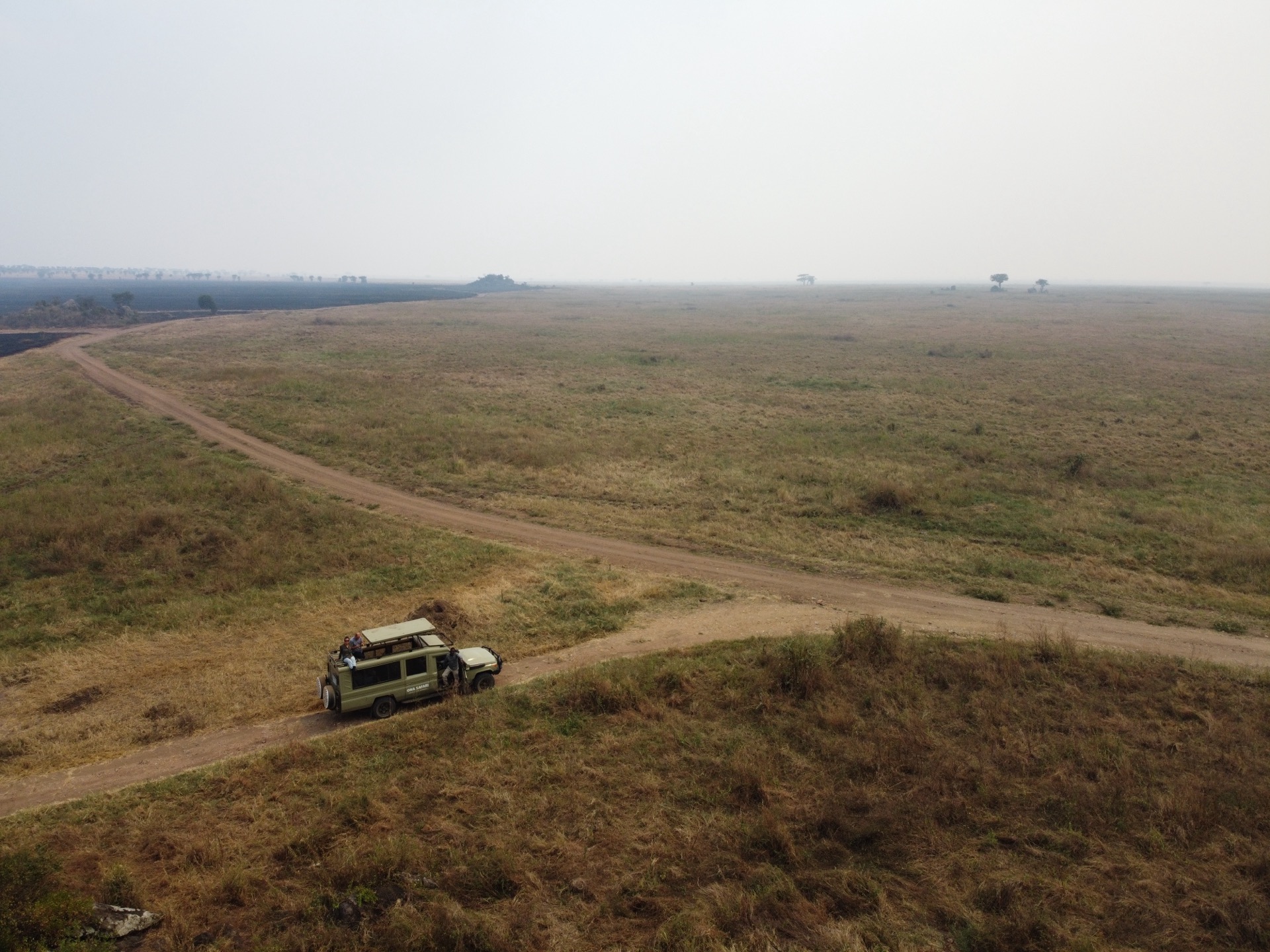
One Mikumi feature that makes the day trip better than it sounds: the A7 highway passes directly through the park, and wildlife is visible from the road. Lions, elephants, and giraffe have been observed on and adjacent to the highway. This means the drive into the park — which day trippers would otherwise write off as dead time — is itself a game drive.
The practical implication: slow down on the road section through the park. Speed limits inside the park apply; more importantly, this is the stretch where most road wildlife sightings happen. A vehicle doing 80km/h through the park is not driving through a safari — it is driving through a highway. A vehicle doing 30–40km/h with windows open is.
The downside of the highway intersection is well documented: many lions have been killed by vehicles on the road through Mikumi. This is the conservation cost of the park’s accessibility. It is worth knowing before you visit.
Day trip vs 2-night stay: the honest comparison
| Factor | Day trip | 2-night stay |
|---|---|---|
| Total game drive time | 4–5 hours | 8–12 hours (3 full drives) |
| Dawn drive access | No (in transit) | Yes |
| Dusk drive access | No (return transit) | Yes |
| Cost (guided, 2 adults) | ~USD 370 total | ~USD 900–1,200 total |
| Fatigue level | High (16-hour day) | Normal |
| Wildlife reliability | Good | Significantly better |
| Flexibility for re-visits to productive spots | None | High |
The day trip costs roughly 30–40% of a 2-night stay for 40% of the game drive time, most of which is in the middle-of-the-day dead zone for wildlife activity. The 2-night stay is better value in both wildlife and experience terms.
That said: if your only option is a day from Dar, the Mikumi day trip is a worthwhile use of that day. Travel platforms list 46 Mikumi day trip products from 29 tour operators — this is a real, established market, not a marginal option.
When the day trip makes most sense
The Mikumi day trip is the right choice when:
- You have one day in Dar en route to Zanzibar or elsewhere and want any wildlife
- You have already done Zanzibar or a beach section and want a taste of Tanzania’s wildlife before flying home
- You are travelling with others who are less interested in a full safari and want to see wildlife without building a dedicated safari trip
The 2-night stay is the right choice when:
- You have the flexibility and can add even one extra night
- You want to see lions, particularly in the morning
- You are combining Mikumi with Nyerere for a longer southern circuit (fly from Mikumi Airstrip to Nyerere after your Mikumi stay)
Getting to Mikumi independently
By road: The A7 highway is sealed tarmac from Dar to Mikumi. A rental vehicle from Dar works; 4WD is recommended for the lodge access tracks inside the park but not strictly necessary for the main circuit in the dry season. Vehicle rental in Dar runs approximately USD 80–120 per day.
By bus: Dar Express, Linjemoto, and similar long-distance services depart from Ubungo terminal in Dar and stop at Mikumi Town at the park boundary. Journey time: 4–5 hours. From Mikumi Town, vehicle-guide hire is available at the gate — approximately USD 60–80 per day plus the USD 20 gate guide fee. This is the budget option and works, but requires advance coordination to have a guide expecting you.
By domestic flight: Coastal Aviation flies DAR to Mikumi Airstrip in approximately 30–40 minutes. This eliminates road fatigue and gives you a full morning drive on arrival — converting the day trip into something close to a proper one-night visit. Cost: approximately USD 80–120 per person one-way.
When to go: Mikumi seasons and what they mean for a day trip
The dry season from June to October is the best window for a Mikumi day trip — and the right choice if you have any flexibility over your Dar stopover dates.
Why the dry season matters specifically for a short visit:
- Wildlife concentrates at water sources when vegetation dies back. On the Mkata Flood Plain, elephants, buffalo, and zebra cluster predictably around the hippo pools and the Mkata River — exactly the areas a day-trip circuit covers.
- Low vegetation gives unobstructed sight lines across the flood plain. In the wet season, tall grass screens a significant portion of what would otherwise be visible from the game-drive tracks.
- The A7 highway is sealed tarmac from Dar to the park boundary and is passable year-round, but shoulder access tracks and routes to some lodges inside the park can become waterlogged in heavy rain.
- Dar es Salaam’s traffic is more predictable in the dry season — wet season delays can add an hour or more to the drive each way, further compressing your already limited in-park time.
Dar es Salaam’s two rainy seasons:
The long rains run March–May, peaking in April. Dar receives approximately 655 mm of rainfall during this window — the most difficult stretch for any Mikumi day trip. Some park circuits are partially inaccessible, wildlife is dispersed across abundant water sources rather than concentrated at predictable spots, and Dar departures are slower. Day trips in April are genuinely difficult; most operators continue to run them but note reduced wildlife reliability.
The short rains run October–December: lighter and more intermittent. A Mikumi day trip in October or November is manageable, though not ideal. Dar’s driest months are June–September.
Peak dry season (July–October): Elephants form family groups of 20–50 individuals at water sources. The hippo pool populations are at their most visible. This is the window to prioritise if your dates are flexible.
Mikumi’s birds: what a day trip actually shows
Mikumi’s bird list exceeds 400 species across its full range of habitats — Mkata River wetlands, open flood plain, miombo woodland, and riverine forest. A day tripper covers the main circuit and the hippo pools, giving access to the two most productive zones for first-time visitors.
Reliable day-trip sightings:
- Grey crowned crane — regularly seen walking the grass margins and open ground near water on the Mkata Flood Plain
- Saddle-billed stork — one of Africa’s most visually striking wading birds, standing over a metre tall; hard to miss along the flood-plain margins
- Yellow-billed stork — common at the hippo pools throughout the year; present in numbers during the dry season
- African fish eagle — present around the Mkata River and hippo pool area; the call — two descending notes — is the sound of East African waterways and is often heard before the bird is spotted
- Martial eagle — Africa’s largest eagle, occasionally perched in flat-topped acacias along the main game-drive circuit
- Lilac-breasted roller — constant, vivid flash of turquoise and lilac on roadside trees and telegraph wires throughout the circuit; practically impossible to miss on any game drive
The hippo pools as a birding stop: The hippo pools approximately 5 km north of the main gate are a standard safari stop for large mammals but are equally productive for birds. Arrive before 11:00am for the best wading-bird activity at the water’s edge — by midday the light flattens and birds move into the shade.
Birding strategy on a day trip: Treat every section of the main circuit as a slow scan, not a transit. Open the windows, drop to 30–40 km/h, and watch the tree line. Most of the interesting bush species — bee-eaters, rollers, hornbills, weavers — appear in the first stretch of the circuit without requiring any detour.
Tim’s birding note: I went to Mikumi to see lions, not birds. But on a morning when the lion pride was asleep in shade and not moving, I watched a pair of saddle-billed storks work through the shallows of the hippo pools for twenty minutes at close range. The flood plain holds species I simply don’t see at the northern circuit parks — the combination of wetland, open grassland, and riverine forest produces a different bird list from anything in the Serengeti or Ngorongoro ecosystems.
Mikumi and the southern circuit: the bigger picture
Mikumi sits at the northern, most road-accessible edge of Tanzania’s southern safari circuit — the set of parks that includes Nyerere National Park (formerly the Selous Game Reserve), Ruaha, and the more remote Katavi in the far west.
The standard southern circuit:
- Nyerere and Ruaha for 3–4 nights each: 7 nights is the stated minimum for a meaningful southern circuit
- At 10 nights or more, Mikumi can be added as a third park — typically as a road approach from Dar before flying deeper south into Nyerere or Ruaha
Nyerere National Park in numbers:
- Approximately over three times the area of the Serengeti in total coverage
- An estimated 800–1,000 African wild dogs — described as Africa’s single largest remaining population of this endangered species
- Entry fee: USD 82.60 per adult per day (TANAPA 2024/25), the same tier as Serengeti
- Access: primarily by domestic flight from Dar — the park is described in the industry as a fly-in destination; driving is possible in the dry season but road conditions require a 4WD and longer journey time
Connecting Mikumi to Nyerere by air: A traveller doing a Mikumi overnight stay can fly from Mikumi Airstrip south to Nyerere’s Siwandu Airstrip on a Coastal Aviation scheduled hop. This connects two very different landscapes — Mikumi’s open flood plain versus Nyerere’s riverine forest and boat-safari waterways — in a compact itinerary that eliminates road time for the most important leg.
Cost context for the southern circuit: Mid-range and luxury camps in Tanzania’s southern parks run approximately 40–50% more expensive per day than comparable northern circuit camps. The reason is structural: fewer total visitors spread fixed operational costs across a smaller base. The trade-off is significantly less vehicle traffic at sightings and a markedly more remote, less-managed experience than the Serengeti.
Who the southern circuit suits: Travellers who have already done the Serengeti and Ngorongoro and want the opposite of that experience — fewer vehicles, wilder terrain, and wildlife encounters without the audience. Mikumi is the lowest-cost, most road-accessible entry point into this circuit, and a Mikumi day trip from Dar is often where travellers discover it for the first time.
Tim’s observation
The TANZAM highway through Mikumi is one of those travel moments that catches you off guard. You have been in Dar traffic for two hours, then Morogoro for a breakfast stop, and then suddenly the road enters the park and a giraffe is standing 15 metres from the tarmac, looking at your vehicle with the mild curiosity of an animal that has watched several thousand vehicles pass and found none of them interesting. It is not a carefully staged game-drive approach. It is a giraffe on a road in Tanzania, just standing there.
That moment — before you have even reached the gate — is worth something. It tells you that Mikumi is not a heavily managed or contained wildlife experience. The park boundary is permeable, the highway goes through, and the animals are not separated from the traffic by any meaningful barrier. Whether you are there for one day or three nights, the wildlife is the same wildlife.
For the full Mikumi experience — Mkata Flood Plain, Mkata River hippo pools, morning lion drives, accommodation options, and how to combine Mikumi with Nyerere — see the Mikumi National Park guide.
For how Mikumi fits into a Tanzania budget safari (and whether the southern circuit beats the northern circuit on cost), see the Tanzania budget safari guide.
Frequently asked questions
How far is Mikumi from Dar es Salaam?
Approximately 300 km by road, via the A7 highway (TANZAM Highway) through Chalinze and Morogoro. The drive takes 4–6 hours depending on traffic conditions in Dar — allow more time leaving Dar on weekday mornings. Departing by 5:00–5:30am puts you at the park gate close to opening at 6:00am.
What is the Mikumi day trip entry fee?
USD 35.40 per adult per day for non-East African nationals (TANAPA 2024/25), plus USD 10 per vehicle per day for foreign-registered vehicles. A guide service is available at the gate for USD 20 if you are arriving without a hired guide. Children aged 5–15 pay USD 10 per day. Entry fees are valid for 24 hours from first gate entry.
What can you see on a Mikumi day trip?
Common sightings on a day trip include elephants, lions, Masai giraffe, zebra, Cape buffalo, hippos in the Mkata River pools (north of the main gate, approximately 5 km from the entrance), spotted hyena, yellow baboons, and warthog. Lions in Mikumi are well habituated to vehicles and are sometimes seen on or near the highway itself. Leopard is possible but much less reliable on a short visit. Wildlife density is highest in the early morning and late afternoon — the hours a day tripper with road time each way has least access to.
Is a Mikumi day trip worth it?
Honest answer: barely, for most travellers. The road each way costs you the best 4–6 hours of wildlife watching time. You arrive mid-morning after the peak dawn activity window, do 3–4 hours of game drives, and leave by early afternoon to make it back to Dar before dark. You will see wildlife — this is reliably the case in Mikumi. But a 2-night stay gives you three full game drives (an evening drive on arrival day, a full morning drive, and a final morning drive) for roughly double the wildlife encounter time. If your only option is a day trip, do it. If you can stay, stay.
What does a guided Mikumi day trip from Dar es Salaam cost?
Guided day tours from Dar are listed on platforms like SafariBookings (46 day trips from 29 operators) and Viator, starting from approximately USD 370 per group for a private tour. These typically include door-to-door pickup from your Dar hotel, driver-guide transport, park entrance fees for a small group, morning and afternoon game drives, and lunch. Per-person cost falls with more people in the vehicle; solo or pair bookings are higher per person.
Can you do the Mikumi day trip by public bus?
Yes — buses on the Dar–Morogoro–Iringa route (Dar Express, Linjemoto) stop at Mikumi Town at the park boundary. Journey from Dar: approximately 4–5 hours. From Mikumi Town, guide-drivers with vehicles are available at the gate for approximately USD 60–80 per day, plus the park guide fee of USD 20. This is the cheapest way to do it — USD 15–20 for the bus, USD 60–80 for the vehicle and local guide, plus the park entry fee. It requires more advance organisation and comfort with variable logistics.
What time should you leave Dar es Salaam for a Mikumi day trip?
Depart by 5:00–5:30am to reach the park gate close to 6:00am opening. This gives you 2–3 hours for a morning game drive before the midday heat reduces wildlife activity. With a guided tour departing at this time, you typically do a morning drive (6:00am–9:30am), stop at a lodge for breakfast, then a second shorter drive before lunch, and start the return journey by 2:00–3:00pm. Some itineraries note a breakfast stop in Morogoro at approximately 7:37am, suggesting departure from Dar around 5:30am.
What is the best time of year for a Mikumi day trip?
The best window is the dry season, June to October — Tanzania's main safari season. Wildlife concentrates at water sources on the Mkata Flood Plain, vegetation is low for clear sight lines, and Dar es Salaam's roads are at their most predictable. Avoid the long rains of March–May, when rainfall in Dar peaks and some park tracks can become waterlogged. Dar's driest months are June–September. October and November (short rains) are workable but less reliable than peak dry season. Elephants form groups of 20–50 at water sources during July–October — the strongest window for reliable large-mammal sightings on a short visit.