
Facts & prices checked: 2026-06-25
Tanzania’s dry season is the period most people picture when they imagine an African safari: open vehicles crossing short golden grass, lions on kopjes, vast concentrations of wildebeest and zebra funnelling toward permanent water, the Mara River churning brown. From late June through October, Tanzania delivers all of this, and on the best days it is genuinely overwhelming.
This guide goes beyond the headline. Why does the dry season actually produce better game viewing — what is the mechanism? What changes month by month between June and October? Which parks reward the dry season visit most, and why is Tarangire in September one of Africa’s most underrated experiences? And what does a Mara River crossing actually involve — the hours, the waiting, the chaos?
Why dry season is the classic safari period
The dry season matters for three reasons that compound each other: water, vegetation, and road conditions.
Water is the primary driver. During the wet season, Tanzania’s plains have surface water everywhere — temporary pans, flooded depressions, dew-laden grass, and seasonal streams. Herbivores can range freely without returning to permanent sources. When the dry season progresses and surface water disappears, animals must converge on the rivers, springs, and permanent waterholes that remain. The concentration this creates is what safari guides mean when they say dry season is better: you are not necessarily seeing more animals in total, but you are seeing them bunched up in predictable locations rather than dispersed across hundreds of square kilometres.
Vegetation follows. The Serengeti’s grasses that reach waist height in the green season are cropped down to ankle height by October. Thornbush loses much of its leaf cover. This is bad news for animals trying to hide, and good news for the person on a game drive: a lion in long grass is a lion you may miss; a lion in a short-grass clearing is a lion you can actually watch for forty minutes.
Road conditions complete the picture. Many of Tanzania’s most productive park areas sit on black-cotton clay soil — the kind that becomes genuinely impassable in wet weather, where a loaded 4WD vehicle can slide off a track and take hours to recover. The dry season eliminates this risk almost entirely on the northern circuit, and substantially reduces it in the south. The descent road into Ngorongoro Crater stays open year-round but is more reliable and faster in dry conditions.
The weather itself is also simply comfortable: warm to hot days (typically 25–32°C on the plains), cool nights (can drop to 10°C in the Serengeti at 1,500 metres elevation in July), and clear skies that make dawn game drives both beautiful and productive.
The water source mechanics — why animals concentrate
To understand the dry season advantage properly, it helps to think about what animals need each day. A large herbivore — an elephant, a buffalo, a wildebeest — needs to drink every one to two days. In the wet season, this is easy: water is everywhere. In the dry season, it becomes a defining constraint.
As the dry season progresses, the hierarchy of water sources becomes visible. Temporary pans go first, usually by July. Then seasonal streams dry from their upper reaches down. By August on the Serengeti’s central plains, the only remaining water is the rivers: the Mara in the north, the Grumeti and Mbalageti in the west, and a handful of spring-fed waterholes. Every elephant, zebra, buffalo, and wildebeest within range of those rivers needs to visit them regularly. They have no alternative.
This concentration is what creates the spectacle. At a Tarangire River waterhole in September, you might wait twenty minutes and watch a family group of forty elephants arrive, drink, mud-bathe, and depart — followed immediately by a herd of four hundred zebra. Repeat this for six hours of game driving, and you understand why guides consider September-October in Tarangire one of the finest wildlife experiences in Africa.
For predators, the concentration of prey makes hunting both more productive and more predictable. Dry-season lions know where the herds will be. The herds know it too, and the tension around waterholes — prey animals arriving in nervous groups, predators resting close enough to smell — is one of the defining experiences of a dry-season safari.
Reduced vegetation adds another dimension: the predators that spend the green season hidden in long grass become visible. Cheetahs can be watched over long distances as they hunt on open plains. Leopards in riverine trees are unmissable. A pride of lions on a kopje stands out against the short grass as they would never do in April.
The Great Migration dry season story
The Great Migration is the annual movement of approximately 1,366,109 wildebeest (based on the 2023 TAWIRI aerial census) plus hundreds of thousands of zebra and other species in a continuous 800-kilometre loop through the Serengeti-Mara ecosystem. There is no start or finish — it is always happening somewhere. But the dry season contains the most dramatic single phase.
Western corridor crossings (May–June): The herd enters the western Serengeti from the short-grass southern plains from around May. The first major obstacle is the Grumeti River, which flows westward through the western corridor into Speke Gulf. These crossings are less famous than the northern Mara crossings, but they have something the north lacks: enormous Nile crocodiles that have grown exceptionally large on limited competition. The western corridor is also significantly less crowded than the northern Serengeti in July-August, making for more intimate sightings.
Northern Serengeti crossings (July–October): The most famous phase. By July, the main herd has moved through the western corridor and converges on the northern Serengeti along the Mara River at Lamai, Wogakuria, and Kogatende. The Mara River crossings here are unpredictable day-to-day — the herd can wait days at the bank before a lead wildebeest triggers the surge — but August is the most reliable month for crossing frequency. Crossings typically peak late July to early September.
The dynamic of a Mara River crossing is worth understanding in advance. The herd accumulates at the bank — sometimes hundreds, sometimes thousands of animals. A period of hesitation follows, sometimes lasting hours, as they scent the water and assess the crocodile risk. Then a crossing begins: a rush of animals into the water, crocodiles moving downstream to intercept, calves swept sideways, exhausted wildebeest hauling out on the far bank. The whole active crossing phase might last five to twenty minutes. Then quiet, and some wildebeest still on the wrong side, who may or may not cross that day.
Book a crossing-view camp — those positioned within a short drive of the Wogakuria or Lamai crossing points — and plan at least 3–4 nights to have a realistic chance of witnessing one.
Sub-seasonal nuances — not all dry months are equal
June (early dry): June is a transitional month that is often underrated. The long rains typically end by late May on the northern circuit, but June can still be green in the south and at higher elevations. On the Serengeti, herds are moving north through the western corridor. Road conditions are rapidly improving. Crowds are notably lighter than July-August, and accommodation rates sit 10–25 percent below the July-August peak. For the southern and central circuit — Ruaha, Nyerere, Katavi — June is the opening of excellent game viewing with very few other vehicles. For those not chasing northern Mara crossings, June can be the best overall month of the dry season.
July–August (peak dry): The busiest and most expensive period. Mara River crossings in the northern Serengeti are at their most frequent, with August the standout month. Wildlife concentration is at its maximum. Dust is heavy in some parks — the Serengeti’s central plains by August look parched and ochre, and vehicle tracks raise significant dust clouds. Accommodation rates peak, and crossing-view camps in the northern Serengeti need bookings 6–12 months in advance. For many visitors this is unavoidable: school holiday schedules and the desire to see crossings drive July-August demand. Go in knowing what to expect — it is worth it.
September (late dry, underrated): One of the best months overall. The herd in the northern Serengeti begins moving south again in September, and crossing frequency declines, but crossings are still possible through mid-September. Crowds start to thin as European summer holidays end. Tarangire enters its peak period: elephant concentrations at the Tarangire River are extraordinary as the ecosystem’s herds converge. The southern circuit (Ruaha, Nyerere) is at its wildlife peak and largely crowd-free. In private conservancies where night drives are permitted, September produces exceptional predator encounters. Many properties begin reducing rates in September while maintaining full game quality.
October (end of dry, value month): The dry season’s value window. Short rains can begin any time from mid-October, and when the first rains fall, animals begin dispersing and some road conditions deteriorate rapidly. This unpredictability is October’s main drawback — you may get a perfect dry-season experience, or you may arrive to find early rains have transformed the landscape. Katavi’s hippo concentrations peak in October as the Katuma River pools shrink to their smallest; this is one of the most extraordinary wildlife spectacles in Africa if conditions hold. Rates drop as low season approaches.
Which parks reward dry season most
Northern Serengeti (Lamai, Wogakuria, Kogatende area): Worth visiting specifically for the July–October Mara River crossings. Outside that window, the northern Serengeti is remote and relatively quiet. The nearest major airstrips are Kogatende and Lamai — most visitors fly in from Arusha or connect via a Serengeti hub strip.
Ngorongoro Crater: Good year-round, with the high crater rim keeping the floor cooler and less vegetation-dependent than open plains parks. Vehicle access via the descent road is more reliable in dry conditions. The crater’s permanent water — the hippo pool and Lake Magadi’s flamingo flocks — means resident wildlife is always present. Ngorongoro in July-August gives you both crater game viewing and a base for northern Serengeti crossings.
Tarangire: Exceptional from July through October, with September the outstanding month. During the dry season, elephants and other ungulates concentrate around the Tarangire River as all other surface water disappears from the surrounding ecosystem — the park’s official fact is that from July onwards, dispersed herds return to the river corridor in increasing numbers through October. The elephant concentrations at major waterholes in September-October are genuinely extraordinary, with family groups numbering in the hundreds arriving through the day. Tarangire in September is one of Africa’s most underrated wildlife experiences and significantly less crowded than the northern Serengeti circuit.
Ruaha and Nyerere (southern circuit): The southern circuit genuinely peaks in the dry season. The Rufiji River at Nyerere and the Great Ruaha River at Ruaha become wildlife magnets as all other water disappears. Lion prides are concentrated and predictable; elephant, hippo, and buffalo gather at the same crossing points daily. The major advantage of the southern circuit is crowd density: even at peak dry season, Ruaha has a fraction of the vehicle numbers you will encounter at popular Serengeti sightings. For the visitor who wants quality wildlife in relative solitude, the southern circuit in July-September is the answer.
Katavi: Remote and exceptional. The park’s Katuma River pools shrink through the dry season, concentrating hippos to extraordinary densities by August–October. Crocodiles follow. Katavi also has outstanding lion and buffalo populations, and dry season road access is the only realistic way to reach much of the park. The trade-off is logistics: Katavi requires light aircraft access from Arusha or Dar es Salaam, and most camps have minimum stays of 3 nights. It is a niche choice, but for those who make the effort, October at Katavi’s hippo pools is unlike anything else in Tanzania.
Dust — the honest story
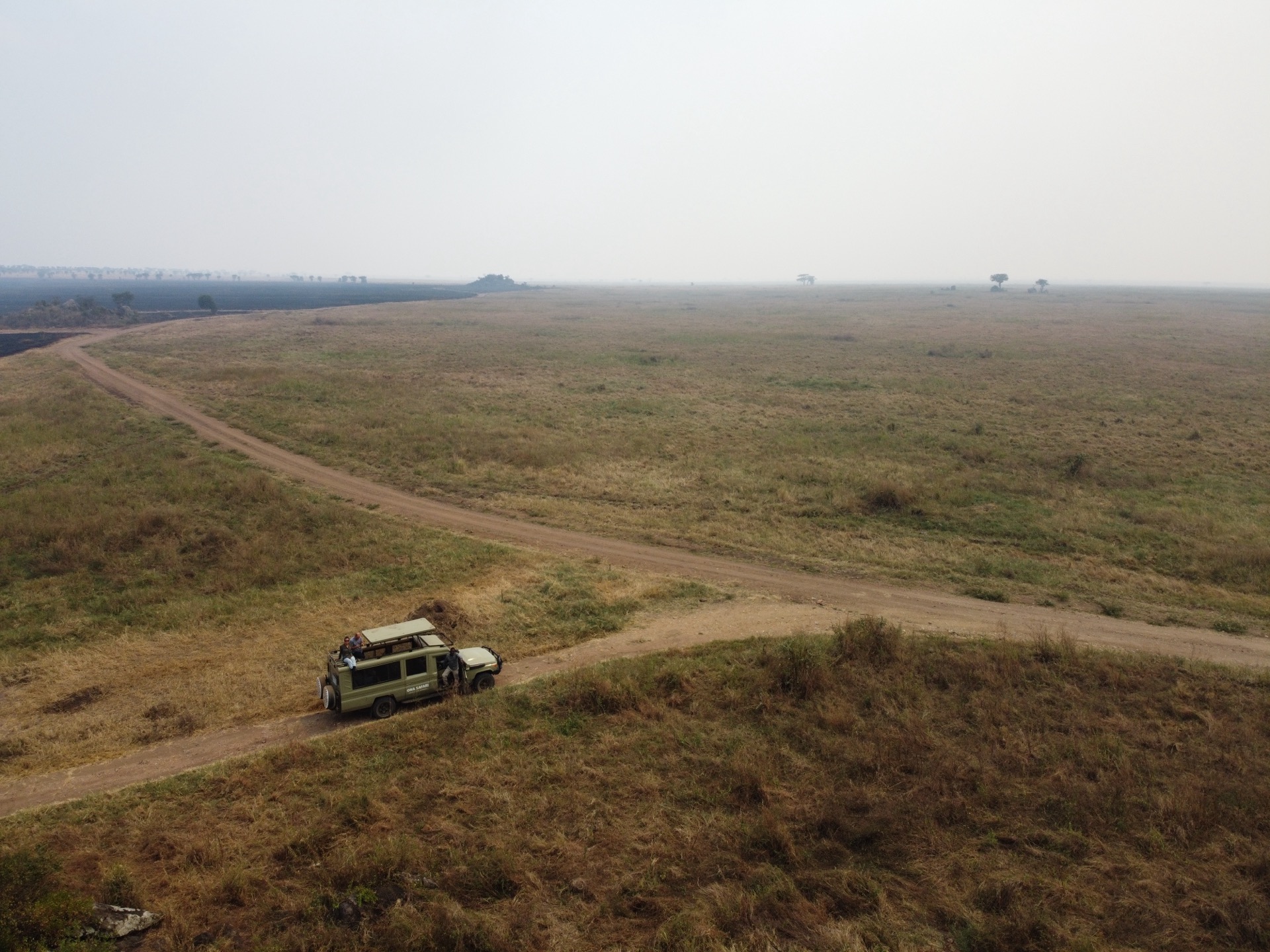
Dry season dust is real and deserves honesty. By August, the Serengeti’s central plains look like a different landscape from the green January version: ochre, parched, with a thin haze on the horizon from dust kicked up by passing vehicles and wind. This is not just an aesthetic note — it has practical implications.
For photographers, dust is challenging in specific ways. Airborne particles settle on sensor elements and lens surfaces. Backlit dust in afternoon light creates hazy images with reduced contrast. Open vehicle windows — the default for shooting wildlife — admit dust continuously during drives. By the end of a full day, cameras and bags are covered.
Practical dust management: use a microfibre cloth and keep it accessible. A UV filter on each lens reduces the need to expose glass directly to dust. A dry bag or pelican case for camera storage between shooting opportunities significantly reduces cumulative exposure. Clean sensors when you reach camp, not in the field.
The same dust also creates extraordinary light. The dry season at dawn — first light hitting the dust suspended in the air above the plains — produces the amber warmth that defines East African wildlife photography aesthetics. Silhouette shots of elephants at dusk, with dust backlit by a setting sun, have a quality that the clean clear air of the green season simply cannot replicate. The Serengeti in August at golden hour is some of the most photogenic light in Africa.
Dust distribution varies by park. The Serengeti central plains and the roads into Tarangire are the dustiest. The northern Serengeti’s riverine vegetation provides more shelter. Ruaha’s Great Ruaha River corridor has dense riparian forest that reduces dust on river-focused drives. Choose your shooting positions accordingly.
Prices, crowds, and booking reality
Dry season accommodation rates are typically 30–50 percent higher than green season rates at comparable properties. Mid-range camps on the northern circuit run approximately USD 400–700 per person per night in peak July–August. High-end lodges near the Mara River crossing points reach USD 1,500–3,000 per person per night during crossing season. Park entrance fees are seasonal too: Serengeti charges USD 82.60 per adult per day in peak season and USD 70.80 in the short low season, while Tarangire runs a flat USD 59 year-round.
For crossing-view camps in the northern Serengeti — those positioned close enough to a Mara River crossing point to reach one within 30 minutes — July and August availability books out 6–12 months ahead, regardless of budget tier. If a Mara River crossing is the central goal of your safari, book that camp before flights, before other parks, before anything else.
June and September are the dry-season sweet spots for value and atmosphere. Wildlife quality is comparable to the July-August peak — the water concentration mechanism is the same, predator visibility is the same — but vehicle counts at popular sightings are noticeably lower and rates sit 10–25 percent below peak. Many experienced safari operators recommend September ahead of August specifically because of this.
October offers the best pricing of the dry season, with rates beginning to approach green season levels at many properties. The risk is the early rains — unpredictable in timing and potentially transforming road conditions quickly. If October suits your schedule and you have some flexibility in your expectations, it is excellent value.
For comparison: the cheapest period to safari in Tanzania is April–May (long rains), when rates can be 40–50 percent below dry season peak. The tradeoff is road access in some parks, thicker vegetation, and some camp closures. The Tanzania green season safari guide covers those trade-offs honestly.
Waiting at Wogakuria: the honest crossing account
I waited five hours at the Wogakuria crossing point in August. We arrived in three vehicles at 7am; by midday there were eleven vehicles, three deep on the bank. The herd had gathered on the far side — a brown mass of movement, audible as a low murmur before you could clearly see individual animals.
There is something peculiar about the waiting. You drink coffee from a flask and watch the crocodiles positioning themselves downstream. The wildebeest accumulate, then thin, then accumulate again. A lead animal approaches the bank, sniffs the water, retreats. Everyone in the vehicles shifts forward. Nothing happens. Twenty minutes later, the same thing.
The crossing, when it came, lasted perhaps eight minutes. A lead animal entered, hesitated mid-current, and then everything behind it came at once — a wall of animals, the water turning pale brown, crocodiles rolling, calves spinning sideways in the current, animals hauling out on the near bank with their legs still shaking. The sound was astonishing: hooves on rock, water, and the yelling from vehicles that nobody could quite stop.
Then it was over. A few wildebeest stood on the far bank looking at the water, still deciding. Some crossed an hour later; some turned back. Nobody said safari means dignified, but that eight minutes was what we had come for, and it was genuinely unlike anything else.
For the full seasonal calendar including the green season and month-by-month breakdown, see the Tanzania when to go guide. For the opposite end of the spectrum — what Tanzania offers outside peak season — read the Tanzania green season safari guide. For the specific Serengeti migration circuit, see the Great Migration guide. For Tarangire planning, the Tarangire National Park guide covers the park in detail. And for cost breakdowns across all safari tiers, see what each tier actually costs.
Frequently asked questions
When is the dry season in Tanzania?
Tanzania's main dry season runs from late June to October, with the driest and most reliable period from July to September. The long rains (masika) typically end by late May, transitioning to dry conditions through June. The short rains (vuli) usually begin in November, ending the dry season. Year-to-year variation is real — June can still be green in parts of the country, and October may see the first rains arrive early. The northern circuit (Serengeti, Ngorongoro, Tarangire) and the southern circuit (Ruaha, Nyerere, Katavi) share the same broad dry season pattern, with the southern circuit offering outstanding game viewing throughout all five months.
When do the Great Migration river crossings happen?
The Mara River crossings in the northern Serengeti typically run from July to October, with August the most reliable month for crossing frequency. July marks the usual start of the northern crossing phase as the herd converges on the Lamai, Wogakuria, and Kogatende areas. September and into October see declining numbers as the herd begins moving south. Before the northern crossings, the herd crosses the Grumeti River in the western corridor from May to June — these crossings are less famous but often spectacular and less crowded. No single crossing day is guaranteed; the 2023 TAWIRI aerial census counted approximately 1,366,109 wildebeest in the Serengeti-Mara ecosystem, and this herd can cross at any time of day depending on conditions. Building in 3–4 nights at a northern Serengeti camp gives the best odds.
Which Tanzanian parks are best in dry season?
Different parks peak at different points. Northern Serengeti (Lamai, Wogakuria area) is specifically for July–October migration crossings. Tarangire is exceptional from July onwards, peaking in September–October when elephant herds and other ungulates concentrate at the Tarangire River as all other surface water disappears. Ruaha and Nyerere (southern circuit) are outstanding throughout the dry season with large predator concentrations at rivers and far fewer visitors than the northern parks. Katavi peaks in August–October with extraordinary hippo concentrations in the shrinking Katuma River pools — a remote experience. Ngorongoro Crater is reliable year-round.
Is July or August the best month for a Tanzania safari?
Both are peak months with outstanding wildlife and active Mara River crossings, but August is widely cited as the best single month for crossing frequency in the northern Serengeti. July is excellent and crossings do occur — the herd typically converges on the Lamai region along the Mara River by July — but August sees the highest frequency. The trade-off: August is the busiest and dustiest month, with the most vehicles at popular sightings. June and September often deliver comparable wildlife quality with noticeably fewer vehicles and better pricing — many experienced safari guides consider these the real sweet spots of the dry season.
How much more expensive is dry season vs green season in Tanzania?
Dry season accommodation costs are typically 30–50 percent higher than green season rates at the same properties, with the steepest premiums in July–August at northern Serengeti crossing camps. Mid-range camps on the northern circuit run approximately USD 400–700 per person per night in peak season; high-end lodges near Mara River crossing points can reach USD 1,500–3,000 per person per night. National park fees don't change seasonally — Serengeti entry is USD 82.60 per adult per day, Tarangire USD 59. For most travellers, June and September represent the best dry-season value: wildlife is excellent, prices sit 10–25 percent below peak July–August, and popular viewpoints are noticeably less crowded.
What should I know about dry season dust in Tanzania?
By July–August, the Serengeti central plains and many other open areas have significant dust — ochre-coloured, kicked up by vehicle tracks and wind, visible in the air at both dawn and dusk. For photographers, dust means risk of particles entering camera bodies (use dust bags and clean gear regularly), backlit haze in midday images, and logistical challenges in open vehicles. On the positive side, dry season dust creates extraordinary photographic light: the golden hour at dawn and dusk has a warmth and atmosphere that defines East African wildlife photography aesthetics. Practical preparation: UV filter on every lens, a microfibre cloth accessible while shooting, a dry bag for gear storage between drives. Dust is at its worst in the central Serengeti and on unpaved tracks in Ruaha — the northern Serengeti's river corridors and Tarangire's riverine forests are more sheltered.