
Facts & prices checked: 2026-06-25
Tarangire National Park sits about 2 hours southwest of Arusha along the Arusha-Dodoma highway, covers around 2,850 square kilometres, and is consistently the park on the northern circuit that visitors feel they understood least before arriving. Not because it is obscure — most itineraries include it — but because the reasons to go are different from the reasons people give for going. The baobabs are not scenery. The elephant density is not hyperbole. And the low vehicle count is not an absence of something: it is the experience.
The elephant density
Tarangire holds the largest elephant population in northern Tanzania. The Tarangire-Manyara ecosystem — which spans roughly 20,000 km² including corridors, wildlife management areas, and community land — also hosts the second-largest population of migratory ungulates in East Africa.
In the dry season, from June through October, the Tarangire River is the only permanent water source in the area. As the surrounding plains desiccate, elephants move in from across the ecosystem, concentrating at the river in numbers that are difficult to prepare for. By late August and September, herds of more than 200 animals gather at single watering points. Individual breeding herds of 50 to 100 animals are standard throughout the dry-season months.
This is not the Serengeti’s elephant experience, where you encounter small groups spread across large distances. In Tarangire at peak dry season, elephants are part of the landscape in the way that wildebeest are part of the Serengeti’s landscape: you are never not near them.
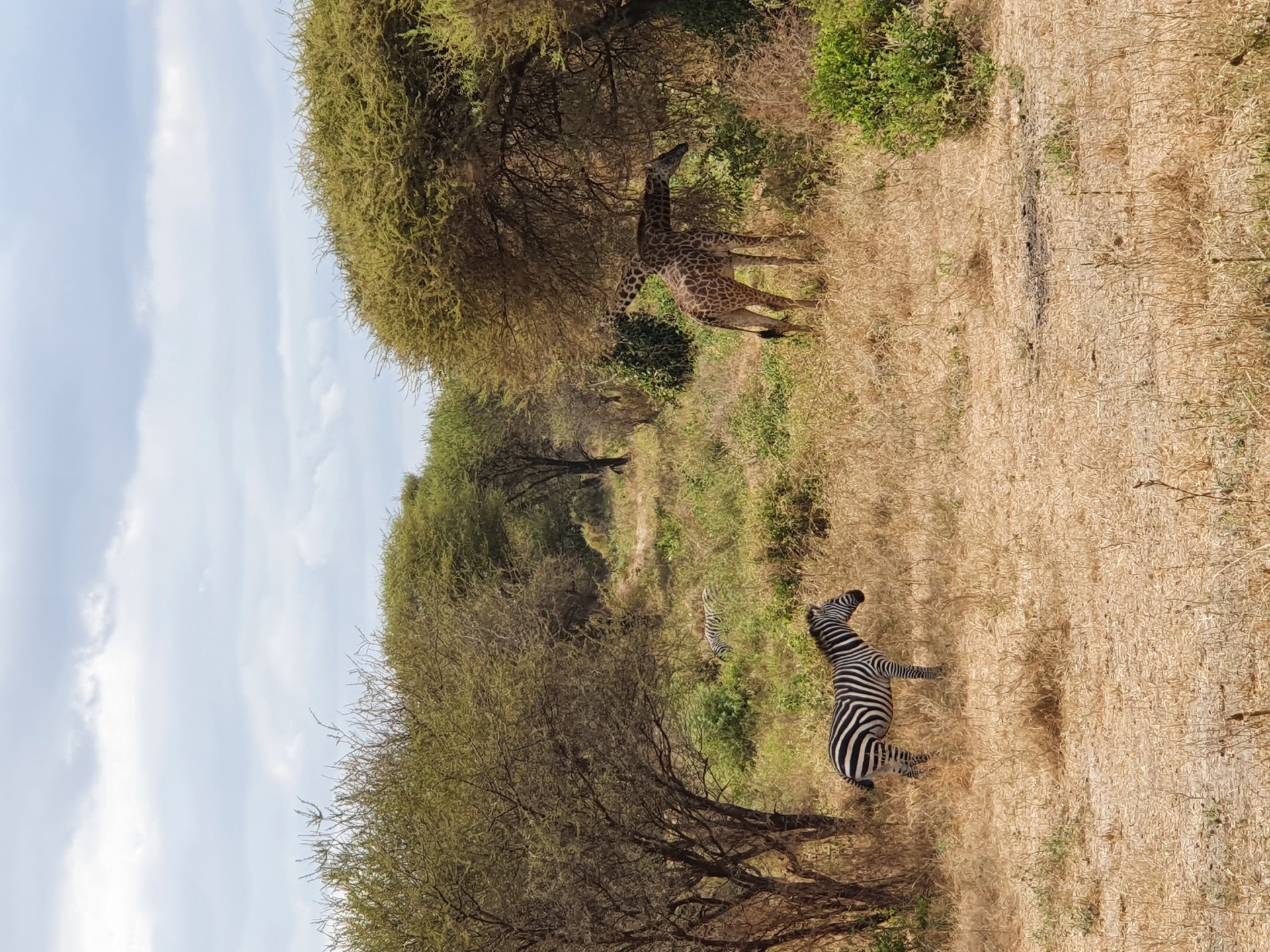
The Tarangire River also draws buffalo, zebra, wildebeest, impala, eland, and giraffe to its banks — the Wild Nature Institute monitors more than 3,500 individual Maasai giraffes in the ecosystem, making this one of the best places in Tanzania for giraffe viewing specifically. The concentration effect means that a morning drive along the river in August is, game-density-wise, one of the most productive drives on the entire northern circuit.
What the baobabs actually are
The baobab (Adansonia digitata) dominates Tarangire’s landscape in a way that has no equivalent in the other major northern circuit parks. These are not occasional photogenic trees. They are the park’s defining visual: hundreds of enormous, swollen-trunked specimens across the river valleys and open ground.
The largest baobabs in Tarangire have trunk diameters of up to 10 metres — trunks wide enough to look architectural rather than botanical. Specimens of this size are typically hundreds or thousands of years old; African baobabs can live 2,500 years. A baobab with a 10-metre trunk has been growing since well before European contact with East Africa.
Tarangire is sometimes called the Baobab Capital of the World, and while that is a marketing phrase, it captures something accurate: the density of mature specimens here is unusual even by East African standards. The hollows in mature baobabs serve as nesting sites for dwarf and pygmy falcons, African scops owls, and various hornbill species. Fruit bats are the primary pollinators — the flowers open at night. Elephants strip the bark for moisture during the dry season, leaving characteristic white scars at shoulder height.
The specific combination — enormous mammals beside enormous trees — produces a sense of scale that the open Serengeti grasslands, however spectacular, do not offer.
The vehicle density (lower than you expect)
Tarangire lacks the headlines that pull the largest tour groups: no Great Migration, no Ngorongoro Crater, no guarantee of black rhino. Most multi-day itineraries allocate it one or two nights before moving on to Ngorongoro and the Serengeti, which means the park runs at significantly lower vehicle density than either of those destinations.
In practice, this changes the experience materially. In the Serengeti or at the Ngorongoro Crater floor during peak season, a good predator sighting quickly becomes a cluster of 15 to 30 vehicles. In Tarangire, the same sighting might attract 4 or 5. For the elephant viewing that is the park’s primary draw, it is not unusual to spend 40 minutes with a single breeding herd without another vehicle arriving.
Night game drives — run by camps on private concession land bordering Tarangire and Lake Manyara, since TANAPA prohibits them inside every national park, the Serengeti and Ngorongoro Crater included — add a dimension unavailable in the better-known parks. These concession-land night drives focus on the river areas where elephants move after dark, alongside aardvark, mongoose, and various owl species. Reception is mixed (some reviews call it “good but hit or miss”), but the nocturnal access is structurally different from what Serengeti or Ngorongoro offers.
Walking safaris are also permitted on the Tembo Njia trail — a 6 km route starting at Maweninga Camp, conducted with an armed ranger.
The park fee comparison
Tarangire’s non-resident adult entry fee is USD 59.00 per person per day. For context:
| Park | Non-resident adult fee per day |
|---|---|
| Serengeti | USD 82.60 |
| Ngorongoro | USD 70.80 |
| Tarangire | USD 59.00 |
| Lake Manyara | ~USD 55–70 |
Tarangire is the cheapest major northern circuit park. On a two-night stay, the saving versus the Serengeti is approximately USD 47.20 per person. This does not make Tarangire a budget destination — a mid-range northern circuit safari still runs USD 2,450–4,200 per person for 7 nights — but it means Tarangire offers the best value ratio of fee paid to game density on the circuit, particularly for elephants and birdlife.
Species Tarangire has that the others don’t
Fringe-eared oryx (Oryx beisa callotis): This long-horned antelope with distinctive ear fringes is reliably seen in Tarangire and rarely elsewhere on the northern circuit. It favours the semi-arid open areas of the park that the other major parks lack.
Greater kudu (Tragelaphus strepsiceros): The woodland edges of Tarangire support kudu at higher density than Serengeti or Ngorongoro. The male’s spiral horns are among the most dramatic of any antelope in Tanzania.
African wild dogs (Lycaon pictus): Tarangire is one of the more realistic options on the northern circuit for wild dog sightings, though encounters are never guaranteed. The Tarangire-Manyara ecosystem supports a resident pack population, and wild dogs are more commonly reported here than in the central Serengeti.
Birds — 550+ species: Tarangire records over 550 bird species, making it among Tanzania’s premier birding destinations. The Silale Swamp in the south of the park is exceptional for waterbirds. The park sits on the East African Rift flyway, giving it high migratory diversity from November through April, when European and Palearctic migrants arrive. Night drives extend the species count into owls and nightjars.
The Northern Circuit parks each have a primary identity: Serengeti = migration, Ngorongoro = density-in-a-bowl, Tarangire = elephants and the baobab landscape. The secondary species lists reinforce rather than replace these primary identities.
Tarangire vs. Serengeti: What each park actually delivers
The comparison most visitors want is straightforward, and the answer is that the parks answer different questions.
The Serengeti covers 14,763 km² of open short-grass plains and woodland. Its primary draw is the Great Migration — roughly 1.3 million wildebeest moving in an annual clockwise loop — and big-cat density in the Seronera Valley. Vehicle counts at kills and migration river-crossings in peak months (July–October) can exceed 30 vehicles at a single sighting. The Serengeti is the more demanding park: larger, requiring more driving time to reach the relevant zones, and more variable in its daily experience.
Tarangire (2,850 km²) is smaller, more concentrated on the river valley, and has its superlative — elephant density — reliably on offer for 5 months of the year. What it cannot match: the sheer spectacle of a wildebeest river crossing, the black rhino guarantee of Ngorongoro, or the open plains that produce the Serengeti’s signature light-across-grass photographs.
The honest conclusion is that the parks are not substitutes for each other. Tarangire wins on accessibility (closer to Arusha, lower fee, lower vehicle counts), elephant density, and the baobab landscape. Serengeti wins on migration spectacle, big-cat variety, and sheer scale. First-time visitors who can only choose one: Tarangire delivers more reliably concentrated game on a 2-day visit. Visitors with 7–10 days: do both, Tarangire first. For the fuller three-way breakdown that also weighs Ngorongoro’s crater floor and rhino chances, see the three-way Northern Circuit park comparison.
What Tarangire looks like in each season
Dry season (June–October): The river is the only water. Elephants concentrate in herds of 50–200 animals from July onward; by late August and September, the gathering at the river is at its most intense. Bush is thin — good visibility. Birdlife numbers fall as migratory species have left. Road conditions are dusty but passable. This is the peak tourist season and the best time for first-time visitors.
Short rains (November–December): The first rains arrive, typically in November. Elephants begin dispersing outside the park boundaries as water becomes available elsewhere. Vegetation greens rapidly. Migratory birds begin arriving from Europe and Central Asia. Game is more dispersed but still present. Fewer tourists than dry season, with some lodges offering lower rates.
Long rains (March–May): Heavy rainfall, often including impassable roads in some zones. Most operators offer significant discounts. The baobabs are in full green leaf — very different visually from the dry season’s bare silhouettes. Birding reaches its annual peak with European summer migrants present. Game is at its lowest density within the park as animals disperse widely.
Green season / short dry (January–February): A short dry period between the two rain seasons. Some game concentration returns to the river. Baby animals are common — impala calves, elephant calves. Birding remains strong. This is a genuinely underrated time to visit: lower prices, good game, and the park feels quieter than peak season.
Birdwatching in Tarangire: what 550 species means in practice
Tarangire’s bird count of over 550 species is not an abstract number. It reflects the park’s unusual combination of habitats: the Tarangire River corridor with its riparian woodland, the open acacia-commiphora scrub, the swamps of the Silale area in the south, and the baobab zones that attract hornbills, raptors, and cavity-nesting species.
Standout species and where to find them:
- Silale Swamp (south of the park): This is the destination for serious birders. Yellow-collared lovebird, Martial eagle, Saddle-billed stork, African openbill, and various herons are reliably present. Access requires a full-day drive from the north or an overnight at a southern camp
- Raptor concentration: The open acacia scrub supports Bateleur, Lappet-faced vulture, Martial eagle, and Brown snake eagle among others. Perches at the tops of dead trees along the river road are worth checking in the early morning
- Hornbills on baobabs: Von der Decken’s hornbill and Red-billed hornbill use baobab hollows as nest sites. Look along the main river road from July onward when breeding activity peaks
- Night drives (concession land only): Add Verreaux’s eagle-owl, Spotted eagle-owl, and various nightjars to your list — none of which are accessible on daytime drives in the national park
I have birded Tarangire after Ngorongoro and found the contrast striking: where Ngorongoro’s crater bowl concentrates everything into a small arena, Tarangire rewards patience along specific habitat edges. The Silale route is a full-day commitment but consistently delivers species that appear nowhere else on the standard northern circuit.
Circuit options: day trip, overnight, or two nights
Day trip from Arusha: The park is approximately 118–140 km from Arusha, about 2 hours by road. A day trip is logistically possible but leaves roughly 6–7 hours inside the park, allowing one afternoon drive and no morning drive. The morning game drive (06:00–09:30) is the single most productive window — skipping it means missing the best elephant and predator activity. A day trip is a last resort, not a recommendation.
One night (recommended minimum): Arrive at the park in the early afternoon, do an afternoon drive (15:00–18:30), overnight at a camp or lodge near the river corridor, then a full morning drive (06:00–10:00) before departing. This covers the river circuit, the main baobab zones, and gives you the two best light windows. The Serengeti, Ngorongoro, and Lake Manyara remain on your itinerary.
Two nights (for birders and serious wildlife photographers): Allows access to the quieter southern sections including the Silale Swamp area, where fringe-eared oryx, greater kudu, and waterbirds are more common. The southern circuits also have lower vehicle density than the main river road. A two-night Tarangire opening combined with one night at Lake Manyara makes a strong 3-day introduction before continuing to Ngorongoro and the Serengeti.
Best position on a northern circuit: Days 1–2. This means starting Tarangire the afternoon you arrive from Kilimanjaro Airport (JRO) — a 45-minute transfer to the gate — and doing a full morning drive before transferring north to Ngorongoro or Lake Manyara. See the Northern Circuit sequencing guide for full sequence options.
Tarangire for first-time safari visitors
I have driven through Tarangire after Ngorongoro and before Arusha on a 7-day circuit, which puts it at the end of the trip when energy is lower. That is the wrong order. The better placement is first: Tarangire on days 1–2, then Ngorongoro, then the Serengeti as the finale. This sequencing builds from accessible (2 hours from Arusha, lower vehicle counts, slightly more forgiving sighting conditions) to the main event.
For a genuine first-time visitor, the argument for Tarangire as the best park on the circuit is this: the Serengeti can overwhelm. The scale is extraordinary, but so is the driving time, the vehicle density at a kill, and the logistical complexity of getting to the migration’s current position. Tarangire is comprehensible at first encounter. The game is concentrated on the river. The landscape is distinctive and readable. You learn to see a safari in Tarangire; you practice seeing the Serengeti.
I stopped near a single large female elephant in Tarangire that was stripping bark from a baobab at roughly 5 metres from the vehicle — bark being rich in moisture during the dry season. The elephant did not look up once. Behind her was a baobab trunk so wide that five people could not have circled it with joined hands. That particular trick — where the elephants make the baobabs look bigger and the baobabs make the elephants look smaller — is a thing Tarangire does that no other park on the circuit does.
How to add Tarangire to your itinerary
From Arusha: The drive to the main Arusha gate takes approximately 2 hours, covering roughly 118–130 km on tarmac. No internal flights serve Tarangire directly.
Minimum time: A single overnight stay with one afternoon and one morning game drive covers the river circuit and main sighting areas. Two nights allows the quieter southern sections (Silale Swamp area) where kudu and oryx are more common.
Best position in a northern circuit: Days 1–2. This means starting Tarangire the afternoon you arrive from Kilimanjaro Airport (JRO) and doing a full morning drive the following day before transferring to Ngorongoro or Lake Manyara.
Combination options: Tarangire and Lake Manyara work as a natural 2-night opening sequence — both use the same approach road, and the contrast between Tarangire’s open baobab country and Manyara’s dense, tree-climbing lion forest is striking. See the Serengeti-Ngorongoro-Tarangire circuit guide for full sequence recommendations and how to structure the 7-day and 10-day loops.
Entry fees: USD 59.00 per adult per day (non-resident 2024/25 rates, VAT-inclusive). East African citizen adults: TZS 10,000. Children under 5: free.
For the full deep dive on Tarangire — park zones, baobab natural history, seasonal game distribution, and lodge options — see the Tarangire National Park guide. For best-month planning, see the Tarangire when to go guide.
Frequently asked questions
Is Tarangire better than Serengeti for first-time visitors?
For elephants, yes. Tarangire holds the largest elephant population in northern Tanzania and the dry-season concentrations on the Tarangire River are more reliably dense than anything in the Serengeti. For big-cat action and the Great Migration, the Serengeti still leads. The ideal answer for first-time visitors is both — Tarangire first, Serengeti last.
How much cheaper is Tarangire than Serengeti?
Tarangire's non-resident adult entry fee is USD 59.00 per person per day. The Serengeti charges USD 82.60. On a two-night stay, that difference is USD 47.20 per person — enough to cover meals or a night at a mid-range camp.
Why does Tarangire have fewer vehicles than Serengeti?
Tarangire lacks the headline draws that bring large tour groups — no Great Migration, no caldera, no rhino guarantee. Most itineraries give it one or two nights rather than the three or four nights the Serengeti gets. The result is game drives where you might park with one breeding elephant herd for 40 minutes without another vehicle arriving.
What animals are unique to Tarangire on the northern circuit?
Fringe-eared oryx (Oryx beisa callotis) and greater kudu are far more reliably seen in Tarangire than in either Serengeti or Ngorongoro. The second-largest population of migratory ungulates in East Africa moves through the Tarangire-Manyara ecosystem. African wild dogs are occasionally sighted — more likely here than in the Serengeti or the Crater.
Is Tarangire good for birdwatching?
Tarangire records over 550 bird species and is among Tanzania's prime birding locations. The Silale Swamp area in the south is particularly strong for waterbirds. Night drives — available on private concession land bordering Tarangire and Lake Manyara, since TANAPA prohibits them inside every national park including the Serengeti and Ngorongoro — add owls and nightjars to the list. The park sits on the East African Rift flyway, giving it high migratory bird diversity from November through April.
When is the best time to visit Tarangire?
The dry season, June to October, is best for elephant concentrations on the river. Peak viewing is late August through September, when herds of 200+ animals gather at the water. July to October is also when the bush is thinnest, making spotting easiest. The wet season (November–May) has prolific birdlife and newborn animals, but game disperses across the wider ecosystem outside park boundaries.
Can I visit Tarangire as a day trip from Arusha?
Tarangire is 118–140 km southwest of Arusha and takes about 2 hours to drive. A day trip is possible but leaves little time on the ground. One night with an afternoon and morning drive is the practical minimum to cover the river circuit. Two nights allows the quieter southern zones including the Silale Swamp area.
What can I see in Tarangire in the wet season?
From November onward, elephants and other ungulates disperse outside the park boundaries when rainfall brings food across the wider ecosystem. Within the park, the wet season brings migratory birds (including European and Palearctic migrants), calving impalas and other antelopes, and deep-green scenery against the baobabs. Game is more dispersed and harder to find, but birding reaches its annual peak.