
Facts & prices checked: 2026-06-25
Mkomazi National Park occupies a corner of Tanzania that most safari visitors drive past on the way to Kilimanjaro or Arusha. That is a mistake that conservation-focused travellers should not repeat. Mkomazi holds approximately 41 Eastern black rhinos across two fenced sanctuaries — nearly 16% of Tanzania’s total black rhino population — and opened one of those sanctuaries to public visitors for the first time in July 2021. It is also Tanzania’s only national park within the Somali semi-arid biome, which gives it a distinctive dry-country character unlike anything on the northern circuit.
What makes Mkomazi different
Mkomazi National Park covers 3,245 km² in northeastern Tanzania, straddling Same District (Kilimanjaro Region) and Mwanga District (Kilimanjaro Region), immediately south of the Tanzanian-Kenyan border. To the north, across the border, lies Tsavo East National Park — one of Kenya’s largest and most remote protected areas. Together, the Mkomazi-Tsavo transboundary ecosystem covers approximately 46,000–49,000 km² of contiguous protected land.
The park was gazetted as a game reserve in 1951. TANAPA took over management and elevated it to national park status in 2008. That shift brought formal TANAPA-administered conservation funding and the infrastructure that enabled the rhino sanctuary programme to expand.
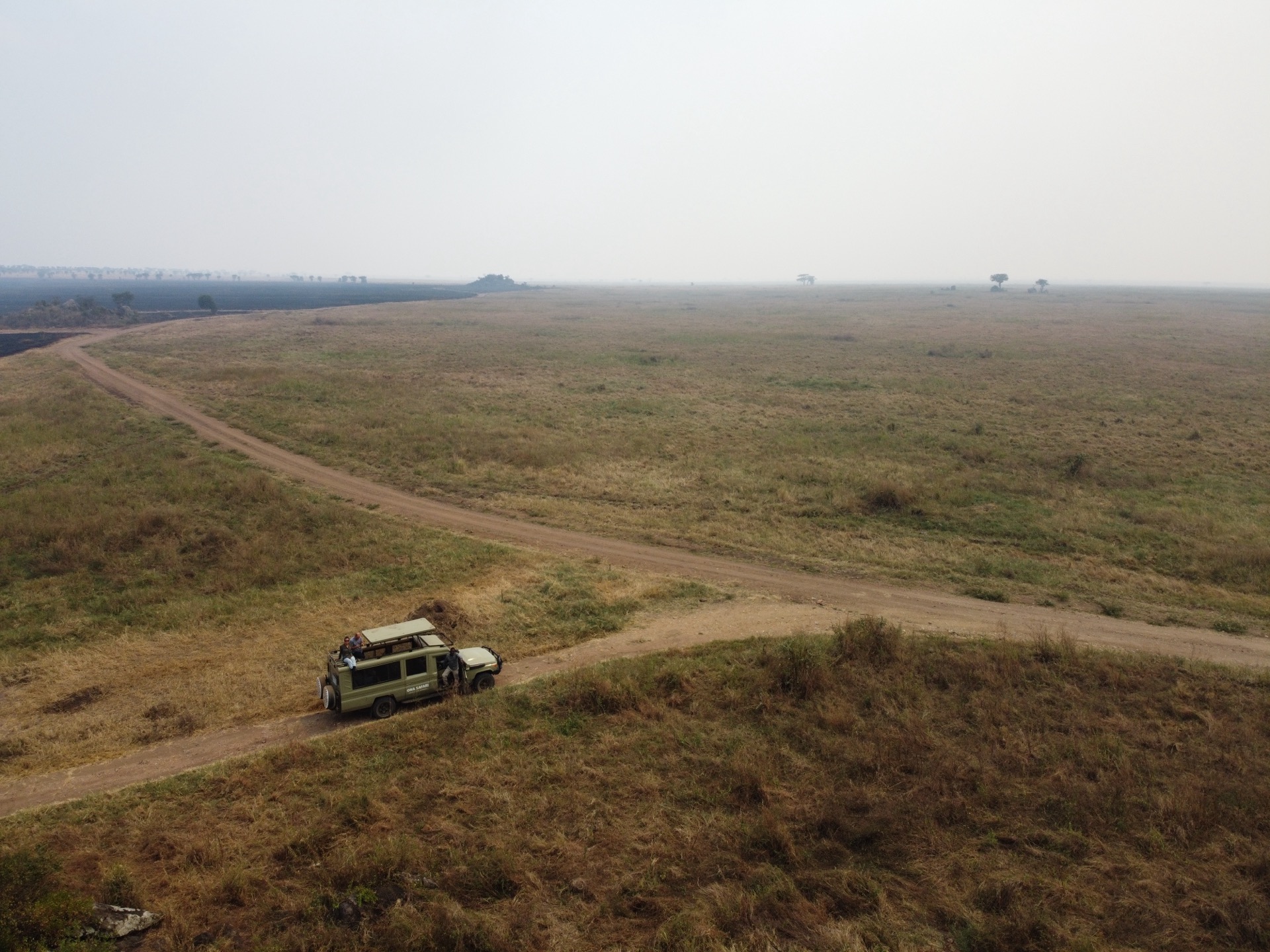
The vegetation zone is what sets Mkomazi apart from Tanzania’s other national parks: Acacia-Commiphora semi-arid woodland — the Somali-Maasai biome that covers northeastern Tanzania and southeastern Kenya. No other Tanzanian national park sits within this zone. The result is a different suite of species, different landscape aesthetics, and a dramatically different atmosphere compared to the Serengeti, Ngorongoro, or Tarangire.
Roughly 8,000 people visit Mkomazi each year — compared to hundreds of thousands at the Serengeti. Most visitors see fewer than 10 other vehicles on a full day’s game drive. If an experience of genuine solitude in a wild landscape is something you value, Mkomazi delivers that more reliably than any park on Tanzania’s northern circuit.
The rhino sanctuary: Tanzania’s largest fenced rhino programme
The headline at Mkomazi is the black rhino. The park houses approximately 41 Eastern black rhinoceroses (Diceros bicornis michaeli) — grown from a founding population of 15 animals translocated from South Africa across five events between 1997 and 2016. This makes Mkomazi the site of one of Africa’s notable black rhino population restoration programmes.
The sanctuary is structured as two separate fenced areas:
Kisima Rhino Reserve (55 km², 40 km perimeter fence): The larger sanctuary, managed on a VIP or private-access basis. This is not on the standard tourist circuit. The Kisima reserve holds the majority of Mkomazi’s rhinos and functions primarily as a breeding and management zone.
Mbula Rhino Reserve (12 km²): The public-access sanctuary. TANAPA-guided open-vehicle visits were opened in July 2021. A visit takes approximately half a day. The Mbula reserve holds a smaller number of individuals — approximately 6 rhinos — within a contained fenced environment. Sightings here are more reliable than a standard open-country rhino search because the animals are within a defined, managed enclosure.
To visit the Mbula sanctuary, arrange through TANAPA at the park gate. Advance booking is strongly recommended — availability is limited and the sanctuary operates on a scheduled basis. The sanctuary visit is separately priced from the standard park entry fee.
Mkomazi’s 41 rhinos represent nearly 16% of Tanzania’s total black rhino population of approximately 263 individuals (TAWIRI 2024 count). In the context of a species listed as Critically Endangered on the IUCN Red List — with approximately 6,788 individuals globally at end-2024 — the Mkomazi population is a meaningful fraction of the global total.
The broader Tanzania black rhino story — the crash from thousands to remnant populations in the 1970s–80s, the recovery from 162 (2015) to 263 (2024) — is covered in detail in the Tanzania rhino guide. Mkomazi represents the managed, fenced-sanctuary component of that recovery; Ngorongoro represents the wild, crater-floor component.
The dry-country specialists: gerenuk, lesser kudu, and fringe-eared oryx
Most Tanzania safari guides focus on the Big Five and the migration. Mkomazi’s appeal is different, and deliberately so. The Acacia-Commiphora biome supports three species that are almost nowhere else as accessible in Tanzania:
Gerenuk (Litocranius walleri): The gerenuk is one of the most distinctive antelopes in eastern Africa. Its name comes from the Somali word for “giraffe-necked” — the neck is genuinely elongated, an adaptation for browsing shrubs and low trees while standing on its hind legs. Gerenuk do not need to drink, deriving all their moisture from vegetation. Mkomazi is the single most reliable site in Tanzania to observe this behaviour. On my visit, we watched a gerenuk stand bipedally for a full two minutes browsing a thorny Acacia branch — a sight impossible on the short-grass Serengeti plains.
Lesser kudu (Tragelaphus imberbis): Smaller than the greater kudu but equally elegant, with vertical white stripes along the flanks and, in males, long spiralled horns. Lesser kudu are secretive browsers of dense bush, making them difficult to observe in thick vegetation. The drier, more open Acacia-Commiphora landscape at Mkomazi gives better sightlines than the thicker bush further south. Early mornings, before the heat drives them into shade, offer the best opportunities.
Fringe-eared oryx (Oryx beisa callotis): A large antelope of arid environments, identifiable by the characteristic black fringe at the tips of the ears. The fringe-eared oryx is more common in Kenya’s dryland zones, but Mkomazi represents Tanzania’s most accessible population. They are tolerant of extreme heat and drought, which means they remain active mid-morning when other species seek shade.
These three species also occur at Tarangire and Ruaha, but at lower density and with less reliable sighting conditions. For anyone specifically targeting dryland specialists, Mkomazi is the most efficient location in Tanzania’s national park network.
Wildlife beyond the rhino
Mkomazi’s other wildlife is less predictable than Ngorongoro’s or the Serengeti’s, and that is partly the point. This is a remote, low-traffic ecosystem with a character shaped by the semi-arid biome.
Elephants: Mkomazi’s elephant history is one of the more striking in Tanzania. In 1989, the resident count was approximately 11 individuals — a population effectively destroyed by the poaching crisis of the 1970s-80s. As Tsavo’s elephants recovered and the Mkomazi-Tsavo boundary became more permeable, wet-season elephant movements from Kenya brought migratory peaks of 500–600 animals (~2010). By 2017, the resident count had stabilised at approximately 23 individuals, with larger numbers still crossing during the wet season. The resident herd is modest but visible; wet-season visits can produce dramatically larger encounters.
Lions: Lions are present in Mkomazi at low density — the semi-arid landscape supports smaller prey biomass than the Serengeti’s open plains, which keeps lion numbers low. Sightings occur, but are less reliable than at major game-viewing parks. Early morning drives near waterholes are the most productive strategy.
Dry-country specialists: Mkomazi is the best Tanzanian national park for species adapted to the Acacia-Commiphora zone. Gerenuk (the long-necked browser of semi-arid eastern Africa), lesser kudu, fringe-eared oryx, and several species of dry-country hornbill and starling are more accessible here than anywhere else in Tanzania.
Human-wildlife conflict: The Mkomazi area has documented significant human-wildlife conflict, particularly involving elephants and lions moving beyond park boundaries. A wildlife damage study recorded 708 livestock lost in villages surrounding Mkomazi, valued at approximately USD 12,846 — illustrating the difficult interface between the park and farming communities that border it. Community engagement through TANAPA’s ranger units and mitigation techniques (beehive fencing) is ongoing.
Getting to Mkomazi: access and road conditions
From Moshi (112 km): The most common approach is south on the A23 from Moshi toward Same. The main route is mostly tarmac and manageable in 2–3 hours under normal conditions. Zange Gate, the main entrance, is 6 km east of Same town — well-signed from the A23 junction. Allow 30–45 minutes’ buffer for roadworks and livestock crossings on the approach road.
Inside the park (4WD required): The tracks within Mkomazi are unpaved and require a 4WD vehicle year-round. In the dry season (June–October) they are passable but corrugated. During the long rains (April–May) sections become impassable; check conditions with TANAPA at Zange Gate before entering the main circuit. The rhino sanctuary road is maintained separately and usually accessible even in lighter rainfall periods.
From Kilimanjaro Airport: The airport sits between Moshi and Arusha, roughly 50 km north of Moshi. Factor in 3–4 hours total from the airport to Zange Gate. If you are flying into Kilimanjaro for a Kilimanjaro trek, a Mkomazi day trip the day before departure is logistically straightforward — the gate is on the same road.
From Dar es Salaam (440 km): The road journey runs north on the A7 then turns inland. Allow a full day’s drive plus an overnight in Same before entering the park — attempting Mkomazi as a day trip from Dar is not practical.
No flight access: There is no scheduled light aircraft service to Mkomazi. The park cannot be reached by the domestic flight networks that serve Serengeti, Ruaha, and Nyerere. Mkomazi is a road-based destination only.
Accommodation at and around Mkomazi
Mkomazi’s accommodation options are limited by the park’s low visitor numbers — a feature, not a bug, for travellers who value space over resort facilities.
TANAPA bandas at Zange Gate: TANAPA operates 6 semi-detached bandas at the park headquarters, 6 km from Same town. These are basic self-catering units. Bedding, mosquito nets, and outdoor cooking facilities are typically available; bring your own food supplies from Same or Moshi. Advance booking through TANAPA is essential — there are very few units and they are not walk-in available.
Same town (6 km from Zange Gate): Same offers a small selection of guesthouses and basic hotels. The town sits on the A23 highway, 30 km south of Moshi. For travellers self-driving from Moshi, staying a night in Same allows an early-morning Zange Gate entry — the rhino sanctuary operates on scheduled morning visits, so an early start matters.
Moshi (112 km, 2–3 hrs): For travellers combining Mkomazi with Kilimanjaro, basing in Moshi and doing a day return is the standard approach. Moshi has a full range of accommodation from budget guesthouses to upmarket climbing operators’ lodges. The drive from Moshi allows a 07:00 departure and a return by 19:00 with time for several hours in the park and a sanctuary visit.
The absence of lodge-based fly-in camps at Mkomazi keeps costs significantly lower than parks like Ruaha or Nyerere. The entry fee of USD 35.40 per adult per day (TANAPA 2024/25 tariff, inclusive of 18% VAT) makes Mkomazi one of Tanzania’s most affordable national park experiences. Children aged 5–15 pay USD 10/day; under 5 is free.
Practical logistics
Getting there: Mkomazi is 112 km south of Moshi by road — approximately 2–3 hours depending on road conditions. The main entrance, Zange Gate, is 6 km from Same town, reached by the A23 highway south from Moshi. From Dar es Salaam, the distance is approximately 440 km. No scheduled flight service operates to Mkomazi — access is road-based. A 4WD vehicle is required on the tracks inside the park.
Entry fee: USD 35.40 per adult per day (non-East-African; TANAPA 2024/25 tariff, inclusive of 18% VAT). Children aged 5–15: USD 10/day; under 5 free. Vehicle entry is additional. Mkomazi sits in TANAPA’s lower-fee tier alongside Mikumi, Ruaha, Rubondo Island, Saadani, Udzungwa Mountains, and Katavi — significantly cheaper than the Serengeti’s USD 82.60/day.
Park hours: Open daily from 08:00 to 18:00.
Season: Best wildlife viewing is June–October (dry season). Long rains: April–May. Short rains: November. The rhino sanctuary operates year-round, but book in advance regardless of season.
Accommodation: Mkomazi has very limited accommodation within or adjacent to the park. Most visitors use Same as a base town, with park lodges available through TANAPA. The low visitor numbers mean accommodation availability is less pressured than at northern circuit parks, but advance confirmation is advisable.
Combining with Kilimanjaro: Mkomazi is an excellent addition for trekkers based in Moshi before or after a Kilimanjaro climb. The 2–3 hour drive from Moshi fits easily into a pre-trek rest day or a post-summit recovery day. The experience — remote dry-country landscape, guaranteed access to the rhino sanctuary, dramatically low crowd levels — is genuinely different from anything on the mountain.
The safari budgeting guide covers the full breakdown of TANAPA fee tiers, vehicle fees, and how to budget a multi-park itinerary that includes Mkomazi.
Combining Mkomazi with Kilimanjaro: the northern Tanzania loop
The strongest argument for adding Mkomazi to a Tanzania itinerary is the geographical proximity to Kilimanjaro. Most climbers arrive in Moshi a day before their trek and have a full day post-summit before flying home — time usually spent in Moshi town with little to do. Mkomazi fills that gap precisely.
Kilimanjaro’s summit, Uhuru Peak, stands at 5,895 m. Most climbers spend 5–9 days on the mountain. The dry season (June–October) is the peak trekking window — the same window when Mkomazi’s wildlife viewing is best. A post-summit wildlife day at Mkomazi breaks the transition between high-altitude effort and coast time neatly.
A practical northern Tanzania loop for 14 days:
- Days 1–2: Moshi arrival, acclimatisation, Mkomazi day trip (Mbula sanctuary morning visit, game drive afternoon)
- Days 3–9: Kilimanjaro climb (7-day Machame or Lemosho route)
- Day 10: Moshi recovery
- Days 11–13: Northern circuit extension (Tarangire or Ngorongoro) via Arusha
- Day 14: Kilimanjaro Airport departure
This itinerary combines two very different Tanzania experiences — the mountain and the wilderness — at relatively low additional cost. Mkomazi’s USD 35.40 entry fee means the rhino day trip adds minimal cost to an already significant climb budget.
Mkomazi in context: the Tsavo ecosystem
The connection to Tsavo is what gives Mkomazi its ecological scale. Tsavo East (13,747 km²) and Tsavo West (9,065 km²) together form one of the largest national park complexes in Africa. Mkomazi’s 3,245 km² extends that protected zone south into Tanzania, creating a single contiguous ecosystem of approximately 46,000–49,000 km² — one of the largest transboundary protected areas in East Africa.
This matters practically for wildlife: elephants, lions, and other species range across the border without registering the international boundary. The elephant seasonal movements described above — wet-season influxes of 500–600 animals — are a direct expression of the Tsavo-Mkomazi corridor functioning as a single ecosystem. The rhino sanctuary programme at Mkomazi complements Kenya’s established black rhino conservation at reserves like Ol Pejeta, though the Mkomazi animals are a distinct population under Tanzanian management.
Why Mkomazi deserves more attention
The park receives approximately 8,000 visitors per year — a fraction of the crowds at Tarangire or Lake Manyara. The combination of factors makes a compelling case for inclusion in a Tanzania itinerary for the right traveller:
- Accessible rhino sightings in a managed sanctuary, opened to the public in 2021 — an experience unavailable anywhere else in Tanzania except Ngorongoro
- Critically low crowd levels — fewer than 10 other vehicles on most full-day drives
- A distinct biome not represented anywhere else in Tanzania’s national park network
- Dryland specialists — gerenuk, lesser kudu, fringe-eared oryx — that are nowhere more reliably seen in Tanzania
- A conservation story in progress — a founding population of 15 rhinos growing to 41 over 25 years, with satellite monitoring, ear-notching, and intensive management visible in the sanctuary operation
- Low entry fees — USD 35.40/day compared to USD 82.60/day at the Serengeti
The Tanzania conservation guide covers how Mkomazi’s rhino sanctuary fits into Tanzania’s wider conservation strategy — the TAWIRI census programme, the fenced-sanctuary vs. open-landscape models, and how the 162-to-263 population growth between 2015 and 2024 was achieved through programmes like this one.
For the full Tanzania black rhino profile — the biological distinction between black and white rhinos, the history of the population crash and recovery, Ngorongoro Crater’s resident population, and photography tips for rhino sightings — see the Tanzania rhino guide. For Tanzania’s full national park breakdown — park-by-park wildlife profiles, fee tiers, best seasons, and how to sequence an itinerary — see the Tanzania best national parks guide.
Frequently asked questions
How many black rhinos are in Mkomazi National Park?
Mkomazi National Park held approximately 41 Eastern black rhinos (Diceros bicornis michaeli) as of the 2022–23 count — grown from 15 founder animals translocated from South Africa across five events between 1997 and 2016. These 41 individuals represent nearly 16% of Tanzania's total black rhino population of approximately 263 (TAWIRI 2024 count). Mkomazi's population is spread across two fenced sanctuaries: the Kisima Rhino Reserve (55 km²) and the smaller Mbula Rhino Reserve (12 km²), which is open to regular visitors.
Can tourists visit the Mkomazi Rhino Sanctuary?
Yes. The Mbula Rhino Reserve at Mkomazi National Park has been open to public visitors since July 2021, via TANAPA-guided open-vehicle visits. A visit to the Mbula sanctuary takes approximately half a day. The larger Kisima Rhino Reserve (55 km², with a 40 km perimeter fence) operates on a VIP or private-access basis and is not part of the standard tourist circuit. To visit the Mbula sanctuary, arrange through TANAPA at the park gate — it requires advance booking and is separate from the standard park entry fee.
What is the entry fee for Mkomazi National Park?
Mkomazi National Park charges USD 35.40 per day for non-East-African adults (TANAPA 2024/25 tariff, inclusive of 18% VAT). Children aged 5–15 pay USD 10/day; under 5 is free. Vehicle fees are additional. Mkomazi is in TANAPA's lower-fee tier — the same tier as Mikumi, Ruaha, Rubondo Island, Saadani, Udzungwa Mountains, and Katavi — compared to USD 82.60/day for Serengeti. Sanctuary access for the Mbula Rhino Reserve involves an additional fee arranged at the gate.
How do I get to Mkomazi National Park from Moshi?
Mkomazi is approximately 112 km south of Moshi by road — about 2–3 hours depending on road conditions. The main entrance is Zange Gate, 6 km from Same town. The route runs south on the A23 from Moshi toward Same; the gate road branches from the town. A 4WD vehicle is required on the tracks inside the park. Mkomazi is approximately 440 km from Dar es Salaam by road. There is no scheduled flight service to Mkomazi — access is road-based.
What wildlife can be seen at Mkomazi other than rhinos?
Mkomazi is the only Tanzanian national park within the Somali semi-arid biome (Acacia-Commiphora vegetation zone), making it the best site in Tanzania for several dry-country specialist species. Elephant numbers are modest — approximately 23 resident animals in 2017, though wet-season migrants from Kenya's Tsavo can swell numbers to 500–600. Lions are present but at relatively low density. The park is excellent for dry-country bird species and offers an extremely low-traffic experience: most visitors see fewer than 10 other vehicles on a full day's game drive.
When is the best time to visit Mkomazi National Park?
June to October (dry season) is the best time for wildlife viewing at Mkomazi. Vegetation thins as the dry season progresses, concentrating animals at water sources and making wildlife easier to spot. The long rains run April–May; the short rains in November. A visit around the rhino sanctuary can be productive in any season since the animals are in a managed enclosure, but general game viewing improves significantly in the dry months. If combining Mkomazi with a Kilimanjaro climb from Moshi, June–October also aligns with the main Kilimanjaro trekking season.
Can I combine Mkomazi with a Kilimanjaro climb?
Yes, and this combination works well. Mkomazi is 112 km south of Moshi — a 2–3 hour drive that fits easily into a pre-trek rest day or a post-summit recovery day. The dry season (June–October) aligns with Kilimanjaro's peak trekking season. Most climbers arrive the evening before their trek departs and spend downtime in Moshi; a pre-trek day trip to Mkomazi or a post-summit excursion on the way back to Kilimanjaro Airport breaks up the acclimatisation or recovery schedule without adding a full extra night.
Where should I stay when visiting Mkomazi?
TANAPA operates 6 semi-detached bandas at Zange Gate (park headquarters), approximately 6 km from Same town. Most visitors base themselves in Same, which has basic guesthouses and local restaurants. Same is the nearest town, roughly 30 km south of Moshi on the A23. Accommodation options within or immediately adjacent to the park are limited — the low visitor numbers mean booking pressure is low, but advance confirmation is advisable, especially for the bandas.